Tuesday, May 10, 2022

TT #162: Route 766 - Enabling the SmartBus


Route 766, was introduced to retain local coverage in the Surrey Hills/Burwood area when the 700 SmartBus started. This was Melbourne's third SmartBus, established after trials of the 703 and 888/889 pilot SmartBus routes showed that if you improve bus service levels more people will use them

Route 700 was an obvious pick for an upgrade. Running from Box Hill to Mordialloc it served many train stations and shopping centres, the largest being Chadstone, along its north-south path. On 14 June 2005 it got upgraded to SmartBus. As well as more trips and longer operating hours the route was made more direct, skipping Surrey Hills. Hence the need for the 766 to retain missed coverage. The 700 later became part of the even longer 903 orbital, passing to Transdev and now Kinetic.  

766's map is below. It has two or three main functions. 

Firstly it’s a train feeder for Surrey Hills. When it was introduced we had more graduated zonal fares that made train travel into the city cheaper from Surrey Hills than Box Hill. And, besides, a trip via Box Hill would have been an inefficient backtracking move. Surrey Hills is a premium (staffed) station and almost all trains stop there (some argue that this is because it was in the former premier Jeff Kennett’s seat). Hence it was an attractive interchange point. 

Secondly while slow it provides a one-seat ride to the major centre of Box Hill from the southern part of Surrey Hills and Burwood. Box Hill has major health and education facilities as well as being a major connection point. 

Thirdly the 766 intersects the east-west 70 and 75 trams. Both go to Camberwell with the 75 continuing beyond Deakin University on Burwood Hwy. 


766’s relation with these and other intersecting services can be seen from the PTV network map below. 


Also notable is that passengers can interchange to the 903 (or the 700 before that). This is an important point especially in the early years of a bus network reform. Some existing passengers would have enjoyed one-seat ride to destinations including Holmesglen Institute and Chadstone Shopping Centre. Not everyone will be happy with their route being cut up but providing a connection point lessens the blow. The first 766 route map actually labelled connections to the 700.

Similar provision was made when the 901 Frankston - Dandenong SmartBus replaced the old 830 and 831. 830 and 831’s local coverage in Carrum Downs became serviced by local routes 832 and 833. Both served a stop on Frankston – Dandenong Rd to which connections could be made with the 901. 833 was later extended in another direction (to Carrum) but the dog-leg stop has unnecessarily remained, delaying and confusing passengers as (in this case) few seem to use this connection. It also makes improved coverage harder, as explained here. Retaining an out-of-the-way connection point might be defensible at first but might not be worth retaining if there are higher network aims.  

Route 766 operates in the seats of Box Hill (Paul Hamer MP) and Burwood (Will Fowles MP). Both are marginals held by the Labor Party. 

A tricky timetable

On weekdays Route 766 runs between about 6:30am and 7pm about every 30 minutes most of the time. The exceptions are (i) when there's some hour morning and afternoon gaps and (ii) where two short trips run in both the morning and afternoon to provide a 15 minute peak service between Surrey Hills and Burwood. 

Run time for the full route is about 25 minutes the the mostly half-hour frequency permits efficient operation with two buses. As the short peak trips are less than 15 minutes just one extra bus is needed to double frequency on its busiest portion. I am assuming that counterpeak trips operate out of service as they don't show in the timetable. 

Monday to Friday operating hours suit 9-5 office workers but not people who start and finish earlier or later than those times. For example starts are late and finishes are early. Also there are hour gaps in both directions around 10am and again around 3pm. I'm guessing this is either due to school bus requirements and/or driver breaks. The passenger service outcome is however poor with the sort of irregular timetable that makes people distrust buses in Melbourne.  

Due to quieter traffic Saturday run time is less; between about 15 and 24 minutes. Service is approximately between 7:30am and 6:30pm. Frequency though is wildly inconsistent. Up to midmorning Saturday service is more or less a consistent 40 minutes, presumably done with a single bus. However after then waits blow out to over 60 and then over 80 minutes. Later they settle down to nearer 40 minutes again. While gaps like these are often due to driver meal breaks, most other routes have consistent frequencies through these backed by suitable rosters. The erratic scheduling would also likely contribute to the 766's very low Saturday usage (discussed later). 

Route 766 was introduced just before minimum standards were in 2006. While this upgraded many existing bus routes, the 766 was neglected. Hence it remains without evening and Sunday service, unlike the old 700 that previously served its catchment. 766, however has service on most public holidays with the (irregular) Saturday timetable operating as per the service standard.  

Usage

Route 766 isn't well used. It gets about 13 boardings per hour on weekdays and 9 on Saturdays. This is barely half that for metropolitan buses in Melbourne, especially those serving Box Hill which is one of Melbourne’s strongest bus hubs. Its irregular timetable with 'holes' where people expect there to be trips, as discussed above, is one reason for this.

Probably 766’s biggest contribution to the network is that it enabled the 700 and later 903 SmartBus. Bus 903 carries more passengers than any other and it's not only due to its length.  Even though the 903 has some quiet parts it averages 32 boardings per hour on weekdays and over 40 on weekends. That's about 50% higher for a bus route in Melbourne. And if you were just to factor in 903's Box Hill - Oakleigh portion the boardings per hour will be higher again. 

It would likely not have been politically possible to have introduce the SmartBus in its current form unless you added coverage to the areas that lost a bus with a route like the 766. This is a prime example of why you shouldn’t judge a bus route on its individual patronage productivity without also considering its contribution to the wider network. Having said that local routes (including the 766) should have simple timetables free of irregular gaps even if they are never made very frequent. I'm not sure that this has been done given the 766's timetable is basically unchanged from 2005.

History

Route 766 started on the 14 June 2005. You can see its first timetable and route map on the BCSV website here. It originally went as far south as Thomas St only with the Burwood Hwy extension added later. Its timetable has not significantly changed in the following 17 years.

766’s future

The most important item on the horizon for Route 766 is the merging of Surrey Hills and Mont Albert station to create a new Union station about mid-way between. This has implications on the 766 (as it feeds Surrey Hills) and potentially also 284 and 612. I discussed these here.  

The 2022 state budget included funds for bus upgrades and reforms in the Box Hill area. This included a rerouting of 903 via Deakin University. This will leave some areas near the 766 with less bus service. As a minimum there may need to be 766 upgrades including longer hours and Sunday service (eg as per minimum standards). Timetables also need fixing with 60 - 80 minute gaps removed. 

Successful bus routes almost always have strong termini at both ends. That means railway stations and/or major destinations like universities and shopping centres. Termini like tram routes and local shopping strips are better than nothing but don't deliver really strong all day bidirectional patronage. 

On this score Route 766's northern terminus at Box Hill is strong but its southern terminus on Burwood Hwy is quite weak. While it intersects with the 75 tram, a short trip on it is needed for local trips such as to Burwood station or Deakin University. An extension to either of these location might be desirable with the Deakin option eventually connecting to the proposed Suburban Rail Loop Station there. 

A more radical concept could see the 766 extended along Highbury Rd to Glen Waverley. This would provide needed coverage to a large unserved part of Mt Waverley and possibly Ashwood. However this would more than double the route's length and operating cost. It wouldn't necessarily be very direct to Box Hill, a feature needed if it's to be useful for more than local coverage. 

Any Route 766 extension will bump up the run time. This may make the scheduling less efficient unless interlining opportunities can be found and/or frequencies are adjusted. Eg, a 'quick and dirty' Deakin extension (possibly via Highbury Rd) might involve a 40 minute interpeak frequency (with no 60  min gaps) and a 20 min service. However this would have 'swings and roundabouts' gains and losses. 

Thoughts on what (if anything) should happen with the 766 are appreciated and can be left below. 

See other Timetable Tuesday items here


Friday, May 06, 2022

UN 124: What could we do with 1% more Metro trains?


Tuesday's Victorian state budget included an allocation for 'Switching on the Big Build'. Preparation for Day One operations of Metro Tunnel. This involves nearly 300 new drivers and station staff in a spend of nearly $60 million. Is this big or not? And what does it mean for service? 

The short answer is that those 'outside the system' don't know. Information is scarce. Even from governments normally eager to sell the benefits of its policies. Often we know more about the number of jobs involved than what's delivered.    

This is particularly so in public transport whose bosses too rarely understand and sell the power of frequency. For example, the Department of Transport stumbled last month when launching Craigieburn's upgraded more frequent bus network. And with nothing recent to go on, we can merely hope that Sunshine will get more than the current (and planned) three trains per hour at most times when Metro Tunnel opens.   

On the latter we do now at least have an indication of staffing for a Day 1 Metro Tunnel service ramp-up. Today I'll run through some numbers in an attempt to understand what this could mean for service. And demonstrate that we can do a lot with a little, if we set our minds to it, before Metro Tunnel opens.


Facts and figures - what can one train driver do?

To get an idea of how significant one train driver is we need to know how many service kilometres they drive per year. We can use a number of metrics to get relevant numbers number including kilometres of service the network delivers, average speed of trains, numbers of drivers and average working hours. Try a few, do some multiplication and division and numbers should broadly tally up.

2022-23 Budget Paper No 3 (page 340) tells us that 24.9 million service kilometres were scheduled on Metro Trains. This was the actual number in 2020-21, the expected outcome in 2021-22 and the target in 2022-23. About 1% of that wasn't delivered due to cancellations but for planning purposes we should use the scheduled figure. 

Metro Trains said it ran 63 705 train services in November 2019. That's about 764 000 trips per year (noting there will be variations eg special event services). Today's number would be higher due to service upgrades in 2021. The average length of a trip (24.9 million km / 764 thousand trips) is about 32 km. 

How many train drivers? Metro's operations in Melbourne has around 3500 employees all up. In 2019 Metro's driver numbers were stated at more than 1100. Today's tally would be nearer 1200 given last year's upgrades. Then there's about two other staff per driver. 

The average Metro driver would clock up 22 636 service kilometres per year. That's more than half way around the world! In 2019 each Metro driver did an average 694 trips per year (764 000/1100).

Now let's do a 'sense check' to see if some of the above numbers are about right. The average Melbourne Metro train goes at about 35 km/h. This means that the average driver would be driving in service for about 22636/35 or 647 hours per year. It seems low but their actual working time would be a lot more. This is because the hours figure above does not include train preparation, driving non-service trains to get into position, pilot operation (ie 2 drivers per train for route knowledge), dwell times at out stations, non-driving activities, paid leave etc.  

Other things being equal, if we want 647 more hours of service per year then we are going to have to recruit one more train driver. More maintenance and support staff will also be needed as we'd be running trains harder. But, except at the margins, most station staffing and PSOs are pretty much fixed costs regardless of whether we run one train per hour or six trains per hour. With economies of scale you shouldn't need anywhere near two extra staff per driver if you're just putting on a few more trains. 

How long does it take a train to the end of the lengths of suburban lines we have in Melbourne? Leaving aside short branch lines it's usually a bit under to a bit over an hour. The typical length of a main suburban line would be about 30 or 40 km, with Pakenham, at 55km, the longest. 

Let's say that you add one return trip per day to the schedule of a line that needs 1 hour run time to get to the end and an hour back. You'll need 730 in-service driver hours per year (365 x 2). One driver won't be enough (unless you only ran that trip 6 days / week) while two would be inefficiently used (unless you added trips on some days). Add more trips on more lines and it gets less lumpy and more efficient. 


A few trips makes a big difference

Last year I mentioned that you don't need to add many trips to dramatically reduce the longest waits for trains, eg to cut maximum waits from 30-40 to 20 minutes. The corollary is that you don't need many train drivers either, though I didn't then estimate that.

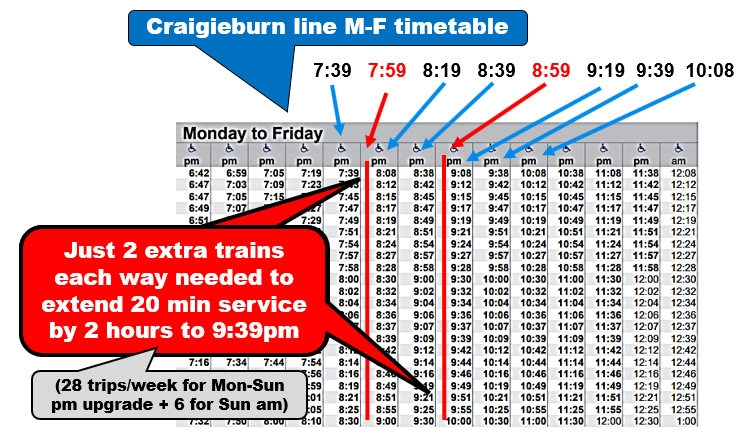
One of the examples used was Craigieburn - a busy but lowly served line with many 30 and even 40 minute maximum waits. The line abuts and serves Transport Minister Ben Carroll's seat of Niddrie. As you can see below 30 minute waits from the city start at 7:39pm on weekdays and earlier on weekends. 

Only about 17 extra timetabled return trips per week (34 each way per week) are needed to reduce Craigieburn line maximum waits from 30-40 to 20 minutes each day until after 9:30pm. This weekly total could be made up of two return trips per day (between approx 7:30 - 9:30pm) and three return Sunday morning trips to commence the 20 minute frequency earlier at 7:35 am rather than 9:35 am. 


34 trips per week translates to 1768 trips per year. Add in the Mernda, Sunbury and Upfield lines (with similar service levels) and you are up to 7072 trips per year. That sounds a lot but it's not. It represents a rise of less than 1% on the number of train services that currently run

Benefits include reducing the maximum wait on four key train lines to 20 minutes until after 9pm 7 days per week. This makes for a much more useful network compared to now where 30 - 40 minute waits are widespread at times many wish to travel. It gets cheaper (or you could do more) if peak frequencies are slightly adjusted if it is considered that some of those who moved to working from home remain working from home. And if money is tight you'd only do Craigieburn, Mernda, Sunbury (possibly to Watergardens only), with Upfield deferred. 

A higher increase (a still modest 2 - 3%) could enable upgrades right across Melbourne. Including for Belgrave/Lilydale, Hurstbridge (part), Pakenham/Cranbourne, Glen Waverley and Sandringham lines. As some of these have more service for more of the time fewer extra trips are needed to get to a 20 minute maximum wait. For example Sandringham just needs a handful of Sunday morning trips to qualify. 

Conversely Belgrave/Lilydale have 30 minute gaps daytime interpeak, not just at night. Service reform here though could pay big dividends, including 10 minute Ringwood frequencies and benefits for some of Melbourne's most marginal seats.


'Getting to 20' - surprisingly few extra drivers required

How many drivers would a 'Getting to 20' maximum wait need? This should be closely related to the number of trips and service hours added (which will be more on longer lines). A 1% increase in the number of trips should need about 1% more drivers. Or maybe 12 - 15 up on the 1200 we currently have. That could deliver 7 day 20 minute maximum waits until around 9:30 pm on several key lines. 

You could do even more with a recruitment of (say) 20 to 50 drivers. That should enable worthwhile upgrades on the rest of the network, notably the 12 lines that missed out on the 2021 upgrades. 

Priority after that would be the 10 pm - midnight period.  This would completely reverse 1978's evening cuts and bring service levels up to what was introduced on the upgraded Werribee and Williamstown lines last year. We could learn from cities such as Perth which has a planning culture where they add what they can today (even if it's only a little) and incrementally add service in later timetable revisions until the desired standard is reached. 


What can we do with the budget's announcement?

The 300 new drivers and station staff in Tuesday's budget is about 10 to 20 times higher than the numbers discussed above. Hopefully their commencement can be phased in with some upgrades starting sooner. 

For example Union Station on the Ringwood line will be opening in 2023 and need a new timetable to reflect its replacement of Mont Albert and Surrey Hills. Hopefully the opportunity will be taken to simplify and expand services in the new schedule. And that planning will be sufficiently advanced to promise it later this year in the election campaign given the marginal seats around there. 

More broadly, let's take a punt and guess that 200 of these jobs are for drivers. Let's also assume that their driving hours and annual kilometres are the same as the average for existing train drivers. If so then something like 138 800 trips per year (694 x 200) could be added to the timetable. 

A figure like 138 800 more trips per year means even less to most people than when governments spruik how they're adding X number of trips per week. (Trips per day is an improvement, or, for a Metro system, a minutes maximum wait frequency figure). Comparing it to the 764 000-odd annual trips however adds perspective in that it's roughly an 18% service boost across the network. 

18% is very significant given what we could do with a well-targeted 1 - 2% service uplift as discussed  before. Instead of 'Getting to 20' it could be more like 'Getting to 10' on some lines. The 2016 Metro Tunnel Business Case could give some guidance with particular gains for Craigieburn and Sandringham but less so Sunshine (as discussed here). The Network Development Plan - Metropolitan Rail from 2012 also plotted a way forward with widespread 10 minute service by now if it was followed.


'Getting to 10' on a hypothetical line

Suppose you've already 'got to 20' with a 20 minute maximum wait on a line as discussed above.  A 10 minute daytime maximum wait, all week, might be the next goal. 

With evenings and Sunday mornings sorted, I will assume that peaks are already every 10 minutes or better. 'Getting to 10' during the day would involve about 8 hours worth of ten minute service on weekdays (9am - 4pm and some peak shoulders) and 12 hours worth on weekends (7am - 7pm). This 10 minute day / 20 minute night service would be similar to what the upgraded Frankston line got in 2021. It also matches 2012's Rail Network Development Plan and coordination framework . 

That's roughly 64 hours of better service per week. I'll assume an existing 20 minute frequency of three trains per hour. This is 192 trips each way per week. Or, doubled and then multiplied by 52, about 20 000 trips annually currently. As we're just doubling the service that's the number you'd add to get from a 20 to a 10 minute frequency.  

How many drivers? With 694 annual trips per train driver that's 29 more needed for that line. Very roughly as line lengths vary and longer lines will need more drivers. 


What about more lines? 

A comprehensive upgrade would deliver such 10 minute service on at least parts of five major lines currently with 20 minute interpeak service. These include Werribee, Sunbury, Craigieburn, Mernda and Hurstbridge (noting infrastructure constraints on sections). 

Now you're up to nearer 150 drivers. And that doesn't include the number needed to 'get to 20' as needed on five of the six.  

Two further lines (Glen Waverley and Sandringham) are also in the mix. However they are shorter and start from a higher base on weekdays with a 15 minute interpeak frequency applying. That makes them cheaper to upgrade with fewer drivers needed compared to the 20 minute lines. 

I've left branches like Williamstown, Altona, Belgrave, Lilydale, Pakenham (Pakenham East?) and Cranbourne (Clyde?) at 20 minute frequencies. However given their growth the last two might justify 10 minute service in their own right with a 5 minute frequency from Dandenong in. 

I've also omitted Upfield due to my emphasis on off-peak uplifts that don't increase the peak train requirement. Adding a 10 minute off-peak service would look odd if we didn't also boost peak service. But the Upfield line serves a dense catchment that justifies improvement. And it would be a local transport game changer, relieving pressure on the 19 tram that people prefer due to its frequency (despite the slowness). Frequent service on the Upfield line has constraints but it's possible on its inner part.  

Within a few years of the Metro Tunnel opening it will be time to prepare for the 10 minute service that will run from Melbourne Airport. 


Conclusion

The boosted numbers of new train drivers and station staff earmarked in the state budget is both necessary and beneficial. My 'back of the envelope' estimates indicate that it is transformative, enabling widespread 10 minute frequencies across Melbourne's rail network. This would transform how we see and use trains in Melbourne with knock-on benefits for tram and bus connectivity. 

Provided it has a large contingent of drivers put to work as soon as trained, you could rate it as amongst the most important items in the whole budget as regards transport. I'd even rank a system-wide 'Getting to 10' service policy as rivalling the Metro Tunnel itself in network importance. This is because when you make something better more people will use it. A large part of that 'better' in public transport is frequency. 

Having said that we should also not ignore what you can do with 1% (and especially 2 - 3%) more train service. This could enable many smaller 'Getting to 20' upgrades with waits of no more than 20 minutes until much later at night across the network. Again vastly better than now with widespread 30 - 40 minute waits on all but three lines. 

Consistent with best practice elsewhere, extra frequency should be scheduled as soon as sufficient train drivers become available. This could enable a staged uplift (eg by rail group and/or only to 9:30pm initially) in the years leading up to the Metro Tunnel's opening and bring forward its benefits.

See other Building Melbourne's Useful Network items here


Tuesday, May 03, 2022

2022 Victorian State Budget shifts to service


Welcome to our look at the 2022/23 Victorian State Budget. 

It's important for at least three reasons.

* It is in deficit and there is desire to reduce it as projected rising interest rates increase debt servicing costs. 2021's budget, described as financially responsible by VCCI, sought to bring it nearer to balance. However an update later in 2021 indicated that its turn around won't be as projected. It will thus be hard to find large funds for new projects, especially those involving recurrent spending or large borrowings with debt servicing costing an increasing proportion of state income

* It's a pre-election budget. While most eyes are on federal politics at the moment, the Andrews government will be considering its re-election prospects when planning revenue and spending measures. Focuses include health and cost of living with a $250 household electricity rebate announced. There was a similar pre-election handout in 2018 but then it was only $50. 

* For us in transport it is the first budget to come after Victoria's Bus Plan. As so much of that plan depends on more service kilometres, and the funding for that must come from the budget, the latter's contents test of the government's commitment to bus reform and transport service generally. That requires more of the abovementioned hard to find recurrent spending. A saving grace is that there is a lot of 'low hanging fruit' potential cheap upgrades due to a lack of past reform. Hence you could do a lot with not much, even as you don't do as much new infrastructure for a while.  

The Andrews government transport emphasis has been very much about major infrastructure projects rather than service. Even pre-election sweeteners on the latter have been missing. For instance election years 2002, 2006, 2010 and even 2014 included significant pre-election service upgrades. 

2018 lacked this. However it could point to achievements in infrastructure including numerous level crossing removals, rebuilt stations and rail to Mernda. They're more visible to non-public transport users than a few extra trips in timetables. However with more infrastructure built by 2022 and an emptier kitty service might nevertheless look more attractive as an affordable win that can be geographically targeted.  


Recent budgets

November 2020's state budget probably marked the high point of the feed infrastructure / starve service approach. However the two main bus initiatives that were funded (Mornington Peninsula upgrade and 390 Craigieburn - Mernda bus) are now up, running and successful. 

May 2021's budget nudged the service tap so there's now a small trickle rather than occasional drops. And it changed the language so that bus reform could be openly discussed (with the Bus Plan coming out about six weeks later). Bus reform planning capability was ramped up within the Department of Transport and several worthwhile service initiatives during the year made 2021 quite noteworthy for train, tram and bus services. These happened despite staff cuts in other areas of DoT. 

One pattern for major projects is that planning may be funded in one budget with construction funding allocated in the next. Hence it's worth looking at planning funded last year to see if projects got construction money this year. The Caulfield Station interchange upgrade got planning funding last year. Construction will need to be funded soon if it is to be ready for when Metro Tunnel services commence. Fishermans Bend transport also got planning funding last year. However with the general downturn in the university sector its urgency may be affected by the extent and speed to which Melbourne University pursues its plans in Fishermans Bend. 


Prior announcements 

What did we know about this budget before it was released? Not much. Certainly less than for some previous budgets. Information about the budget is tightly controlled prior to the speech. However governments may release some details a few days prior. This may include 'bad news' revenue measures or highlights they wish to accentuate. 

This year's relative quietness may be because the government's major capital works agenda is already large with previous years' announcements. They may also be intending to keep any new projects up its sleeve for the election campaign later in the year when there's more certainty in Canberra. Speaking of which, the current federal campaign will be diverting some peoples' attention.

Transport infrastructure has had a fair suck of the sauce bottle for a while. With worry about the deficit and interest rates, it's getting harder to shake dollops out. Bold hard to fund projects might have lost a little gloss with cost of living concerns. Plus the pandemic has driven health to push transport infrastructure off centre stage. 

However we did hear about the letting of the construction contract for 100 G-class trams last month. 

April also saw the delivery of the first two of 36 electric buses from Volgren. Electric buses tick boxes including public transport, skills, jobs and emissions reduction. Unlike multi-billion dollar 'all or nothing' infrastructure projects, but like level crossing removals, you can be more incremental in their funding. I think we can reasonably expect to hear more about zero emission buses whether in this budget and/or as an election commitment. 

The main pre-budget transport announcement though was last Sunday. Over $150m in train, tram and bus accessibility upgrades were announced. This is another area where the network has lagged, especially for trams. A ramped-up community campaign called for more accessible transport. The clock is ticking on a 2032 DDA deadline we will struggle to meet. Adding urgency was Victoria's success in winning hosting rights for the 2026 Commonwealth Games. I listed accessibility as a priority to get our  transport network Games-ready for locals and guests. 

Highlights from the abovementioned accessibility package include: 

* $24.6m to permit unassisted boarding of the new trains (HCMTs) on 14 stations on the Cranbourne and Pakenham lines

* $21.9m to upgrade Lalor, Merri, Thornbury, Victoria Park and Warrnambool stations. Improvements to include boarding ramps, tactile ground surface indicators, CCTV and shelters. Development work for  accessibility upgrades at Auburn, Belgrave, East Camberwell, Canterbury, Willison, Hartwell, Moorabbin, Newport and Watsonia stations.

* $68.1 million for six new level access tram stops along La Trobe St. La Trobe St is the last major CBD street with the old stops remaining. There are more than that number of stops currently there so this work means that some will be removed or merged. There will also be improvements to the Park St tram interchange which will improve connectivity to Metro Tunnel trains. 

* $5.5m to develop future corridors of level access tram stops for upgrades. 

* $5m to upgrade up to 80 bus stops across the state. To include seats, shelters and real time bus information. Some buses will get wheelchair restraint systems for evaluation. 


The budget documents: Where everything is

See budget.vic.gov.au

A short cut to the budget papers is here 

On Twitter follow #vicbudget (or #vicbudget2022 )

The budget papers most important for public transport are:

* Paper 2 (Strategy and Outlook)

Page 16 refers to $3.5b for public transport services and infrastructure, including $383 million for additional train services and to operate new infrastructure delivered under Big Build. $250m will build and buy 12 new V/Locity trains for regional Victoria. V/Line will get $248m to improve efficiency and reliability. 

* Paper 3 (Service Delivery) Pages 109 - 122, 331 - 352 and 405. (more from this below)

* Paper 4 (State Capital Program) Pages 10 - 13, 82 - 89 (more from this below)

* Paper 5 (Statement of Finances)

Summaries on some transport aspects of the budget are here


Salient points from Paper 3 (Service Delivery)

* 'Switching on the Big Build'. Preparation for Day One operations of Metro Tunnel. This involves nearly 300 new drivers, station staff and others and a spend of nearly $60 million

This should permit significant train frequency upgrades. It will also be possible to develop wayfinding and customer information. It is desirable that the thinking for the latter is network rather than project based as we have a case of different types of passenger information across the network depending on the project and funding at the time. 

This is a good initiative but specifics on frequencies and service levels would be welcome. And it's desirable that it be staged with some low cost upgrades (eg removing all >20 min waits from the timetable by adding a few trains here and there) being done sooner. We need to move towards a service culture where frequency is regarded as a good by itself rather than something reluctantly and belatedly done when crowding gets extreme or as part of a capital project.

* Delivering Victoria's Bus Plan. A welcome funding uplift from 2021/22 but not what you'd call large. Dollar amounts over the next four years (from 2022/23) are 11.6, 20.7, 23.2, 24.0 (in millions). 

There will also be $13.5m in each of 2022/23 and 2023/24 for this plan. This will deliver: 

• service changes and operating funding for the Bulleen Park and Ride which will open in 2022 as part of the North East Link Busway

• a first phase roll-out of wheelchair restraint systems on metropolitan buses

• accessibility and amenity upgrades at 80 bus stops

• network changes to deliver Flexiride services in Greensborough and St Helena

• network changes in Heatherton to complement Suburban Rail Loop works

• improvements to bus routes connecting Kilmore residents to the town centre

• improvements and service uplifts to Gisborne town bus services

• service uplifts for bus routes between Torquay and Armstrong Creek to Geelong

• a high frequency weekday shuttle bus between Donnybrook and Craigieburn Stations

• new services for Sunbury and Diggers Rest

• expansion of bus routes in Cranbourne West and Narre Warren

• improvements to bus routes and services between Box Hill, Oakleigh and Southland

• new and uplifted school services across Victoria targeted towards growth areas

• development funding for the Footscray Station Bus Interchange.

This is a mix of middle and outer suburban services. Greensborough and St Helena have some poorly used local routes so attention in this area is welcome. However the proposed FlexiRide needs to be done in conjunction with regular route reform if it is not to be horrendously inefficient. Reference to 'network changes' is encouraging as FlexiRides in Rowville and Lilydale have mostly ignored such reform and sometimes overlapped existing routes.  

Armstrong Creek, Cranbourne West, Diggers Rest and Donnybrook are significant growth areas that need new service coverage. Torquay has even been mooted as a potential rail extension.

Box Hill, Oakleigh and Southland is a major north-south corridor that in parts parallel the Suburban Rail Loop and intersects with many train lines and shopping centres. There is a scope for network simplification and service boosts particularly on weekends in this area. A bolder reform could lead towards an SRL SmartBus concept involving reformed parts of existing routes. Without specific corridors or routes listed it's not yet clear what's in mind here as several routes could be in play. Part of the Route 903 orbital runs from Box Hill to Oakleigh as does all of Route 733. 767 runs from Box Hill to Southland via Deakin Uni but not Oakleigh. Also the current network has some inefficiencies between Box Hill and Deakin University with an inefficient and complex 201 / 768 overlap. The university has also advocated rerouting 903 via Deakin as well. The Box Hill - Clayton portion of Route 733 more than justifies an upgrade but the Clayton - Oakleigh portion (which largely overlaps another major route) does not. And at the Southland end reform could either involve a potentially controversial rerouting of 903 via Southland or bus reform in the Bentleigh East area involving routes 627, 701, 767 and 822 to provide a direct East Boundary Rd connection and preferably also more direct connectivity to Sandringham from Southland. 

Narre Warren is an established areas that has a very convoluted bus network that's crying out for more direct routes. It is essential that reform here is comprehensive and does not involve merely adding a new route over an existing unreformed network. 

* Substantial funding for the delivery of the Tram Plan, totalling $81.1m. This will be done in the lead-up to the Metro Tunnel opening (noting there's some significant network interdependencies). It will include the already announced six accessible stops on La Trobe St and one at Park St. Also work near Melbourne University terminus and planning for future accessible stop corridors. 

* Caulfield Station interchange. Planning funding for this has continued from last year's budget. This will become a major station feeding into the Metro Tunnel. More passengers will use it as an interchange point as the Dandenong and Frankston lines will go different ways into the CBD. $2 million is allocated here. 

* Northern corridor transport and land use plan. A fast growing area where development has spread further than trains and buses. There have been some service upgrades but more is needed for coverage. Funding is provided to develop a plan. There is also, in a separate measure, funding for a weekday bus between Craigieburn and Donnybrook. This is something that Ros Spence MP has advocated for.

* V/Line improvements including capacity improvements for Melton and Ballarat ($23.8m) and regional rail upgrades including for 'sustainability' and rolling stock. 12 new V/Locity trains will be used on the Shepparton and Warrnambool lines. 

* Active transport measures include bicycle parking at train stations, upgrades for various cycling trails and some pedestrian infrastructure. 

* Train station accessibility and amenity upgrades as outlined before

Outputs, costs and performance measures can be found from page 335. 2022/3 patronage targets are unchanged on what was projected for last year. Our metropolitan bus network is expected to have just under 1 passenger boarding per service kilometre. Metropolitan bus service kilometres are projected to increase by 400 000 per year due to timetabled service increases. This is a rise of about 0.3% on the previous year. No increases in scheduled kilometres are projected for metropolitan trains or trams. 

Other performance measures for transport are on page 405.


Salient points from Paper 4 (State Capital Program)

Page 10 lists new capital projects for transport. These include:

* $250 million to purchase 12 new V/Locity regional trains for planned service improvements on the Shepparton and Warrnambool lines

* $205m for what is termed V/Line organisational improvement projects to support reliability, efficiency and maintenance. 

* $173m for metropolitan train radio communications

* $96m to improve the tram network and services. Mentioned above.

Pages 11-12 pages give short summaries of the progress of major projects including SRL and level crossing removals. Pages 16-17 are about private-public partnership projects including the HCMTs and Metro Tunnel. The latter will commence service in 2025. Public Transport Ticketing Renewal (p21) is listed as a new High Value High Risk project. 

New transport projects (see p82) include Delivering Victoria's Bus Plan. This has a total capital expenditure of just under $29m. $15m is listed here for active transport. $2.3m is for 'switching on the Big Build'. Other entries here are for roads and ports. 

If you're curious, the capital for 85 level crossing removals comes at a touch under $9 billion (p83). Some bus improvement and reform comes under existing projects. $13.7m is listed here with the vast bulk of this to be in 2022/23. Completion is expected by the last quarter of that financial year. There's $5.3m for a similarly named entry on p84 with a note regarding infrastructure components for Route 202 (the Victoria Park - Melbourne University shuttle). Costs of the massive North-East Link are listed as 'tbc' on page 85. Page 87 has about $40m for walking and cycling upgrades. 

Some projects are scheduled to be 'completed after publication date but before 30 June 2022' (p88). This includes an entry of $9.711 m for 'more train tram and bus services'. It's row gives a 'financial completion date' of quarter 4 2022-23. 


Salient points from Paper 5 (Statement of Finances)

This paper gives an overview where you can see how transport compares with other portfolios. For example transport assets are the single biggest item of what the state government owns, accounting for over $100 billion and rising fast (p36). Page 127 projects more farebox revenue as commuters return. Assets are considered to have risen due to the completion of major road and rail projects. 

Page 192 brings to our attention that the 'public transport partnership agreements' (ie the franchise contracts for Metro Trains and Yarra Trams) expire on 30 November 2024. Thus whoever wins this year's state election will be able to choose whether to keep or change the existing operators. But before that there will need to be an update of partnership agreements and a refranchising process that reflects changes eg the transition to Metro Tunnel operating and ticketing system updates. 


A few statistics

Budget documents include other numbers such as actual and projected public transport patronage. In recent times these have changed only marginally. Predictions are also conservative, rising by about the same as population. Hence they have often been of little interest. 

Last year's budget drafters had the unenviable task of predicting this year's patronage. They got it wrong. They assumed a faster recovery than happened. 

As I said last year, "This seems ambitious given that international students are major users of public transport and their numbers are down. Also some workplaces may switch to remote working for at least some of their staff for some of the time.". 

Buses are nearer their pre-pandemic usage than trains and trams as (in Melbourne) their patronage mix includes fewer peak period CBD workers and more school and shopping trips. It's the first group of passengers who have changed their travel habits most due to continued working from home. If this is continued this might actually represent an opportunity on some train lines to rethink peak service levels with a view to introducing a flatter, more frequent and generally more useful frequent all day timetable


Conclusion

In this budget there's been a switch in emphasis from once all-dominant transport infrastructure to health. This (and age care) has got increased public interest and attention following the pandemic.

Within transport there is an emphasis from building to operating as projects like Metro Tunnel get close enough to fruition that we need to think how they might operate. There have also been accessibility upgrades budgeted and more money for much needed bus network reform and coverage extensions. 

This shift to service is both welcome and overdue. For it is only with good service that we can get the most benefit from the infrastructure we build. 

Exactly what will we get? There's not a lot of detail is in the budget documents. This makes it hard to evaluate some of the proposals, especially for bus. For example do the upgrades involve adding a few trips here and there or does it involve substantial reform with frequent routes? Then there's timing. It would be desirable that rail service upgrades happen in stages, preferably with some starting before the Metro Tunnel opens. Let's hope that further information emerges before too long. 

Comments are welcome and can be left below.