Thursday, August 03, 2023

UN 160: Where are Melbourne's productive but underserved weekend bus routes?


With many routes and timetables substantially unchanged for decades, Melbourne has a problem with bus services not meeting today's travel needs.

On no part of the week is this more apparent than on weekends. Saturday passengers typically wait twice as long for buses as weekday passengers, even on our premium SmartBus routes. Sunday gaps between  buses are often even longer, if the service operates at all.  

Some people assume that the lower service levels are because people don't use buses on weekends.

But this ain't necessarily so. 

How do we know? Earlier this month I wrote about boardings per hour productivity data for Melbourne's bus routes. Some routes recorded higher average per trip loadings on Saturdays than Sundays. And that number has shot up hugely in the last few years.

Today I'll look at the numbers and see what this means for weekend service levels, their adequacy and cost-effective opportunities for improvements.  

Saturdays vs weekdays

Let's first compare Saturday versus weekday productivity for bus routes in Melbourne. I started with all 350+ of them and narrowed things down to include only the most productive on Saturdays relative to weekdays. The diagram below shows what I did.   


A key finding was that about 40% of bus routes that ran Saturdays (ie 123 out of 311) actually had higher passenger boardings per hour on Saturdays than on weekdays. This is despite schools, universities and major corporate/government workplaces (all big contributors to bus usage) typically  not operating on Saturday.

The differences weren't trivial with some routes recording 40 to 60% higher productivity on Saturdays than weekdays. Keep reading as I'll list them later.  

2019 vs 2022 productivity trends 

How have usage patterns changed over the last few years? As it turns out, hugely. The chart below tells the story. More working from home, especially amongst CBD workers, has reduced commuter peak travel while off-peak and especially weekend travel has held up. Thus the number of bus routes that have higher boardings per hour on Saturday versus weekdays has increased by about 2.5 times. 


Except for the low cost 2021 bus timetable changes and Mornington Peninsula's Route 788 boost, bus services haven't really responded to this shift. Ditto for Craigieburn's revamp in 2022 which left weekend services at every 40 minutes, despite weekdays doubling to 20 minutes. Endeavour Hills network revamp tried but fell short on operating hours

The absolute best case service for the rare weekend uplifts that do occur (eg 733 & 767 earlier this year) is to an underwhelming every 30 min Saturday and every 40 min Sunday. Hence the gap between when people need to travel and the services provided is wide and widening.  

A productivity shortlist

Where do we start if we want to reappraise Saturday bus timetables? The most productive routes with the highest patronage growth potential sounds like a good place.

The median Melbourne bus route has about 14 boardings per hour on Saturday (Spring 2022 data). Those that exceeded 25 are thus well above average. All up 39 routes were both more productive on Saturday than weekdays and attracted at least 25 boardings per hour. 

In other words these routes were productive but underserved. This makes them a good shortlist to analyse further. Those most productive on Saturdays relative to weekdays are listed first.  


Three factors these productive Saturday routes have in common include:   

1. Serve key suburban shopping centres that are busy on weekends. Centres that feature prominently include Chadstone, Doncaster, Box Hill, Glen Waverley, Southland and Northland. 

2. Serve certain areas with high weekend activity or favourable demograpics for buses. Examples include Moonee Ponds, Footscray, Port Melbourne, Richmond, Kew and the Monash-Dandenong area. Some inner areas have or had trams with busy shopping strips remaining. 

3. Are underserved on Saturdays relative to weekdays. Routes where Saturday frequency is half or less that of midday weekdays include 279, 293, 625, 626, 623, 412, 281, 885, 402, 624, 800, 902, 732 (most) and 905. Of these Route 800, whose service drops from 20 minutes weekday to every 60 - 120 minutes on Saturday, is most striking. In other cases (like 813 and 862) the frequency drop is less but nearby routes do not operate much (if at all) Saturdays, thus inducing usage on those that do. 
 
The case for service uplift

Transport demand is often supply led. The more you have the more people use it. Build or widen a road and you get induced traffic. Make public transport more frequent and more people will use the (now) better service. Make one mode better relative to the other and you get mode shift. 

The thing we're most interested in is the extent to which this happens for buses. It would not be very worthwhile if a 100% rise in service led to a usage increase of only 20%. That is what economists would call inelastic (0.2). This is the least steep line on the graph below. 

In contrast a patronage increase of 150% for our 100% service increase as per the steepest line would be fantastic. Even higher elasticities are less common but do exist. For example the Route 623, now Melbourne's third most productive Sunday bus route, ran no Sunday trips 20 years ago. Hence you could argue its elasticity is infinite. The busier parts of the SmartBus orbital routes are another success story, with their 30 minute weekend gaps, though better than what existed pre-SmartBus, now demonstrably inadequate

Graph example: Assume that service on a bus route is increased from every 60 to every 20 minutes. Thus it gets three times the service, an increase of 200% or a service multiplier of 3 on the graph. If its patronage elasticity was 1 usage would also grow three fold (patronage multiplier 3.00). But if patronage elasticity was 0.5 then usage would grow by half the service added, ie 0.5 the 200% serviced added or 100%. That's a doubling or usage, or a patronage multiplier of 2. 


What degree of elasticity is acceptable? Because public transport has high fixed costs (like infrastructure and DTP admin overheads) elasticity less than 1 might still stack up, especially if it uses otherwise idle trains and buses off-peak. In plain language, this means that if you are going to have a transit network then you might as well work your trains and buses hard all day to get the most benefit from them. 

Higher patronage led by improved service spreads relatively constant fixed costs over more passengers. And any mode-shift this induces can be added as a win due to the high individual and social costs of driving and car dependence. Whereas lower fares, that other politically-popular route to higher patronage, eats into the system's revenue base and is more likely to induce demand at the expense of high benefit transport modes like walking and cycling. 

What patronage/service elasticities are we likely to get in practice? I discussed this in detail last year including the industry-respected ATAP guidelines. In summary: 

a. Patronage is more responsive to service during off-peak rather than peak times 
b. Short-run off-peak elasticity can be 0.5, increasing to 1 in the long run as habits change
c. Real examples exist in Melbourne. Eg our buses recorded an elasticity of about 1 when MOTC minimum standards and SmartBuses boosted service by about 25% between about 2006 and 2011 

There's a more recent example too. In September 2021 Routes 279 and 293 got their Sunday service basically doubled. Route 279 went from every 60 min to every 30 min while 293 went from every 120 min to every 60 min. Operating hours were extended too. These improvements happened less than a year before the 2022 figures were gathered. Despite all the extra service, the productivity held up, indicating a doubling of patronage and an elasticity of 1, showing that people do respond to better service. Sunday and Saturday usage patterns are closely linked so patronage elasticity should be similar on both days. (click below for clearer view if needed)


I didn't graph weekday trends but 279's fell from 41.5 to a (still good) 27.1 boardings per hour. 279 is a strong white collar commuter route from Box Hill and usage would have been greatly affected by people working from home. 293 also dropped on weekdays in productivity but by less (24.1 to 16.1) from a lower base. 

I included 623 and 626 as a sort of control group for popular routes that did not get a frequency increase. Like 279 and 293, they run to major weekend destinations. They both run hourly on Saturdays and Sundays. Productivity was high and little changed, with the trend being similar to 279 and 293. 

Despite evidence of weekend bus patronage responding to service basically 1 for 1 in Melbourne, I'll be conservative and assume 0.5 elasticity to offset any data errors in later projections. Still I think it's a low figure since (a) I'm concentrating on the highest patronage potential routes to the busiest Saturday destinations, (b) I haven't counted knock-on 'network effects' which could induce usage of intersecting trains and trams due to frequency's power to improve connectivity and (c) I'm not assuming network reform that could redistribute resources and increase efficiency.   


Productivity and patronage skip this if you just want to get to the point

When you add trips you may attract passengers but productivity will still fall if elasticity is under 1. Is reduced productivity a bad thing? Not if it is currently so high that buses are overcrowded and reliability suffers. 

Productivity is a statistical ratio. Patronage is about real peoples' trips.

Both are important in different worlds, as I'll attempt to explain below. 

Productivity should be studied and acted on by DTP to optimise community benefit for a budgeted amount of service kilometres. Once DTP has got its house in order (by optimally using existing resources) then it can reasonably seek funding for improvements. If I was in (say) Treasury the first thing I'd be checking is whether DTP has made a reasonable effort to optimise use of its existing service kilometres. If the answer is no (which is very likely) I'd probably send them back empty-handed until they do. 

Especially in the current policy environment where transport (admittedly infrastructure, not service) has had a massive call on state finances that people in say health or housing would be getting impatient with. Those in the Minister's office would also want to see that DTP is efficiently deploying resources for maximum community benefit and to ensure that its budget submissions have the best chance of success. Let's just say that for whatever reason, 2023's state budget was not DTP secretary Paul Younis' most successful on the transport service side.  

Patronage needs to be maximised to maximise public transport's wider benefits (eg land use efficiency, social and economic participation, wider labour markets, cost of living, functioning cities, carbon emissions etc). Because public transport in cities scales up better (with lower costs per trip) than if everyone drove, it is acceptable to keep funding service on it even if elasticity drops below 1. This is particularly the case for off-peak services (including weekends) where the marginal cost of increasing service is much lower than in peak times. Also
 too much productivity can be bad as it can signify poor service, stagnant timetables and suboptimal patronage. 

To summarise, provided that the route you're looking at is well above average productivity (which all 39 are) it is acceptable (and even desirable) to increase service to the point where productivity falls but is still higher than most other routes. That is even if elasticity is under 1. 

How much can we boost Saturday service while retaining high productivity?

Our listed 39 bus routes all have higher than average productivity on all days they run. Therefore there won't be much (if any) scope to transfer service hours from weekdays to Saturdays.

Instead service hours for Saturday service uplifts should come from either reducing services on other routes or (preferably) new funding. If the latter then a strong benefit case must exist.

Part of this case can come from the fact that we already have a shortlist of high performing and high patronage performing routes that have a high priority for upgrade. Something else we can do is limit the extent of service uplift so Saturday productivity does not dip below weekdays, even assuming a conservative 0.5 elasticity.  

Example One - Route 246

Route 246 is a popular route along Hoddle St/Punt Rd between Clifton Hill and Elsternwick. It's Melbourne's most frequent bus, with service every 10 minutes on weekdays and 15 minutes on weekends. Saturday productivity averages 40.6 boardings per hour versus 33.8 for normal weekdays. 

The table below shows a test where I've kept weekday service constant but am dialling up Saturday service to various points between 1.2 and 4 times the number of trips that run today. Can I appreciably increase Saturday service while retaining better productivity than weekdays? 

I've conservatively assumed 0.5 elasticity. Hence if you increase the Saturday service by 20% (x1.2) the patronage rises by 10% (x1.1). The Saturday productivity falls but is still well above weekday usage at this point. Keep stepping up the service and it slowly declines, though it remains above 27 even with a 5 minute headway (an uplift to 3 times the current 15 minute frequency). 
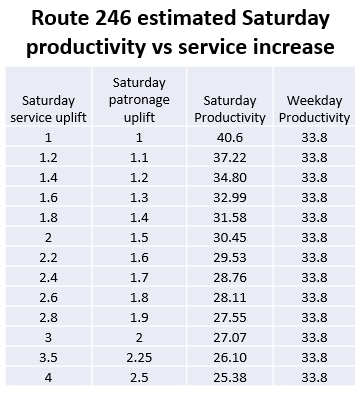

The graph for this chart is below. This gives a better visual indication of the relation between productivity and service at a given elasticity. It also shows us where the lines cross. 
 

Saturday meets weekday productivity at about 1.5 times the existing Saturday service. Multiplying Saturday's existing 4 buses per hour by 1.5 gives you 6 buses per hour, ie the same 10 minute frequency the 246 already runs on weekdays. 

To summarise, Route 246 is underserved on Saturdays. Instead of every 15 minutes it should run every 10 minutes, like it does on weekdays. You can be fairly confident that such a 50% boost will give a Saturday productivity that matches weekdays even without counting the likely network effects expected from a route that crosses about half of Melbourne's train and tram lines. Even greater network effects would likely accrue if a 246 service boost was accompanied by opening all entrances at Richmond Station at all times and providing multimode information and maps at key interchange points.  
 
Example Two - Route 623

Route 623 runs between three popular weekend destinations - St Kilda, Chadstone and Glen Waverley. It's far less frequent than the 246, being every half-hour on weekdays and only hourly on weekends. But it is 1.43 times more productive on Saturdays as it is on weekdays, versus the 1.2 times for the 246. This makes it proportionately more underserviced, even ignoring its vastly lower frequency (every 60 vs 15 minutes on Saturdays). 

Redoing the above table and graph with 623's numbers means that we can multiply Saturday service by as much as 2.6 times before productivity falls to reach weekday levels. 60 min / 2.6 gives a boost to 23 minutes. In practice though you would run daytime core service every 20 minutes with early mornings and evenings dropping to every 30 minutes along with some longer operating hours. 


Higher than 0.5 elasticities may be possible through modest network reform, eg removing duplication and consolidating with duplicative parts of the 624 between Chadstone and Caulfield and enhancing network effect connections by routing via Caulfield Station. 

Example Three - Route 800

Route 800 runs from Dandenong to Chadstone, mostly via Princes Hwy. It is the only public transport in some areas of Noble Park. It is one of five high-performing routes that lack 7 day service. Saturday service is also limited. The Saturday / MF ratio is 1.16, ie a shade under the 246 discussed before.

About 1.4 times the number of trips would bring its Saturday productivity in to line with weekday productivity. Given that 8 trips run on Saturdays that's an extra 3 trips. You would almost certainly add these to the afternoon to 120 minute gaps to 60 minutes and improve operating hours to approximately 8am to 6pm.

This is still a very limited service for a main road route whose strong weekday usage proves its worth. Many more trips (similar to those suggested for the 623) would be justified, not to mention a Sunday service. And the strength of Saturday trip generators and catchment demographics may mean a higher elasticity than assumed for other routes.  

And Sundays?

Sunday usage is closely correlated with Saturday usage. You can see a graph I plotted showing this here, though note my concerns with the data for Dysons routes. 

Three clusters of routes stand out. These include: 

a. Routes that are very productive yet underserved on Saturdays as discussed above. Sunday usage and timetables tend to be similar so the pattern discussed for Saturdays applies on Sundays too. This includes routes to major shopping centres eg 623, 626, 900 etc.  Generally speaking the Saturday frequencies proposed above for these routes should apply on Sundays too. 

b. Routes that are so productive on Saturdays that they are listed above. But they do not run Sundays so  there are no figures. However the tight link between Saturday and Sunday usage indicates that we can predict with high certainty that these routes will be productive if Sunday service was provided. Examples include the 281, 506, 800, 804 and 885. Three of the five are in the Greater Dandenong area, indicating the extent to which the area's 'safe seats' missed out on 2006 MOTC upgrades and neglect by successive governments since. 

c. Routes that don't feature above but are more productive on Sundays than Saturdays. These are typically in Melbourne's established north-western and western suburbs. These popular routes typically had a 15-20 min Monday to Saturday service that collapses to every 40 - 60 min on Sundays. Examples include the 406, 408, 410, 465 and 472. This cluster of routes typically has Sunday productivity that is 1.3 to 1.4 times that for Saturday. If we do Saturday's exercise but use Saturday productivity for weekdays and Sunday productivity for Saturday then we can get Sunday's productivity to equal Saturdays when we double Sunday frequency. That should be taken as a starting point if considering Sunday service improvements to these routes.  

What hasn't been mentioned?

A limitation of the approach taken of comparing weekend with weekday productivity is that it 'rewards' routes that have relatively lower weekday productivity. 

It's important to mention that there are certain routes that have both very high and very flat productivity across all 7 days. For example 495 in Point Cook has productivity of between 36 and 42 boardings per hour throughout the week. If one set a target productivity of a (still above average) 30 boardings per hour each day then you could increase off-peak service from every 40 to 20 minutes and extend evening operating hours and still likely meet it. Similar comments would apply to other busy Wyndham area routes like 150, 170 and 182 too.  

Conclusion

A significant proportion of Melbourne's most productive bus routes are underserved on weekends with disproportionately high usage versus service when compared to weekdays. 

Scope exists for significant frequency uplifts that would make the service more useful while retaining productivity that is higher or equal to weekdays. 

This is even assuming conservative patronage elasticity figures which could be exceeded due to network effects and favourable destinations and demographics. 

Next week I'll get into the nuts and bolts of specific bus service upgrades around one of Melbourne's major shopping centres and biggest weekend destinations. 

Index to other Useful Network items here

Tuesday, August 01, 2023

[Video] First Day of new Glen Huntly Station

Tram and bus hold-ups and train slowdowns at Glen Huntly are now a thing of the past with the removal of level crossings at Glen Huntly and Neerim roads. This saw the removal of one of the last tram squares in Melbourne and a rebuilt station with more shelter. 

I was there on Monday 31 July 2023, its first day of opening, and made this video. 


Here's an older Glenhuntly station video, showing the station before last. 


Thursday, July 27, 2023

Guest post: This week's Adelaide bus changes


I've written about Adelaide twice. Firstly in 2020 about their aborted radical bus network reforms and then in 2021 when I compared public transport services across the larger Australian capitals (including Adelaide)


They've since had a change of government, with the Liberals losing to Labor. Most political attention has been devoted to reversing privatisation but there have been some bus changes starting this week.  

To take us through them I am pleased to welcome Tom (@AussieWirraway on Twitter) who has provided this guest post.  


Introduction

This is a featurette covering themes in Adelaide bus planning, and changes that while minor, are worth writing about as we take stock on the motivation for bus reform of an overly complex network. This week saw some notable changes and service improvements to Adelaide Metro’s bus network. 

For the first time since about 2017, bus service hours will increase. Since the failed Network Reform of June 2020, Adelaide’s bus network has remained unchanged, but these improvements are not all sunshine and rainbows. 

The South Australian Public Transport Authority (SAPTA) is reverting to an old model of service improvements, that ignore their own context, and especially in the case of the 206/208 have been implemented in ways that leave a lot to be desired. This post will (try to) briefly cover these service improvements – the good and the bad.

Frequency upgrades

The best reform to come out of these services changes is route 206 to Lightsview becoming a “Go-Zone” bus, which dictates service levels of every 10 minutes in the peak, every 15 minutes at other weekday times from 7 am to 6:30 pm, and every 30 minutes all other times to last service and on weekends. 

The 206 is an existing bus that was previously peak only, running every 15-20 minutes to the city between 7 and 9:30 am, and outbound between 3 and 5:30 pm. That’s a very good improvement! For context Lightsview is an infill suburb in middle Adelaide and was home to 6,090 people on census night, it has one of the highest suburban densities in Adelaide. (click image below for a clearer view)

However, this Go-Zone provides limited new coverage over an existing one, adding just 9 stops to the existing Galway Avenue Go-Zone as shown on the above map (That’s not even to mention the fact that 3 of these stops are already served by the 202/203 go-zone on Hampstead Road!). 

The 208 remains unchanged despite the 206 improvements making it increasingly redundant. The 208 is a bus that provides a link through the middle Northeastern suburbs from the City to Paradise Interchange, it’s a good route, with strong anchors at either end, but outside its go-zone has relatively poor operating hours. 

On weekends, for example, the last bus leaves Paradise Interchange for the city at 5:42, with all trips until midnight being 208N (N for terminating in Northgate). This remains unchanged in the timetable; indeed, the entire 208 timetable remains unchanged every day of the week, except that 208B (B for terminating in Broadview) trips have become full 206 trips. This means that on weekdays between the city and Regency Road where these services split has an uneven frequency, as a bus running every 15 minutes meshes with one running every 30 minutes.

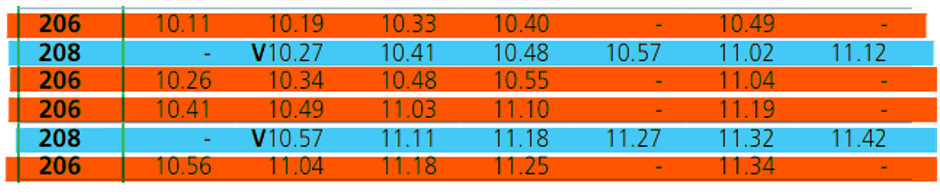
Take this sample for buses running from the city in the 10 am hour, if you live south of Regency Road, these are not easy to remember clockface frequencies. On weekday nights this does mean frequencies are double what they are now, and Galway Avenue, Walkerville Terrace and Melbourne Street now all have buses every 15 minutes until 11:30 pm, a very high level of service and rare in Adelaide.

Weekends are even weirder, with the 206 running every 30 minutes and the 208 running every hour, 30-minute waits for buses will still be common, and instead of meshing buses on Galway Avenue better, SAPTA has instead decided to have buses run more evenly to Stop 26, Folland Ave, Northgate.


So don’t get me wrong, these service improvements are more than welcome and should have been done years ago, but watching in real time such a mistake being made is bizarre. There were other options here, including buses that used the O-Bahn to Klemzig Interchange like the existing Lightsview bus, the 528, or combining the new frequent 206 with the tail end of the 208 to Paradise Interchange and deleting other parts of the 208 no longer needed. 

This is poor route reform, but planners likely know this. Implementing a Go-Zone to Lightsview was a half-hearted commitment of the Government at the 2022 election, and I wasn’t even aware of it till told recently. It’s unknown when the decision was made to pursue this change, as SAPTA had zero public window for public consultation, it appeared in the June state budget and has now been implemented in slightly over a month. 

That’s a good timeline and speaks well of SAPTA’s ability to implement new timetables, and operators' ability to schedule drivers and buses to fill changes. Torrens Transit, who will operate the new 206, has struggled for drivers since 2021, which has led to new less intensive peak timetables in many parts of Adelaide. This is hopefully a sign that the 2019 timetable can once again be implemented in full.

Northern suburbs, new route


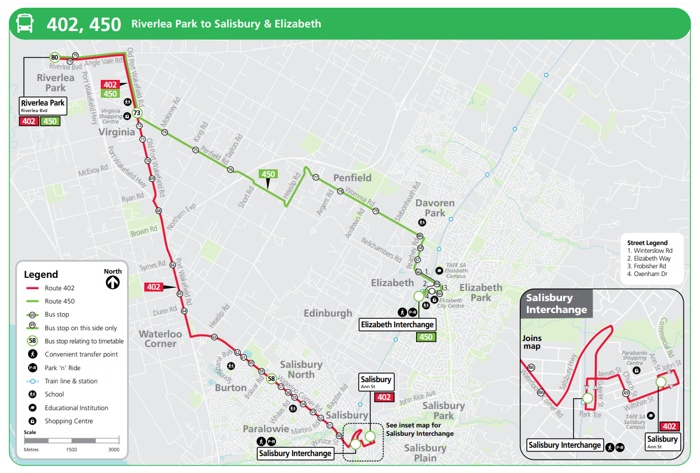
Casually announced on the Adelaide Metro website a few weeks ago was a brand-new bus route, the evenly numbered 450 to serve a new growth area in Adelaide’s north. Riverlea Park is currently not a particularly large community, the local council estimates a population of around 800 people, but by 2041 should be 11,000. It also benefits the current 2,000 residents in the small town of Virginia, who for the first time will have a regular connection to the Adelaide Metro network, which is decades overdue.

The 450 is presented as the main route to this development, and will likely become a frequent one in future, running essentially express along vacant farmland to Elizabeth railway station and city centre. At the same time, the presence of the 450 has caused the existing 4 times daily route 900 (which was basically the 402 and 450 combined as one bus via Virginia) to be deleted and reformed into the new 402, a 6-trip daily, peak route from Riverlea to Salisbury railway station. It’s not a traditional express route and takes longer than the 450 but offers an express train connection on the Gawler line.

The 450 has the bones of a good route and is ultimately sensible, but its hours of operation could be significantly improved. Inbound to Elizabeth it runs hourly from 6:20 am until 2:49 pm. Outbound from Elizabeth it’s the same, hourly from 10:15 am until 7:15 pm. Residents coming back from the city in the evening certainly won’t want to miss the 6:38 pm Gawler Central train, as it’s the last one that makes a bus connection. I also haven’t mentioned that both the 402 and 450 are weekday-only routes, which while understandable for the 402, is very disappointing for the 450. 

These hours of operation are not fantastic and are indicative of the very limited funding currently available. Given that many of the PM trips terminate in Riverlea Park without forming inbound services, buses will head out of service to the depot or a form a different route elsewhere. Edinburgh North depot, where the buses are stabled, is a 5-minute drive from Elizabeth station! 

Running these completely unavoidable trips in service back to Elizabeth station rather than deadheading can add no more than 15 minutes to a driver’s roster, but it’s not here. There was no governmental budgetary announcement for either the 450 or 402, and no consultation from Adelaide Metro, which perhaps indicates that these services are funded by the developer of Riverlea as part of its services obligation, and that from the axed 900.

Overall, the 450 is a solid bus route and one that will be very useful for the residents of Riverlea to reach the city and local Elizabeth shopping and government services. As the area gains more residents more funding is likely to become available to increase the hours of operation and the frequency of the route, while the 402 remaining a peak-only route largely makes sense, but the trip does need to be faster.

Splitting a corridor, less frequent buses

In the definitely questionable “did this really need to change?” territory is the splitting of the 230 and 232 frequent go-zone corridors. The 230 and 232 currently have a go-zone standard route from stop 31 Torrens Road to the city, providing wide, frequent coverage to many residents in the northwest outside the reach of the Outer Harbor line, and providing one of three frequent corridors to the Arndale shopping centre. 

These changes, as shown below, have split this route much earlier than it does today, at stop 10 Torrens Road. This is so the corridor can serve Days and Harrison Road, as they previously did before the South Road upgrade.

This change sees the 232 significantly increase its runtime (several minutes) due to a substantial deviation it now must complete. One which mainly parallels the Gawler train line, which also offers a much faster trip into the city, it also fails to interchange with that rail line providing no new stops for passengers wanting to make a transfer. The 230 and 232 will see no other changes to their frequency both running every 15-20 minutes in peak, 30 off peak and hourly in the evenings and weekends. 

This is a very hard change to justify which increases the travel time for passengers, significantly impacts clockface frequency for many more residents than it benefits, and overall seems like a downgrade on the existing network. There are also some weird oddities in the peak timetables for this bus, but for the sake of brevity, I won’t mention them here.

The consultation for this change occurred in November 2022, so the lead time on this one is approximately 8 months, however, no outcome from the consultation was ever publicly released. At the time of the consultation, I publicly advocated for people to write submissions against the change, but Adelaide Metro has adopted it along with this other suite of reforms. However, this one isn’t too complex, but is a shame for such a marginal benefit saving so few minutes of walking for a few hundred residents.

Conclusion

This set of bus changes is entirely unrelated to one another, occurs essentially in completely different contract areas and had no right to all be implemented on the same day in late July, but it can't be denied it's convenient for me. 

Overall, this is a mixed bag of changes, especially given that what is good here, could have been unashamedly better if more attention was paid to network reform. All the changes apart from those to the 230 and 232 are worthwhile, but I hope you'll agree it could have gone further. 

This was a lot of words to talk about what's essentially three changes to buses in Adelaide. The long and short of it is that it does demonstrate the fact that SAPTA can do reform quickly, and the public consultation isn't necessarily seen as something that “must” be done before implementing a change seen as “without downside,” demonstrated both with the 450 and 206 changes. 

A lack of consultation has seen the downfall of previous plans, the 2020 new network proposal is a case in point here, but equally, I don't have a real problem with announcing these changes a few weeks out from their implementation. 

I'm glad to see some changes happening, and if kept in motion I'll be interested to see what might come up next, namely the timetable revision for the Gawler rail line should be due sometime before the end of the year, which offers a strong opportunity to reform many parts of the northern bus network. 

But with the government focused on bringing the train and tram networks back into public ownership, it remains to be seen if this is a priority or not.

Follow Tom on Twitter 
Tom is also involved in advocacy group People for Public Transport

Opinions expressed above are Tom's alone and the above is presented as supplied. Thanks to Tom for this contribution.