
There is significant unmet demand for bus services.
Boost service on a existing popular (but underserviced) bus route and usage will rise in proportion. Higher frequency and longer hours induce new demand, just like the 200% rise in Saturday use of Dandenong's Route 800 bus when weekend trips were added.
Such underservicing is common even on our most important bus routes, with headways of 30, 40 and even 60 minutes widespread, especially on weekends. I looked at this back in 2023, when 2022 data was available.
Our most productive bus routes
Last week Mohan Wadia released similar analysis, based on data from 2023.
This compared patronage with service hours per route to arrive at a productivity number. This averages 18.3 passengers per live bus hour across the network with wide variations.
Though we need to be careful with patronage numbers. The Auditor-General found that, even after accounting for non touch ons, DTP bus usage data was inaccurate and actual bus ridership could be substantially higher than stated.
As for service hours, there are two things that can make that number high. That is the time a route takes from start to finish and the number of trips per week. Both are high for the long SmartBus orbitals.
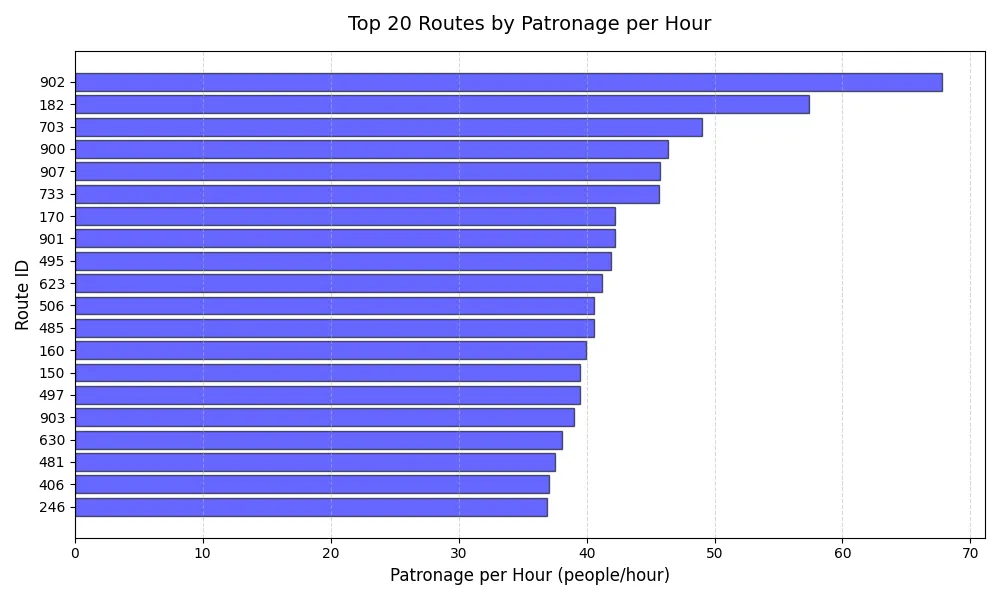
The analysis starts by listing the 20 highest productivity/highest overall hours bus routes. Starting with the most productive first they are:
902, 182, 703, 900, 907, 733, 170, 901, 495, 623, 506, 485, 160, 150, 497, 903, 630, 481, 406, 246.
These can be separated into the following:
* Orbital SmartBuses: 901, 902, 903
* Other SmartBuses: 703, 900, 907
* High productivity regular routes: 246, 406, 506, 623, 630, 733
* Wyndham routes: 150, 160, 170, 182, 495, 497
* Sunbury routes: 481, 485
I pointed out back in 2019 that high productivity, such as all these routes exhibit, is a sign of underservicing. All justify higher service but, for the longer routes, not necessarily along all of their length as segments can have widely varying productivity and/or inefficiently overlap other routes.
I will now discuss each grouping of routes and recommend actions arising to further improve productivity and service levels.
Orbital SmartBuses
While 903 has the highest patronage (and some sections with more intensive service), it is beaten by both 901 and 902 on productivity. This is likely due to 903 west of Northland being inefficiently overlapped by multiple other routes (eg 527, 465, 411, 232 and more) as well as having some low patronage industrial catchment in the west. These factors make it ripe for breaking up as an orbital with western and northern parts merged with other routes to provide a consistent seven day 10-15 minute frequency on most sections.
The 901 also suffers from some overlap with 902 in the Templestowe and Greensborough areas, serves an industrial catchment in Dandenong South and has territory between South Morang and Greensborough that likely do not justify a frequent service.
902 likely tops the productivity list due to its extremely high usage around Glen Waverley and Springvale as well as duplicating fewer routes on its way across to the north and north-west. It may however benefit from some improved directness near Greensborough and operation to Melbourne Airport instead of Airport West Shopping Centre (whose catchment is more localised).
Usage on the orbitals has been the fastest to rebound after the pandemic with usage in 2023 within 5% of 2019's number. It may well be higher now due to the reduced attractiveness of driving due to higher fuel prices.
Shorter term recommendation: Operate short workings to boost the busier parts of the SmartBus orbitals to every 15 min during the day on weekends. Add after 9pm Sunday service on these portions. Existing service levels on Route 907 could be adopted as a template on both these counts.
Longer term recommendation: Split SmartBus routes into more manageable shorter segments typically operating every 10 minutes or better on their busiest portions. Consolidate with overlapping routes for best legibility, economy, productivity and evenness of service.
Other SmartBuses
All three (703, 900 and 907) are in the top five performers for productivity. Route 907 has steadily got service increases over the years. It has long operating hours including (rare for Melbourne) 15 minute weekend frequency and after 9pm Sunday service. Its next step is possibly an improvement to daytime frequency to 10 minutes and late evenings to every 15 or 20 minutes.
The other two far lag the 907 in service. 900 was meant to be the substitute for a promised railway to Rowville. However it does not have train-standard frequencies on weekends and evenings with 30 minute gaps typical. It also stops around 9pm Sundays. The 900 gets most of its productivity from the busy Caulfield - Chadstone - Monash area. Productivity at the Rowville end is hampered by poor quality feeder services east of Stud Road and bad walking connectivity between the shopping centre's bus interchange and the Route 900 stop.
703 is even further behind in service with this the only pilot SmartBus that did not get upgraded to the full SmartBus service levels on weekdays during the day or in evening finishes. While it does not serve any big shopping centres it does serve Monash University which contributes greatly to its high productivity.
Recommendation: Upgrade operating hours and weekend frequency on Routes 703 and 900 to match 907's current service level. Upgrade 907's service level to every 10 min or better during the day all week and every 15 - 20 min at all other times.
High productivity regular routes
These routes are the unsung heroes of the bus network. They didn't get the special branding of SmartBus but have well above average productivity. Most are on straight alignments or serve major destinations such as universities and shopping centres. With the exception of the 733 (part of which got a boost to every 15 min on weekdays) none of these routes has had significant timetable improvements in the last few years.
406, 623 and 733 are most notable for the large shopping centres served. Their weekend loadings are particularly high indicating that their typical 30 to 60 minute service is insufficient. Despite inconvenient access to trains at Richmond (because the nearest station entrance is kept closed at non-event times) the 246 is a strong patronage performer due to its very direct main road alignment along Punt Rd/Hoddle St. It is also one of a handful of routes that runs a 10 minute frequency on weekdays with 'rapid running' or headway-based timetables.
630 has a weak western terminus but still performs well due to Monash University at its other end. 506 is an east-west route centred on Brunswick. It is the only route out of the top 20 not to run on Sundays.
The above confirms, as did the 2021 Bus Plan, that in Melbourne there is often a mismatch between a bus route's patronage (or patronage potential) and the service levels provided. Cities such as Perth, where timetables are continuously reviewed and there is a conscious effort to form a seven day high frequency network every 15 minutes or better from high performing routes, suffer from this less.
Shorter term recommendation: Upgrade weekend services levels on all routes to match weekday frequencies. Extend operating hours to midnight.
Longer term recommendation: Network reform and straightening on all routes (406 more direct between Footscray and Highpoint, 506 removing Brunswick West kink, 623 potential amalgamation with part of 624 and routing via Caulfield Station, 630 a stronger western terminus, 733 southern terminus extended through Clarinda to Cheltenham instead of Oakleigh) with further service upgrades.
Wyndham routes
These are also high productivity routes but are uniquely concentrated in a local government area that got almost its entire bus network redrawn in 2013 (Point Cook) and 2015 (Hoppers Crossing/Werribee/Wyndham Vale/Tarneit).
Five of the six routes (150, 160, 182, 495 and 497) drop to a 40 minute service outside peak times. While there have been Wyndham area bus upgrades in the last few years they have not benefited these routes despite scope to deliver 20 minute headways (such as their routes run in peaks) with the existing bus fleet. The continued existence of productive main road routes running only every 40 minutes lends weight to those who assert that Melbourne's west has been short-changed by Daniel Andrews political strategies that prioritised swing seats in the east.
The other Wyndham route in this list is the 170. Unlike the others this has a 7 day 20 minute service. It's a main road route between Werribee Station, Werribee Plaza and Tarneit Station. It possibly justifies a tram-like 10 minute frequency given its usage.
Recommendation: Upgrade routes 150, 160, 182, 495 and 497 to every 15 min peak (to match proposed late 2026 Werribee line train timetable with its 7.5 min service) and 20 min off-peak seven days. Extend operating hours to midnight to match service levels recently implemented on routes such as 153, 154 and 192. Upgrade Route 170 to run every 10 min day, 20 min night to form a tram-like corridor.
Sunbury routes
481 and 485 are short local feeder routes in Sunbury, typically operating every 40 minutes. I'm surprised they made the top 20 most productive as Sunbury demograpics are slightly different from the high bus using mix seen in areas like Wyndham, Brimbank, Craigieburn and Greater Dandenong.

Other comments
The analysis also plots routes on a scatter graph.
601, the Monash University - Huntingdale express shuttle, stands out as the most productive route. This is achieved by short run times, high frequency and a high volume corridor. It didn't make the list of 20 charted above as its shortness means it doesn't require many bus hours, despite its high frequency.
Other strong performers noted include the 402, 737 and 767 with the 737 (which serves major destinations in the east such as Monash University, Glen Waverley, Knox City, Boronia and Croydon) singled out as being worthy of improvement.
Route 788 (Frankston - Portsea) is identified as an example of a low productivity route out of the top 50 (as measured by service hours). This can be attributed to several factors. First of all it is a long route - so its service hours will inevitably be long even if its frequency is not high. Parts are slow, with speed humps and significant local traffic in parts. That's important as slowness hurts productivity.
The 788 is also overlapped by significant service on routes 781, 784 and 785 between Frankston and at least Mornington. Parts of its catchment is low density, whether inland, the part hugging the bay (fish don't tend to ride buses) or parts west of Sorrento. The route is also partly paralleled by an express bus (887).
However the 788, as the Mornington Peninsula's main public transport spine, goes to many useful places and has a steady hop on and hop off usage. It is possible that the reformed Mornington network that started on 5 July will nudge more people to get the 788 as the Barkly St bus interchange now has fewer buses. That, and the potential to make a new connection from Hastings due to the new 886, should somewhat improve the route's productivity.
I mentioned the 18.3 passengers/hour average productivity. It should be noted that there is what statisticians call a 'long tail'. Many routes are significantly below average. Sometimes this is unavoidable if it is agreed that coverage in a hard to reach area should be retained for equity reasons. But on the other hand there are parts of the bus network where inefficiencies such as overlapping routes or excessive service levels (in a few cases) could be tackled to improve productivity. Some of the latter is the sort of more complex bus network reform that successive governments have often found difficult.
Summary
The pattern of high productivity bus routes remains similar to last reviewed. That is routes that serve major shopping centres, large universities and run directly between train stations on at least two lines are highly productive.
But just because a route is already productive does not mean it can't help even more people get around. This is possible by cutting maximum waits, increasing operating hours, and, particularly on orbital SmartBuses that serve weak catchments or overlap other routes, simplifying the bus network so that corridors have a smaller number of routes running more frequently.
There has been welcome acknowledgement by government that there is a place for routes that are consistently more frequent 7 days with longer operating hours as shown by funding in recent state budgets for service upgrades to some Wyndham buses and other key routes like 508 and 561 to run every 20 minutes all week.
However an opportunity remains for Melbourne to (i) both expand this frequent network to more routes, (ii) present a more consistent service offer (our main routes still vary hugely on service levels, reducing legibility), (iii) adopting a more frequent turn-up-and-go standard for our top tier routes, and (iv) publicly defining and selling the frequent network more like we used to do with SmartBus.
Sydney's All Day Frequent Network (every 10 min or better), Perth's High Frequency Bus Services (every 15 min or better) and Auckland's Frequent Transit Network (every 15 min or better) all represent best practice Monday to Sunday examples from this part of the world.
Perth's model is most notable for how it forms its frequent buses - it continuously reviews the bus network and goes out of its way to optimise resources to upgrade or consolidate regular routes until they are frequent enough all week to qualify for High Frequency status (after which they get a 900 route number). This means that even in times when there is not a lot of new funding for bus services new frequent routes can be added, as happened earlier this week when existing Route 100 was upgraded to the more consistently frequent 920.
With Melbourne's historically much slower rate of bus network reform, the opportunities to do this here are far higher here than in Perth, with political will seemingly the only barrier.


2 comments:
It would be good to see a similar commentary on the least productive routes.
Regarding the 903, the underused western portion should probably be rerouted at Sunshine, swap Altona with Wyndham Vale or Tarneit and it will be packed at all hours, especially when V/Line inevitably goes haywire.
The 905 and 908 are a bit of a white elephant, there always seems to be two or three empty 905s go past while I'm waiting half an hour at night on Lonsdale St for either a 906 or 907 only for both to turn up at the same time 20-odd minutes late (yay 40 km/h freeway works) - also, way too many people get on the DART buses only to get off 500 metres up the road e.g. get on at William St only to get off at QV which makes them even slower, outbound DART buses on Lonsdale St should be pick up only (inbound being set down only), let the 300-series buses take the lazy people.
The 908 in its current guise doesn't make any sense whatsoever, it fails to even pass as a proper SmartBus as it stops short and forces you to either wait for a 907 or go the long way on the 207 and take nearly an hour to get to the city (and swapping to the 48 tram doesn't make the 207 option any quicker).
The 902 should probably be split at Doncaster. I really wish they'd delete the Glen Waverley station stop and just have the bus stop on Springvale Rd outside The Glen like the 901 does at Mitcham. Sometimes it can take ten minutes to turn off Springvale Rd, stop at Glen Waverley station and get back onto Springvale Rd due to all the red lights and having to share a narrow side street with literally a hundred cars entering and exiting the car park. Seriously not good enough for a "premium" SmartBus service. Never mind it not having Night Network services when even the lowly 703 is running (the 903 and the 901 north of Ringwood not running overnight is another sore point).
The 901 should be split into quarters. 901 The Pines to Melbourne Airport or Airport West (deliberately not using "911"), 703 extended from Blackburn to The Pines using the 901/271 stops, 670 extended from Ringwood to Box Hill also using the 901/271 stops (271 truncated at Blackburn and using the 703's terminus), nuke the completely worthless Albert St bus stop from orbit, and reinstate route number 665 for Ringwood to Frankston.
The 246 is let down by Hoddle St, Punt Rd and an abhorrent half-hourly weekday evening frequency.
The 733 is a joke. Caught it once in February from Ferntree Gully Rd to the 75 tram just before 3PM, no school kids out yet, still crush loaded. Then had to wait nearly 20 minutes for the tram while being blasted by the sun (the glass shelters just act as a greenhouse), while the two trams that showed up at once went elephant-style all the way to Vermont South. Never again. I don't even want to know its nighttime or weekend frequency. FWIW I was going to go all the way to Box Hill but forget that, I (eventually) got the tram to Springvale Rd and then the 902 to Nunawading instead (no point in going all the way to Vermont South as the 736 and 742 are barely above trash tier for frequency, even though the latter could easily pass as a SmartBus for its length).
Post a Comment