Tuesday, June 08, 2021

Timetable Tuesday #121: Footscray's 223 - the tram remnant that's still going


Next year marks 60 years since the Footscray tram system was closed and replaced by buses. However the end was nigh a few years before when service on Sundays was run by buses instead of trams. It is these tram replacement buses that form the beginnings of the 223 bus which plies the same streets (and a little further) today. 

Route

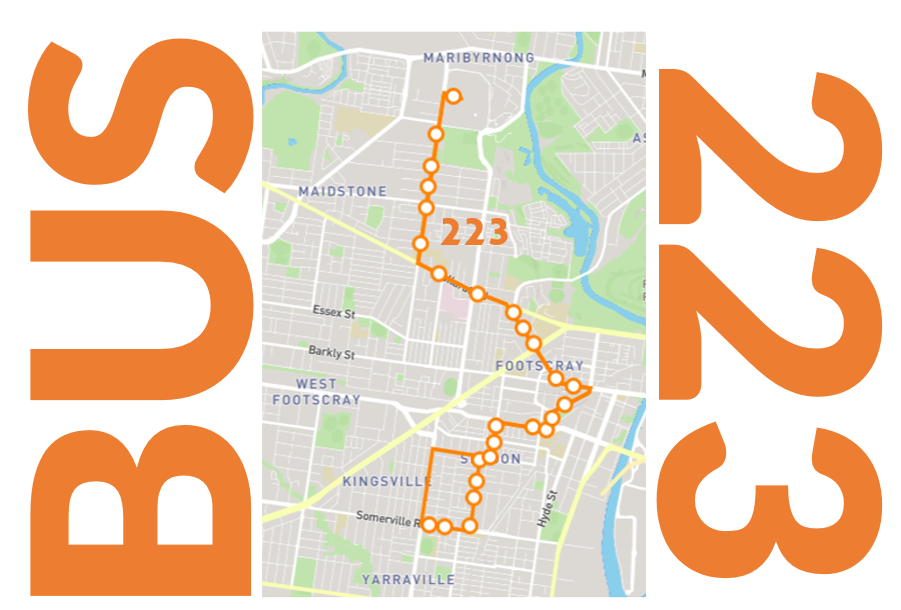
The 223 is quite short. It starts at Highpoint Shopping Centre and runs along main roads to Footscray. Then it, like the predecessor tram, runs south past the Seddon shops in Victoria St. But unlike the tram it does a clockwise loop via Williamstown Rd, Somerville Rd and Gamon St before returning to Footscray. This loop adds travel distance compared to the tram which ran via Gamon St in both direction. 

Below is the 223 overlaid on a PTV local network map. It has almost no unique coverage due to the presence of the 82 tram and the 406 bus. Like the 82 but unlike the 406 it goes a fairly direct way to Highpoint. On the latter, there was some rationale for 406's indirectness when the student village was open (as the 406 provided a direct connection to Victoria University) but that need has vanished. 

South of Footscray the 223 has no unique coverage, with it never getting far from either Middle Footscray Station, Seddon Station, Yarraville Station and the 472 bus on Williamstown Rd. Neither does it have nearby unique destinations as all these run to Footscray. 

Seddon and Yarraville used to have infrequent (20 minutely) trains off-peak with even less at night and on Sunday morning. However service upgrades  on the Werribee, Williamstown and Altona lines (some as recently as January 2021) have seen these stations get a 10 minute daytime, 20 minute evening service. This makes frequency here way better than elsewhere.  

Add the 223's long operating hours and the 15 - 20 minute service of the 472 on nearby Williamstown Rd Monday - Saturday (with less service on Sundays and evenings), you can see that this pocket is one of the best served for buses and trains in Melbourne. 

Timetable

The 223 is one of those legacy ex-Tramways buses that enjoys operating hours and service frequencies equal or better to SmartBus services. Most notable is that it is one of Melbourne's few full-time bus routes with 7 day early morning to late service (even on Sundays). 

During the day Monday to Saturday the 223 runs every 15 minutes with a 20 minute service at night. The Sunday timetable is a relic with services every 30 minutes in the morning and evening, improving to every 20 minutes after lunch until late afternoon. You'll see a similar pattern with other historic timetables, eg for trams where the Sunday service was either late starting or at reduced frequency. Another remnant of past working patterns (eg the 44 hour week) was that the Saturday morning timetable features a 15 minute service from first service, despite likely low usage. 

Services finish at or close to midnight seven days, which, as mentioned before, is rare for buses in Melbourne. However the weekday start is quite late, with first trips arriving around 6:30 - 7am. And in the northbound direction the first Saturday trip is about 15 minutes earlier than the first weekday trip.  

Patronage

223 is an above average patronage performer compared to other Melbourne bus routes. Usage in late 2018 was 33 boardings per service hour on weekdays, 30 boardings per service hour on Saturdays and 36 boardings per service hour on Sundays. The high Sunday figure is likely due to the popularity of Sunday shopping at Highpoint and that service frequency is less than on Saturday. Catchment and demographics also help - just about all bus routes around Footscray are well used. 

223 is however less productive than the 406 which serves a similar and often overlapping catchment between Footscray and Highpoint. 406's usage is 55 boardings per weekday, 32 on Saturday and 39 on Sunday. The high weekday usage is likely due to Victoria University being on the route. And the high Sunday usage is due to the 406's low Sunday frequency. 

Another factor is Tram 82. This only runs every 20 minutes interpeak on weekdays but 15 minutes on weekends. Those travelling from Highpoint on weekdays might thus prefer the 223 over either the 82 or the 406 which are either less frequent or slower.  

More on how high productivity can cause bus routes to run at less than their potential here

History

The map below shows the Footscray local tram network in 1934. 

This was closed in 1962, though service was reduced in the years leading up. Barkley St became served by what we now know as bus route 220 while the Yarraville and Ballarat Rd portions were served by what we know as the 223. The 1971 map below shows these in green since they were operated under the government-run Tramways board (unlike the red routes eg the 408 and 410 which were and are privately run but now publicly subsidised). 

The 1978 map removed the colour distinction between government and private bus routes. Also at least some trips of 223 were extended north to the then new Highpoint West Shopping Centre. 

A more comprehensive history of the 223 and its relationship with the trams appears at BCSV here

Ideas and opportunities

223's alignment has been unchanged for close to 50 years. Its basic service level hasn't had much reform either. But bus routes in the area are either complicated, indirect and infrequent even though there is the patronage, demographics and busy trip generators for services to be so much better for little added expense if routes were straightened, merged and run more frequently. 

Several questions exist. Least radically, should 223's Sunday service be upgraded to reflect Highpoint's business as a shopping centre with the first step being to lessen early Saturday morning frequency in exchange for more Sunday morning trips? 
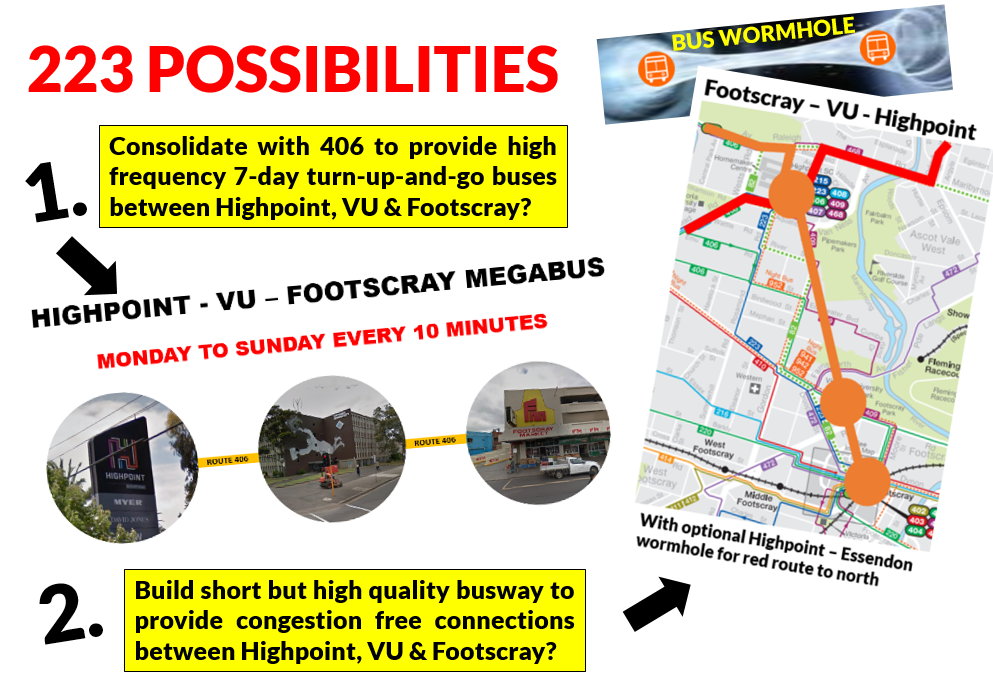
An advance on that could be to merge 223 with a straightened 406 to cheaply become part of a 10 minute frequent service corridor as discussed in Useful Network 11. Also, is the quiet Yarraville portion needed given today's increased train frequency at Seddon and Yarraville, especially if the nearby 472 was given some extra Sunday service and longer hours to compensate? 

More radically, does the density of development around Highpoint and it having only slow trains and buses justify a high-speed bus wormhole to improve connections to Victoria University, Footscray and the new hospital?  

If you have any thoughts on the 223's future please leave them in the comments below. 

Index to all Timetable Tuesday items

Friday, June 04, 2021

Building Melbourne's Useful Network Part 93: How accessible is Australia Post's new HQ site?


If you're running a top-tier business and want the best possible accessibility from the entire metropolitan area then you locate in the CBD. The public transport system focuses on it and you are a short walk or tram away from higher order legal and other services. These 'other services' include the likes of The Melbourne Club that corporate 'old boys' who probably went to their private schools together can repair to. Along with the potential for taking business prospects to the best restaurants or the theatre after work.  

Sometimes though other factors, such as the desire for a lower rent, purpose built buildings, larger floor plan and even possibly more parking, might be influential. That may cause corporates to flee the CBD in favour of a less central location. In the case of Melbourne, with much of its corporate elite living in the established inner-eastern suburbs, such a location can make driving in more convenient for the top brass. 

Coles HQ 

One example from 1986 was when Coles HQ moved from the CBD to a purpose built site on Tooronga Rd in Hawthorn East. It was (and is) a terrible site for public transport access from most directions with its mode share falling from a majority to a small minority. For example it is a slightly less than convenient walk from one train line, Tooronga Rd has one half-hourly bus while Toorak Rd, a major east-west artery, has nothing. Because Coles is such a big user of business supplies and services, their decision had a knock-on effect for other bad location decisions decades later, for instance a shop equipment supplier moving nearby in 2019

The idea that development or density spurs improved public transport is a myth, at least in Melbourne. Basic service levels in the area are hardly better now compared to then despite Tooronga Rd being part of a high patronage potential but underserved Caulfield - Swinburne - La Trobe university bus axis. 


Australia Post

Just recently we read that Australia Post's HQ will also be fleeing the now struggling Melbourne CBD. It's moving to a location on Swan St near Burnley Station. This location decision is a bit better than Coles' but it will likely still increase travel times for most arriving by public transport, especially from the west, north and south. 

Public transport mode share will certainly decline. And by quite a lot. Moving a workplace even a few blocks from the CBD centre (especially to somewhere remote like New Quay) has a big impact on travel time from most directions with our network.  

This is basically because Melbourne has traffic-choked surface trams rather than a faster subway in our inner suburbs along with under-developed buses. Our trains are so CBD focused with no circumferential lines through quite dense inner areas. Also poisoning our railway's core health is a complex reversing loop that discourages interchanging along with sometimes poor frequencies, even in peak on some lines.  

Anyway, what are Burnley's current transport options like, bearing in mind people will be coming from all directions?

Most notable is the train. The site is very close to a junction station at Burnley. Trains from Alamein, Belgrave, Lilydale and Glen Waverley stop there. The last three have good peak frequencies. Off-peak frequencies are every 15 minutes, weekend frequencies are every 10 - 20 minutes while evening services drop to a mediocre 30 minutes on each line. If you worked late at night you would think twice about getting the train home. But overall access is good from a large chunk of the eastern suburbs. Some stations are served by some of Melbourne's busier feeder buses though only rarely are their peak frequencies better than every 15 minutes. 

Running past the site is the 70 tram. Like the train this is also east-west. It is quite frequent but slow. And apart from Camberwell it connects at no major suburban hubs. 


Your transport problems start if you are not one of the 20% or so of the population in the eastern suburbs. If you're coming from the south-east via train the best way to Burnley is likely via a change at Richmond. For now that is. 

But when the Metro Tunnel gets built and Dandenong trains skip South Yarra and Richmond then access from there will be harder. In the absence of any other transport you will have to get a train to Burnley from either CBD South/Flinders St or State Library/Melbourne Central, depending on what they do with the City Loop pattern on the Burnley group. That's a lot more backtracking than now. 

The Mernda and Hurstbridge lines are a victim of poor geometry. You go quite near (but still beyond walking distance) to Burnley at West Richmond then you go further before you can change to a train to backtrack. There is a tram going east but no connections south from it to Burnley. An option exists to get the 246 bus but this requires a double change and physical connectivity with trains is poor. 

Lines from the west require a change in the CBD to a train out to Burnley. Services are frequent on the inbound but the 20 minute frequency on lines like to Williamstown and Altona make home-bound trips chancy and travel times blow out by maybe 50% at times. Similar issues apply for the Upfield line to the north. 

Closer in connections are also limited. Burnley has only east-west routes; there is no connectivity to the north and south where a north-south bus could connect with numerous other routes (mostly east-west trams). 

The main effect of this is that trips from even quite close by require two changes of vehicle and potentially significant waiting and backtracking. In many cases it's faster to get to the CBD by public transport than locations closer to you even though the distance to the latter is less. Apart from Richmond, this issue afflicts other inner-suburban job-rich areas including Fishermans Bend, Kew, Parkville, St Kilda and even parts of Docklands. It is a major structural flaw with the network as currently configured and scheduled. Sydney, in contrast, tends to have a less steep drop-off in modal share as you move away from the CBD, partly due to its less radial rail network.  

Solutions

How could you improve transit access to Burnley from more directions? Here's my top six picks. 

1. A Burnley St bus for north-south connectivity. This would connect Burnley with nearby areas both north and south of the Yarra including Toorak Station. It could run from Victoria Gardens to Elsternwick. Implementation could could be reduced if it involved a rerouting of the 604 bus to terminate at Victoria Gardens instead of Alfred Hospital. This would complete a missing part of the local transit grid and enable single change trips from many east-west train and tram lines. I discuss the Burnley St bus concept here and nominate it as one of the 12 links Melbourne most needs

There would be overlap with trams but some might argue for a somewhat longer route starting at either North Richmond or Kew. This would reduce the number of transfers for some trips from 2 to 1. You wouldn't consider resourcing a bus for that reason in a sparse area but in a densely populated area with lots of jobs then it might be worthwhile.  

2. Ringwood line trains turn-up-and-go with simpler timetables. For good connectivity into the CBD and across the eastern suburbs there needs to be turn-up-and go trains running every 10 minutes or better to a predictable stopping pattern all day. Ringwood line stopping patterns are the most complex in the network as explained here. And despite being a junction station Burnley is skipped by many trains. 

First priority, and cheapest to do would be to simplify stopping patterns and boost the Ringwood line to a 10 minute all-day service. That has the benefit of improving connections to the ends of the line, with an upgrade from every 30 to every 20 minutes. More detail on that here. As well as benefits for Burnley there would be gains for many politically marginal seats in the outer east. And as one of our busiest lines Ringwood should be like Frankston and get a service every 20 minutes or better at all times, even at night and on Sunday mornings. 

3. Glen Waverley line frequency upgrade. The Glen Waverley line (which also serves Burnley) would be a lower priority than the longer Ringwood line. But could still be worthwhile as a way of taking pressure off the busier Ringwood and Dandenong lines. And in its own right it can connect Burnley to a wide catchment especially if better bus connections to the Monash precinct, Knox and Rowville were added. Again it could be boosted to every 10  min off-peak daytime and 20 minutes at night. 

4. Tram 70 upgrade including accessible stops and more priority. Also increased frequency, eg every 10 min or better at all times. 

5. 567 southward extension to Hawthorn and/or Glenferrie Station area. Not a direct improvement but would increase the area accessible to Burnley with one change (to the train). Has wider network benefits eg around Fairfield, Northland and La Trobe Univesity. Discussed in more detail in Useful Network Part 15

6. Better information for interchanging passengers at key stations including Richmond. Also inside trains. That would help passengers know which platforms they need to change to without having to wait for an announcement. 

You would not necessarily do this just for Australia Post. But this is a dense area with poor connectivity. Space is at a premium and it can't reach its potential if it relies on car access. However current public transport is encouraging this as access is so poor from most directions. 

Burnley is in the marginal seat of Richmond, held by planning minister Richard Wynne MP. 

Conclusion

Densifying Burnley needs good public access from many more than the two or three directions it currently has. Described has been a few network measures that could economically enable this. If you think more can be done (and the list looks a little short) then please add them in the commens below. 


See other Building Melbourne's Useful Network items here


Tuesday, June 01, 2021

Timetable Tuesday #120: Government responds to the Disadvantaged Jobseeker Inquiry (on transport)

Last year a parliamentary committee inquired into sustainable employment for disadvantaged jobseekers. I put in a detailed submission devoted to the transport aspects of this. In particular I proposed a job ready public transport network that better served where many disadvantaged jobseekers live and would be most likely to find jobs. This would be quite different from current timetables that best suit middle-class 9-5 CBD office workers and are arguably anti-poor

The committee heeded my submission and included in its final report support for public transport that better suited jobseekers travel needs.  

The specific recommendation (65) reads: 

That the Department of Transport review the number and frequency of bus services to and from  education centres and commercial and industrial zones in metropolitan and regional Victoria in relation to where jobseekers facing disadvantage live, and make improvements where necessary to increase access.

Government response

The final stage of this process is that the government must provide a response, addressing each of the inquiry's findings. It did so on April 30, 2021. You can read it here

Today I'll comment purely on the government's response as it relates to transport. 

Page 17 of the response says the government supports the recommendation in full. Their response is as follows: 

The Victorian Government’s $100 million Better Bus Fund and the $28 million More Regional Bus Services initiative has delivered improved bus networks and services across Melbourne and Regional Victoria. These investments supplemented by other funding into bus services has made it easier for students to get to school, TAFE, University as well as VCAL and VET classes.

The 2020-21 State Budget committed another $25 million to improving bus services including initiatives that make it easier and safer for students to get to school. The Victorian Government regularly reviews bus routes across the network as changing transport needs arise across the network. When reviewing existing bus routes or planning new ones, factors considered include the likely number of users, suitability of the road network for bus operations, development of a direct and easily understood network, and connectivity with other public transport services.

As part of the new timetable delivered in January 2021, approximately 360 bus and coach routes are progressively being re-coordinated to align with the new timetable. Coordination between buses/coaches and trains is vital as it helps people access education, employment and health services and it enables people to participate in social and sporting activities. It also helps to reduce demand for station car parking and reduces traffic congestion at the station and on roads.

The Victorian Government’s Flexible Local Transport Solutions Program invests in small-scale initiatives across Victoria that addresses transport disadvantage, integrates with other local transport options and improves transport access. The program aims to support flexible, tailored transport services or trials particularly in regional Victoria and outer suburban/interface areas.

The Government works through Regional Partnerships, local councils and community organisations to identify and co-fund projects and initiatives that strengthen communities by improving access to local transport services and infrastructure. Projects funded include initiatives to provide vital transport services for disadvantaged young people to access VET programs in South Gippsland. 


Comments on government response

Let's split and discuss each paragraph one by one (my comments in blue). 

The Victorian Government’s $100 million Better Bus Fund and the $28 million More Regional Bus Services initiative has delivered improved bus networks and services across Melbourne and Regional Victoria. These investments supplemented by other funding into bus services has made it easier for students to get to school, TAFE, University as well as VCAL and VET classes.

There have undoubtedly been benefits but changes have been at the margins. Value for money spent has been less than it should as changes generally comprised new routes layered over an otherwise unchanged existing network (Endeavour Hills was the main exception - discussed here). In other cases the wrong routes were upgraded with only a fraction of the possible benefits. Or there was an emphasis on access to education/training rather than jobs (not a bad thing in itself but still limits access to jobs).  

The 2020-21 State Budget committed another $25 million to improving bus services including initiatives that make it easier and safer for students to get to school. 

The main mention here was on school transport. Apart from the Route 788 upgrade this budget was  disappointing for users of route bus services. Service per capita continued to decline and many areas remain with no or limited service as the budget was almost exclusively about major transport infrastructure, not service. My write-up on 2020-21 budget is here

The Victorian Government regularly reviews bus routes across the network as changing transport needs arise across the network. When reviewing existing bus routes or planning new ones, factors considered include the likely number of users, suitability of the road network for bus operations, development of a direct and easily understood network, and connectivity with other public transport services.

The pace of review and improvement to bus services is both (a) currently extremely slow and (b) much less in the five years to 2020 than it was in the five years to 2015 and (especially) the five years to 2010. There is no indication that the needs of disadvantaged jobseekers are being considered despite many living in areas that have high propensity for bus use. Service upgrades in such areas should thus give good patronage returns per dollar spent.   

As part of the new timetable delivered in January 2021, approximately 360 bus and coach routes are progressively being re-coordinated to align with the new timetable. Coordination between buses/coaches and trains is vital as it helps people access education, employment and health services and it enables people to participate in social and sporting activities. It also helps to reduce demand for station car parking and reduces traffic congestion at the station and on roads.

This is regular business that seeks to maintain what existing bus/train coordination there is when train timetables change. It should be noted that the emphasis in recoordination is to favour morning travel towards the CBD and afternoon travel from it. This may or may not assist those who work in non-CBD locations or make trips opposite to the peak direction. I discussed 2021's recoordination here, here and here 

The Victorian Government’s Flexible Local Transport Solutions Program invests in small-scale initiatives across Victoria that addresses transport disadvantage, integrates with other local transport options and improves transport access. The program aims to support flexible, tailored transport services or trials particularly in regional Victoria and outer suburban/interface areas.

The Government works through Regional Partnerships, local councils and community organisations to identify and co-fund projects and initiatives that strengthen communities by improving access to local transport services and infrastructure. Projects funded include initiatives to provide vital transport services for disadvantaged young people to access VET programs in South Gippsland.

These are typically very infrequent services that may only operate a few days a week. Unless you are very lucky they do not run at times that suits peoples' needs (unless aimed at targeted groups eg VET participants). They do not replace the role that a comprehensive local network should play. 

There was at least one case where the government did something highly beneficial but undersold itself by not including it in its response. Possibly because the recommendation was about buses and the change was a new train timetable with a significant number of service upgrades. Nevertheless disadvantaged jobseekers use trains too and improvements here, especially off-peak, would be beneficial. 

I refer to the January 31, 2021 train timetable upgrades that improved service frequencies to Ballarat/Melton and reduced maximum waits on the Frankston, Werribee and Williamstown lines from 30 - 40 to 20 minutes. Spreading such an upgrade network wide would be a major improvement to the network's job readiness and something I recommended in my submission. 

Subsequent good news

The government's response was written before the 2021 state budget was handed down. It would have been constrained by the infrastructure-heavy 2020 budget that had very little for improved transport services. 2021's budget was better, with mention of bus network reform (something that previous ministers Allan and Horne pushed less on) and more funding for better services. 

The budget document itself had little detail but more came out in the days subsequent. Those that would help make the network more job ready include: 

(a) Improved bus services for Fishermans Bend 

(b) New route 154 from Tarneit to Palmers Rd 

No one lives at Fishermans Bend. But there are lots of jobs here with buses the only public transport mode. A bus upgrade here should be beneficial for many trips to work.  

Possibly of potential greater importance to disadvantaged jobseekers is the proposed bus route 154. This serves new housing estates and some jobs near Palmers Rd. This is a significant improvement over now, where there is no route from Tarneit to here. 

However a terminus in an industrial area isn't normally good for patronage, especially if the route stops short of more jobs a little further along. And, on marketing grounds, a bus that goes directly to jail (and not beyond) is probably not a good look. 

While the 154 appears to have been drawn up based on the usual 'grafted on' approach, there may be opportunities to connect it to more jobs if it was merged with other routes to stronger termini eg Sunshine, Laverton or even Altona Gate. The network concept in my submission is one possibility that could improve connections between Laverton North jobs and the surrounding residential areas.   

With usual budget to implementation lead times of new bus routes exceeding two years and possible revived interest in bus network reform I would not however completely discount the possibility of the 154 eventually getting a better and more useful eastern terminus, either on Day 1 or (more likely) somewhat later.  

Conclusion

The government's response (on transport) to the Disadvantaged Jobseeker Inquiry has been underwhelming. However subsequent improvements (notably train service upgrades) and 2021 budget measures give more hope than just looking at the response might provide. 

See other Timetable Tuesday items here