Tuesday, May 11, 2021

Timetable Tuesday #117: The new 152 and 182 starting this month

Two new bus routes are starting later this month. Both provide much needed coverage to growth areas around Tarneit. Early advice of routes 152 and 182 was given on Facebook by Sarah Connolly MP

Routes

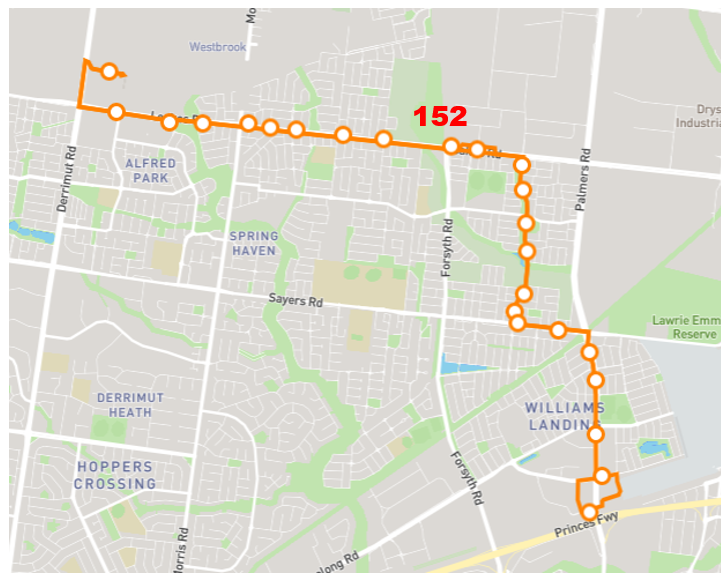
The map shows them relative to the existing network. Both are main road routes between two railway lines. The main area of new coverage is on Leakes Rd both east and west of Tarneit Station. They will fill many coverage gaps in the City of Wyndham between the Werribee and Geelong lines. The main  remaining coverage gaps are in the fast-developing estates north of Tarneit off Dohertys Rd where no b buses run.  

More detailed maps of each route, including stop locations, are below. 


Timetables

Both routes operate every 40 minutes off-peak. Route 152 operates about every 30 minutes during peaks while the 182 is about every 20 minutes. 

Local bus routes routes are supposed to operate to minimum standards with regards to frequency (every 60 minutes or better) and operating hours (6am - 9pm weekdays, 8am - 9pm Saturdays, 9am - 9pm Sundays). Some routes are actually a bit better. It's widely recognised that these standards underestimated travel demand early on weekend mornings. As a result some new bus routes start about an hour earlier than the standard on Saturdays and Sundays. The minimum standards commenced in 2006 when there was a major program to upgrade buses throughout Melbourne. A lot was done but there was still unfinished work, especially for routes in some established areas. However most new routes do meet the standards. 

Here 152 and 182 both skimp a bit. There should be an additional one or two early weekday arrivals at Williams Landing for the 152 as the first arrives as late as 6:40am. The last weekday departure of 8:17pm is also poor with one or two extra trips desirable. Sunday evening is the quietest evening of the week for travel demand yet its last evening trip is 30 minutes later than the last weeknight trip from Williams Landing. It's much more uniform going the other way with the last 152 departures just after 9pm on every day of the week from Tarneit. 

Route 182 also has similar early finishes from the Werribee line direction except in this case it's 7 days per week (8:22pm finish). 

Even though the catchment of both routes is nearer to Tarneit than Werribee line stations, if I was a local resident there would be times when I'd be catching the Werribee line train instead. This is because of (a) its superior evening frequency (now never worse than 20 min on any day of the week) and (b) direct services from Flinders Street. These considerations are why connections from the Werribee line should at least meet the 9pm minimum standard, which is not the case on neither route on any night. 

Route 182 is mainly there for its northern part where it provides unique coverage. However it overlaps the 180 on parts of Tarneit Rd to Werribee Station. That can assist in improving frequency given the gaps the 180's timetable sometimes have. Earlier in the year I mentioned how DoT poorly scheduled the Route 180 am weekday timetable with a 28 minute gap in arrivals at Werribee at the height of the morning peak with no buses between 7:21 and 7:49am. Does the 182 fix this? The answer is it does, partially. The 182 has arrivals at 7:13, 7:40 and 8:00. This reduces the longest gap to 19 minutes. Ideally two nominally 20 minute routes would be offset by 10 minutes to provide a combined peak frequency nearer to 10 minutes (although it's a balancing act with regard to balancing return trips to connect with trains at Tarneit). 

What about other co-scheduling opportunities? The schematic shows some related routes. Most local routes are typically half the frequencies of interpeak weekday trains (every 20 minutes). The best service is provided if times are offset so that those between both routes have the option of catching both at different times. In other words 167 and 182 should be offset by 20 minutes weekday interpeak to provide the best service. Unfortunately this does not hold on weekends due to the poor frequency  of trains Tarneit gets then (trains only every 40 minutes) despite its high usage and populated catchment.  

Something similar should apply for the 150, 151 and 152 although it is impossible to get it right to benefit everyone. For example the largest catchment benefits if 150 and 152 operate at the same times with 151, the in between route, offset by 20 minutes. However this provides a poor service on the 150 and 152 overlap with two buses every 40 minutes and nothing in between.  

The 150 and 151 (and likely the 152 once it gets established) are some of Melbourne's most productive bus routes as measured by passeger boardings per kilometre. The most desirable outcome would likely be a doubling of interpeak train and bus frequencies to reduce gaps (eg trains every 10 minutes, buses every 20 minutes). 

The diagram below shows some (but not all) relationships. The most notable omission is the 166 which should be offset by 20 minutes on its common path with the 167 between Hoppers Crossing and Werribee Plaza. Hence there are many trade-offs with scheduling and the best approach in such a high usage area with (already) efficiently planned routes is just to run everything as frequently as possible consistent with harmonising with trains (although even that becomes less important with high train frequencies). 


Conclusion

Both the 152 and 182 are welcome additions to the Wyndham transport network. They are simple, direct and provide worthwhile new coverage in an area where bus usage is high. And where they overlap with established routes they provide some increased frequency. Hence they should be successful, although longer operating hours and higher frequency would always be welcome. 


Index of Timetable Tuesday items


Friday, May 07, 2021

Building Melbourne's Useful Network Part 90: Getting the most from Keysborough South's second bus route

It was promised by local MP (and one-time transport minister) Martin Pakula before the 2018 election. It got funded in the May 2019 state budget. Even leaving aside the fact that it takes yonks to set one up in Melbourne, you'd have thought we'd have heard more by now. Even if if was just some public consultation or a start date announcement. But we haven't. 

What am I talking about? A bus route promised for Keysborough South. It's a growth area that's been crying out for buses. Its first bus started several years ago when the 709 was extended from its old Waterways terminus to Noble Park via Keysborough South. This crosses but doesn't go along Chapel Rd. Hence the call for a second route. 

Other new bus routes take just over two years from budget funding to implementation. How much is Keysborough South's lagging? Assuming there is no consultation it's slower by about a year. However consultation on its exact route was promised. Even discounting COVID that adds extra time with implementation about a year after consultation. And we are not yet at the consultation stage (if it's happening) for Keysborough South. 


Have any clues been given as to where the new route might go? Pakula's promise is that "this new service will travel along Chapel Road, connecting locals to the surrounding schools and shopping centres". Some of these are identified on the map below (click for better view). 


A base case (with standard 'grafted on planning')

We don't know what the Department of Transport has in mind for the new service. But I've plotted a base case option below. It serves Chapel Rd, shopping centres at Parkmore and Keysborough South plus some schools. It also connects the area to its nearest station at Noble Park. Hence it meets the promises made for it. 

Its length is also efficient. Melbourne buses operate at an average speed of about 22 km/h. Because it is just under 10 km long, one bus is sufficient to provide an hourly service with recovery time at the end. And two buses will comfortably provide a half-hourly service, like that which runs on the relatively new 627 and 709 routes. I will assume that the new route will also run at this frequency.  


While this fix meets a political promise and need not change things for users of other routes, it has shortcomings. For example trips to Parkmore from Chapel Rd are indirect as you are going south before going north.  The same applies for Perry Rd if going to Noble Park station, with the complication that  you would be waiting on the opposite side of the road than for the existing 709, which also goes there. As a distributor road Perry Rd is likely to carry significant traffic. It may present hazards if passengers see a bus they want on the other side and cross hastily without looking. 

As is common Department of Transport planning practice (including with the 627 and 709), I've assumed no changes to the existing bus routes that the new one overlaps. This is in keeping with  their weakness in challenging the opportunity costs of lazy 'grafted on' approaches to bus network planning. 

I don't think this is necessarily all due to a lack of planning expertise in the DoT. Instead there appear to be internal blockages somewhere high in the chain of hierarchy that stops or slows good things being done. Even where the government and/or minister may be risk averse with regard to bus network reform, the case should at least be made (though the present minister has indicated support for a bolder approach to bus reform). 

In another context (a major IT project failure) the state auditor-general recently said that "(the Victorian public service) must also re-examine its approach to providing robust advice to the government, especially when the government may not be receptive to the advice". It is possible that such a recommendation may also have benefited past and present DoT executives who have been unable to win ministerial support for bus network reform.


Network options (with a wider network overhaul)

I discussed a simplified Greater Dandenong bus network back in Useful Network 4 . Something mentioned then was the large number of infrequent routes (typically hourly) with overlapping coverage. Nothing has changed since. 

However the additional resources (likely two buses) for the Chapel Rd route could go a fair way towards funding a 2014 Brimbank style network revamp for Springvale, Noble Park and Keysborough with wider benefits like simpler and more frequent services. Had such planning begun as soon as the 2019 budget come out we would not be far off seeing that network being implemented now. 

Areas where you could simplify and improve services are below. Because many routes eat into each other's catchments, it should be possible to get some frequency upgrades with similar or improved coverage. 


If an hourly 10 km long route requires one bus to run then saving 1 km from an hourly route should require 0.1 bus less. Route level calculations are coarse so trimming fractions of buses does not necessarily save much. But with interlined schedules (where one bus might run several routes in a shift with layovers minimised) it becomes finer, tending towards the theoretical figure on a network level. This is particularly for larger operators such as Ventura (who runs all non-SmartBus Keysborough area routes). 

Potential km savings by section of route removed are mapped below. 


812 Kingsclere: 1.5km* (would only do if a route added to Corrigan Rd to serve stops)
812 Dandenong - Keysborough 6km (would only do if nearby 813 upgraded)
815 Dandenong - Keysborough 6km (would only do if nearby 813 upgraded)
815 Keysborough - Noble Park 3.5 km (portion would gain trips with revised 815 - see later)

(*) The distance cut is greater as it includes Corrigan Rd as well as Kinsclere Av. However this is partly offset by rerouting via Cheltenham Rd instead. The 1.5 km figure reflects an overall saving. 

The total is approximately 17 km. Given that these are all served by hourly services the resources of approximately 1.7 buses is in play. There is no significant loss of coverage and very few stops would be left without service. Thought may however need to be given to better serve the area around Railway Parade Dandenong depending on usage of existing stops. A diversion of one of many routes in the area would achieve this. 


Option 2

This network overhaul not only delivers a Chapel Rd service but also provides a third Keysborough South route, simplifies other routes and increases frequencies across a wide area from Springvale to Dandenong south of the railway. The savings above make it economical to deliver. Yet coverage is expanded and very few stops would have service removed. 

Key components include: 

1. A Route 813 that has its frequency doubled for the 13.3 km between Dandenong and at least Springvale. This is funded by consolidating the Dandenong - Keysborough portions of the 812 and 815 into an upgraded 813 service. While this reduces service on some portions from three to two buses per  hour, the revised timetable features simpler and evenly spaced trips 7 days per week over longer hours (eg the current 815 only operates 5 1/2 days per week). The 813 upgrade would mean a high patronage portion of Springvale gains doubled service  and a busy portion of the 902 SmartBus would get some relief. 

The main complication is that 813's service north of Springvale station would likely remain at hourly unless further network reform takes place. A potential option could involve terminating 813 at Springvale Station with the 813 portion north of Springvale Station to be run as a shortened 814 improved to every 30 to 40 minutes (instead of the current 60  minutes). Springvale South could have a rerouted 811 instead of the 814 to gain 7 day service. Any resource shortfalls could be met by pruning frequency or hours on the now overserviced 704 which is much less used.  

2. A new coscheduled pair of routes (815/816) serving Keysborough South including Chapel Rd. These are about as direct as can be, starting at Noble Park Station. It would give Corrigan Rd a direct bus to its nearest station it doesn't currently have. 816's southern terminus could be the new Keysborough South shopping centre. However services would be planned (as with Point Cook's very popular 494/495) so that buses there continue via a revised Route 815 to Noble Park via Parkmore Shopping Centre. This allows people in a wide area to have a single bus trip to and from Parkmore. Also if departures are offset those who just miss the 815 at Noble Park Station have the option of catching the 816 and going the other way around (and vice versa). As part of this change to improve directness  and save kilometres Route 812 would be rerouted to go straight to Parkmore instead of indirectly via Corrigan Rd (that would gain the more frequent 816). 

The round distance for this pair of routes is about 13.3 km. That should allow a 40 minute frequency with the two buses assumed. While this is less than the 30 minute frequency for the single Keysborough South route in Option 1, scope exists to offset departure times at Noble Park to assist those near both 815 and 816. Also the frequency and operating hours is superior to the current 815 in the Noble Park area, delivering a substantial improvement across a wider area than just Keysborough South. Legibility is also improved, with passengers going in the expected direction to Noble Park Station and some being able to take advantage of same direction buses on the 709. 

3. Optional extension of 812 to Dandenong via Dandenong South. This could improve connectivity to jobs from the Keysborough area.  It requires additional route kilometres so involves additional expense. Although it is an hourly service it runs 7 days per week which is more than can be said for the 857 in the area. Hence it may be possible route route the 812 via the residential area instead of the 857 to provide homes this expanded service. 

Routes 709 and 824 in the area could stay the same though it is desirable that 824's frequency and operating hours are improved. Having said that, many near the 824's catchment will benefit from the new 816 and the upgraded 813. 


While a large improvement over what's there now, this network is not perfect. The 813 should ideally be every 20 minutes given the favourable demograpics for buses in the area it serves. And the 815/816 pair should have a higher frequency than the resourcing allows.

Another deficiency is that routes are still too close together in the Noble Park area. However economising by terminating 709 at Keysborough will remove its train feeder function. I would be very wary about doing this as the 709 is quite a good performing route. Another possibility could be to run the 815 and the 709 on Bloomfield Rd. If the 815/816 pair were boosted to every 30 minutes and the 709 and 815 staggered at Noble Park then the result would be a 15 minute combined service as far as Westwood Bvd (Keysborough South) - ie superior to anything now in the area. People near Buckley St would need to walk about 300 metres east to Bloomfield though some would benefit from the new 816 on Corrigan Rd (300 metres west). Overall this could be a 'stage two' network reform to be considered after the first changes have had a chance to be tested. 


Option 3

This is a more austere network that delivers a new route down Chapel Rd but not via Corrigan Rd. It enables higher frequencies but at the price of somewhat less directness.  Key components include: 

1. A doubled frequency Route 813 as per Option 2. This would again be paid for by merging the Dandenong ends of 812 and 815 into it. 

2. A Keysborough South route comprising a single linear route from Noble Park. This would operate as a modified Route 815 extending there instead of Dandenong. This route is 8km long and could comfortably operate every 30 minutes with two buses. Such a 30 minute frequency could provide more even connections with intersecting routes like the 709 or the upgraded 813 (both of which would run every 30 minutes). 

Route 709 and 824 would stay the same. Because there is no dedicated Corrigan Rd route the 812 would also remain indirect, going along parts of it. However it would still finish at Parkmore. 


The extended 815 has a weak terminus near Mt Hira College. Also its 8km length is not very efficient for a 30 minute frequency (whereas a length near 10km would be). Scope exists to reduce its length to under 7 km by terminating it at the Keysborough South Shopping Centre. This might (just) allow a 20 minute peak period service to be run with two buses. Meanwhile one bus could run a 40 minute off-peak and weekend service if economies were needed. 

Conversely, if connections to the Dandenong South industrial area were desired the route could be extended east along Greens Rd to Dandenong. Extra buses would however be required unless peak frequency was greatly reduced. Better Dandenong South public transport connectivity has long been advocated for by the City of Greater Dandenong (such as in this 2003 era strategy).  

Conclusion

Keysborough south is due for a new bus route soon. If it was anything like the last additional route (the 709) and others in the south-east (like the 627) it will be plonked on to an existing unchanged network. 

While expedient this carries significant opportunity costs. 

Described are two revised networks that deliver benefits wider than just Chapel Rd across several suburbs. And they should be fairly cost-effective too. 

I'd like your thoughts on which of the three networks you prefer. Or maybe there's another variant I haven't mentioned. Please leave your ideas in the comments below. 


Tuesday, May 04, 2021

Timetable Tuesday #116: The Eynesbury problem and its new bus


Eynesbury, in the middle of a green wedge west of Melbourne, should never have been subdivided for suburbia. Yet it was. The developers are even trying to kid buyers it was inspired by pre-suburban Australian country towns because houses have eaves (a good thing) and picket fences. It's almost like they were trying to pitch it to a certain proud provincial putting demographic, a bit like Sunbury

Anyway, admittedly slower than developers would have liked, people moved in. Naturally they wanted to do what people do. That is work, shop and go to school. Because Eynesbury has almost none of these services internally there needed to be roads and transport services to the outside world. 

So Eynesburians (as some call themselves) started demanding buses. First for their children and then more generally. The Department of Transport, not known for speedily rolling out new bus routes at the best of times, has refused such requests for many years. 

The problem isn’t that Eynesbury is particularly far from Melbourne. At 44km, it’s not. Growth areas like Pakenham, Cranbourne, Melton and Clyde North are roughly similar distances but got buses sooner.  

The difference is that all the other places are designated growth areas or corridors. They have main roads close and railways (mostly) somewhat near. New developments may abut housing that was built only a few years prior. If that is the case then it may be possible to economically provide coverage with a short extension of an existing bus route. 

Alternatively you will need new routes but because these are large planned growth areas with lots happening there will be the residents, shops and schools needed to make their running worthwhile before too long. And with favourable demographics buses in contiguously built growth areas can rank amongst Melbourne's most productive with extra frequency justified. 

In other cases a new route may be slow in coming but there may be a bus to an older estate a kilometre or so away or on a nearby main road between two larger established centres that can sort of cover the area (with extra walking). That's the benefit a development gets by being on the way to somewhere else as there is already some demand that can support service even before people move in. 


None of this applies for Eynesbury. Firstly it is not on any significant road or rail corridor, whether it is radial towards Melbourne or circumferential between two suburban centres. Secondly it is in the middle of the Western Plains South green wedge not intended for housing. Thirdly Eynesbury abuts no other developed area and nothing passes anywhere near. 

Hence if Eynesbury was to ever get a bus it will need to be its own route or a more expensive extension of an existing route. Even then its patronage will be stymied by the large empty area it must pass through.  Because of this the only people who will use the bus are Eynesburians and if they are not sufficiently numerous then patronage will be poor. 

If there was a bus it would only be one route. Eynesbury's layout around a golf course makes it difficult to be direct if you want reasonable coverage. The most likely outcome would be one with a large loop at the bottom, like a hangman's noose. Single direction could work for a feeder to Melton but does not consistently connect with any local destinations. Bidirectional might do that but would dilute the frequency and be confusing. Eynesbury wasn't designed with buses in mind, people bought in the area with no transport service yet now apparently they want it. 

The DoT's competing priorities

A transport department with 100 good ideas but funding for only 5 will have to make some tough choices. Let's say that they could find about $400 - 500 k per year which could fund the purchase and operation of one bus for a new service. Even that is too rare but let's be optimists. 

A single bus on a local route in a suburban area with favourable demographics and geometry can attract around 100 000 passengers per year . It might do better in growth areas like Craigieburn or Tarneit which have great density and demographics for buses. But, for reasons mentioned before, if you ran the bus to Eynesbury it is unlikely to do even half as well (although a bus to Weir Views is overdue as part of growth area development).  

What if you were to use non-patronage measures like social inclusion? Even then I fear that Eynesbury’s case would be weaker than say Glenroy/Hadfield, Springvale South, Dandenong North or Campbellfield. All these are low income areas with limited service. They were built 50 or 60 years ago and have had a 30 years plus neglect of its local routes. Their social needs are compelling. Eynesbury, in contrast, is a latecomer whose residents, typically on higher incomes, moved from more serviced areas of their own free will.    

The present under-resourcing of bus services means that the Department of Transport currently says no to too many good ideas. But even if more funding was available, Eynesbury’s case for a comprehensive bus service would still be weaker than for many other places without one due to its isolated ‘off way’  green wedge location.  So the answer, for the foreseeable future, is No!

Should we pay for others' lifestyle choices? 

Eynesbury residents will contend that they pay taxes and should get government services (including buses) that they would consider universal. Government is building a primary school that should relieve the need for at least some parents to ferry their children to Melton schools or rely on the current developer-funded school bus. A school bus with concentrated demand patterns is one thing but their suburb’s remoteness and internal geometry makes a public bus service dearer per passenger to provide there than elsewhere. 

Should other Victorians pick up the tab for this or forego wider benefits from buses elsewhere? While the principle of a metropolitan to regional cross-subsidy is widely accepted (eg V/Line versus Metro Trains for subsidy per passenger) as supporting equity across the state, the principle of subsidy within a metropolitan area is perhaps less supported.  

People who buy houses in Eynesbury are adults. They made a lifestyle choice to buy in an unserviced area (fewer than 10% rent). Presumably this choice was made after weighing pros and cons including transport. Should they bear the consequences as private costs (given most are on above average incomes with a higher capacity to pay) or is it reasonable for the wider public to kick in as part of providing a universal service? Especially as circumstances can change and some may no longer be able to drive.   

These sorts of arguments come up in discussions between inner and outer suburban people, or more precisely those who have trams & trains and those who have only infrequent buses. The inner suburbanites will point to the sacrifices they made with regard to space to afford their accessible location. Meanwhile outer suburbanites will say that they are driven by home affordability and space, with the increased driving a necessary evil, especially inevitable with a family. 

The difference with Eynesbury is that everyone there, if they wanted to, could have paid less for a home that had superior transport accessibility if they chose Melton. Why didn’t they? Obviously factors other than affordability and transport were critical and drove their choice. 


The next suburb north of Eynesbury is (until the suburbs got renamed) Melton South. It has schools, shops, and a train station. And the cheapest house prices in greater Melbourne. The problem is that the Melton suburbs have a social stigma with likely anxiety over crime and schools etc. Eynesbury, in contrast, has a very different demographic. It's not unlike comparing Point Cook with Werribee or Caroline Springs with St Albans. 

Interestingly though house prices have appreciated faster long term in older Melton South than newer Eynesbury. Those who bought in Eynesbury hoping to get a foothold to trade up later might be disappointed by weak capital gains. Buying in new estates, particularly those with poor access, can be a wealth hazard.  

The stalemate

Eynesburians have paid a premium to be away from Melton to live an idyllic anti-urban life on the fairway. But now some are wanting the very services that they moved away from. Like buses.  

Up to very recently there’s been a stalemate. 

On its own volition the Department of Transport probably won’t move, preferring (reasonably) to channel limited bus resources to where they are more widely beneficial. DoT is imperfect on this, with many existing inefficient services operating unreviewed for years and some dubious choices being made with regards to upgrades. But prioritising almost anything over Eynesbury would stack up better on patronage and equity grounds. To give one example, Route 511's service level at Donnybrook is an embarrassment. 

The only way Eynesbury will likely get a route bus ahead of higher priorities is if any semblance of rational planning is put aside. That means a directive from the minister to the department to reassess priorities. If that means that a more beneficial upgrade somewhere else is scrapped then the overall result will not be for the public good. 

None of that fazes Eynesbury people who still want buses. Planning matters like a subdivision's geometry and its ability to support efficient buses could not be further from their mind when they bought. But personal circumstances can change. For instance (as commented in one of the petitions) people can get injuries that means they can no longer drive. Without a bus service they are pretty much stuck. Especially somewhere with a Walk Score of just 7 (car dependent). In an answer to a question, the developer describes the town centre as still being in the early stages of planning, ten or more years after people started moving in.  

Petitions on new bus services are easy to get signatures for. Many people like the idea of a bus but not necessarily use it themselves. They may consider it as something that would be good to have for when they get old. There have been cases where buses have been petitioned for, got introduced but then attracted only disappointing usage. This is most likely in isolated developments like Eynesbury where owning a car is virtually a pre-requisite for living there.  

What about the developer? After all Eynesbury is still a developing estate. Developers aren't normally in the business of running buses. Although there is an (imperfect) process through GAIC where they can fund them for a while. 

Normally developers want to get in, subdivide, sell off, get out and move on to the next project. And with massive population growth including on our fringes, developers have had some bumper years recently. Nevertheless Eynesbury has had troubles with the project being mired in dispute and it passing between several developers. It's as if the general area was never meant to be successfully developed - see Marcus Wong's post regarding the 1950s English migrant land scam at nearby Chartwell (Rosewood Estate).  

Developer buses

With the DoT uninterested, the developer was the first to blink. Possibly to help sell their notoriously inaccessible blocks, they put on some token bus services from at least 8 years ago. 

The public component was tried for a month in 2013 but had insufficient patronage so converted to being purely a school service. Referred to in this Change petition it apparently has insufficient capacity for all students. You can see its 2021 timetable here

Then, last month, the developer added trips and resumed service for non-school trips. The announcement is here. It's described as The Bus For Us on a local community Facebook group. 


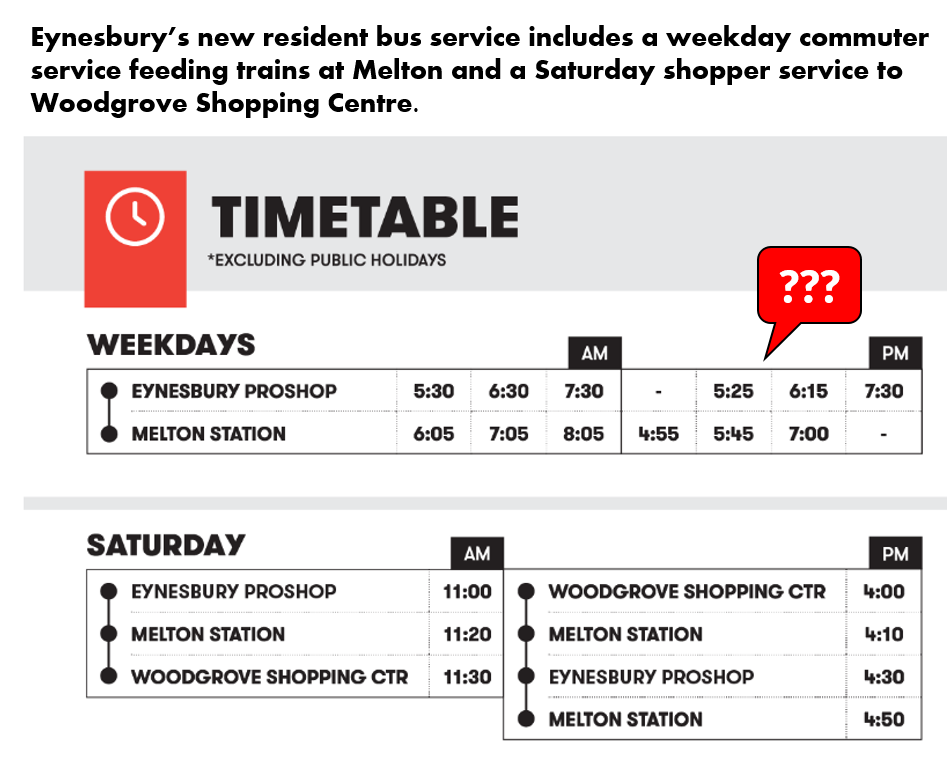
It is a commuter service on weekdays and a day shopper service on Saturdays. No service runs on Sundays or public holidays. A quick video and resident comments appear here

There are three weekday morning peak services to Melton station, spaced an hour apart. That is about the best service possible with the buses’ uniform 25 minute run time. The passenger is left to consult train timetables to check connections and arrival times.

In the afternoon three trips appear to operate from Melton Station to Eynesbury. Scheduled run times are longer at 30 minutes. Departures are at irregular intervals (up to 75 min gaps) and again planning train connections is left to the passenger.

The pm timetable is confusing to read. It would appear they have tried to economise on space by labelling the stops only once. People are used to reading timetable times from left to right or down to up. Also they do not expect to jump columns unless it’s a different trip.  Unfortunately, the afternoon timetable fails on both counts and it is difficult to read. Also adding train connections and any late train waiting policies would be a nice touch for a commuter oriented service.

On Saturdays the bus extends beyond Melton Station to Woodgrove Shopping Centre. The timetable is easier to read because stops are better labelled in both directions. Having said that it is only after thorough examining that you notice that there are actually two trips from Eynesbury to Melton with the afternoon trip terminating at the station. Scheduled run time from the Pro Shop to the station is 20 minutes, with another 10 minutes allowed for Woodgrove.

This timetable allows 4 ½ hours at Woodgrove and nearly 5 hours at Melton Station. Thus it could potentially be useful for short trips elsewhere, such as to Sunshine or even the CBD. 


The Eynesbury terminus for all trips is the Pro Shop. This is at the far east of the estate and beyond reasonable walking distance of most homes which are to the west. There is no mention of other stops in Eynesbury. Some bus users would get a lift to the stop but the limited local coverage will not be helpful for many others. The nearest to there being a route map is this stylised version posted on Facebook


Conclusion

The developer provided bus may attract some commuter usage but service frequencies are likely too low to make it a persuasive options for most. The lack of midday service on weekdays and flexibility on Saturdays make the bus you’d only take if you had no other option.

Melton is expanding south to Weir Views which likely justifies a regular PTV bus route. This is about half way to Eynesbury (and not in the green wedge). It is possible that some trips on that route could extend south to Eynesbury. However frequency is unlikely to be high unless much more of the area is urbanised such that Eynesbury residents lose the ‘away from it all atmosphere’ they hoped for when they moved in.

All this is fine if you don't want services now or ever. But if you do then expectations should be tempered accordingly. Always think before buying and move where you won't regret . 


Timetable Tuesday index