Tuesday, December 14, 2021

Free rides this summer but you're on your own!


Yesterday the state government announced they were giving away 250 000 free travel vouchers for use over December / January. This should help get people moving post-COVID, encourage business activity and support public events.

This holiday period is often chosen to do major (and necessary) train and tram network maintenance and construction works. These typically require line shutdowns and bus replacements. The rationale is that without school or university traffic and with many commuters on holiday fewer people would be affected than if it was done elsewhere in the year. 

The Frankston, Pakenham and Dandenong lines are some of our busiest. Large parts will be disrupted in the coming weeks and months. Passengers will be moved onto buses for all or some of their trips. 

Travel will often involve complex bus - train changes including the use of unfamiliar lines. These arrangements aren't necessarily consistent with variations on different days and nights. 

Add to that people who haven't been on trains for a while (due to working from home) and the extra demand induced by the free travel vouchers and you have a recipe for mass confusion.

To mitigate that passenger communications needs to be top-notch. 

Agencies like various 'big build' construction bodies, Metro Trains, PTV and the Department of Transport need to be both consistent and accurate in their information and messaging.

Otherwise there will be lots of bad travel experiences with simple trips taking three times or more longer with backtracking and long waits.

Then what should be a positive (ie people getting out and about with the free travel) risks becoming a negative for business and jobs, the City of Melbourne, and the State Government. 

Are those responsible for passenger communication up to the job?

Regrettably this summer, as in past years, the answer appears not. 

For all the talk of 'simple connected journeys' the Department of Transport, as the main coordinating agency, has issues each year. People may change role and organisations may restructure or rebrand but the same systemic issues remain. 

Before we discuss fixes to this let's get down to the detail of what is really happening on the Pakenham/Cranbourne and Frankston lines. Or at least try to. As it's a hard test with a likely high failure rate. 

What follows is long. Too long to expect many to read. But the detail is there if you want it. Otherwise scroll near the bottom if you're just interested in making things better for next time. Published information is presented first (as photos of brochures or screenshots) with comments on them afterwards. 

Pakenham/Cranbourne


Key disruption pattern – Pakenham/Cranbourne Line

• Disruption limits Caulfield to City

• Express replacement buses from Caulfield – Burnley, connecting with City Loop trains

• Stopping All Stations replacement buses Caulfield – Parliament (noting Parliament is not on Frankston Line normally)

Variation 1 to key disruption pattern – Pakenham/Cranbourne Line

Wednesday 15/12 to Friday 17/12 daytime

• Express buses operate Caulfield to Federation Square (instead of Burnley) for direct CBD access – these do not operate during the second working week

• Separate express buses operate Caulfield to Arts Centre for Frankston Line passengers

• Two different versions of brochure printed, second version has revised dates to match the diagram and now unclear works are effecting Wednesday – Friday daytime (no separate panel unlike Frankston Line brochure). Second version of brochure currently online.  

• Journey planner shows the Caulfield to Burnley express bus as operating 

• Journey planner does not have the Caulfield to Arts Centre or Caulfield to Federation Square express bus times 


Variations to key disruption pattern – Pakenham/Cranbourne Line

Monday 13/12 to Wednesday 15/12 evenings 

• Disruption limits extended Oakleigh to City (instead of just Caulfield to City) for three nights 
• Limited express replacement buses from Oakleigh – Burnley, connecting with City Loop trains (instead of starting at Caulfield) 
• Some passengers change replacement buses at Caulfield (eg travel Hughesdale – South Yarra) 
• On Monday night (13/12) & Tuesday Night (14/12) buses also operate Cranbourne – Dandenong with a train service operating in between two disruptions 
• Metro Website Status Board advised of a limited express buses Burnley – Lynbrook then all stations to Cranbourne but this is not noted anywhere else online or in the brochure 
• Burnley – Cranbourne limited express buses are not shown in the journey planner 
• Wednesday night (14/12) trains operate Cranbourne – Dandenong  
• Thursday night (16/12) follows standard disruption
• Effectively there are 3 different versions of the evening disruption over 4 nights in the same week 


PTV website

Main article - https://www.ptv.vic.gov.au/disruptions/disruptions-information/article/cranbourne-and-pakenham-lines-buses-replace-trains-various-times-between-8-30pm-wednesday-13-december-to-last-service-thursday-23-december

Duplicate main article - https://www.ptv.vic.gov.au/disruptions/disruptions-information/article/cranbourne-and-pakenham-lines-buses-replace-trains-from-8-30pm-monday-13-december-to-last-service-thursday-23-december-2021

Monday 13/12 – Tuesday 14/12 - https://www.ptv.vic.gov.au/disruptions/disruptions-information/article/cranbourne-line-buses-replace-trains-from-8-30pm-to-last-service-each-night-monday-13-december-and-tuesday-14-december-2021 

November & December summary - https://www.ptv.vic.gov.au/disruptions/disruptions-information/article/night-and-weekend-works-on-the-cranbourne-and-pakenham-lines

·         * Does not provide written information on route options (replacement buses from Parliament, Federation Square and Burnley)

·         * Maps can only be viewed by opening PDF (no JPEG provided) – not mobile friendly

·         * PDF maps do not show Wed 15/12 – Fri 17/12 daytime option with buses to Federation Square

·         * No hyperlink to evening articles for Monday 13/12 to Wednesday 15/12

·        * Duplicate article has scroll bar on summary table and omits link to works brochure and fails to list evening Cranbourne Line works Mon 13/12 & Tues 14/12

·         * Stop list omits Federation Square, Parliament & Richmond

·        * Cranbourne Line evening works article does not mention Burnley – Lynbrook then all stations Limited Express replacement bus or concurrent works City – Oakleigh

·         * Cranbourne Line evening works article links to January works map PDF

Metro Trains website article - https://www.metrotrains.com.au/planned-works/?pwId=433555

·       *  Written information does not mention Federation Square buses Wed 15/12 – Fri 17/12 or stopping all stations bus operating from Parliament and Richmond

·         * No maps on route options

·        *  Should reference evening works City – Oakleigh / Dandenong – Cranbourne (with links to separate articles) 


Metro Trains website article - https://www.metrotrains.com.au/planned-works/?pwId=435792

·         Does not provide written information or map on route options

·         Does not mention Burnley – Lynbrook then all stations Limited Express replacement bus

·         Should reference evening works City – Oakleigh (with links to separate article) 


Metro Trains website article - https://www.metrotrains.com.au/planned-works/?pwId=433594 

·         Article and calendar entry is for Monday 13/12 only

·         It is assumed that the main Tues 14/12 to Thurs 23/12 article will mention the extension of works on Tues 14/12 & Wed 15/12 (but that heading and article doesn’t)

·         Does not provide written information or map on route options (from Parliament & Burnley)

·         Should reference evening works Dandenong - Cranbourne (with link to separate article) 


Metro Trains website travel alert - https://www.metrotrains.com.au

·         Reference to limited express bus express Burnley – Lynbrook then all stations to Cranbourne, which is not stated elsewhere online or in works brochure.

Metro Trains website article – https://www.metrotrains.com.au/planned-works/?pwId=433223

·         Does not provide written information or map on route options (replacement buses from Parliament, Burnley and Brighton Beach)

·         Should reference daytime works City – Caulfield (with link to separate article) 

Frankston

Key disruption pattern – Frankston Line

• Disruption limits Caulfield to City
• Passengers for outer end of line take a replacement bus Moorabbin - Brighton Beach to connect with Sandringham Line trains
• Train however continues onto Caulfield (some passengers will fail to transfer)
• Express replacement buses from Caulfield – Burnley, connecting with City Loop trains
• Stopping All Stations replacement buses Caulfield – Parliament (noting Parliament is not on Frankston Line normally)

Variation 1 to key disruption pattern – Frankston Line
Monday 13/12 to Wednesday 15/12 evenings

·         * Disruption limits extended Moorabbin to City (instead of just Caulfield to City)

·         * Limited express replacement buses from Moorabbin – Burnley, connecting with City Loop trains (instead of starting at Caulfield)

·         * Some passengers change replacement buses at Caulfield (eg travel Bentleigh – South Yarra)

·         * Thursday night (16/12) follows standard disruption

·         * Map lacking labels for some bus routes 


Variation 2 to key disruption pattern – Frankston Line
Wednesday 15/12 to Friday 17/12 daytime

·        * Express buses operate Caulfield to Arts Centre (instead of Burnley) for direct CBD access – these do not operate during the second working week

·        * Separate express buses operate Caulfield to Federation Square for Pakenham/Cranbourne Line passengers

·         * Journey planner however shows the Caulfield to Burnley express bus as operating

·        * Journey planner does not have the Caulfield to Arts Centre or Caulfield to Federation Square express bus times

·        * Map lacking label for Stopping All Stations replacement bus 


Variation 3 to key disruption pattern – Frankston Line
Sunday 19/12 to Wednesday 22/12 evenings 

·        * Disruption limits extended Mordialloc to City (longer than Moorabbin to City that applied at night the previous week)

·         *Thursday night 23/12 standard disruption will apply 

·         * Limited express replacement bus to Burnley originates at Mordialloc

·         * Express replacement bus to Brighton Beach originates at Mordialloc, stopping only at Moorabbin  

·         * Passengers for Highett – Parkdale who travel home via Brighton Beach forced to transfer replacement buses at Moorabbin 


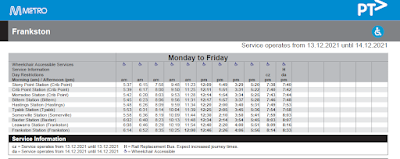
Online Stony Point Line timetable
Monday 13/12 & Tuesday 14/12  

·      *   Indicates that evening peak trains after 6pm Tuesday 14/12 will operate as buses, despite other sources advising Stony Point Line disruption is after 9pm  


Online Stony Point Line timetable
Friday 17/12

·        * Does not list times for buses replacing the Friday evening services until 21:42 ex Frankston / 22:23 ex Stony Point (Monday – Thursday timetable shown) 
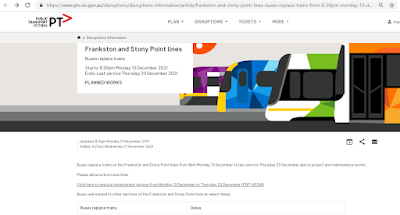

PTV website articles


Main
- https://www.ptv.vic.gov.au/disruptions/disruptions-information/article/frankston-and-stony-point-lines-buses-replace-trains-from-8-30pm-monday-13-december-to-last-service-thursday-23-december-2021

Evenings Mon 13/12 – Wed 15/12 - https://www.ptv.vic.gov.au/disruptions/disruptions-information/article/frankston-line-buses-replace-trains-from-9pm-to-last-service-each-night-monday-13-december-to-wednesday-15-december-2021

Evenings Sun 19/12 – Wed 22/12 - https://www.ptv.vic.gov.au/disruptions/disruptions-information/article/frankston-line-buses-replace-trains-from-9pm-to-last-service-each-night-sunday-19-december-to-wednesday-23-december-2021

·        * Does not provide written information on route options (replacement buses from Parliament, Arts Centre Burnley and Brighton Beach)

·         * Maps can only be viewed by opening PDF (no JPEG provided) – not mobile friendly

·        * Ambiguous headings in main article that may lead some passengers to think buses operate all day Tuesday 14/12

·        * Stop locations for Arts Centre, Parliament & Richmond omitted in some articles, while Flinders St location provided is irrelevant 

·        * Richmond bus stop location needs clarification – Punt Rd stops used in the past for buses to/from Caulfield

·        * Moorabbin bus stop location needs clarification – buses often use Nepean Hwy service road outbound when extended to Mordialloc

·        * Old Glenhuntly, Ormond & Highett bus stop locations used in week 2 evening article (stops moved to Grange Rd & Highett Rd)

·        * Stop locations Highett – Mordialloc omitted from main article while Southland bus stop location omitted from week 2 evening article

·        * Unclear why stop locations listed for Mordialloc – Frankston section, given no works in this section. Old directions and station closure dates given for exiting Edithvale, Chelsea and Bonbeach, with Bonbeach info incorrectly stating outbound stop is on Nepean Hwy.


PTV Summer Works page - https://www.ptv.vic.gov.au/disruptions/major-disruptions/major-disruptions-on-metropolitan-trains/

·         No hyperlinks to works articles

·         No mention of replacement buses Dandenong – Cranbourne Monday 14/12 or Tuesday 15/12

·         Does not list Frankston Line works in late December mentioned in Big Build newspaper ad


PTV Cranbourne/Pakenham/Frankston major works page - https://www.ptv.vic.gov.au/disruptions/major-disruptions/major-disruptions-on-metropolitan-trains/

·        * Table omits Frankston Line for Wednesday 15/12 to Thursday 23/12

·         * No hyperlinks to Frankston article for Wednesday 15/12 to Thursday 23/12

·         * No hyperlinks to Frankston article for evening extension Sunday 19/12 to Wednesday 21/12

·         * Does not list Frankston Line works in late December mentioned in Big Build newspaper ad 


Metro Trains website

Main article - https://www.metrotrains.com.au/planned-works/?pwId=433537

Evenings Mon 13/12 – Wed 15/12 - https://www.metrotrains.com.au/planned-works/?pwId=433220

Evenings Sun 19/12 – Wed 22/12 – https://www.metrotrains.com.au/planned-works/?pwId=433223

·     *    Does not provide written information or map on route options (replacement buses from Parliament, Burnley and Brighton Beach)

·   * Should reference separate daytime or evening works as appropriate, with link to separate articles


Metro Trains website travel alert - https://www.metrotrains.com.au

Suggests Stopping All Stations replacement buses operate from South Yarra, not Parliament as per the brochure 


Metro Tunnel Big Build Newspaper ad 

• Incorrectly states Stony Point Line works are only at night (and after last trains!) and not for correct set of dates 

• Details for works in late December not yet available online (on PTV, Metro or Big Build websites) 


Journey planner result – Wednesday 15/12 

• Does not suggest the Arts Centre – Caulfield or Federation Square – Caulfield replacement buses 
• Suggests going via Burnley or South Yarra to connect with a replacement bus to Caulfield 
• Alternatively, suggests taking a Route 3 tram to Caulfield 


Journey planner result – Wednesday 15/12 

• Burnley – Caulfield bus is shown despite not been included on diagrams in brochures


Journey planner result – Monday 20/12  

• Evening buses incorrectly shown Brighton Beach – Moorabbin with a connection to a second bus to Mordialloc, rather than as a through-journey

Key issues and fixes

Major works are planned months or more in advance so there's no reason not to plan and communicate bus replacement arrangements better and clearer. This is unlike unplanned disruptions where much needs to be improvised on the fly and staff do the best they can with imperfect information.  Hence the standard to expect from planned works are and should be higher. 

Information about planned disruptions and bus replacements comes from a wide variety of sources and media. Even what the public expects to be one source is highly fragmented in reality.

Take just the PTV website. It alone may convey information via online timetables, journey planner, text disruption advice, online diagrams and website news items. Each appears to be done by a different person with only a limited ability to cross-link related information or check for accuracy and consistency.  One channel of PTV might publish something they receive from an operator  and treat that as gospel without verifying it's complete or consistent with other messages such as from the operator themselves or construction agencies. 

People joke about stuff being done by the 'work experience kid' but the average inexperienced arts graduate in a communications role might not be that better. Passenger communication is a specialised skill. Not all in these roles necessarily have the network, local area knowledge or even power in the organisation to find and stop errors and inconsistencies before they get published. 

There may also be a culture of being 'safe', that is passively republishing what the operator sends in, even if incorrect, incomplete or inconsistent. As opposed to the more adventurous path of questioning and challenging content to get it right for the benefit of passengers. 

In an organisation like DoT specific network knowledge appears to decline once you rise to executive levels of seniority. This can isolate leaders from on-the-ground challenges in areas such as disruption communications. To counteract that a positive move could be for Minister Carroll to ask that staff like Department head Paul Younis, deputy secretaries and other executives travel the network over summer (including lines subject to bus replacements) to see things for themselves. They could then be charged with and evaluated on addressing some of the systemic information issues that make travel much harder than it should be.

The same problems with poor passenger communication happen each year, especially over the summer period. They are a structural issue with the governance of transport in Victoria and a lingering 'CBD commuter centric' view as to service priorities. 

Systems that PTV people work with, such as to do with the website, are not conducive to fast correcting when something needs amending. More coordination is needed across all its channels to ensure correctness and consistency. Staff turnover may also be an issue; if one person learns to do better then they might not stay around for very long and the issues repeat the following year. 

Summary

As the heading says, if you're catching Frankston or Dandenong trains this summer season, you're on  your own. Published information is often confusing and conflicting.

The variation in service patterns over a short period and a passenger mix that includes many occasional riders don't help either.

It would be regrettable if bumbling and poor communication by transport departments and bodies undermines the goodwill generated by potentially worthwhile promotions such as the free city travel voucher scheme.

If there's ever a time we need to be restoring confidence in our city and our network, it's right now. The state government knows this at the political level but the bodies it entrusts the detail to appear neither well equipped nor accountable to handle these challenges, at least for passengers in Melbourne's south-east. 

The good news is that there is opportunity to do much better. And with a continued full construction agenda  (including upcoming major City Loop works) and a state election coming up a renewed emphasis on better managed disruptions (including associated information) should be a top priority for the Department of Transport and allied agencies and franchisees. 

Friday, December 10, 2021

UN 115: The bus network the Metro Tunnel needs (Part 1 - west)

Infrastructure Victoria's 30 year strategy proposed a reshaping of the Melbourne bus network and the introduction of 'next generation' bus services. Recommendation 57 suggested starting with bus network reforms in Melbourne's north west and south east. These would coincide with the opening of the Metro Tunnel in 2025. 

Improved buses could support access to Metro tunnel line stations and development around them in a way building more car parking could not. Such development brings homes and jobs to places that  support more sustainable settlement patterns. It is also key to realising the Metro Tunnel's full economic and social benefits. 

The State government expressed support for reshaped bus networks in its recently released Victorian Infrastructure Plan. Its exact words were to 'include route changes and service upgrades to support the opening of the Melbourne Metro Tunnel'. The proviso is that implementation depended on funding in future budgets. 

The state response cited Victoria's Bus Plan released back in June. Its time-lines basically devoted 2021-2023 to the development of the Bus Reform Implementation Plan to drive larger network reforms after 2023. This should allow a 2025 start provided funding is allocated in the 2022 or 2023 budgets (2024 will possibly be too late). However the scale of planning work required is probably such that some needs to start now and cannot wait for the Bus Reform Implementation Plan (which is basically a plan for a plan) to be finalised.

Reformed bus network for Metro Tunnel (west) - Overview

Today I'll describe a possible reformed 2025 bus network for the western part of the Metro Tunnel. This network will feed most Sunbury line Metro Tunnel stations between Watergardens and Footscray. Some V/Line and Metro station on other adjacent lines should also benefit. 

Before you can design a bus network you need to know how often the trains it will feed will be. If they are infrequent then you need a 'pulse timetable' with bus headways and times adjusted to meet trains. Whereas if trains are 'turn-up-and-go' then you don't need to be as fussy about bus headways (unless you want reliable bus-bus connections at some locations). 

Sunbury line trains between Watergardens and Footscray run every 20 to 40 minutes outside the weekday peaks. This is about half as frequent as Dandenong to which they will connect via the Metro Tunnel. We don't yet know whether Metro's opening will remove or retain this east-west bias in service, as discussed here. 

However I'll be optimistic since less would represent a gross under-use of infrastructure. I will assume a 10 minute 7 day / all week frequency between at least Watergardens and Dandenong. 20 minute frequencies may apply on outer portions such as Sunbury, Pakenham and Cranbourne and late at night. High frequencies, in concert with frequent well-designed bus routes, can set up a network effect suitable for a wide variety of trips, not just to and from the CBD. That's important with post-COVID travel patterns. 

Without any more words, here's a concept 2025 Metro Tunnel supporting bus network: 


(See a higher quality version of the above map here. Then left click to enlarge, right click to save as.)

There's a lot to take in so I'll run through the main points. 

The big diagonal line is the Sunbury line that will feed in to the Metro tunnel. Watergardens to Footscray is shown. Dots are key interchange points or destinations. Dark blue is Metro stations, purple V/Line stations, red universities, green shopping centres and pink  hospitals. Many are potential interchange points. 

Thick lines are frequent 'next generation' bus routes. Operating hours would be early morning to late at night. These would run every 10 minutes or better (at least during the day) all week. The map shows eight such premium routes (216, 220, 402, 406, 411, 420, 460 & 904). This is much more than now (zero) but less than Sydney's reformed eastern suburb and inner west network (with 11). Most are potential bus rapid transit corridors that could multiply the Metro Tunnel's access catchment. 

Medium lines are 'Useful Network' services operating every 20 minutes or better all week. These also get improved operating hours with extensions to their current 9pm evening finish and 8am weekend start. Most people are within 10 minutes walk of these direct services. Overlaps between two or three of these routes can ensure a frequent service on common corridors such as Sunshine CBD's north-south spine. To assist this colour coding and/or consecutive route numbering may be desirable to accentuate the combined frequency and make the experience more like catching CBD trams.   


Thin lines are other train and tram routes shown for completeness. Most people would be within walking distance of 10 or 20 minute routes but local services (similar to today's) would provide infill coverage where needed at lower frequencies. These are not shown on the map but get discussed later.  

All stations get at least one (and often multiple) feeder bus routes operating at least every 20 minutes. Large interchanges like Footscray, Sunshine, St Albans, Watergardens and Newport get several. As do some non-rail interchanges including Highpoint, Caroline Springs Town Centre, Brimbank Central and Altona Gate. 

Major shopping and education destinations 1 to 5 kilometres of the Sunbury line are connected to it with service every 10 minutes. These greatly extend the Metro Tunnel's catchment. Direct routes also run to previously hard to reach destinations including Melbourne Airport and the Laverton North jobs area. Flow-on effects occur elsewhere as well. For example reforms to routes feeding Footscray and Sunshine also affect Altona North. This in turn enables a modified route from Newport to establish a corridor for a Metro 2 tunnel, with buses operating to Fishermans Bend. 

The network especially supports Sunshine Superhub by providing improved internal transport within it and more one-seat rides to it. For example frequent through-routed south to north buses (408, 416, 419) would serve the Sunshine South to Sunshine Marketplace spine with better access to Victoria University as well. New areas to gain direct buses to Sunshine include Keilor Downs, Albanvale and Kings Park. 7 day 20 minute service to Sunshine is added on 8 new corridors, providing a major connectivity boost. Access to Sunshine Hospital from a wider area is also improved with an additional route.  

Victoria's transport infrastructure planning and bus network planning operate in divorced silos. Level crossing removals rarely if ever get complementary bus network reform. Hence passengers still need to change buses if they wish to cross a rail line whereas motorists can now zoom straight through. Reformed through bus routes along the now grade separated Furlong Rd (Ginifer) and Main Rd (St Albans) correct these anomalies and make travel faster. 

Like the rest of the rail network, Metro Tunnel trains will operate 24 hours on weekends. Hence they need feeder services. These would be provided by operating six regular bus routes 24 hours on weekends (marked with a crescent). They would replace all special Night Network only routes in the area, delivering a consistent 24 hour network.  

This is a significantly reformed but not quite 'blank sheet' bus network. Unlike Adelaide's aborted new network proposal there are no wholesale bus stop closures. Thus it shouldn't 'frighten the horses' too much. It is also not 'all or nothing' and reforms can be staged if desired, like Perth does. 

All but a few route numbers are familiar. However some are added and deleted. I'll go through each below to explain the extensions, straightenings, mergers and service upgrades needed to improve directness and reduce duplication. 


 Reformed bus network for Metro Tunnel (west) - Detail

154: An extension of an already proposed and funded Tarneit route to connect the Laverton North jobs area with stations at Tarneit and Sunshine. Every 20 min weekdays with less service on weekends but a key element of a job ready bus network. Shown as dotted line as operating hours would be shorter than other routes shown. More here.  

216: No change to route. Upgraded to SmartBus. Service every 10 min or better day, 20 min night with long hours. Consider through-routing at Sunshine with 220 inbound trips to provide one seat ride to Sunshine Plaza. 

220: Rerouted (with reformed 410) to provide a more direct service via Ballarat Rd. Upgraded to SmartBus. Service every 5 min peak, 10 min off-peak, becoming part of the ten minute network. Potential tram-like BRT 'Megabus' service with better stops, off-bus validation and faster speeds. More here. 

232: Rerouted to start at Altona Gate and operate via Mason St and Newport Station to serve jobs in Fishermans Bend. Rerouting would increase residential area catchment and provide a Newport - Fishermans Bend service before Metro 2 is built. Operating hours extended. Service every 20 minutes, with only every second service operating east of Newport on weekends. The poorly used Altona North Park & Ride would no longer have a bus but could be kept for parking at a potential reopened Paisley Station. Background on the 232 here with Altona North network reform discussed here. 

402: No change to route in Footscray area. A popular city fringe connector. Operating hours extended to midnight. Weekend frequency potentially boosted to 10 minutes. Background here. 

404: Extended to Williamstown to replace existing 472 but routed nearer Williamstown shops. Operated every 20 minutes 7 days per week with hours extended. This provides a more consistently more direct service over the whole route. Upgrade would also provide a new 7 day service to the Kensington area. More here.

405: New north-south route to provide a fast train feeder for Tottenham and improved Highpoint connections via developing Hampstead Rd area. Would support Route 220 straightening and improved access from densifying Kingsville area. Every 20 min 7 days. More here. 

406: Rerouted in Footscray with services consolidated with 223 to provide frequent and direct connection to VU and Highpoint. Route 409 rerouted to retain coverage in Maidstone. Straightened in Avondale Heights and extended to VU St Albans as part of reforms involving 903 (904). Other local routes would retain coverage in Avondale Hts. Could operate every 10 minutes with long operating  hours as discussed here. Potential cheaper option is to operate only Footscray - Highpoint portion every 10 min with 20 min frequency to St Albans. More here and here. 

408: Highpoint - Sunshine portion replaced with 904. Western section extended to Brimbank Shopping Centre via 423 alignment, thus replacing 423 and 422. Ginifer - St Albans portion replaced with new Route 416 which provides improved directness to Sunshine and a simpler Furlong Rd route (taking advantage of the level crossing removal). Every 20 minutes seven days. 

410: Operates Footscray - Sunshine West. Modified alignment to reduce overlap with rerouted 220. Operated consistently via Churchill Avenue, then Ashley St then 220 alignment to Footscray. Extension west of Sunshine replaces existing 428 and 429 with a higher frequency service. Operates every 20 min 7 days with extended hours. 

411: Route alignment unchanged but upgraded to frequent SmartBus between Footscray and Laverton. A potential part of the frequent service ten minute network. Partly funded by terminating 903 at Sunshine. Route 412 would be truncated at Altona but extended to Sunshine via existing 903 alignment. More here. 

416: A new Sunshine South - Brimbank SC route that provides a faster connection to Sunshine Hospital and replaces 408 between there and St Albans. From there it would continue to Brimbank Shopping Centre to replace 424 at a higher frequency and with longer hours. This through route would provide a direct service from one side of St Albans to the other, something that wouldn't have been reliable when the Main Rd level crossing was still there. Service would be every 20 minutes all week. 

418: No change to route. Upgraded to operate every 20 minutes 7 days to provide the most direct connection between Metro Tunnel trains and Caroline Springs Town Centre. Operating hours also extended. More here. 

419: Southern portion rerouted to operate to Sunshine instead of St Albans. This improves connectivity to Sunshine NEIC and closely replicates Night Network bus, allowing 24 hour weekend operation. Main Road East portion replaced by extended 406. From Sunshine bus would continue south to Williamstown mostly via existing 471 alignment but direct via Blackshaws Rd as discussed here. This would provide better access to Sunshine Marketplace and near VU. Upgraded to operate every 20 minutes 7 days with longer operating hours. 

420: No change to route. Operating hours extended. Improved evening frequency. Potential upgrade to every 10 min with BRT style service.

426: No change to route. Upgrade to every 20 min seven days. Seek to coschedule with overlapping Route 456 during peak periods to maximise peak frequency. More here.

460: No change to route. Operating hours extended. Improved evening frequency. Potential upgrade to every 10 min with BRT style service. More here.

465: No change to route. Upgraded to every 20 min on Sundays with later trips added (at least between Essendon and Milleara) to substitute for rerouted 903. 

472: Shortened to operate Moonee Ponds - Footscray only via existing alignment. Footscray - Williamstown portion operated as extended Route 404 (see above). Frequency adjusted to be every 20 minutes seven days. 

500: Direct limited stops bus between Sunshine and Melbourne Airport. Operates long hours. Every 20 min timed to meet Geelong line trains at Sunshine. More here.

904: An optional replacement for 903 SmartBus west of Heidelberg if 903 is split there (which would allow eastern portion's extension to La Trobe University). More on the benefits of that here. Whether this is done or not this route would be rerouted via Highpoint, replacing Route 468 and the eastern portion of Route 408. Upgrades and extensions to routes like 406 and 465 would replace 903 in Essendon West while new or extended 416, 419 and 500 would do the same in Sunshine North. This would deliver Highpoint its first SmartBus with better connections from the Craigieburn line and Sunshine. More detail on all that here and here. Instead of running to Altona (as it does now) this route would terminate at Sunshine with an extended 412 providing a service nearer to demand through the industrial area to Altona. Services would operate every 10-15 min with long operating hours with a special focus on weekend daytime frequency upgrades. 

Deleted and added routes

A major thrust is simpler, more direct and more frequent routes to more places. Hence some are joined so more people can take one-seat rides to key destinations such as Sunshine. In other areas, such as Footscray to Highpoint, duplication is removed to provide a simpler more frequent service. Overall nine route numbers are taken out of use while four new ones are created. Lists below:

Routes deleted:

223: Replaced by upgraded 404 (472) and 406
403: Replaced by Metro tunnel trains to Parkville
422: Replaced by rerouted 408 operating at a higher frequency
423: Replaced by rerouted 408 operating at a higher frequency
424: Replaced by new route 416 operating at a higher frequency
428: Replaced by extended route 410 operating at a higher frequency
429: Replaced by extended route 410 operating at a higher frequency
468: Replaced by rerouted 903 (904).  
471: Replaced by 419 extended to Williamstown

Routes added: 

405: New Highpoint - Ashley St - Tottenham - Yarraville route. 
416: New Sunshine - Sunshine Hospital - St Albans - Brimbank SC route. 
500: New Sunshine - Melbourne Airport limited stop route. 
904: Heidelberg - Sunshine SmartBus. Route number change to 903 in area subject to Heidelberg reforms - see above.

Local coverage routes

Routes neither on the map nor mentioned above remain. These are typically local coverage routes every 40 to 60 minutes. Although some have higher peak service. 

If funds are available those most suited to an upgrade to every 20 minutes all day include 425, 461, 421, 462 and a reformed 409, probably in that order. Even if that didn't happen modest shoulder peak and span span extensions such as an hour or two extra in the evenings and mornings (particularly weekends) would improve the usefulness of local buses. Upgrades like these are very low cost and may involve only a few extra operating hours per week per route. 

Furthermore, an upgrade to the Sunshine - Derrimut portion of the 400 may allow 427 to be removed for a simpler network overall. There may also be merit in operating Route 400 to Williams Landing (instead of Laverton) in conjunction with reforms or upgrades to 414 and 417. This would help reduce the significant difficulty of travel between Point Cook/Williams Landing and Sunshine.  

Deer Park station isn't a very good transport interchange at the moment with terrible walkability and access to buses. Weekend trains are still infrequent. However there are a lot of weekday trains. There is also the prospect of local area improvements when the level crossing is removed. A future bus upgrade may involve extending the existing Route 425 south from St Albans to Deer Park via Victoria University, Cairnlea Town Centre and Cairnlea Drive. This could also support development of the Orica site, especially if Cairnlea Drive is extended south through it. 

Bus services at Diggers Rest and Sunbury stations have not been discussed. These are generally quieter than the routes mentioned above, at least at non-school times. Sunbury also has had a slower population growth rate than other outer areas like Melton and Tarneit which have got more new routes. Nevertheless it could be worth reviewing the role of the limited service 479 and 483 routes, along with any need for improved coverage near Diggers Rest.  

Resource usage

This network has not been costed. However it removes more routes than it adds. Route kilometres should be fairly similar to now as removing 223, 403, 422, 429 and shortening 903 would almost offset the new 405, 416 and 500 routes. This is efficient and means that pretty much all extra funding would go towards better operating hours and frequencies on key routes. 

This network would need more buses to operate than the current network due to generally increased frequencies. This is especially if the top tier 'New Generation' routes operate every 10 minutes (like Sydney and Perth do) rather than 15 minutes (like all but a couple of Melbourne's premium routes). Every 10 minutes is preferred as it is nearer to true turn-up-and-go and may match the Metro tunnel's off-peak frequency. 

By far the biggest increase in resource use would be in service kilometres since much more of the fleet is being worked harder for more of the day. However on a fare revenue per bus metric this network should outperform 'peak heavy' commuter-oriented networks that have an intensive peak service but leave the buses idle for most of the day. 

All emerging factors favour a less peaky all-day focused bus service pattern like advocated here. For example the switch to electric buses, which are more expensive to buy but cheaper to run. It would match post-COVID travel patterns and generally favourable passenger demographics (eg pockets of low workforce participation and low income casual labour) in much of the Watergardens - Footscray area. And it would support intensive development, especially around Footscray, Highpoint and the Sunshine National Employment and Innovation Cluster. 

Longer term, if we can build exclusive segregated busways on the main routes then driverless buses can happen sooner than if they were in mixed traffic. Again the economics of frequent all-day service improve, this time with lower labour costs. 

A reinvented and more versatile bus network like described here is essential since cars (electric or otherwise) use too much space to store and move to allow these centres to fully develop into thriving places. It also supports Metro Tunnel usage as it expands its catchment to the majority of residents beyond walking distance of stations without the personally and socially expensive option of driving to them.  

Areas to benefit span a wide area from Melbourne Airport to Williamstown and Tarneit to Footscray. They encompass most of the cities of Brimbank, Maribyrnong, Hobsons Bay and some of Wyndham, Melton and Moonee Valley. As well there are gains for those outside these areas accessing locations within them by public transport.    

Department of Transport processes

Victoria's Bus Plan warns us not to expect much in the 2021 - 2023 period. Much of that time will be spent developing the Bus Reform Implementation Plan. There might be some smaller network and timetable reforms in those years but probably nothing major. 

Having said that, there is no reason why network reform could not be worked towards in stages, starting with simpler or cheaper things first. These would be based on well known network planning principles. Ideally the first steps should be done in parallel with rather than following the Implementation Plan. Indeed such an early start is likely necessary since developing a network like this would be more work than anything else the DoT has done in the last 10 years with buses (including Wyndham in 2015).  

One approach could be to break the work up into stages. This might involve reform to between two and five routes with several stages needed to transform a network over a 2 or 3 year period. If several were done simultaneously in different parts of the metropolitan area (to avoid complex interactions) then overall network reform could be quite fast with it done by 2025 but with some improvements sooner. In the Metro Tunnel context this could mean reform in clusters such as Watergardens - Footscray, Caulfield - Huntingdale, Clayton - Dandenong and the CBD area.  

I would expect that most activity in developing a reformed Melbourne Metro Tunnel bus network would be around 2023 - 2024. It could be worth checking back then to see if enthusiasm for bus reform has remained, strengthened or dissipated. 

The latter remains a constant risk since other matters can assume more urgent importance in the portfolio at short notice. One need not mention COVID for a recent example. But there have been others before such as around 2010 when issues with rail network meltdowns resulted in a stalling of bus reform including the cancelling of part of the Green Orbital and all of the Blue Orbital. This is why it might be better to do whatever reform you can now (even if small scale and low cost) rather than waiting two years for another plan. 

Even political changes unrelated to transport can make a difference, both bad and good. For instance the Adem Somyurek affair and cascading cabinet reshuffles saw a more reformist minister take over. Even if state Labor wins in 2022 the incoming ministry will be very different to now due to retirements. Victoria's deteriorating budgetary position is another threat; despite the cheapness of service upgrades their recurring costs makes them softer targets for cuts or cancellations than infrastructure projects whose massive capital costs are concealed by borrowings at low interest rates.   

Conclusion

A reformed bus network for the western part of the Metro Tunnel has been described. It delivers streamlined 7 day routes across a wide area. Operating hours are extended and maximum waits for many passengers would be halved. Both those using Metro Tunnel trains and those travelling locally would benefit. While ambitious by Melbourne standards, its service levels match what recent network reviews have delivered in established parts of Sydney (which are similarly unserved by trams). Also similar bus upgrades carried across Melbourne could transport more people than the Metro Tunnel itself.

Do you think it's a good network or could some aspects be done better? Is it too radical or too conservative? Is it a reasonable comparator for whatever the Department of Transport may develop? Comments are appreciated and can be left below. 


See other Building Melbourne's Useful Network items here

PS: This is the first of a three part series. A similar but even bigger Caulfield - Dandenong Metro Tunnel bus network is discussed here. And details of a CBD area revamp (including tram reform) are here.