Friday, April 19, 2019

The public holiday gamble on Melbourne buses

Today is Good Friday. A public holiday. Like Christmas Day, it's customary for train, tram and bus services in Victoria to operate to a Sunday timetable. Except when they don't. And because Night Network never operates the night before Good Friday (and two out of seven days on Christmas Eve), trains commence at the old late morning time that marooned early Sunday travellers before Night Network started.

On other public holidays public transport normally runs to a Saturday timetable. Except when it doesn't. For example some bus routes either run to a special timetable, run a modified Saturday timetable without footnoted trips after 9pm, or, most significantly of all, operate Saturdays but not public holidays.

Trains and trams are fairly uniform but we lack consistently applied rules for buses. It's not simple like other cities where a Sunday timetable applies on all public holidays, no ifs or buts.

Still, we were making excellent progress about 10 years ago. The 2006 Meeting Our Transport Challenges plan seriously started holiday standardisation and more than half finished the job. Bus operators like Ventura had public holiday service added to some of their Monday to Saturday routes. Further standardisation occurred in 2013 when Transdev took over from Melbourne Bus Link (which had its own idiosyncratic holiday timetable pattern). And new bus networks in areas like St Albans, Werribee and Cranbourne got standard public holiday timetables from the outset.

Since then progress has stalled. Today nearly 30 Melbourne metropolitan bus routes remain outstanding with service on a Saturday or Sunday but not public holidays. That's not insignificant. But it's not a big number either. So it would be cheap to fix. To pluck something out of the air, a couple of million dollars a year would go a long way towards sorting it out. If anything's left over you'd end reduced summer holiday timetables as well. Non-standard timetables on public holidays remains one of the factors that make catching buses, the only public transport near most homes, harder and less certain than train or tram travel.


The just gone Labour Day public holiday (11 March) is an example. Trains, trams and most bus routes ran to a Saturday timetable. But other bus routes that operate at least Monday - Saturday, including two that feature 7 day service, did not.

Some weekday-only routes serving universities (eg 201, 301, 401, 403, 601) also operated. This makes sense because Labour Day is a university teaching day. However Route 768, Deakin's second university shuttle, appeared not to run.

Despite past progress, public holiday arrangements for buses in Melbourne remain so complex that both bus companies and Public Transport Victoria, whose job it is to provide passenger information, do not always understand what runs when. When bus operators and PTV publicly disagree (eg below) what hope does the passenger have?


When asked online, PTV is always fast to respond. However they like using weasel terms like "may have been a change" or "service may not be operating today". Not the stuff to win confidence of passengers travelling long distances in an area where alternative services are sparse or infrequent. They often apologise but rarely concede error. 


As it turned out, PTV's website timetable was right and Ventura's advice wasn't. PTV's speculation about Route 887 not running proved idle. That was demonstrated when the bus was seen operating in the web-based bus tracker below. Still that doesn't help when planning a bus trip in advance.


The point of this post is not to level blame at any bus company or organisation with regard to incorrect advice on public holiday timetables. What is known is that errors and/or ambiguities appear almost every public holiday. This adds to the perceived flakiness of bus services in Melbourne.

Errors are human. But (i) bad network design, including complex public holiday timetable arrangements, and (ii) lax internal data quality assurance systems, are making problems inevitable rather than rare exceptions. Both are cheaply and easily fixable in terms of the scale that we've become used to in transport projects.

Want to know more about the intricacies of public holiday arrangements for buses in Melbourne? Others have probed this in more detail.  So grab multiple glasses, cups or mugs of your favourite beverage and read the BCSV's Public Holiday Inconsistencies on Melbourne's Buses.

You might enjoy these well-regarded books on transport topics

Better Buses, Better Cities: How to Plan, Run, and Win the Fight for Effective Transit Steven Higashide NEW!

The Public City: Essays in honour of Paul Mees Gleeson & Beza

A Political Economy of Access: Infrastructure, Networks, Cities, Institutions (Access Quintet Book 4) David Levinson

Human Transit: How Clearer Thinking about Public Transit Can Enrich Our Communities and Our Lives Jarrett Walker

Transport for Suburbia: Beyond the Automobile Age Paul Mees

(Sales links: I get a small commission if you buy via the above - no extra cost to you)

Wednesday, April 17, 2019

The network at 10pm: More maps and the politics of evening service

Since it was elected in 2014 the Andrews Labor government has made much of Melbourne being a major events city that's open for business and fun 24 hours a day. In this we have the edge on Sydney, whose main airport has a night curfew and where party goers must contend with lockout laws.

A practical demonstration of the government's agenda has been 'Night Network'. Instead of trains and trams shutting down around 1am, Night Network provides 24 hour weekend service on all Metro train lines and six key tram routes.  About 20 special bus routes serve areas remote from trains and trams between about 1 and 5 am. Also added were 2am coaches to key regional centres. Running Night Network, particularly the trains, is not cheap.  One could have greatly upgraded service at other times, when more people are travelling, for the same money. However the political will was there so it happened. Night Network commenced in 2016, replacing the previous bus-only NightRider service.

Less well known is what happens in the hours before Night Network starts. If your only public transport is a local bus, the last service is normally around 9pm.  On Friday and Saturday nights that means several hours without service until Night Network kicks in (assuming you're near a route). Though that's better than fifteen years ago, when few bus routes ran much after 7pm (or on Sundays). 

With most local bus routes having finished, what is still running at 10 or 11pm? That's easy to find out via the PTV website if you're only interested in a few routes.  But, like what we found with the daytime frequent network maps, getting a whole-network view is harder.

This is where these maps come in. They show the entire operational network at 10-11pm on a weekday, Saturday or Sunday. You can choose between 20, 30 and 60 minute frequencies (click at top left to open menu and again to close it). Again one can select a route to get more detail on its frequency and operating days. Some routes only operate in one direction after 10:30 or 11pm so it's important to check timetables if using these maps to travel. If you only see one mode use the top left button to select a list and select those you need.

Melbourne public transport 10pm network: Monday - Friday


Note: Several routes (eg 170, 180, 460, 494, 495) have after 10pm service on Friday evenings only. These are not shown above. These routes also operate until late on Saturday and are shown on the map below.

Melbourne public transport 10pm network: Saturday


Note: This map generally also applies on public holidays where a Saturday timetable operates. The exceptions are a few routes (eg 170, 180, 460, 494, 495) where 10pm and later service only runs on Saturdays. See PTV timetables for footnotes. 

Melbourne public transport 10pm network: Sunday


Note: This map also applies on public holidays where a Sunday timetable operates, eg Good Friday and Christmas Day.

Maps last updated February 2022

Network service patterns

What are the main operating patterns of after 10pm services? Some areas have several routes while others have none.  Those unfamiliar with service planning history might assume that if a route has 10pm service there must be demand for it, and if it doesn't have 10pm service there is no demand. In other words they assume tight monitoring and responsive planning that distributes service to where it is most needed and used.

That's not how it works in practice. The assumed 'common sense' responsiveness of service provision to patronage rarely occurs unless crowding reaches politically significant proportions. This is less likely at night than at peak times, despite the much lower marginal cost of adding off-peak service. 

Where service appears excessive governments have been slow to trim due to the fear of what befell previous administrations (notably Kirner and Kennett) that did cut transport service.  And, where service is insufficient, the types of passengers who crowd 10pm trains, trams and buses (overseas students, foreign-born service industry workers and youth) either cannot vote or are politically weaker than (more affluent) peak CBD commuters. So although our city has doubled in population, with evening patronage rising even faster, today's 10pm train frequencies on most lines are much as they were after large cuts circa 1978. In contrast weekday peak train services have improved on many lines and make the front pages when they fail. 

Outside the minority of areas that have had their buses recently reviewed or greenfields timetables implemented for trains and trams, history and inertia are bigger influencers of public transport service than passenger demand or social need.

In more detail, the factors that determine whether an area has service at 10pm are as follows:

* The presence of trains and trams. Anywhere with a train or tram will have service at 10pm. Anywhere with a bus probably won't. At 10pm trains typically run every 30 minutes. Monday to Saturday trams are every 20 minutes, making connections with trains erratic. Sunday night trams run every 30 minutes except for some routes recently upgraded to 20 minutes.

* Legacy bus routes with 10pm Sunday night service. Most are old ex-Tramways services that have inherited long operating hours. Or they involve substitutes for altered or promised train, tram or bus services. For example Route 190 compensates for rerouting Geelong trains away from Werribee.  732 is a substitute for extending the Route 75 tram to Knox City. And 426 replaces the part of the long-hours Route 216 west of Sunshine. Similarly, the former 571 'Train Link' substituted for the deferred rail extension to South Morang while the previous 896 'Train Link' was the government's response to a promised but not delivered Cranbourne East rail extension. 

* The presence of 900-series SmartBus routes. These are orbital and radial routes introduced about 10-15 years ago. They represent the biggest addition to Monday - Saturday 10pm service in decades across a large swathe of middle distance (10-30km) suburbs. None run at 10pm Sundays.

* The presence of local routes unusual for running at 10pm weeknights but over only a narrow span on weekends. Long-standing ex-MetBus routes concentrated around Box Hill and Ringwood. They missed out on the minimum standards upgrades about 10 years ago. Hence they are shown on the map in grey, to denote their nil or early finishing Sunday service. Some of these routes were radically changed in 2014 but operating days and hours were left below minimum standards.

* Routes with 1 or 2 day per week 10pm service. Some outer areas, such as Point Cook, Werribee, Caroline Springs and Cranbourne, had their local bus networks reviewed in the last 5 or 6 years. Local routes were reformed, and, where they finished earlier, upgraded to at least the 9pm minimum standard.  However a few of the main routes got upgraded beyond that, with 10-11pm service operating on Friday and/or Saturday nights. Along with SmartBus these upgrades were the second significant extension of after 10pm service, albeit only on a few nights of the week.

* Established post 1950s suburbs that haven't had a recent bus review. A huge number of middle-distance suburbs remote from either train or SmartBus services are unlikely to have 10pm service on any night of the week.

* Fringe growth suburbs. Almost certainly will not have 10pm service, particularly between Sunday and Thursday night. This is despite their high population density, and, in some cases, demographic characteristics that may make 10pm services more successful than some areas in which they currently run.

What about the borderline cases? The train to Melton had >60 min gaps in the inbound direction around 10pm. I included that one. Some routes finished earlier in one direction. Others were borderline in both directions. For example some former Moorabbin Transit routes (eg 811, 812, 822, 825) differed in their interpretation of the minimum service spans with starts and finishes later than desirable in some directions, particularly on weekends. The same goes for Sita's 472 on Sundays. I left these out even though it's possible to board along at least parts of these routes in at least one direction after 10pm. 


Have a look at these maps and note weekday and weekend variations. Also think about the distribution of 10pm service. Should more areas without it have it? And can you find cases where buses appear to duplicate trains or trams, even at 10pm? 

Tuesday, April 16, 2019

Timetable Tuesday #19: This way or that way? The alternating bus route 513.


The most important factor that determines the usefulness of a public transport service is not whether it's a train, tram or bus but its timetable, route and stops.

“It’s the destination that counts, not how you get there”. That’s possibly the credo of whoever designed Route 513 across Melbourne’s northern suburbs. At first glance the 513 looks like any other bus route. It runs roughly east-west from Eltham to Glenroy via Bell St, serving a mix of mid-20th century residential, industrial and retail catchments.  Operating along one of the main roads in the middle-northern suburbs, Route 513 is one of the area’s most established and least changed routes.

The first clue that something isn’t ordinary is the text at the top of the map below.  According to that, if standard convention is followed, the route goes to Glenroy via Lower Plenty then Greensborough.  That matches the numbering sequence of the timepoints on the map.  But it gets tricky when traced.  Does the bus backtrack via Eltham or is there an unshown short-cut from Lower Plenty to Greensborough?

As it turns out, neither is correct.  Instead, as you’ll see from the timetable, 513 is basically two routes. They’re the same between Glenroy and Rosanna. But between Rosanna and Eltham they split. One goes via Lower Plenty while the other operates via Greensborough. This means that passengers catching a bus need to watch for the route number, destination and via point.


513’s western half is shown below. It provides unique coverage to much of Hadfield and Pascoe Vale. Then it heads east via Bell Street, overlapping the much newer Route 903 orbital SmartBus. Unlike eastern areas (such as Carrum Downs and Nunawading) where existing routes were modified when the orbitals commenced, no local route changes occurred here. Similarly the 513 remained unchanged when Route 561 was extended west from Coburg to Pascoe Vale more recently. 


The rest of 513 is shown below. It is the only route in the area that misses Northland Shopping Centre.  This directness along Bell Street allows faster travel between Coburg and Heidelberg than other parallel routes such as 527 and 903.  The 513 splits east of Rosanna.  All trips go to Eltham but they alternate between whether they go via Greensborough or Lower Plenty.  Therefore the route’s frequency east of Rosanna is halved.  Trips via Greensborough form the only public transport in parts of Macleod and Watsonia.  In contrast, 513 trips via Lower Plenty add destinations but not unique coverage as there is significant overlap with the long-established Route 517 and the newer SmartBus 901 and 902 orbital routes.  Also, unlike other parts of Route 513, such as around Bellfield and West Heidelberg, the demographics of Lower Plenty for high bus usage are unfavourable.


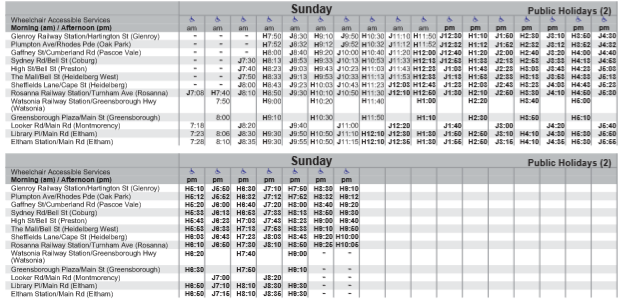
The 513’s timetable is below (one direction shown - other direction has similar service levels).  Weekday service frequency west of Rosanna is 15 minutes during peaks, 20 minutes interpeak and 30 minutes at night.  Frequency is halved on each section east of Rosanna. Operating hours are slightly longer than the minimum standard for local routes.

Frequencies are harmonised with trains at most times. However the length of the route and the number of train stations served makes precise timetable coordination difficult. 


Weekend frequency west of Rosanna is 40 minutes. Again service alternates between Lower Plenty and Greensborough with each operating every 80 minutes, ie below the hourly minimum standard.  However 513’s weekend starts are earlier than the minimum standard.


What (if anything) would you do with the 513?  Would renumbering one part 514 help simplify it? Or, given known PTV difficulty with communicating the higher frequency of what would become a multi-route corridor, would this fragment the service and do more harm than good? Another option, noting the significant overlaps, could be to run all trips to Greensborough and terminate there, with a possible review of routes in the Lower Plenty area to retain coverage.  Extra points if you consider its relationship with other routes in the area, especially 293, 517, 527, 561, 901, 902 and 903.

PS: Visit Krustylink for historical background on the 513 including old timetables

See other Timetable Tuesday items here