Many think of flexible route buses as new up-and-comers that could transform transit. They're not. They go back to at least the 1970s as 'dial a ride' services tried in many places. Most failed, with low ridership and high costs per passenger.
Despite their chequered record, 'demand responsive' buses are a recurring recommendation in various transport plans over the years, old and new. These include 1988's MetPlan and 2021's Victoria's Bus Plan. More on why flexible route buses often fail here.
Telebus in Lilydale
One of the 'dial a rides' that did survive is 'Telebus'. It's operated near Croydon - Lilydale in Melbourne's outer east since the late 1970s. Telebus was established to service sprawl and demographics that could not be more hostile to bus usage as subdivisions turned their back on highway and station access.
High car ownership, high incomes, low density and, most critically, street layouts did not enable direct and efficient bus routes. That is even if governments were willing to fund them, which they weren't in much of the 1970s and 1990s. For Chirnside Park this was initially due to a golf course being in the middle of the estate. When this later got filled in with houses the neighbourhood remained bus-hostile with narrow, winding and disconnected internal streets. Telebus was thus an 'after the horse has bolted' attempt to minimally serve a bad layout that good planning should have prevented.

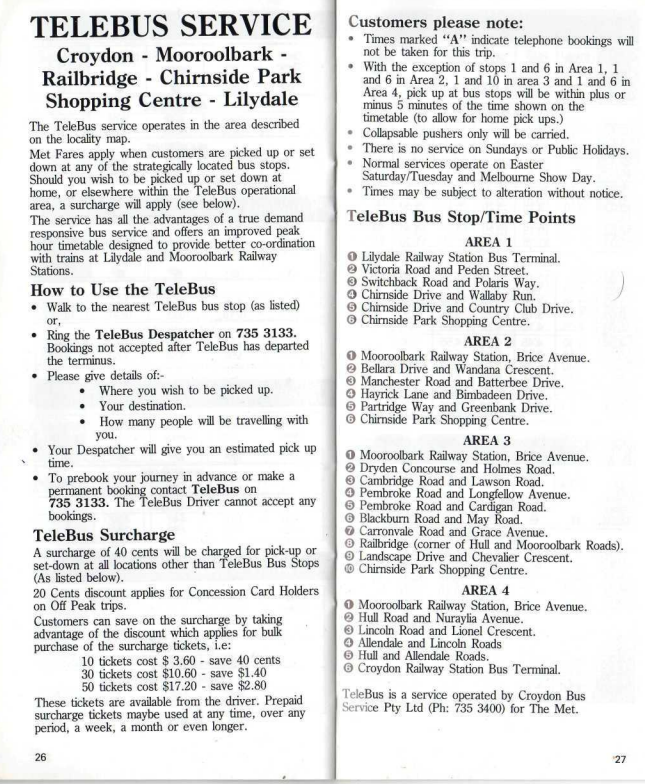


Unusual for buses in Melbourne, Telebuses don't have conventional route numbers, making information on them hard to find on the PTV website. The same can be said for 'how to use' details, which requires effort to find the special page here. PTV's app has even less information with recourse to the full website item necessary to find the number for booking.


The short answer is no.
Just replacing Telebus with FlexiRide is replacing one low productivity bus service model with one even lower. All while neglecting the fixed route network with greater potential. The tendency to take the path of least resistance of rebranding an existing similar service, adding an app and calling it bus reform is a habit the Department of Transport needs to quit.
This is because flexible route buses have low passenger boardings per hour. Most commonly this is around 5 to 10 boardings per hour (or less for operating models less successful than Telebus which is probably 'best of type'). Even quiet fixed routes in sparse suburban areas do about double that. And it's double again in areas with straighter streets, higher density and better demographics.
Rowville does not have great demographics for buses. It also has a pitiful mix of a poor quality unreviewed fixed route network and a limited hours FlexiRide service grafted over it. Similar applies in the Mooroolbark and Chirnside Park areas where routes like 664, 675, and 677 operate near or through the Telebus area. The presence of both types of services may mean that neither thrive for the thin patronage market offering.
A concept network
The order we plan various parts of the network is critical. Service planning is basically about providing the best service to the most number of people at an affordable cost. 'Best' typically means things like operating hours, frequency, directness and speed. This usually means running frequent service along main roads that are reasonably walkable to most.
Such a network may have coverage gaps which routes on in between streets can cover. Planners may have to trade-off frequency and coverage depending on local needs and demands. They may have to insert local 'in between' routes, especially if neighbourhood walkability is poor. Both frequent and local bus services are fixed routes, with flexible routes a last resort due to their high costs per passenger carried and sharply reduced reliability if more than a few people start using the service.
Their inability to efficiently serve passengers means that before you start fiddling with flexible routes a higher priority should be to reform fixed routes, as per the framework below. If flexible routes have a role it is a minor residual one serving certain special needs that justify the high cost per passenger.

Just like in Rowville, the recipe in Lilydale is 'FlexiRide first'.
It is being introduced while the local fixed route bus network is hardly changing.
Buses would become more useful and more reliable if the order of reform was reversed.
Two concepts where regular routes were deviated or extended to throw coverage into areas currently served by Telebus (and would be served by FlexiRide) are mapped below:
NETWORK 1


The pockets where any flexible route may be considered would get smaller if not vanish. This will result in a smaller and preferably zero proportion of buses being used for inherently indirect and inefficient operations. This should make it possible to deliver the most effective and economical bus networks to an area where service has long been substandard.
Other network concepts worth exploring appear in 2010's bus service review for Knox Maroondah & Yarra Ranges. Only a few recommendations from that were implemented.
Conclusion
On one level it is good that buses in the Lilydale area are getting attention. On another it's not the attention that would necessarily deliver the most efficient and economical service.
This is because changes are being made in the wrong order, with flexible route services being adjusted without there being a review of fixed routes first. Because the latter generally have higher boardings per bus hour (or potential for same) reforming fixed routes should be done first.
Two concepts for fixed route networks that would lessen or remove the need for flexible routes have been outlined. Comments are appreciated and can be left below.
See other Building Melbourne's Useful Network items here