Friday, May 20, 2022

UN 126: The 'Perth model' and what it can teach us


Some cities are better than their public transport. Perth has public transport better than its city, which is overwhelmingly post-1960, built around the car. 

That wasn't the case in 1982. Back then Perth had just two operating diesel passenger rail lines that missed its two main postwar growth corridors not to mention a lot of infill. And in the early 1990s Perth had just one bus route more frequent than every 20 minutes off-peak, and even that was just weekdays. 

Despite having some of the nation's highest incomes and car ownership rates, Perth has showed that a city can build surprisingly good public transport that outperforms much better endowed Brisbane and even aspects of Melbourne's network. 

Here's a recent RM Transit video on Perth's rail network. 


Peter Newman on the background to Perth's rail revival. 


While Perth is most known for its freeway trains, these couldn't get the usage they did without space-effective ways of getting to the station. With widely spaced freeway median stations distant from most homes that meant a strong feeder bus network. Buses are also important for many cross-suburban trips. 

The early 1990s suburban bus network in Perth was only slightly better than Melbourne's after its Cain/Kirner cuts. Many routes were indirect, ran at irregular frequencies and ended at dead end termini. The slightest variation had their own route number. A different network often operated on weekends. There was however more after 7pm service and an occasional Sunday service (typically 4 to 8 trips per day) on many routes.  

The Joondalup line gave the first nudge to bus reform with freeway express buses configured to form train feeders. That was followed by network reform in other areas arising from the 'System 21' plan for premium direct bus routes operating frequently over long hours. There was also a Circle Route to overcome the network's main problem - that is you could take public transport to and from the CBD but not across suburbs. Since then there have been many more cross-suburban routes added, some at 15 minute frequencies, especially since the opening of the Mandurah line. Local routes have also been boosted with frequencies harmonised with trains and some higher frequencies, including on weekends.   

See this thread for key milestones in Perth's network development: https://twitter.com/MelbOnTransit/status/1520504671487807488

A recent case study on how Perth does bus reform is here. This is particularly applicable to Melbourne with its revived interest in this. 

Perth's transit network is a long way from perfect. Due to poor land use relative to transport many trips are still bus - train - bus and uncompetitive with driving. However in planning and running a transport network they give us much we can learn from. If what they do works there even better results should be possible in a city with a more transit friendly urban form - such as Melbourne.  

Index to other Useful Network items here


Tuesday, May 17, 2022

TT #163: Waiting for days: The hunt for Melbourne's bus super waits


It's widely known that many parts of Melbourne have sparse bus services. Hourly waits are common even on busy routes (like the to be upgraded 733) that should run every 10-15 minutes. 

We even have some two-hourly gaps on services serving dense suburbia with lots of homes, jobs, shopping centres and more (eg Route 800 down Princes Hwy past the high-rise M City development). 

But that's not today's topic. Today I'll identify where the super waits are. These are neighbourhoods where you could wait days for the next bus. Especially around holiday periods such as the Easter just gone. And they're not necessarily in the country; there's parts of established Melbourne suburbia built 30+ years ago that never got a full timetable, even to 'minimum service standards' laid down in 2006. 

I used this online duration calculator to calculate times from timetables. Here's where you'll find some of Melbourne's longest waits for buses if you're there at the wrong time: 


Lilydale/Mooroolbark: 106 hours Rt 680

When it comes to bus super waits, some places equal but none beat Lilydale, Mooroolbark and surrounds. Taking the title is Route 680 mapped below. It runs weekdays only despite significant unique coverage. There's also no public holiday service. This means that there's no service for four days in a row: Good Friday, Easter Saturday, Easter Sunday and Easter Monday. That's 106 hours. Over a normal weekend the gap between buses falls to the 60 hours approximately between Friday afternoon and Monday morning. For a long weekend with a holiday Monday? The wait rises to 83 hours or nearly half a week.  


The Mooroolbark FlexiRide (basically a rebadged Telebus without any extra service days)  is also shown. That has Saturday service. However without Sunday and public holiday service it leaves its catchment without public transport for 60 hours over ordinary long weekends.  Because Easter Saturday is a Victorian public holiday its super waits can be up to 106 hours on that weekend too. 

Not on the map is Route 675 between Mooroolbark Station and Chirnside Park. Like the 680 it tops the super wait charts with 106 hour gaps. However some of it is overlapped by the 7-day bus 664 (which runs all public holidays). Still if you want a quick trip up to your nearest big shopping centre from Mooroolbark you'll need the 675. Weekend service here is justified as it's the second busiest weekday bus route in Melbourne that lacks a Saturday service

Most of this area is in the seat of Evelyn, held by Bridget Vallence MP. 


Campbellfield: 106 hours Rt 531 & Rt 538

Low-income residential Campbellfield hasn't had a single bus service improvement in at least 30 years. Its two local buses even missed out on 'minimum standards' upgrades that many others received about 15 years ago. Thus its residents are left behind with bus super waits, especially over long weekends. Campbellfield has local shops only and has poor cycling and walking connectivity due to industry or  busy / impermeable roads. The role of buses is doubly important without these active transport connections.   

Residential Campbellfield has two partly overlapping bus routes, both with limited service. These include the Monday - Friday only Route 531 and the Monday - Saturday morning Route 538. Neither operate on public holidays. Super waits for both of approximately 106 hours have applied for both since Easter Saturday became a public holiday. On 'normal' Saturday - Monday long-weekends the super waits for 531 is approximately 82 hours and 64 hours for the 538 (due to the latter's Saturday service, albeit finishing at 1pm). That's a long time to be stuck in your own suburb. 


The 2021 state budget mentioned changes to Route 538 but it is not yet known whether this will include a timetable upgrade.  The area is in the seat of Broadmeadows held by Frank McGuire MP.


Brooklyn: 106 hours Rt 414

Brooklyn, like Campbellfield, is known for both its toxic waste industrial fires and limited buses. And there'd be people (including decision-makers) who didn't know it had a significant residential component. Its bus route 414, from Footscray to Laverton, hasn't had a significant timetable upgrade for decades. 

Without Sunday or public holiday buses it faces a 100 plus hour wait between buses over the Easter weekend. However on ordinary long weekends it fares better than Campbellfield as its bus runs on Saturday afternoons (until about 5pm). This brings its maximum wait then down to about 60 hours.  


Brooklyn is in the seat of Williamstown held by Melissa Horne MP. 

Rowville / Lysterfield 106 hours

Politicians have talked about trains and trams to Rowville for decades but their governments struggle even with running buses. Especially east of Stud Rd where most of its people live. A recent attempt (FlexiRide Rowville) didn't address the key issue of limited operating hours in the area. The result is there is just one 365 day route (the 691) in the whole large area east of Stud Rd. That puts tens of thousands of people distant from regular public transport in a massive service 'black hole'.   

As discussed here, Rowville has two half-networks. 681 / 682 are indirect fixed loop routes. They run Monday to Sunday but not 365 days per year. How can this be? It's because they are the only two 7 day bus routes in Melbourne that don't run on public holidays. With Good Friday, Easter Saturday, Eastern Sunday and Eastern Monday public holidays this means that these routes have a 4 day spell where they don't run. That means a long gap in service in locations distant from the 691. 

Ordinary weekends are better as there's at least the 681 / 682 running then. But on a normal 3 day long weekend the super wait is down to less than 40 hours (measured between Sunday afternoon and Tuesday morning). 


This area is in the seat of Rowville held by Kim Wells MP.

Reservoir: 105 hours - Rt 558

Reservoir is the size of several small inner suburbs. However its buses have been neglected with most of its routes being time-capsules from the 1970s. In no case is this more obvious than with the 558, attempting to serve the entire north-west of the suburb. 

Leaving aside its route alignment, odd frequency and midday reversal, the 558 timetable has problems with operating hours with that too missing out on minimum standards upgrades. Hence it remains without public holiday service and has a Saturday service that finishes at midday. 

The Easter bunny brings no joy for 558 users with a 105 hour super-wait over that long long weekend. On ordinary long weekends the super wait is nearer to 65 hours with nothing running between Saturday afternoon and Tuesday morning. 


Route 558 runs in the seats of Preston (Robin Scott MP) and Thomastown (Bronwyn Halfpenny MP). 

More examples

There's other examples apart from the above five that have long bus super waits. These are mostly in established areas that haven't had significant bus reform for up to 30 years and missed out on 2006's minimum standards upgrades. Some middle northern suburbs, much of the east around Kew, Balwyn and Ivanhoe, many places east of Stud Rd, the Mornington Peninsula and smaller regional cities have particular concentrations. 


Reasons for super-waits
 
Why might bus routes have super-long waits? It all comes down to service. There's not enough trips over enough of the week. In order of lengthening waits, issues are: 

* No service Sunday (hence ~36 hr Sat pm - Mon am gap) 
* No service Saturday afternoons or Sundays (hence ~41 hr midday Sat - Mon am gap) 
* No service Saturdays or Sundays (hence ~59 hr Fri pm - Mon am gap) 
* No service Sundays or public holidays (hence ~60 hr Sat pm - Tues am gap on long weekend) 
* No service Saturday afternoons, Sundays or pub hols (hence ~65 hr midday Sat - Tues am gap) 
* No service Saturdays, Sundays or public holidays (hence ~83 hr Fri pm - Tues am gap on a long weekend and ~107 hours over Easter) 
* The bus only runs weekly (hence ~167 hour gap) 

Lack of Sunday service is the most common cause of super waits around 36 hours. Lacking Saturday afternoon service can extend these to over 40 hours. That means no service from around midday Saturday to Monday morning. 

But it's public holidays that can double or triple super waits to over 80 to 100 hours. This is because most public holidays are tacked onto a weekend (mostly on a Monday). But sometimes it can be both Friday and Monday, as happens each Easter. There can also be similar issues in some years around Christmas and New Years Day, depending on when public holidays fall. 

Whereas the 2006 standard is to run a Saturday timetable on public holidays except Christmas and Good Friday) it was never fully rolled out. That leaves a lot of bus routes that run on Saturdays but not public holidays. And even a couple (681, 682) that run on Saturdays and Sundays but not public holidays. 

None of this is inevitable. What's there now is purely a result of history, state government priorities and current funding settings. These declare that buses (the nearest form of transport to 70% of Melburnians) are less important than trains and trams and don't need consistent, reliable daily service. More on the public holiday gamble on Melbourne buses here with further details via BCSV here

I've not discussed weekly buses. We have a couple in the outer east (extensions of 695 and 697) but typically there's coverage from other routes. Similar comments apply to the quirky Friday - Sunday 695F to Fountain Gate. 


Fixing the super waits

It's simple. Closing the gaps on the longest examples just need a small amount of funding and a revised timetable specification that applies across all Melbourne bus routes. The cost is low as not much more service kilometres per year is required. Most routes with super waits are short. Fixing them just needs a few more driver hours per route working the existing bus fleet harder.

In order of priority, fixing the easiest/cheapest first, these are: 

1. Add standard pattern public holiday service to all routes with 7 day service (involves only routes 681 & 682 plus Melton FlexiRide) 

2. Remove public holiday anomalies so that all routes that currently operate on Saturdays also operate on public holidays as per the standard (ie mostly Saturday timetable except for Good Friday and Christmas where a Sunday timetable operates). About 20 routes.

3. Add at least Saturday afternoon service to routes that currently finish around noon. About 8 routes (512 538 558 697 699 814 844 & 857).

4. Add at least a basic Sunday service to all routes that operate (i) Monday - Saturday only and (ii) Monday - Friday only if in a residential area. Maybe 50 routes?

Doing the first 3 would close most multi-day bus super waits in residential areas. It cannot be emphasised enough how incredibly cheap this is since we're adding something like an average of 3 to 6 service hours per week per route. 

Doing all four would deliver 365 day service in all residential areas as proposed in the 2006 'Meeting our Transport Challenges' plan and end all super waits. A little dearer at around 10 more service hours per route per week but still great value with outsized gains by upgrading say the top 13 to 20 routes to 7 day running.    

A few routes would remain weekday only, such as peak expresses, industrial and school routes. These would remain as is unless there is a need for them to run on public holidays (eg university shuttles on holidays not observed by universities). 


Service standardisation could actually lead to some operational savings due to fewer call centre queries and PTV getting it wrong less often. The benefits of this can't be underestimated; currently the Department of Transport often doesn't understand when its own services run because timetable arrangements are so complex. This makes errors on the PTV website and at bus stops common, thus confusing and potentially stranding passengers.  

Last week minister Ben Carroll said "Under me as Minister, they (buses) will not be the third cousin of public transport" (Whitehorse Leader - paywalled). For this to come about bus super waits will need to be abolished amongst other service reforms and upgrades. Reform here would be some 'quick wins'  with widely-spread gains including in marginal seats that could form the key to who wins the 2022 Victorian election

Know of any other suburbs with bus super waits? Please let me know in the comments below.


Friday, May 13, 2022

UN 125: Delivering for Deakin with the 903


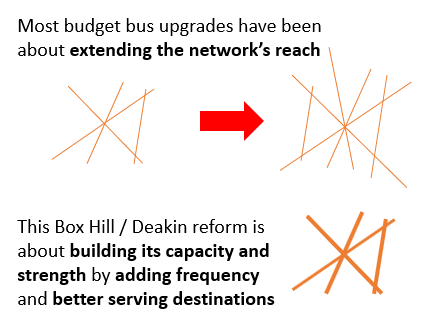
The 2022 Victorian state budget announced several bus service upgrades. Most were coverage increases in fringe areas. These will bring public transport to growing areas that previously didn't have it. Extensions like these extend the network's tentacles, typically with a basic 40 - 60 minute frequency, in fringe suburbs.  

Up to recently other aspects of bus network development such as route reform and frequency upgrades in densifying middle suburbs, have often been side-lined as ministerial attention turned to infrastructure. 2021's Victoria's Bus Plan, though lacking specifics, recognised the issues and set a direction for reform. We've already had some, as described here.

Service upgrades on their way

The 2022 state budget included improvements to bus routes and services between Box Hill, Oakleigh and Southland. We could then only guess what they were as no route numbers were listed.  


A day or two later Will Fowles MP listed the routes involved. 


Then Box Hill member Paul Hamer MP wrote on his Facebook page that 733 and 767 will have higher off-peak capacity. A premier's website release confirms Box Hill - Monash - Clayton (busiest part of 733) and Box Hill - Deakin - Southland (all of 767).  

733 and 767 are both high patronage routes that deserve frequency upgrades. 733 between Box Hill and Clayton especially. Despite being one of Melbourne's busiest bus routes it groans under an hourly Sunday frequency and being no better than half-hourly at most other times. 

Last year's 234 and 907 frequency upgrades signalled a welcome new willingness to deliver 7 day frequent bus services on popular routes that need it. It doubled the number of bus routes running every 15 minutes or better 7 days from 2 to 4 (out of 300+ total). Upgrades like these add muscle as well as reach to the network. That's overdue as Melbourne's current bus network is a gangly thin-limbed adolescent with poor core strength and co-ordination.

Boosting the 201 Deakin University express shuttle is another capacity builder. Its current 20 minute frequency makes it much less of a 'go to' option compared to other university shuttles operating every 4 to 10 minutes. It's also not helped by being duplicated by an older university shuttle (the infrequent Route 768) that was not removed when the 201 started in 2016. 

A more frequent Route 201 should relieve pressure on other routes and, with reform, allow a two-tier style service to Box Hill in conjunction with other routes. A similar arrangements operates between Huntingdale and Monash Clayton where there is an overlap between the 601 shuttle, the 900 SmartBus and a local route 630. 201 has been the subject of work to speed travel though traffic signal priority. You can read about that here

903 rerouting

Now we get to today's main topic, the 903 being rerouted via Deakin University. This is significant because Route 903 is the area's orbital SmartBus. Operating more frequently and for longer hours than most other bus routes a rerouting would improve access to the campus from areas north and south including Heidelberg, Doncaster and Oakleigh.  

The map below shows the existing 903 and other routes around Deakin University. Four currently operate between Box Hill and Deakin University. These include the 201 and 768 shuttles, the 281 extension and the 767 down to Southland. Also starting at Box Hill is the 732 to Upper Ferntree Gully and the 766 to Burwood. These go near but not quite to Deakin University. 


Maps of 903's new alignment aren't yet out. How might it go? Just speculating, two potential options could be those below. Both involve one more turn than now.


Alignment A is perhaps simpler and retains connectivity with the Route 70 tram. However it doesn't quite go to the eastern part of the campus (which has an internal bus interchange). Still, uni campuses, like major shopping centres, are large places, and most people accept reasonable walks from one end to the other. 

Option B goes further east but overlaps the 75 tram more (along with the 732 bus). I am guessing that if adopted it would not pull in to the university interchange as it would usurp the distinctive role of the  (to be upgraded) 201 shuttle which does. Besides run time is money when planning bus routes and 903 needs good speed for through passengers, being the area's only frequent orbital transport option.

Network implications

These can be broken up into three main issues, as follows. 

1. Retaining Camberwell / Surrey Hills / Burwood local connectivity

Both 903 options pull service out of the west end of Wattle Park, leaving just the 766 remaining. To ameliorate this Route 766 needs, as a minimum, an upgrade to 7 day service, longer operating hours and an overhaul of its current timetable (which features some 80+ minute waits). I said more about Route 766 on Tuesday. 

2. Box Hill - Deakin University corridor

Existing connectivity is complex with the four routes operating at unattractive 20 to 40 minute frequencies each. Three routes (201, 281, 768) operate to the internal campus bus interchange while 767 stops outside. This network upgrade needs to simplify services including more clearly defining  each route's role with an appropriate service frequency. 

Orbital Route 903's routing via Deakin will add a major route operating every 15 minutes off-peak and better in the peak. Because Box Hill is a major centre with a large catchment increased speed on it would be desirable. This may include the potential for wider stop spacing if other routes exist for intermediate stops. 

Route 201 should remain as the express Box Hill - Deakin shuttle but at higher frequency. Ideally funded largely by a 'reform dividend' (eg incorporating the 768 and another route - more later). Combined with its speed a 10 minute frequency would make it the route of choice for everyone making that trip. This should relieve pressure on the 767 and rerouted 903, freeing these up for longer distance travel to Box Hill.  

A way of directing Deakin passengers to the 201 could be to make it the only route that runs to the university's internal interchange. It is also a good candidate for a 'rapid running' frequency timetable type service with minimal dwell time at interchanges. A cheap way of freeing up even more service kilometres to deliver a frequent 201 could be to truncate Route 281 at Box Hill. In exchange those who want a one-seat Doncaster - Deakin option would gain a more frequent service via the rerouted 903. 

Elgar Rd between Box Hill and Deakin is currently crowded with four bus routes but doesn't get consistently good service due to all being either infrequent, duplicative, irregular or express. The above simplification would leave it with just the (not stopping) 201 shuttle and the 767. Boosting the latter to say every 20 min (preferably 7 days) should provide a simpler, stronger corridor. Delays due to passenger loading between Deakin and Box Hill could be reduced as some passenger from Box Hill would shift to the 201 shuttle while some from the south would use the 903. 

The visual below shows how it might work.  


'Loose ends' created by the above include Route 766 (fixable - discussed at 1 above) and the southern end of the 767 (which justifies its own reforms around Bentleigh East/Southland along with 627, 701 and 822). There are also two bus operators involved with 281 and 903 run by Kinetic and the rest by Ventura. That makes reform harder than if there was just one. However pretty much all Melbourne bus operators have routes that justify upgrades so that if one of their routes required trimming some of their service kilometres / hours could be redeployed so they don't lose out. 

3. Surrounding network structural issues and SRL planning

You might wish to end things right here. And if you did a worthwhile network reform will have been delivered. 

However other issues with the bus network around Deakin University exist. These include residential area coverage south of Highbury Rd (which lacks its own bus route), 732 overlap with parts of the 903 and the 75 tram and 766's weak southern terminus. These are shown on the map below. 


Out of these the 732 overlaps may turn out to be non-issue as (a) the route gets good usage and (b) it relieves busy parts of the 903. On the other hand 903's rerouting may lead to other opportunities as discussed here.  

The Suburban Rail Loop's station at Burwood presents the opportunity of a terminus for a future revised bus network. This might involve routes such as 732, 766 and a Highbury Rd route. 

Southern opportunities (the Clayton / Southland end)

When you reform or boost services on one bus route you often unlock opportunities elsewhere on the network. While they might be considered 'out of scope' for this reform they should not be forgotten. That's so they can drive the next stage of cost-effective bus network reform. Both opportunities for this are at the Clayton / Southland end, as follows: 

Opportunity 1: Bentleigh East 

We know that all of Route 767 will receive service improvements. While it mostly has its own corridor north of Chadstone, its southern half around Bentleigh East has other nearby parallel and partly overlapping routes (map below). This is not desirable if you want the highest benefit from the extra resources you're spending on frequency. 

If you look at the broader north-south network you'll see the very frequent Frankston line to the west and the mostly frequent 903 SmartBus to the east. These are about 4km apart. 

Exactly half way between is a corridor formed by Murrumbeena, East Boundary and Chesterville roads. As you saw from the map above it has no simple continuous and frequent bus. But if it did then it would mean that almost everyone would be within 1km of a frequent north-south service to major destinations. 

With its frequency upgrades already funded in the 2022 budget, the 767 is the obvious choice for such a direct and more frequent route. It just needs rerouting between Chadstone and South Rd with about the same route kilometres as now. No new bus stops would need to be built on its new corridor as existing (less frequent) routes already serve it. However these existing routes (notably the 822 but also possibly 627 and 701) would need reform to retain coverage at stops the 767 is moved from. All the routes involved are run by the same bus operator, further simplifying reform. 


The simplified and rerouted 767 could be a candidate for further frequency and operating hours  upgrades as patronage warrants and funds become available. A simple route with enhanced service on the East Boundary Rd and Chesterville Rd corridors is also consistent with Principal Public Transport Network planning that guides land use decisions (see Glen Eira and Kingston PPTN maps here).

Opportunity 2: Clarinda/Southland 

The premier's release said that Route 733 will be upgraded between Box Hill and Clayton. This is only  some of the route as the full route operates to Oakleigh. However it is sensible as the Clayton - Oakleigh portion is both less used and is near (even sometimes overlapping) other routes offering higher service. Confining the frequency upgrade to the busiest portion allows the shortest possible waits where most needed.  

Terminating some trips at Clayton is also a step towards a next stage of reform. That is operating the Clayton - Oakleigh portion as an independent local route (if justified) and terminating all 733 trips at Clayton. 


That provides a simpler network as all 733 trips will finish at the same place. It also opens the way for a 733 extension to Southland (or Sandringham) to more closely replicate the Suburban Rail Loop, and, in the interim, boost service in the Clarinda area and improve connectivity to Monash University Clayton from the south. 


I presented more detail on this concept back in 2020. The most cost-effective implementation is likely to involve reform to and/or amalgamation with Clarinda area routes such as 631, 821 and 824. 

Conclusion

These upgrades will make public transport stronger in the Deakin University area. Even more so if wider network reforms such as at Bentleigh East and Clarinda are considered. The main remaining questions are the magnitude of the upgrades in terms of higher frequency and improved operating hours.  

When will these changes happen? Past bus upgrades have taken about 25 months from budget funding to implementation (for a new bus route). However a Whitehorse Leader article (paywalled) encouragingly says that these reforms will happen 'within 12 months'.  

Your thoughts on routing the 903 via Deakin and other network improvements you'd like to see in the area are appreciated and can be left in the comments below. 

See other Useful Network items here