Sunday, March 03, 2024

The 'One Million Club': Melbourne's busiest suburban stations (and how the Metro Tunnel could benefit them)


Last year I got some annual 2022-23 station entry train patronage stats from DTP. What stuck out was a small number of high patronage stations, which I've defined as exceeding 1 million passenger entries in the year. 

Here they are, roughly grouped in clockwise order. The first numbers after them are million entries per year. They're followed by service levels. These are Weekday interpeak frequency/Weekend frequency/Maximum waits (all in minutes).

Werribee/Williamstown/Sunbury

Footscray 4.0 <10/<10/<20
Sunshine 1.6 20/20/40
Williams Landing 1.2 20/20/20
Newport 1.1 <10/10/20
Watergardens 1.0 20/20/40

Craigieburn/Upfield

Essendon 1.2 20/20/40
Craigieburn 1.1 20/20/40

Mernda/Hurstbridge
-

Belgrave/Lilydale/Alamein/Glen Waverley

Box Hill 1.9 15/10/30
Glenferrie 1.7 15/10/30
Camberwell 1.6 15/10/30
Ringwood 1.3 15/10/30
Glen Waverley 1.3 15/20/30

Pakenham/Dandenong/Frankston/Sandringham

Caulfield 2.7 5/5/20
Dandenong 1.7 10/10/30
Springvale 1.2 10/10/30
Clayton 1.2 10/10/30
Oakleigh 1.3 10/10/30
Huntingdale 1.1 10/10/30
Frankston 1.0 10/10/20

CBD area (largely not discussed here)

Flinders St 18.8
Southern Cross 10.9
Melbourne Central 8.6
Parliament 4.7
Richmond 3.1
Flagstaff 2.8
South Yarra 2.8
North Melbourne 1.1


I'd query some numbers. Some stations, like CaulfieldFootscray and Newport, require exiting the fare paid area to change between some platforms. That may inflate numbers. There will also be variations such as changed travel patterns when buses are replacing trains. Still it does show that some lines have more super-busy stations than others. 

The Clifton Hill group had no entries in this class, though it had a reasonable share of middling well-used stations like Reservoir, Heidelberg and more that exceeded 500 000 boardings pa. Significantly, nearly half (9/19) of the 1 million plus suburban stations will be served by the Metro Tunnel when that opens. 

Busy stations with high maximum waits

Stations with 30 or 40 minute maximum waits are shaded. 4 out of the 19 busiest suburban stations had a 40 minute maximum wait (between approx 6am and midnight, 7 days) while a further 10 had a 30 minute maximum wait.

That makes 14 out of 19 with 30 minute or more maximum waits. This can be attributed to past resourcing decisions which placed a higher priority on boosting service on the electorally critical Frankston line over the lines to Ringwood and Dandenong which had more busier stations.  

Footscray and Caulfield, by virtue of being on multiple lines, had the shortest waits. However even here intervals are irregular as lines through them operate at frequencies unharmonised with one another (with a mix of 20, 30 and/or 40 minutes common evenings and/or Sunday mornings). 2012's Network Development Plan - Metropolitan Rail would have had this fixed by now if service reform (most of which didn't need to wait for the Metro Tunnel) had been accorded a higher priority.

The silver lining is that the timetables associated with the Metro Tunnel offer a great opportunity to catch up on what has been almost a lost decade in metropolitan rail service improvement. Let's now look at some exciting service upgrades which could be ahead.  


Effect of 2025 Metro Tunnel associated timetables

Seven of the shaded low service but busy stations will be served by Metro Tunnel services. These include Watergardens, Sunshine, Huntingdale, Oakleigh, Clayton, Springvale and Dandenong.

If well-scheduled the 2025 Metro Tunnel timetable will cut maximum waits at these stations from their current 30 or 40 minutes. In addition two other stations (Footscray and Caulfield) that already have frequent service will gain further. As mentioned before that means that nearly half of the busiest 19 suburban stations could directly benefit from the Metro Tunnel. 

Right now we can only guess the extent of the Metro Tunnel's benefit as its timetable (or even service specification) isn't public yet. But I would expect that planning would be guided by a. 2012 Network Development Plan - Metropolitan Rail, b. 2016 Business Case and c. recent rail planning practice, notably the 2021 Caulfield and cross-city group timetable revamp

This has informed the hypothetical frequency plan below.    

(click above for better image)

I would not expect much use of the bare-bones A pattern, except possibly early Sunday morning. You'd pick C if core frequency, including relieving trams to enable a reconfigured network, was a priority. B, the middle option, gives a turn-up-and-go service for medium to longish trips, while offering excellent legibility and one-seat rides.

A and B are poor for asset utilisation given Metro Tunnel's construction cost. Still, getting something like B for most off-peak periods (including weekends and evenings) with A applying early weekend mornings would still represent a large uplift in service. Hence I will assume this is about what we get.

With that sorted we can now discuss the other busy stations and their prospects for better service.  

Essendon and Craigieburn are the two remaining busy stations with 40 minute maximum waits not on the Metro Tunnel. The Craigieburn Line could have had boosted off-peak services (including closing the dreaded 40 min Sunday morning gaps) at any time since the line opened in 2007 but never did. However the 2016 Metro Tunnel business case proposes a halving of Craigieburn line waits to 10 minutes day/20 minutes nights and Sunday mornings (matching the current Frankston line pattern). Hence there is the possibility (though not a certainty) of next year's Metro Tunnel associated northern group timetable erasing current 30-40 minute waits. The case for this is compelling given the Craigieburn line's high usage and the low marginal cost of halving maximum waits.  

The Upfield and Sandringham lines lack 1m plus stations but the Sandringham line in particular has good average usage per station with none really quiet. Like the Craigieburn line both have 40 minute maximum waits and are listed for improvements in the business case. 

The abovementioned 2016 business case limits its scope to lines that are interdependent with the Metro Tunnel. Hence Table 2-2 in it does not list service levels for the Burnley (ie Belgrave/ Lilydale/ Alamein/ Glen Waverley) or Clifton Hill (ie Mernda and Hurstbridge) group lines. Thus I assume that no improvements are planned for these timetables. To be fair there were minor amendments made last year but none that made inroads into maximum waits or complex service patterns. 

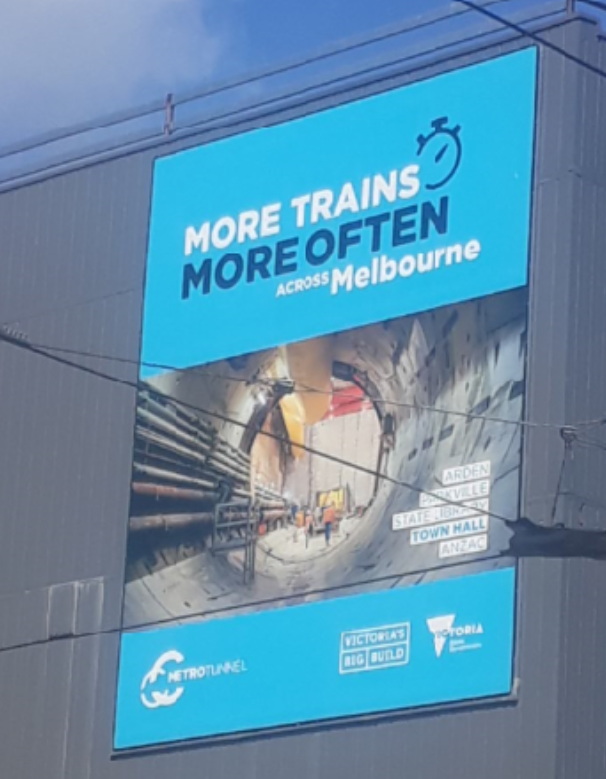
This, coupled with posters like those below, may give rise to a public expectation that timetables associated with the Metro Tunnel will have wide rather than narrow benefits, both in relation to the lines served and the span of hours. 


The Burnley group is particularly relevant here because it contains five 'One Million Club' stations with 30 minute maximum waits. These are Glenferrie, Camberwell, Box Hill, Ringwood and Glen Waverley. Of Melbourne's train operating groups, Burnley also has the most need for a simpler greenfields timetable due to its unappetising combination of 30 minute maximum waits (including midday weekdays at outer stations) and
complex peak stopping patterns

Such a reformed schedule could apply the generally superior weekend daytime 10/20 min pattern to weekdays as well (for minimal cost) with this extended as late at night as possible. Doing both interpeak and evenings would give Belgrave, Lilydale and Ringwood service parity with Pakenham, Cranbourne and Dandenong, assuming the Reference Option (B) is chosen for Metro Tunnel services.

If this is not done then the Metro Tunnel risks becoming a project of envy rather than pride as Ringwood passengers find waits between their 30 minute evening trips are triple those enjoyed by Dandenong passengers. Such a 3:1 service disparity is also not justified on patronage and urban development grounds given the usage of and prospects for popular stations like Glenferrie and Box Hill (including the Suburban Rail Loop).     

Finally there's the Clifton Hill group. No stations from it are represented in the 'One Million Club', although Jolimont, assisted by sports crowds, comes close at over 900 000. As mentioned before this group includes moderately busy stations, including Reservoir, Thomastown, Epping, South Morang and Mernda on the Mernda line plus Ivanhoe and Heidelberg on the Hurstbridge line. In addition the power of frequency to draw usage is demonstrated on the combined section of these lines with Victoria Park, North Richmond, Clifton Hill and of course Jolimont the busiest. All the listed stations had over 500 000 annual boardings in 2022-23. 

Conclusion

The Metro Tunnel should directly help cut waits at about half of Melbourne's nineteen busiest suburban railway stations with 1 million or more boardings per pear. Because waiting is such an important component of travel time, especially if changing to other services, this represents a major mobility benefit for passengers. 

Success here requires a 'good service every day' style of timetable being developed with short maximum waits over a wide span all week (even Sunday mornings) being implemented. 10 minutes would obviously be ideal but even getting to 20 minute maximum waits would be a large improvement, reversing the 1978 evening cuts on some lines.

This job would be finished, and the benefits magnified, if similar principles were applied to the remaining busy suburban stations and others mostly on the Burnley and Clifton Hill groups, as is possible for low marginal cost. 

The main gain here would be a spreading of project benefits to aid the whole metropolitan rail (and even tram and bus) network due to vastly improved connectivity and interchange. Only then will the city-shaping potential of the Metro Tunnel be truly unlocked.  

Friday, March 01, 2024

2024's top 5 ideas for better buses in Wyndham (and beyond)


Friends of The Earth Sustainable Cities campaign is running a bus forum for the community in just under two weeks. Why is the West still waiting for Better Buses in 2024 is timely given it's 992 days since Victoria's Bus Plan came out (with not even the Bus Reform Implementation Plan known to be delivered yet). 

The March 14 forum takes place at Williams Landing in the City of Wyndham. Speaking will be community advocates, local government people, MPs and a representative from the Minister. 

To mark the event here's my five point plan on what's needed for local buses. For simplicity I've mainly stuck to Wyndham and kept to buses but an integrated approach across the west involving both buses and train services is desirable, with some ideas for other areas given later. 


1. New bus routes for growth area coverage

Areas like Mambourin and parts of Tarneit North don't have buses. But they should. Existing Wyndham bus routes get metropolitan-beating patronage levels so there's no reason why these wouldn't be as productive. It's known that providing bus routes early in an estate's development reduces car dependence and cost of living pressures. The government needs to improve funding and processes so DTP can be more responsive as Melbourne has a problem in ensuring bus services are there when people move in, with waits of up to 14 years.   


2. Double all day frequency on key routes 

Wyndham has amongst the most productive bus routes in Melbourne, thanks to a reformed and mostly direct network introduced in 2015. However many still drop to every 40 minutes off-peak and on weekends. Also all but one route finishes shortly after 9pm most nights. Boosting off-peak frequency  to every 20 minutes (which meshes with trains) needs more driver hours but is otherwise economical as it makes use of the existing bus fleet. High priority routes for such improvements include 150, 152, 160, 192, 494, 495 and 497. Others like 170 and 180 are mostly every 20 minutes but need longer spans. Together these would deliver a long span, moderate frequency bus within 10 minutes walk of most Wyndham residents. 


3. Connect people and jobs

Laverton North is one of the biggest jobs areas in Melbourne's west. A short distance west are Truganina and Tarneit, both residential growth areas with huge workforces. No bus runs between the two, making existing public transport a multi-leg trip involving often infrequent trains and buses. Tarneit hardly existed when Laverton North's bus network was last reviewed. Hence it's time for new connective routes to jobs, most notably between Tarneit and Laverton North but also potentially involving Williams Landing, Laverton, Sunshine and/or Altona North. More on building job ready networks in the west here


4. Scrap FlexiRide / replace with fixed routes

Tarneit North FlexiRide is a dud. It is the public transport equivalent of trying to phone Centrelink, with about as much chance of success in peak times. While introduced with fanfare it is unsuited to the mass transit needs of a dense, diverse, mobile population better served with fixed routes. FlexiRide is geometrically doomed. Its main success is to max out with 'service unavailable' messages while simultaneously carrying fewer passengers per driver hour than a regular fixed route. Hence it is best replaced by regular routes such as which succeed elsewhere in Wyndham. One of them (on Dohertys Rd) could even link to jobs in Laverton North as mentioned above. Similar comments apply to Melton's FlexiRide which also gets oversubscribed. 


5. Tram-like Route 170 SuperBus between Werribee, Werribee Plaza and Tarneit running every 10 minutes

Would run every 10 minutes 7 days per week with bus priority to ensure reliability along Derrimut Rd. Each stop would feature larger high-quality shelter, real-time information and direct pedestrian access across the road. Essentially a 'BRT light' joining key destinations in Wyndham, this would be a precursor to similar upgrades on other corridors in the area, for example Ballan Rd to Wyndham Vale (Route 190) or to Williams Landing via Sayers and/or Leakes Rd (150 or 152).   

Melbourne's west beyond Wyndham

Top priorites here could include 1. Growth area coverage in areas like Mt Atkinson currently without service, 2. Getting popular but underserved bus routes like 423 and 424 up to 'minimum standard' operating hours (ie at least a 9pm finish) along with 7 day service on 414, 415 and 431, 3. Operating hours extensions and/or 7 day frequency boosts on key trunk routes including 406, 408, 411, 418, 420 and 460, 4. Simplification of routes to enable 10 minute frequent corridors (a) between Footscray and Highpoint, (b) along Ballarat Rd and (c) along Millers Rd, 5. Major bus network reviews in Melton townsite and Altona North/Williamstown to simplify the network, 6. Improved connections to jobs, notably in Laverton North and Fishermans Bend and 7. A Bus Rapid Transit corridor along Taylors Rd for efficient east-west transit to growth areas. 

Conclusion

This is my top 5 for bus upgrades in the Wyndham area, along with an outline of priorities for other parts of Melbourne's west. For maximum effect they should be combined with boosted train services, notably weekends on the Geelong line. Together these initiatives would create a vastly upgraded transit network fit to connect the area's growing population to jobs and opportunities.  

If this, or other bus concepts, interests you, visit their website to register for the forum - it promises to be very interesting.  


Tuesday, February 20, 2024

TT #187: More Frequency means More Go: Attitudes to PT frequency


If you're catching a plane to London or New York you're making a serious journey that is typically planned days, weeks or months in advance. Unless you're in the top 1% such a trip would be made rarely. On account of its significance, cost and rareness you're happy to rearrange your life schedule around it. Because of that it doesn't much matter much if flights are only a few times a day (or less). 

There may be changes to another flight if flying to smaller airports but the wise traveller plans long enough stopovers to lessen risks of missed connections. And you'd have to hope that there is good enough land travel at the other end to your destination. If there isn't it's accepted that you'll either hire a car, get a taxi or have the people you are visiting drive an hour or two to the airport then back to their place. Similar applies for transcontinental rail trips, especially the tourist types.  

Why frequency is key for metropolitan transit

Metropolitan transit is the opposite to all the above. For a start trips are shorter, cheaper and thus more frequently made. Travel time predictability is essential as travel may be to time-sensitive jobs, school lessons or appointments. But finish times can vary so the system must also be robustly amenable to changes of plan. 

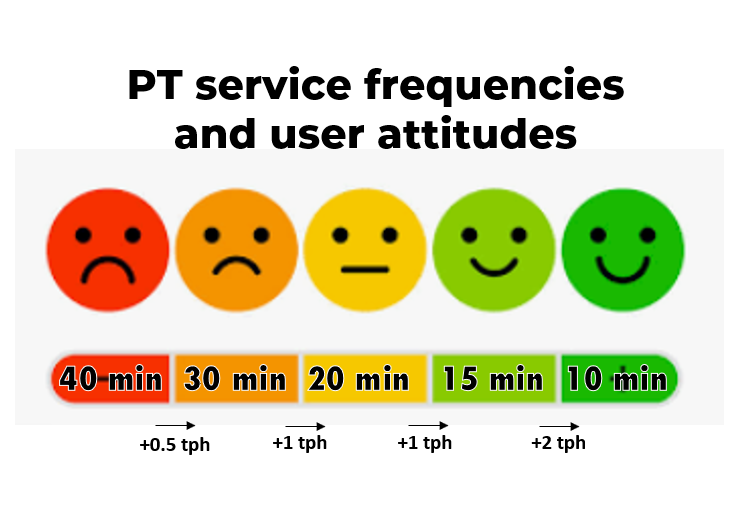
Want all the above in on a public transport network? Good frequency on as many routes as possible is key. If you don't have it then the network isn't very useful as waits can easily exceed travel times. Yesterday I devised the 'five smileys' diagram below that I think summarises this neatly.  

The assigned frequencies and attitudes, I think, suit Melbourne and suburbs. 

Prevalence and user experiences of various service levels

Every 40 min

Melburnians loathe 40 minute frequencies yet they plague our bus network, including on some of our most productive routes in western and northern Melbourne. I have no doubt that 40 minute frequencies cause much of the deserved low regard that buses are held in. Key train lines to destinations like Wyndham Vale, Sunbury, Broadmeadows, Coburg, Epping and Greensborough are also only every 40 minutes, notably Sunday mornings but sometimes other times as well. The short-changing of the north is very obvious in the frequency map presented last week

40 minute headways lack the 'memory timetable' that services every 60, 30, 20, 15 and 10 minutes have. Perhaps their only merit is that they harmonise with trains every 20 minutes, as typical in Melbourne's west, north and outer south-east. Hence 40 minutes is a very common off-peak frequency for bus routes, even though the patronage on some in areas like Tarneit, Point Cook and Craigieburn would easily justify a 7 day 20 minute service.  

Every 30 min

30 minute frequencies are what make our SmartBuses not so smart on weekends and most of our rail network inconvenient for evening and occasionally also daytime travel. Even trams have half-hourly gaps on Sunday mornings and evenings. Like with every 40 minutes, a 30 minute wait due to a just missed connection, can double travel time for most trips. 

Still there's one thing worse than 30 minute waits and that's the abovementioned 40 minute gaps. Getting this to every 30 min is a small but worthwhile improvement. And it's super-cheap. This is because a 30 minute frequency is four trips every 2 hours versus three for a 40 minute frequency, you just need to add one return trip per two hours to boost the service. 

To take a Mernda line Sunday morning example, instead of 40 minute gaps before the 10:36am arrival at Flinders St (current timetable) the 40 minute service could finish with the 8:36am arrival with the improved 30 minute service until 10:36am. That's with one extra return trip per week scheduled. 

Even better would be one additional earlier return trip to cut the earlier 70 minute gap (before 7:56am) to 40 minutes. That's a lot of value for just two extra return trains per week. Similar Sunday morning gains are possible for at least parts of the Sunbury, Upfield, Craigieburn, Hurstbridge and Sandringham lines with a combined total of 12 return trains per week. That's about 24 trips each way, or about 100 per month. For context Metro runs about 64 000 train services per month (November 2019 figures), meaning an increase of just 0.16% in monthly services

That's tiny in the whole scheme of things given it would get almost our whole rail network from a maximum 40 to a maximum 30 minute wait for 18 hours a day / 7 days a week. It does not speak well for the planning, leadership and internal advocacy capabilities of DTP that Secretary Paul Younis has been unable to win government support for even these minor upgrades implemented across the rail network. 

Every 20 min
  
20 minutes is a sort of middling frequency. Its not horrid but not great either. It might be OK for non time critical trips involving no changes. But it can still greatly slow travel if making one or more connections that are not timed. Still, it is vastly better than the 30 and 40 minute headways so widespread on the network.

I have seen 20 minutes referred to as a 'check and go' frequency - in other words you are still looking at a timetable but it does not require the sort of detailed planning that you might do for a 30, 40 or 60 minute headway. 

The roll-out of much more 20 minute service was proposed for metropolitan rail lines and bus routes in 2012's Network Development Plan (Metropolitan Rail). This plan wasn't much favoured by the following government. Still, Werribee, Williamstown and Frankston train lines gained maximum 20 minute waits in the good but undersold 2021 rail timetable change. And before then quite a few bus routes gained 20 minute service

20 minute service is not something that people are begging politicians to implement. It's less saleable than every 10 minutes in that regard. But it's also vastly cheaper to do over multiple lines if your starting point is 30 or 40 minute service. The fine print of the diagram lets you compare the relative cost of upgrading to the next higher frequency in terms of extra trains, trams (or buses) per hour. 

As noted before, a boost from 40 to 30 minute is the same as going from 3 to 4 return train trips every 2 hours. That 0.5 extra trips per extra hour of improved service. 

The next step, of going from 30 to 20 minutes maximum waits, needs an additional return train trip per hour to be added. That's a bit dearer but is still a bargain when it is recalled that most of rail's costs are fixed. Also you've shifted the whole perception of the rail network from 'at worst bad' to 'at worst neutral' by halving maximum waits from 40 to 20 minutes.

These gains hugely aid reliability, build network robustness and cut travel time variability, especially when rail replacement buses operate. A similar 30 to 20 minute upgrade would also assist our popular SmartBus routes, which with few exceptions run their frequent service on weekdays only.

The better you make something the more people use it. Thus upgrades to this and even higher frequencies induce higher patronage, especially during off-peak times. With rail you could get a lot more 20 minute service with a small increase in monthly service.

To use round numbers, the Melbourne rail network averages about 2000 trips per day. A 1% increase is about 20 trips, or 10 return trips. Adding one return trip on 10 lines with 30 minute evening service would give an extra hour where services are every 20 rather than every 30 minutes. Go for a 3% increase and the maximum evening wait falls from 30 to 20 minutes until about 10pm network-wide. The point is that you can do a surprising amount with just a 1 to 3% increase in monthly train services, with about a 5% rise needed to finish the job.

Buses would need a bigger percentage increase as they're usually less frequent to begin with, especially on weekends. But trams would need a much smaller increase as their timetables are already every 20 minutes or better except for early and late on Sundays.  

Every 15 min

15 minute frequencies are largely confined to a few lucky train lines in the east and some weekday buses (notably premium SmartBuses). Many trams have 12 or 15 minute off-peak and weekend frequencies. 15 minutes is about what many people start to consider as turn-up and go for a single trip. It's only one extra trip per hour compared to 20 minutes and two extra trips per hour compared to 30 minutes so is fairly economical. 

While an improvement on all the previously discussed frequencies, 15 minutes is still not great for trips involving a change. This is because waiting could still amount to 30 minutes of total travel time in the worst case. An unreliable 15 minute service is also poor as the cancellation of just one train opens up a half hour gap, with similar issues possible for delayed main road buses stuck in traffic. This you might have 15 minute service as a top tier service in a small to medium sized city but a large city requires something better. 

Every 10 min

This is proper turn up and go service suitable for key suburban lines in a major city. It requires 2 extra trips per hour compared to 15 minutes and 4 extra trips per hour compared to a 30 min frequency. Thus you don't go running 10 minute service on every back street bus route. 

Still a 10 minute frequency makes the network vastly more transfer-friendly, encourages sympathetic transit-oriented land use and lifestyles and makes road time and space re-allocation (including traffic light priority and bus lanes) more justifiable. All this induces even higher patronage. And scope exists for bus network reform to deliver 10 minute frequencies on key corridors in parts of Melbourne that really need them (eg around Northland and Highpoint shopping centres).  

Widespread 10 minute frequencies were a major service aim in 2012's Network Development Plan (Metropolitan Rail). That plan also specified it for trams and top tier bus routes in its multimode coordination framework. Reference to this framework was regrettably omitted from the Victorian Bus Plan released 982 days ago today.

Nevertheless there has been some progress towards more weekday routes every 10 minutes, notably the Route 202 Melbourne University shuttle and routes 235 and 237 in Fishermans Bend (which provide a welcome precursor for a tram unlikely to be built soon). 

Other cities and expectations

The above is a Melbourne perspective. Those from large Asian, European and even some Canadian cities expect far higher frequencies than typically run in Melbourne. A Melburnian would very happily accept a 9 minute wait for a 10pm train while a Torontonian or Vancouverite would grumble. 

Even Sydney's expectations would be higher. In contrast, Brisbanites would set their sights a little lower than us, with most Canberrans, saddled with embarrassing 120 minute weekend bus headways, a lot lower.  

What do we want from our network?

Then there are more objective measures such as what you want the network to do. If it's to provide a versatile all day service for a multitude of trip types and destinations then there is going to be more interchanging (at all hours).  Passengers have a certain 'interchange time and inconvenience budget' for each trip they make. If the network imposes anything beyond that they people will either drive or not travel at all. 

Day and night high frequency is a necessary condition for the versatility the network needs to grow its role and patronage. Official understanding and responsiveness has varied over time. 

Understanding probably peaked during several decades between which the rail network was primarily regional and goods focused (late 1800s) and when it became a more extensive electrified but narrowly suburban commuter service (post 1950s). During this early to mid 20th century 'sweet spot' the tramstrains and even some buses were double their current frequency, especially at night, albeit on a smaller network than now. 

Suburbanisation, electrification extensions and core area off-peak service cuts followed. Interest in frequency narrowed to become solely as a means to maximise peak capacity rather than as a benefit in itself. The peak of this narrow commuter thinking was probably the 1970s when the City Loop was under construction (for the commuters) but evening timetables were savagely cut in 1978. Not unsurprisingly public transport reached historic patronage and mode share lows around 1981 (when Melbourne was losing prestige to Sydney and jobs were suburbanising). 

Subsequently patronage recovered (albeit in a larger city) and some service frequencies were restored. Indeed day and night services on the politically marginal Frankston line are now more frequent than they've ever been. Ideally we'd have continued with NDP Metropolitan Rail frequency upgrades in tandem with bus reform that was then accelerating. Unfortunately this basically stalled with everything going on infrastructure builds instead.

Of these the Metro Tunnel is a better project than the one-trick City Loop. Similar could be said about the Suburban Rail Loop, though one might still quibble about timing, design decisions and costs. 

The huge borrowing for these and other projects (including roads) may make it easier for government to say there's no money for service, given rising interest payments. Still, that's not what the Metro Tunnel banners say. 

Let's hope they're right and its opening heralds a renewed realisation in the power of frequency that we've waited too many decades for.  


Index to Timetable Tuesday items here