Tuesday, February 18, 2020

Timetable Tuesday #62: Frankston's loopy 770 and 771


Certain pockets of Melbourne have concentrations of confusing bus routes. Reservoir is one. Another is Frankston. A local bus review was done about ten years ago but only minor things got implemented. We may have been closer to some larger reforms but it got knocked on the head ('deferred' might have been the official term) at the last minute.

In the case of new bus networks a deferral is as good as a cancellation, government assurances notwithstanding. If there's a chance of getting a small network improvement through you should grab the opportunity as it may be a decade or more before the chance comes again.

Bus network reform quickened during Terry Mulder's four years as minister. Good things were done but more remained undone. It basically stalled under the infrastructure-focused Jacinta Allan. And the pace has yet to increase under current "the jury's out" minister Melissa Horne. The result is that ten years on the 770 and 771 continue how they've always run. Why is this bad? Keep reading!

Both 770 and 771 provide the main service from Frankston to the Karingal area. That’s important because while a frequent service (789/90/91) operates along Cranbourne Rd, there is poor walking access north of it due to hilly topography and pedestrian-hostile impermeable street layouts.

Consequently an internal bus network for Karingal, as provided by routes 770 and 771, is essential. The 770 and 771 are closely related routes. In fact some trips, such as to Karingal Shopping Centre, require you to get the 770 in one direction and 771 on the return trip. The map below shows them both along with the 777 (covered previously).
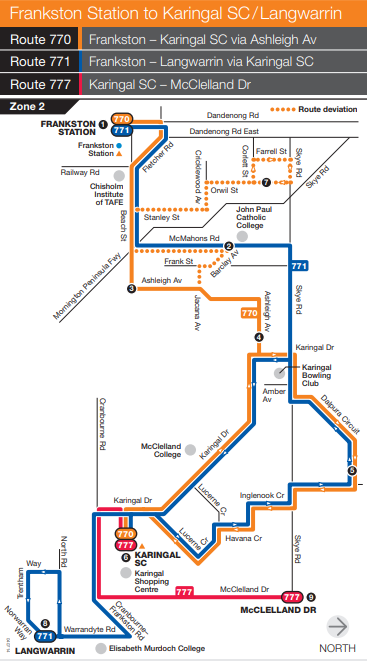

Both routes have large loops. Route 770 has a loop at its end with Karingal Shopping Centre about midway along the loop. Route 771 has a loop part-way along it, then a section of two-way running from Karingal Shopping Centre then a small loop at its end near its Langwarrin terminus. Also shown on the map is a 770 variant. This is an occasional service covering the Orwil St area very different from the regular Route 770.

You can see how it relates to the broader Frankston network from the map below. Interestingly it does not show the deviation crossing Frank St.


Patronage

Route 770 gets above average usage for a Melbourne bus route with 29 boardings per bus service hour. Its usage is relatively constant throughout the week, with similar Saturday to weekday usage and Sunday dropping slightly to 25 boardings per service hour. Strong weekend patronage is quite common in coastal areas such as Frankston. Older, often working class, middle northern and outer eastern suburbs often have much less weekend trading and bus patronage, particularly on Sundays.

Route 771 is a bit quieter with 22 boardings per service hour on weekdays, dropping to 16 on weekends. This is probably because the route is longer, extending into low density parts of Langwarrin where car ownership is higher and bus usage is less.  


Timetable

Both routes operate at close to minimum standards, that is 7 days per week until approximately 9pm. The main exception where service falls short is 770’s early last departure from Frankston on weekends (8:23pm).  

Headways are uneven. On weekdays Route 770 operates every 30 to 40 min during peak periods and around 50 to 60 minutes off-peak. Weekends are a flat hourly service. Two off-peak trips operate between Frankston and Orwil St – there is very little in common between that and the other Route 770 services except for the route number. 

Route 771 has a more consistent timetable. This includes a 40 minute frequency on weekdays and hourly on evenings and weekends. Even though it is the quieter route its last trips are later at night than 770’s last trips, with the difference greatest on weekends. 

Despite having roughly similar service levels, no attempt appears to have been made to evenly stagger departures from Frankston to provide a doubled combined frequency for those near both routes, even during peak times. The story is similar on weekends where, instead of offset by an even 30 minutes, the departures are offset by 20 and 40 minutes. This may have made sense when Frankston trains were every 20 minutes on weekends but does not now that trains run every 10 minutes. 


Conclusion

What would you do with 770 and 771? Would you swap them over in the Karingal area so that both routes are simple bidirectional services? Is there scope for better connectivity with the frequent Cranbourne Rd services? And should their timetables be tidied up to provide more even frequencies and offsetting to maximise effective frequencies for those near both routes? Please share your thoughts in the comment below.

PS: An index to all Timetable Tuesday items is here.

Melbourne on Transit bookshop

Favourably reviewed books about transport and cities. Purchases via these links support this blog and its independent reporting (at no extra cost to you).   


Friday, February 14, 2020

Building Melbourne's Useful Network Part 38: A Reservoir and Thomastown recap


Sometimes you describe something, look at it later and have second thoughts. These thoughts might have come from a conversation or a second look freshened by the passing of time. 

A recent example is Reservoir’s bus network. 

There's no doubt that the existing bus network west of Reservoir is very poor. Routes like 553 start from near they are finish and have deviations that duplicate other routes. Then there's the execrable 558, Melbourne's only bus that has a midday direction reversal where Saturday morning service goes the same way as weekday afternoon service. Its limited operating hours also deny areas west of Reservoir weekend service. 


I discussed one approach to fixing 553 and 558 two weeks ago in Useful Network 36.  I made 558 bidirectional and extended it to Northland via the Route 555 alignment. Route 555 was modified to replace 553, with it running to the latter’s Thornbury terminus instead of Northland. Route 526 was then extended eastward to Northland and then in a merger with the 550 to La Trobe University. You can see this in the map below.

While a simpler network it would have had its detractors. For example the popular Route 555 got a less popular southern terminus that’s really only of local rather than regional significance (like Northland is). And the 558, although straighter, remained with a weak northern terminus good for connecting with the 902 orbital but little else.

Sometimes casting one’s net wider can generate other ideas that lead to an overall better network.

Consider Lalor and Thomastown for instance. Areas east of the railway have buses running to a variety of destinations. For example Bundoora RMIT (566 and 570), Reservoir (556), Epping Station (556) and Epping Plaza (556 again but indirectly).

That is not so for those significantly west of High St. Local routes 554 and 557 run to Thomastown and Lalor. Route 357 to the north operates to Epping. However there are no connections to the south or east. That stymies access to destinations such as Coburg, Reservoir, La Trobe University and Northland. And what should be a one-change trip often involves two changes. This is because, similar to the Hadfield / Broadmeadows divide, there are no north-south buses. Instead the 357, which ought to be the north-south bus, turns to terminate at the minor but impressively stationed Thomastown, just like everything else in the area.  

A minor southern extension of the 357 to Reservoir would change all this.  Instead of alighting at Thomastown, waiting up to 20 minutes for a train and then potentially another similar wait for a bus, vastly more destinations would be available with a single change at Reservoir. These include Coburg, La Trobe University and alternative routes to Northland. Access to jobs in the industrial area near the M80 and connections to the 902 orbital SmartBus would become possible.

This alignment serves many areas away from stations and possibly justifies a 20 minute interpeak service given favourable catchment demographics. However it does not need to serve north and south of Epping. Instead the route could be split, with 357 operating to Wollert and an extended and upgraded 558 taking over Edgars Rd to operate between Reservoir and Epping. Then it would become a mirror image of the successful 556 along Dalton Rd east of the railway.

What are the implications of this for western Reservoir? There would be another route, which would be a major bonus for a historically underserved area. The 553 could be retained in a much simpler form with an extension to north-western Reservoir, serving areas that the 558 currently stops at. The 526 would still extend east to Northland while the 555 can retain its current alignment to Northland (but with an upgrade to an even 20 minute frequency).


Route 558 would be timed to meet trains at Reservoir, with its 20 minute frequency providing consistent connections. The portion north of Epping which remains as the 357, would connect with trains at Epping, preferably with a 20 minute offset with Route 356 to permit a combined 10 min peak/20 min interpeak service in the overlap portion (although note stop placement issues discussed here).

Conclusion

Presented is an alternative network for western Reservoir that also delivers substantial benefits for Thomastown and Lalor. It shows how time can change how one sees the network and the ideas one has for its improvement. If you have comments on it please leave them below.

An index to all Useful Networks is here.


Tuesday, February 11, 2020

Timetable Tuesday #61: Can we have weekday trains every ten minutes to Ringwood for almost nothing?


Today I'll try to answer a single question: "Can we have trains every ten minutes Ringwood for not very much while also boosting Belgrave and Lilydale service?". 

Why is this significant? On weekends the ten minute service already exists, at least during 'core hours' between approximately 10am and 7pm. The outer portions to Belgrave and Lilydale get a 20 minute service, which is normal for most Melbourne lines. 

Weekdays though are different. The Ringwood line is unusual. Like the 82 tram and a section of the 664 bus, there is a higher basic frequency on weekends than during weekdays (timetable extract below). However if the weekday timetable was fixed then Ringwood would join Dandenong and Frankston in offering a 'turn up and go' ten minute frequency during the day.


Labor's large 2018 win meant that the main belt of politically marginal seats shifted from the Frankston line to the Ringwood line. If either party wishes to win in 2022 we can expect promises  in areas including transport to favour those in Ringwood line seats. More detail than you'd ever want on worthwhile transport service initiatives for marginal seats appears here. 

I'll only talk about weekday off-peak services. Peak frequencies are higher. But there's a huge number of stopping patterns. PTUA looked over 2006 Connex timetables and found 13 unique stopping patterns. That's just in the outbound direction. And the real number would be higher if loop variations were included. Some details have changed since but the Belgrave/Lilydale line has not had a revamped simplified 'greenfields' timetable that Cranbourne/Pakenham and Frankston got (the latter resulting in large and mostly sustained punctuality improvements). That's worth another post. But in the meantime you can see the variation in the number of trains at different stations, partly due to the complex peak stopping patterns. 

Back to interpeak weekday trains.

There's more to it than this but the current timetable offers a basic 15 minute frequency to Ringwood with portions east to Belgrave and Lilydale operating only every 30 minutes. Missing a train at these stations will severely lengthen your trip. And 30 minutes is the lowest frequency on any populated part of the network and even inferior to the Geelong line (which sees interpeak trains every 20 minutes). As a partial trade-off there is express running at certain off-peak times (something unusual in Melbourne). However the time spent waiting offsets the time saved with express service unless you're dead lucky with the timetable.

All stations trains from Blackburn (every 15 minutes) serve the stations skipped by the expresses. The inbound expresses stop around midday then resume around 2pm with only the closer in stations skipped. This is because CBD-bound Alamein trains resume approximately 90 minutes earlier than starters from Blackburn.  Another complexity is the City Loop reversal; morning trains run to Parliament first, afternoon trains to Flinders Street first. Consequently there is no consistent pattern between the peaks like you have on (say) the Frankston and Werribee lines; the pattern you might have noted will almost certainly have changed two hours later. And again two hours after that.

Infrequent off-peak expresses - not as good as they seem

How much time does express running save for a trip to the city? The 10:47am from Belgrave takes 55 min to reach Parliament, its first CBD station. This is limited stop from Blackburn in. The 12:47pm from Belgrave takes 64 minutes to reach Flinders St (as the loop has reversed). This stops all stations except East Richmond. The 2:47pm is 62 minutes to reach Flinders St as the express running is confined to stations in from Camberwell.

The 9 minute gap between the off-peak express and stopping all stations is about 15 per cent of travel time. But that's only for trips all the way to the city. And it depends on whether the loop is for you or against you for your travel time and destination. Take out these factors and the express running time saving is less significant.

In contrast the 30 minute frequency is significant if a train has just been missed. For Lilydale a just made non-express train takes roughly an hour to do the 38km. As compared to 90 minutes for the next train after one has just been missed. Which translates to a very slow 25 km/h - a similar speed to a bus. The effect of higher frequency would have an even greater relative effect for shorter trips, such as to Ringwood or Box Hill. To summarise, if you wish to speed up travel look to frequency first. Only when frequency is high should one consider express running.

This latter philosophy applies on the Frankston line. Frankston is a similar distance from the CBD as Belgrave and further out than Lilydale. However Frankston gets three times the frequency, with a 10 minute midday service seven days per week. Frankston's lack of interpeak express service make travel slow but the high frequency covers a multitude of sins, especially for shorter distance trips.

Nearly everyone wins with the weekend pattern

Would the Belgrave/Lilydale lines be better off if interpeak service followed the weekend pattern?

I think it would be. While you'd lose the expresses you'd (generally) gain in frequency as below:

Belgrave: 30 > 20 min
Lilydale: 30 > 20 min
Ringwood 15 > 10 min
Alamein 15 > 20 min

The number of trains per hour would drop at some stations. However current timetables are uneven so higher on-paper frequencies can still mean longer than desirable waits. For example while Box Hill has 8 trains per hour in the morning interpeak, maximum wait times are 12 minutes. Whereas an even 6 trains per hour would drop this to 10 min, an overall better result. The diagram below shows the effect, with most stations facing shorter maximum waits with the weekend timetable than on weekdays.


The main instance where this isn't the case is with the very quiet Alamein line whose interpeak frequency would drop from 15 to 20 min. To see if this is an issue it's worth comparing the populations that get more trains versus those who get fewer. Train station boarding numbers are here: https://philipmallis.com/blog/2019/02/14/station-patronage-in-victoria-2013-2018/

They show that, comparing east of Blackburn versus the Alamein line, about seven times the patronage catchment would gain a 50 per cent increase in interpeak frequency as against the small number on the Alamein line who have a 33% reduction. Parts of the Alamein line have nearby frequent trams while others, such as Ashburton, could be compensated for by low cost bus upgrades such as extending Route 734 to Caulfield.


What about the costs?

I did a quick addition of train minutes inbound between 10am and 5pm (as measured at the CBD end). I got 2369 live train minutes (excluding the Alamein line Camberwell - Alamein) for trips between the terminus and the first CBD station (ie either Flinders St or Parliament).

For weekends I got 2583 live train minutes (again inbound only) for a 7 hour period. Although in this case I took an hour midday sample and multiplied by 7 as train frequencies are less earlier on weekends. The difference between the two is a bit over 200 in-service train minutes. Outbound numbers were not measured but should be similar. If I included the Alamein portion south of Camberwell the difference would be slightly less due to the Alamein interpeak frequency reduction.

Very roughly then we're talking a difference of about 400 to 500 in service train minutes per weekday counting both directions. To put that in context, that's about 8 hours extra service. Or about a 10% increase in interpeak service.

Since the Belgrave/Lilydale line is quite peaky and the peaks go longer than for other lines the increase in service counting peak, evening and weekend trains as a base is probably nearer to 4% if not less. As a proportion of all Metro train services in Melbourne this increase would equates to an increase in total train operating hours somewhere around 1.5% if not less.

That's not much to deliver a 10 minute turn-up-and-go interpeak service on the key line to Ringwood while boosting Belgrave and Lilydale service from near the worst on the network to the more normal 20 minute headway. Such a frequency would also support bus upgrades, such as boosting the 201 express shuttle from Box Hill to Deakin University to every 10 min and the 733 (Box Hill - Clayton only) from 30 to 20 min interpeak and the same for the 664 serving Chirnside Park, Croydon, Bayswater and Knox City.

Apart from the political appeal benefiting five marginal Labor seats (Bayswater, Hawthorn, Box Hill, Burwood, Ringwood) and three marginal Liberal seats (Croydon, Evelyn and Ferntree Gully) the cost would be much less than the boosting 20 minute lines like Mernda, Craigieburn and Watergardens from their current 20 to 10 minutes interpeak since these are coming from a much lower base.

Increasing service on those lines is also important but the costs are higher and you'd need to train far more train drivers. If you wanted something substantial yet quick to do before the 2022 election with the other lines (which mostly serve safe seats) for afterwards, you'd pick the Ringwood line first. And the momentum generated from this small increase (eg stepped up training for the extra train drivers needed) could be scaled up for other lines later.


Conclusion

Adopting the weekend timetable for interpeak weekdays would give an easy local win with improved service to a catchment of hundreds of thousands. That includes ten minute service to Ringwood and upgraded frequencies for Belgrave and Lilydale to consign today's half-hour waits to the history bin. It's not free but it's cheap. Since the suggested timetable already runs on the weekends there's no question about it not being feasible. And the politics stacks up as well!

What do you think? Please leave your comments below.

PS: An index to all Timetable Tuesday items is here.


Melbourne on Transit bookshop

Favourably reviewed books about transport and cities. Purchases via these links support this blog and its independent reporting (at no extra cost to you).