Tuesday, November 10, 2020

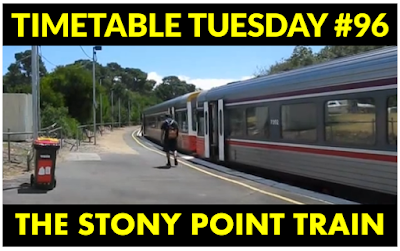
Timetable Tuesday #96: The Stony Point train and Baxter electrification


The Stony Point line has been in the news lately with its upgrade the subject of local advocacy, proposals and reports. The interest is in electrifying its inner part so that more frequent electric trains extend to a rebuilt Langwarrin Station or Baxter. 

Context and background

The desire to redevelop and revive Frankston's CBD appears to be a key driver of the project. Currently Frankston is in the position of being (i) a tired city centre whose traders complain about parking pressures, (ii) a rail terminus for Metro trains with a huge catchment, and (iii) a hub for numerous buses (and one train), spreading 30 or more km out, but often only hourly or less. 

Central Frankston, especially in the streets outside the Bayside shopping centre, is diverse but not in a fashionable or exotic way. People from other parts of Melbourne can freely make jokes about it (classism, unlike racism, is less challenged and can often pass as social commentary). A mix of reputation and vibe causes some middle class people to avoid Frankston in favour of classy Mornington, the villagey Mt Eliza, the more compact Karingal or even the autopic Power Centre. 

Frankston's Sunday market has long been in decline with COVID being the final nail in its coffin. Some main street shops have been empty for years, with too many graffitied roller doors abutting footpaths. Retail has really been struggling, with protracted roadworks and now COVID not helping. Yet Frankston remains a hub for government, business, technical education and social services. Along with a bit of nightlife and its role as a transport interchange. Its bay side location offers potential. And it's had some success with jobs when South-East Water built a big office tower on Nepean Hwy. 

Local hopes were raised when public transport in the Frankston and Mornington Peninsula area was considered a nationally significant priority by Infrastructure Australia (a fairly toothless federal agency with advisory power only). Transport, especially rail, advocacy has been one project of the Committee for Greater Frankston. Their thinking was that a rail extension could relieve parking pressure in Frankston CBD as commuters who currently park there could park further out, with CBD parking spots being freed for shoppers. 

Various proposals

The 1969 Melbourne Transportation Plan proposed a massive freeway program and rail electrification to Mornington and Hastings (both via Baxter). The reverse happened, with rail closures in 1981. An electrified rail extension to Baxter was proposed in 1988's MetPlan. However the Cain/Kirner Labor government ran out of money within two years of MetPlan being released. Public transport infrastructure entered a lost decade (or more) and the electrification never happened. 

Government finances subsequently recovered despite some high-profile cost over-runs along the way. The Andrews Labor government spent everything it could on level crossing removals, including many on the Frankston line. It built new rail stabling near Kananook to replace what was at Carrum (and more). 

In some cases though the willingness to spend money exceeded the ability to get good outcomes. For example Frankston got an unsatisfactory rebuilt station and a clumsily narrowed Young St that even to this day is insufficient to accommodate all bus routes suitably near the trains.  

The federal government sometimes contributes to public transport infrastructure projects. It did under Rudd/Gillard, stopped under the road-obsessed Abbott but resumed under Turnbull (a public transport enthusiast) and Morrison (who had an election to win). 

Baxter electrification was talked up in federal Liberal circles since the area had two marginal seats (Dunkley and Flinders) that were considered marginal before the 2019 federal election. A favourable redistribution helped Labor win Dunkley, while Flinders remained with the unexpectedly re-elected Morrison government. The 2018 federal budget pledged $225 million for Baxter duplication and electrification with an effusive Herald Sun story presenting its construction as a certainty.  

The state government, on the other hand, has expressed no interest in Baxter since the Liberals' defeat in 2014. Their support is essential for the project to proceed (the federal government's $225m being insufficient). Last week its Department of Transport released a preliminary business case for Baxter electrification (hosted on the Committee for Greater Frankston website). DoT considered various options involving electrification, an upgraded diesel service and/or bus. The Department doesn't seem that interested in the project as they haven't updated their website item on Baxter electrification to reflect the report's release.  

None of the bus options were much good with the basic hourly service frequencies proposed being little better than what currently runs. Travel might be faster but waits would still be intolerable, with marginal benefits overall. A Stony point diesel train upgrade would offer more benefits but at higher cost. Particularly the 30 minute option would be too weak to greatly lessen the incentive to park at Frankston to avoid an extra wait and transfer. Electrification options (both Baxter and Langwarrin considered) diverted car parking but carried much higher costs. 

I should mention that benefit cost ratio statistics can convey the impression of objectivity and be used as a tool to shut down debate or limit options 'because the numbers say so'. But in practice it can be massaged to reach a desired conclusion by underestimating costs and adding so-called 'wider benefits' (if you want the project to happen) or 'gold plating' with unnecessary scope additions that inflate costs (if you wish to quietly kill it).

Then there's the discount rate. That's basically a figure that reflects the time value of money. Due to assumed continued inflation $1000 cash now is worth more than $1000 in the future. There's also relativities against returns from other types of investment. 

Changing the discount rate can greatly affect the calculated economic viability of a project. A higher rate makes projects (especially big long term projects) harder to justify while a lower rate makes previously unviable project stack up (even though nothing about the project itself changes). Some people like the Grattan Institute says that the 7% discount rate commonly used is too high and we need to rethink it.  On the other hand, just two days ago, Grattan also said that transport megaprojects were often poor value and prone to cost over-runs. These should be a last rather than a first resort, Grattan said. 

Getting back to Baxter electrification, none of the options had a favourable benefit / cost ratio. Though some might regard the 7% discount rate as being high and the project's scope including aspects not strictly necessary (eg grade separations). And the poor bus options presented dealt that out of serious consideration.  Last week the Committee for Greater Frankston criticised the State Government's negative view towards the project with it labelling the business case as 'Orwellian'.

My own 18-point multimodal network plan for the Frankston area was described back in March. While detailed analysis has not been done this is likely to be relatively more cost-effective than some of the options that the Department of Transport considered.  

So much for future plans that may or may not happen. What's there now? There's basically two main  trunk public transport corridors on the Peninsula. These are the 788 bus on the Rosebud side and the Stony Point train line on the Hastings side. That's today's topic. 

The Stony Point line

The Stony Point service is a curious little line, running as an isolated diesel operation from Frankston connecting there to electric trains. It's a rare survivor since all other branch lines were replaced by buses. Stony Point actually met that fate in 1981 but had service restored in 1984. It serves suburban density areas including near Monash University (Leawarra), Baxter and Somerville. From there development becomes more scattered with the major centre, about half way down the line, being Hastings. The end of the line at Stony Point comprises little more than a caravan park, a general store, boat ramps and the departure point for the ferry to French and Phillip Islands. It's the only diesel service run by Metro Trains, using Sprinter trains from V/Line. The oddity of its operation makes it one of the first places you'd likely take a visiting interstate or international railfan. 

Stations along the way attract varying usage. For example Tyabb is the area's main antique centre while Crib Point attracts usage from the nearby HMAS Cerberus base. Morradoo, meanwhile, is a cemetry.  

There was a station at Langwarrin but that got closed in 1981. The surrounding road geometry was not favourable to good access from nearby houses and shops (including Karingal Shopping Centre). Just before the 2014 state election the Liberal government got PTV to hold a public drop-in session to discuss location options for a rebuilt Langwarrin Station. However the Napthine government lost power and the proposal got nowhere. 


Timetable

The timetables are below. Services are infrequent. If you trace the timetable you can see it is done with one or two trains (depending on day and time). From many locations the 782/783 buses, which run roughly parallel to the line offer a more frequent service. 


Services are irregularly spaced. Intervals are roughly 40 to 120 minutes, though it looks like that bunching has been done to try to coincide with peak times on weekdays. 

Operating hours vary by day.  An oddity is the early finish, especially from Frankston, on Monday to Thursday nights. The early finish, especially when combined with delays that can happen on the electric service, means that people in the city need to leave work only a little after 5pm to catch the last train to Stony Point. In contrast weekend services have their last train an hour later. Fridays have the latest finish of all with the last departure at 9:40pm.  Weekend services are roughly every two hours. Saturday has an extra trip and an earlier start though times for Saturday and Sunday are otherwise not necessarily identical. 

The Stony Point line's low frequency make a timetable essential. There would be many times when it's faster to catch the bus. Also where the trains are replaced by buses times can be unpredictable, though there have been occasions where the substitute bus has been much more frequent than the train. 

As for connectivity to the French Island ferry at Stony Point you can see what I wrote back in 2010 here. Since then the ferry has had some trips added. Careful comparison of timetables for both ferry and train is essential to avoid long waits. This is particularly where substitute buses are running. 

Conclusion

What are your thoughts on the Stony Point train? Should sections be duplicated to allow a higher frequency? Is electrification all or part of the way appropriate? Does there need to be a new or relocated station nearer the hospitals at Frankston? Or has it outlived its usefulness, as was thought in 1981? Please leave comments below. 

Index to all Timetable Tuesday items


Friday, November 06, 2020

Building Melbourne's Useful Network Part 69: The temporary COVID tram change we should have kept

This is fruit so low it couldn't hang any lower. It could almost be called windfall - there for the taking. It is so sweet that only the short-sighted could have ignored it. But that's what's about to happen when a temporary (and very good) reform to the tram network will be ditched on Sunday. 

Don't know what I'm talking about? It's about the streets that Tram Route 12 runs along in the CBD.  

If you said that Melbourne's tram network was pretty much stagnant you wouldn't be far wrong. Most  alive today would either be old or dead by the time it becomes fully accessible if the current rate is maintained. That's how slow recent progress towards accessibility has been. 

Maximum waits are still 30 minutes on most routes, network extensions are as far off as ever and we haven't even seriously optimised what runs now. And as you'll read later even when something is good is done there's a risk of it being retracted rather than continued. 

In short, Melbourne's tram network, though carrying only slightly fewer passengers than our trains, has no visible direction, champion or leadership. This is not helped by politics since most elections are decided in seats beyond the tram tracks. Many knew who Sir Robert Risson was. Pretty much no one  outside the industry can name the Department of Transport's secretary.

Trams have not kept up with our changing CBD. Consider the need to serve the apartments going up in the northern parts of Spencer St. Or the fast growth of Southbank, Docklands and Southern Cross Station. These factors have made a tram network revision essential rather than desirable. Especially one that can be done for little additional operational cost. 

For example Spencer Street needs its own tram route. It's the only key street in the CBD without one. Sure trams run along most of it but they keep turning off it. So you can't get a simple tram up it like you can with other corridors. This affects connectivity to regional trains and Skybus at Southern Cross Station.  

 Another structural issue with the network is the inability to easily get from northern parts of the CBD to Southern Cross Station. This is despite Melbourne Central Station being nearby. This is only sometimes useful for such trips due to the varying directions of the City Loop over the day and over the week. The journey can be completed with two trams but apart from the extra transfer it adds congestion to the busiest part of tram routes on Swanston and Bourke St. Pedestrian connectivity across Spencer St to Southern Cross from Bourke St isn't great either.

A change to Tram Route 12, introduced as a COVID-19 emergency measure, brought Melbourne closer to the simpler more connected network we need. The change, as announced below, moved Route 12 from Collins St (which shares other tram routes) to the less served La Trobe St. 


This temporary change had the following benefits:

* Better access to the rapidly growing northern end of the CBD by boosting service along the historically poorly served La Trobe Street.

* New travel options for Route 12 passengers, including the RMIT city campus and the western end of the CBD.

* A simple continuous service along the full length of Spencer Street 

* Improved access to regional trains, regional coaches, and Skybus at Southern Cross Station from the northern part of the CBD

The benefits are so great that the revised Route 12 should have been made a permanent part of the network. Instead passengers saw the following advice on the PTV website. 


Thus, in just two days, Tram 12 will have returned to Collins St and a very worthwhile network reform with long-term benefits will have ceased. 


It would seem that with trams even the smallest and cheapest of changes are just 'too hard'. Even if implemented temporarily there appears a lack of sense to retain those that are of enduring value like this example. Part of 'coming back better' should be to retain the good things that were done under COVID to make them permanent.  


Tuesday, November 03, 2020

When backing self-interest can come unstuck (Hearings from IBAC's Operation Esperance)


Public transport, or at least its management, has been in the news a lot lately. And it's been there for bad reasons. Many spent last week transfixed by IBAC hearings as part of Operation Esperance. 

Viewers heard riveting accounts of secret cash payments from cleaning contractors (Transclean) to transport managers, unauthorised extensions of contracts, shoddy cleaning work including during the COVID pandemic, betting syndicates with amazing returns, secret phones, shady job offers, multi-person money laundering, excessive chumminess, convoluted house financing deals, 'sprinkles', 'stuff' and more. Audio and video from house raids and covert surveillance made the coverage more gripping than your average hearing. 

The affair involves V/Line's CEO James Pinder and Metro Trains' Peter Bollas (Rolling Stock Manager). Both were suspended in August and formally sacked last week. V/Line also ended Transclean's contract while Metro is investigating internal probity processes. IBAC will continue to collect evidence and write its report. It remains to be seen whether evidence is sufficient for the pair and others involved, such as Transclean boss George Haritos, to be brought to trial.  

The case of James Pinder is particularly interesting. He is part of a large cohort of UK rail managers we have imported to run our trains in the last 20 years. The initial impetus for this was rail franchising which started in 1999. Even though V/Line has reverted to state ownership and Metro is Hong Kong owned, British overseers remain over-represented in a complex organisational hierarchy that I've previously suggested resembles colonial structures. 

Why wouldn't they stay? The rest of Australia disparages Melbourne's weather but we tell similar jokes about London's. Melbourne ranks in the world's top few cities for livability. And the pay's great, with the V/Line CEO (for example) taking home more than the state premier. 


International managers can bring world expertise to little provincial train systems. And introduce a drive, enterprise and objectivity that local bosses might have lacked. In plainer language that might mean cutting costs, ending over-staffing and lessening the unions' grip on how things are done. 

That was the plan anyway. V/Line's James Pinder, corroborated by Transclean's George Haritos, gave another perspective at the IBAC hearings. This was a personal view, based on what it is like to start work in a new country in which you know no one. 

Someone established here will have formed ties based on family, interests, clubs, sports, schools, ethnicity and/or community. Or at least some of these. They will have no difficulty in finding things to do or people to meet on their days off. A few friends may be work colleagues. But they are unlikely to be a majority of a person's social circle. And relationships with them would normally be, as is proper, purely social.  

Those listening last week heard that Pinder arrived in Australia basically friendless. His first, best and possibly only friends were met through work (then Metro Trains). Such a circumstance might not be uncommon in senior ranks where working hours are not conductive to hobbies, clubs or other interactions that could expand one's social circle to people outside work. 

Pinder would often go to the races or casino with his new friends. By far the most important relationship was with Haritos. At this time Transclean was in dispute with Metro. As part of the subsequent resolution, Metro's Andrew Lezala introduced Pinder (who was Metro's Rolling Stock Manager before Bollas) to Haritos. They soon found they had common sporting team interests and formed a close friendship. This was even though in work life they were on opposite sides of an increasingly lucrative contractual relationship. 

Pinder left Metro in January 2016 after about three years. He worked in his native UK for a bit then returned to lead V/Line in November 2016. His LinkedIn is here. The V/Line that Pinder inherited was in a bad state. The CEO position was only vacant as V/Line's previous boss left under a cloud of poor operational performance (the wheel slip affair) and corruption allegations (IBAC Operation Lansdowne). An incoming foreigner would be a cleanskin, with no chance of being associated with past internal problems.  

As the inquiry heard, the Pinder-Haritos friendship went beyond what most friendships would, especially given their work roles. Allegations of impropriety made headlines and TV news. Without being specific (IBAC's report will likely give the definitive account) the dealings were enough for V/Line's board to immediately sack Pinder and cancel the contract with Transclean. 

Watching the proceedings reinforced on me a potential loneliness that socially isolated foreign-recruited managers are prone to. This is due to their life revolving around work and people met through work. This opens them to a vulnerability that settled people with established roots may lack. Friendships may be few, tight and be mostly with people met through work. Under certain circumstances, such as where friendships cut across supplier relationships, the vaunted objectivity of an imported boss can give way to a partiality that affects the integrity of their work. Especially if combined with character flaws including greed, temptation and naivety (which job recruiters do not necessarily pick up). 

What one might call the 'lonely expatriate syndrome' cannot explain Metro's Peter Bollas situation in this. His evidence sparked some of the most sensational stories to come out of the Operation Esperance hearings. In particular the extra business opportunities due to COVID-19 and short-cuts when it came to not spraying trains. These angles provided a direct link between this affair and the state's number one ongoing news story for 2020. 


As for Transclean, the IBAC people listened incredulously when they heard about the extraordinary race picking ability of Haritos and his regular success with high-yield but low probability quadrellas. Listeners also came away astonished with the lengths taken, involving multiple payments and accounts, to finance the deposit on Pinder's $2.5m Williamstown house. It was all so complex that the broadcast hearings will resume on Friday to cover everything the Commission wanted to ask.  


IBAC will have a lot of work to do afterwards. All we can do is await their report and any subsequent action arising. But it would already seem from the hearings that neither the public interest nor even an ordinary duty owed to one's employer was necessarily uppermost in all minds at all times.  

Self-interest may have driven some. The problem is that, if less honourable forms of self-interest are exposed, it does not pay out. Indeed one might have to pay in. In the likely words of the Williamstown house auctioneer, "It's not where we start that counts but where we finish". And a pathetic end to one's career is far far worse than a pathetic start since the currency is time and that's unredeemable.