Sunday, August 25, 2019

Wynbus first day tomorrow

This is a quick post. I won't discuss the ins and outs of minibuses, non-integrated fares, location of the last stop, overlap with PTV routes, infrequent service or long-term sustainability.

But I still thought it was worth at least mentioning this transport initiative which sprung out of last year's pre-election 'Pick My Project' thing. Basically people could suggest things that if they got enough support could get a bit of government funding. 

One of the successful projects was Wynbus, a demand responsive bus service for Point Cook; a  fast-growing suburb the size of a rural city with just a handful of congested roads connecting to the outside world. 

Anyway it starts tomorrow. Some information was contained in a report on tonight's Ch 9 news. 

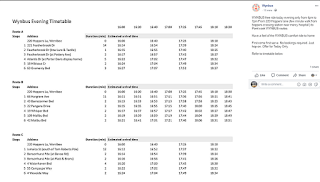
For those of us used to route maps and timetables, information on the new service is sketchy. But eventually I found some times and stopping locations on their Facebook page. This is below. 


This indicated three routes terminating in Hoppers Lane five or ten minutes walk south of Hoppers Crossing Station via a busy, pedestrian-hostile intersection. The travel times seemed very short compared to PTV's recently upgraded Route 498 (although that does go further - to the station proper). 

However my appetite was not satisfied until I saw a map. I created my own from the stop addresses above. It is below. 


Each route has 6 pick-up stops. Routes A and B are south of Sneydes Rd while Route C runs nearer the freeway. Some stops will be closer peoples homes than the regular PTV network (map here). But it does serve some gaps that PTV routes don't quite (though there are typically some within 800m). 

Note that the above is for am peak only. There is an interpeak service and pm peak services also.

Later on, browsing their Facebook page and scrolling down I did find some route maps. This is what they look like.


The Channel 9 report mentioned that Wynbus will run for a 6 week trial, with the cost favourably compared to how much a parking space at a station costs. It will be interesting to see how it goes.

UPDATE 26/8/2019: Wynbus have published their afternoon timetable. Free travel without a need for booking is being offered. There are also much longer run times (the mornings appeared short). They make the northernmost stops on Route C (in particular) less time competitive than alighting at Williams Landing and simply walking.


You might enjoy these well-regarded books on transport topics

Better Buses, Better Cities: How to Plan, Run, and Win the Fight for Effective Transit Steven Higashide NEW!

The Public City: Essays in honour of Paul Mees Gleeson & Beza

A Political Economy of Access: Infrastructure, Networks, Cities, Institutions (Access Quintet Book 4) David Levinson

Human Transit: How Clearer Thinking about Public Transit Can Enrich Our Communities and Our Lives Jarrett Walker

Transport for Suburbia: Beyond the Automobile Age Paul Mees

(Sales links: I get a small commission if you buy via the above - no extra cost to you)

Friday, August 23, 2019

Building Melbourne's Useful Network: Part 17 - Melbourne Airport (it's all about Sunshine)


The construction of a railway to Melbourne Airport is planned to start in 2022. It is expected to take up to 9 years. By that time Melbourne's population will have added nearly 2 million more people to hit 7 million. Much of that growth will be north and west of the CBD.  

Melbourne Airport is tipping even greater growth, with a doubling of passenger numbers expected in the 20 years from 2018

With this projected growth and Airport Rail not coming until the decade after next, there's a need to rethink the airport's public transport network. Not just as a stop-gap measure until Airport Rail starts, but also long term to better serve surrounding areas that Airport Rail won't benefit.

This is what I will attempt in today's Useful Network. 

Existing Useful Network

Ten years ago there was no useful public transport to Melbourne Airport. There were just occasional buses to a few places, with multi-hour gaps between trips. At the time I suggested some upgrades here

And there were improvements, starting the following year. Most significant is the SmartBus 901 orbital via Broadmeadows and Epping to Frankston. You can see this on the map below (7 day interactive maps here). 


Other regular bus routes operate from Melbourne Airport. These include 478 and 479 to Airport West and 479 to Sunbury. They're also better than they were 10 years ago with an upgrade in 2014. But they're not yet up to a Useful Network frequency and service level (explained in more detail here). 

Despite its size Melbourne Airport's public transport has just one frequent route from one direction - far less than major destinations like Chadstone and Monash University or smaller hubs like Coburg or Mentone. Even the much smaller Adelaide airport has better local bus connectivity with its surrounds. 

My assessment omits Skybus to the CBD. This express service operates frequently day and night. However it is not on the myki ticketing system. The premium fare makes it unsuitable for budget travellers or low-income airport workers. Neither is it fast for local trips where backtracking is involved like to Broadmeadows or Niddrie. Skybus also runs to other destinations like Werribee and Frankston but at lower frequencies. 

Public transport versus driving speed

Melbourne Airport has a metropolitan (and indeed statewide) catchment. Its service area is bigger than any university or shopping centre. A change to a less-than-frequent train at Broadmeadows (not frequency harmonised with the bus) helps for some destinations to the north and south. However, despite its importance, the airport is  not reasonably accessible from many other directions. And even if you factored in the CBD Skybus, the geometry makes it poor for access to surrounding areas.

How does public transport (as it currently exists) compare with driving to the airport from surrounding areas? I  used trip planners to compare travel speeds. The 'snail map' below shows public transport travel time as a ratio of driving time from selected locations.


Origins without snails have quite fast public transport access. Often because there's a direct route or a single change only. Places with big snails have the slowest access.  More detail is in the table below. I used the average for each mode to determine the ratio.


The above numbers don't include parts of the trip time for both driving and public transport. For example driving time excludes time spent parking and subsequent access to the airport. Public transport time excludes the wait for the first trip. Also the effects of low frequency have been omitted. This is most notable for Sunbury which has only two trips to the airport on Saturdays. In all cases starting locations are train stations or tram stops, except for Caroline Springs where it's the town centre. The overall effect is that, if anything, this comparison favours public transport. Include these factors and actual ratios will be higher than given.
 
Slow from Sunshine

Where are the Irish joke origins?

That is the places you wouldn't want to start from if going to where you wanted to go - in this case the airport.

Sunshine stands out.

People can run from there to the airport much faster than any regular public transport option. The latter is both indirect and requires a minimum of two changes.


Sunshine is not only an important place in its own right. It's also a major transport interchange. All the state's busiest regional rail lines go through there. As do major metropolitan train and bus routes.

What about the other 'snails'? The other two big ones, Tarneit and Caroline Springs, have direct train or bus routes to Sunshine. As does Melton. So if you sort out Sunshine you'll improve airport access from all of these locations plus others like Watergardens, Altona North and Footscray.

Greensborough is also quite slow, even though a one-seat bus ride from the airport is available. Because this route is indirect the fastest way involves a change of buses. But this doesn't have to be so and travel could be faster. Coburg also has potential for improvement, but that's longer term. More on both later.

Speeding things up with a better Useful Network

What could an upgraded Useful Network for Melbourne Airport look like?

Here's a list, in order of priority.

#1. New bus route 500 Sunshine - Melbourne Airport. Limited stop. Every 20 minutes Monday - Sunday with wide operating hours, timed to connect with trains from Geelong at Sunshine. This service would support growth of the Sunshine National Employment and Innovation Cluster, bringing forward some of the benefits expected to accrue from airport rail. Equally important is improved  airport access from a large catchment (including many regional rail lines) where it is currently difficult.

A 10 to 15 minute train-bus interchange time allowed at Sunshine would assist the less mobile, those with luggage and provide a buffer for minor train lateness (reliability being more important than speed for to-airport trips).

This route would operate until 2031 or whenever airport rail starts. It would likely need 4 to 6 buses to operate. Much of Melbourne's west (and beyond) would benefit, including Tarneit, Wyndham Vale,  Geelong, Melton, Caroline Springs,  Deer Park, Watergardens, Altona North, Footscray and more. This is top priority with the wider travel time savings summarised below.


I haven't mapped the route. I'd go with the fastest between the termini. There would be few (if any) intermediate stops. This is because good speed is desirable and no intermediate stop is likely to attract more than a fraction of the patronage of the two end stops. But if they're on the way you might have a couple of stops in the industrial area before the airport and one or two nearer Sunshine. The 40 to 50 minute bus travel time estimate from Sunshine is conservative and is higher than the longest car travel time indicated above. It could be more during peak times but is likely to be less at most other times.

#2. Swap routes 902 and 901 at Broadmeadows so that Route 902 goes to Melbourne Airport and 901 to Airport West.  This would speed access to the airport from Greensborough and thus the Hurstbridge line. Easy connections will be possible to the 86 tram and thus the La Trobe National Employment and Innovation Cluster (including the university and an international student market). Swapping would also pave the way for future improved Upfield line connectivity - see later.

Apart from transition expenses, this change is cost-free. It would not increase the amount of service kilometres nor deny any stop a SmartBus service. A change will continue to be available at Broadmeadows for those who need it. However adding after 9pm Sunday evening service, even if a single bus shuttling between Melbourne Airport and Broadmeadows for a couple of hours, would be desirable to avoid people being left with no service to anywhere.


#3. Upgrade and simplify bus route 478/479. Operate all trips (including short-workings from Airport West to Melbourne Airport) as Route 479 so people have only one route number to remember and frequency is better communicated. Increase service to provide 7 day 20 minute frequency between Airport West and Melbourne Airport. Areas like Essendon and Moonee Ponds would be the biggest beneficiaries, with an easy connection to Tram 59 at Airport West. This would be time-competitive with Skybus, which requires an indirect trip via the CBD.

While a lower priority, the Sunbury portion could increase from every 60 to every 40 min, providing better connectivity with local buses (which, like the train operate on a basic 40 min pulse). A weekend frequency upgrade would also be desirable. This upgrade would require 1 or 2 extra buses to operate, depending on what is done at the Sunbury end.


#4. New bus route 416 Caroline Springs - Melbourne Airport. Route could overlap Route 418 alignment until Arthur St then continue east via Green Gully Rd, Keilor and Old Calder Hwy to Melbourne Airport. If operated every 40 minutes the times could be staggered with Route 418 to provide a combined 20 minute Caroline Springs - Keilor Plains - Keilor Shopping Centre service.

This is the lowest priority as Caroline Springs already gains from the new Sunshine route and this route may not be well used. Still there are local network benefits. For example it would connect Keilor to its nearest station and shopping centre. And Caroline Springs  Town Centre would gain a more frequent connection to the Sunbury line at its closest point. You might commence this service when Airport Rail starts, using resources no longer needed for Route 500.

Associated rail service upgrades, rail infrastructure upgrades, information and marketing

The above are all bus network changes. The following train service and infrastructure upgrades would complement these and improve connectivity to the airport.

#1. Stop Bendigo trains at Sunshine. This will allow improved connections to other trains and buses including the 500 bus to the airport.

#2. Upgrade weekend Geelong line trains from every 40 to every 20 minutes. As well as being highly desirable on its own (due to crowding) this would enable a high quality airport connection at Sunshine to the 500 bus (above).

#3. Construct a new station at Campbellfield on the Upfield line with convenient access to the 902 bus.  In conjunction with the airport swap (see previous) this would aid local network connectivity including to Melbourne Airport. The timing of this is not critical.

#4. Adequate information and promotion. PTV isn't strong at explaining and promoting bus services, especially as part of a multimodal network. Recent marketing has been creative but single modal, poorly targeted and sporadic. Even though a service every 15 minutes is qualitatively different to and more useful than one every 60 minutes for some reason they don't highlight the former and sell its benefits to drive patronage growth, which recently has been feeble.  Information at major interchanges is also limited compared to cities with more advanced network thinking, like Perth.

Because most people only travel to the airport occasionally promotion and information are important if this network (particularly Route 500) is to be successful. On-system information needs to be good and enduring, not only at the termini but also over a broad section of the western suburbs and Geelong within an easy connection to it. Online marketing, including through website, app, social media and journey planning channels, needs to reach other potential passenger segments including airport area workers who live locally and budget travellers, leaving time-poor and price-insensitive  passengers to the existing faster Skybus services.

Relationship with Airport Rail and the Suburban Rail Loop

All the above network improvements are designed to build patronage for, and eventually complement, Airport Rail. When that starts the Sunshine - Melbourne Airport bus route would no longer be needed, at least at its suggested service level. It could either be deleted or kept as a lower frequency all-stops service to connect areas away from stations if intermediate stops prove well used. Any buses saved could be put towards new or improved routes from surrounding areas that airport rail does not directly serve such as Caroline Springs (416 above), Keilor East/Essendon (Route 465 extension) or Greenvale/Craigieburn (new route).

Not only could the Sunshine - Melbourne Airport bus be considered to be the first step towards Airport Rail, but also a first step towards Sunshine - Broadmeadows connectivity culminating in the Suburban Rail Loop. This trip starts off by being bus to bus, then train to bus, then, finally, train only. Again the early presence of bus access shapes peoples mental maps of places they can get to and thus life decisions like where to live and work.


When can we have it?

Processes for introducing new bus routes are currently slow. These include not only the need to appoint a bus operator, procure buses and recruit drivers, but also a lot of 'back-end' data work with PTV. All that might normally take a couple of years. But if funding was available and there was a determination to fast-track the service, the flagship Sunshine route could be up and running sooner.

In any event a high-profile and well-promoted airport bus network that's operating by the 2022 election would show that the government is serious about airport transport, access to jobs, inbound tourism and connecting the state. It would also boost its credibility when it comes to bigger plans like the on-again/off-again airport rail, which has been the butt of public cynicism for years.

Conclusion

The network presented would greatly improve airport access from a large part of Melbourne's northern and western suburbs. Instead of being up to 4 times slower public transport may only be twice as slow as driving. While still slower, public transport has other benefits that may still make this a reasonable trade-off for people such as students, budget travellers and local airport workers. Even though most of the latter will likely continue to drive, the size of the airport precinct workforce could still mean patronage even if only a small percentage opt for the bus.

The Sunshine - Airport bus, in particular, could induce a culture of using public transport to the airport, especially from places like Melton, Tarneit and Sunshine. Its implementation would effectively build up the travel patterns of Melbourne Airport Rail so that when it starts there is already an established passenger base that just needs to switch from bus to train.

The above upgrades would require 6 to 8 new buses operating 7 days per week. Is this a far-sighted visionary upgrade that sets us up for the future? Does this network  represent good value for money? Or is it distributionally regressive, compared to if we used these buses elsewhere? Maybe there's routes and connections I've missed.

Please use the box below to leave your comments. Better still, if you want something like this  email
Public Transport Minister Melissa Horne MP or your local member in St Albans, Tarneit, Kororoit, Werribee, Niddrie or Essendon to let them know the difference improved airport buses would make.

PS: Want to see expanded Useful Networks in other areas? An index to them all is here.

Tuesday, August 20, 2019

Timetable Tuesday #36: Thirteen Melbourne bus routes that most deserve Sunday service


With few exceptions, no Sunday buses ran in depressed 1990s Melbourne. If you weren’t near a train or tram you could rarely 'Get The Met' on Sundays. Even Saturday afternoon travel was often difficult. Trains worked for city trips but anything else required sometimes long in-out travel via near-CBD stations.   


Improvements to some routes from 2002 and a more comprehensive minimum standards program from 2006 introduced (and in some cases restored) Sunday service on buses in most residential areas of Melbourne.  

The upgrades sparked a patronage boom as more people found buses useful. Sunday buses facilitated retail trade and meant that, with transport alternatives existing, turnover growth could outstrip parking space provision. 

Good though they were, the improvements did not happen in order of merit. For instance, the quiet back-street route 701, serving a middle-class catchment between Bentleigh and Oakleigh, was in the first round of upgrades in 2006. Whereas the busy highway route 800, serving major shopping centres and with a large high-needs catchment in Noble Park and Dandenong, missed out. Not only then but also in each of the thirteen state budgets following. 

Why was this? 2006 was an election year. Bentleigh is normally a marginal seat whereas those towards Dandenong aren't.  Maybe that had something to do with 701 getting first priority? Although you can't attribute it all to electoral politics; even in the same area minor routes like 625 and 626 got Sunday service well ahead of the main road route 703 between Bentleigh and Brighton. Whatever the reason, some major ‘unfinished business’ remains. 

Buses benefit people

Numbers like patronage and trade aren’t the only outcome of bus service improvements. 

Underneath each statistic is a human story. Jobs. Education. Relationships. Buses are great enablers. They broaden what people can wish for and reasonably achieve. If you want a better society where people can be the best they can be then improved buses must be part of the solution. For more people in more places. Over more of the day. On more days of the week. More about this here

Completing the 2006 plan

The 2006 Meeting our Transport Challenges program of bus upgrades remains incomplete. Faced with a higher political imperative to fix overburdened railways that voting commuters couldn’t rely on, the Brumby government cancelled 1.3 orbital bus roll-outs, welched on fully implementing most of the bus network reviews it commissioned and slowed minimum standards bus timetable upgrades. The emphasis shifted to rail infrastructure (eg RRL) and services, with new train timetables introduced on some lines. Oh, and sorting out the then embarrassing but now good enough myki ticketing system. 

While all this was happening Melbourne added a million people. Most are in fringe suburbs beyond walking distance of trains.  Which brings us back to buses and the need to improve them. After all it’s nearly ten years since the fast pace of bus routes gaining Sunday service between 2006 and 2010 gave way to the slower progress since. 

Today's priorities

Where should we start? One could find at least 40 or 50 suburban residential area bus routes without Sunday service. But some are likely to get more use than others.  

What if you could only pick a dozen or so routes to give Sunday service to? Which upgrades would serve the most jobs, homes and passengers? It would also help if the routes are well used on other days of the week, particularly Saturday, so that good usage on Sunday is almost guaranteed.  

Here’s my pick. I’ll start with what I think should be top priority. I'll say a bit about each route and the value that adding Sunday service could provide.  


#1. Route 800

This highway route, running past premier Daniel Andrews electorate office, has to be top priority for Sunday service to be restored. Route 800 had Sunday service until 1990/91 cuts slashed timetables for it and other routes. Route 800 operates between Chadstone and Dandenong along Princes Hwy, areas subject to parking pressures during busy times (including weekends).  It serves high bus-using catchments including Monash University students around Clayton and low income residents around Noble Park and Dandenong. 800 currently operates every 20 minutes on weekdays, every 60 to 120 minutes on Saturdays and not at all on evenings and Sundays. The services that do run are well used, making it an excellent candidate for upgrade. More on 800 here.


·    #2. Route 536

Route 536 operates between Glenroy and Gowrie. Serves a large residential area (northern Glenroy) with no Sunday bus service. Current usage on the days it does run is very strong. Again Sunday service operated before the early 1990s cuts.  Most of the route operates in the seat of Broadmeadows, held by Frank McGuire MP.


·      #3. Route 506

Operates between Moonee Ponds and Westgarth along Dawson St and Glenlyon Rd, this is a well-used and direct east-west route. Catchment has low car ownership and high usage of north-south train and tram services. The route is centred on the marginal seat of Brunswick, held by Tim Read MP. More on Route 506 here


#4. Route 885

Operates between Glen Waverley and Springvale. Runs parallel to the busiest part of the Route 902 SmartBus orbital but serves unique catchment on Wanda St, Mulgrave. It wouldn't normally rank this high but the Springvale area catchment is good for bus usage. Like Route 800, the 885 serves the premier's seat of Mulgrave. 

#5. Route 281

The 281 goes between Templestowe and Box Hill. It serves two large shopping centres (both active on Sundays) plus Macedon Square and Templestowe Village. 281 also connects Doncaster and Box Hill to major hospitals in Box Hill just beyond easy walking distance of the station. It is a popular and direct north-south route with unique coverage on High St (the overlapping 309 runs only occasionally off-peak). An upgrade would be cheap if done in conjunction with reforms to other routes one of which already has Sunday service.   It would benefit the seats of Bulleen (Matthew Guy MP) and Box Hill (Paul Hamer MP).   

#6. Route 804

Part of a complex trio of routes (also including 802 and 862) between Chadstone, Oakleigh, Monash University Clayton, Dandenong North and Dandenong. Serves very strong bus trip generators such as Chadstone and Monash University Clayton, whose bus interchange is surprisingly active on a Sunday. Passenger catchment includes significant numbers of low car owning households around Clayton (often university students) and low income earners around Dandenong. The related Route 802 has an even more limited service with nothing operating much after 6pm weekdays, Saturdays or Sundays. Route 804 serves several seats, including Mulgrave (again), Dandenong (Gabrielle Williams MP) and Oakleigh (Steve Dimopoulos MP).   

#7. Route 814

Route 814 operates between Springvale South and Waverley Gardens Shopping Centre. It doesn't look much on a map but runs through high bus usage areas around Springvale. The current timetable lacks weeknight, Saturday afternoon and Sunday service. Route 814 is discussed in the Greater Dandenong Useful Network item here. The route serves the seat of Keysborough held by Martin Pakula (Martin Pakula MP) and (once again) the premier's seat of Mulgrave. 

#8. Route 559

A unidirectional loop route that serves an older low-income and high bus using catchment in Lalor and Thomastown. Serves the busy Lalor shopping centre and local stations. The current timetable lacks weeknight, Saturday afternoon and Sunday service. Only a single bus is needed to provide a 20 minute service. Route 559 is in the seat of Thomastown represented by Bronwyn Halfpenny MP

#9. Route 284

The 284 is the only connection to Balwyn North from Box Hill, a busy rail hub, tram terminus and shopping centre. It also operates to Doncaster Park & Ride. It is the only north-south transport in a large area. This is especially so on Sundays with a 4km gap between north-south public transport routes (nothing between Normanby Rd, Kew and Elgar Rd, Box Hill North).  Parliamentary seats include Box Hill (Paul Hamer MP) and Kew (Tim Smith MP)

#10. Route 404

As a direct route, the 404 is the fastest way to get from Footscray to Moonee Ponds (alternatives like the 82 tram and the 472 bus are indirect). It also serves dense housing at Kensington Banks. Apart from the addition of Saturday afternoon service a few years ago, current bus timetables do not reflect this land use change. Hence Route 404 has potential for higher usage as discussed in the Footscray Useful Network item here. Parliamentary seats served include Footscray (Katie Hall MP) and Essendon (Danny Pearson MP)


#11. Route 612

A neighbourhood route running via Camberwell, the 612 operates between the major 7-day destinations of Box Hill and Chadstone, which suffers major weekend parking pressures. Most areas served are near trains or trams but the bus connects places the other modes don't. Serves the marginal government constituencies of Box Hill (Paul Hamer MP) and Burwood (Will Fowles MP).  

#12. Route 503

This is an east-west route in Melbourne's inner northern suburbs. It connects Essendon to Brunswick East via Albion St and Anstey Station. It has not had a significant service improvement for decades. However housing density in the area is increasing and a higher than average number of residents don't own cars. Route connects the seats of Brunswick (Tim Read MP) and Essendon (Danny Pearson MP). More on Route 503 appears in the inner north Useful Network item here

#13. Route 414 

Runs from Footscray to Laverton it has a large industrial catchment. But there are also substantial residential areas. These include the southern portion of West Footscray and parts of Laverton just beyond walking distance of the station. The latter contains many low income households with high social disadvantage. Sunday usage could be further increased if the route was reformed, for instance run via Altona Gate Shopping Centre.  More on Route 414 here. Local seats include Williamstown held by Public Transport Minister Melissa Horne MP, Footscray (Katie Hall MP) and Altona (Jill Hennessy MP).


Conclusion

Presented is a bakers dozen bus routes that should be top priority for new or reinstated Sunday service. All are well used. All serve catchments that would use the added services, either due to the route's existing patronage, favourable demographics or high population density.

A surprising number are in the premier's seat of Mulgrave. This is because the MOTC  upgrade program of about 10 years ago missed many local routes around Springvale/Dandenong despite their strong existing patronage and area's high social needs. Some other routes listed, particularly in the eastern suburbs, serve marginal electorates. The members listed, or those from other parties wishing to snatch them might wish to make Sunday buses part of their campaign.

What do you think? Is this a good list of bus routes that should get Sunday service? Are others more important? And should some on the list not be there? Your comments are appreciated and can be left below.

See other Timetable Tuesday items here