Thursday, August 10, 2023

UN 161: Top priority bus upgrades for Chadstone

Last month, armed with new statistics from the DTP, I looked at Melbourne's most productive bus routes on a passenger boardings per hour basis. Then last week I listed 39 routes that were more productive on weekends than weekdays. Differences were so high that you could double the weekend service frequency on many and still have productivity similar to weekdays, even assuming conservatively low demand elasticity.

Charting Transport analysis released on Tuesday showed that weekend day bus usage in Melbourne had risen from 48 to 68% of normal weekday usage in just three years, the fastest rate of any city surveyed. This shift means that weekends should now be top-of-mind when it comes to how we allocate service resources. Especially given how our bus frequencies collapse on weekends relative to trains (and trams) which hold up 6.7 days per week. 


Where do we start? I took the top 15 out of the 39 really productive weekend routes. The cream of the cream as if it were. Of that 15 no less than 8 (900, 625, 626, 623, 903, 862, 804, 742) served Chadstone Shopping Centre. 

Thus of the big shopping centres, Chadstone has a special place when it comes to attracting passengers to buses. Not only due to its sheer size and number of jobs but due to its off-rail location that makes buses the only public transport there. Driving and parking are also a hassle, making buses, provided they run frequently, a real option. Especially for its youthful and often student workforce (who typically have less flexibility with times than leisure shoppers). 

And here's the rub. Too few of them do, especially on weekends where bus services fall off a cliff, being one-half or even one-quarter what they are on weekdays. And, despite upgrades about 15 years ago, a significant proportion of routes still don't run 7 days, or have gaps of up to 2 hours between buses. 

All this is despite the benefits of higher frequency, especially off-peak. These are likely highest in busy places where there are parking pressures, young minimum-wage workers without cars, and a large student demographic in surrounding areas. Chadstone ticks the boxes on all counts. Plus boosting service on Chadstone routes has direct benefits for areas as far away as Dandenong, Box Hill, Cheltenham and St Kilda.      

Existing service conditions

Here's the current state of play for bus routes in Chadstone. Data is in the following format: Route number/Midday weekday frequency/Saturday frequency/Sunday frequency/evening service. 

612 30/60/no service/no service
623 30/60/60/to 9pm
624 30/60/60/ to 9pm
625 30/60/60/ to 9pm
626 30/60/60/ to 9pm
627 30/40/40/ to 9pm
742 30/40/60/ to 9pm
767 20/30/40/ to 9pm

800 20/60-120/no service/no service
802 40/no service/no service/no service
804 40/60-120/no service/no service
822 30/40/60/to 9pm
862 40/60/60/to 9pm
900 15/20-30/30/to midnight most nights
903 15/15-30/30/to midnight most nights

Chadstone area routes can be divided into three rough service categories: 

1. SmartBus. Melbourne's premium bus offering. Long operating hours, every 15 minutes weekdays but up to 30 min gaps on weekends. Include the east-west 900 and the north-south 903 orbital. 

2. Regular routes. Operate 7 days until about 9pm. Mostly every 30 minutes weekdays, dropping to about hourly on weekends. Include most routes listed eg 623, 624, 625, 626, 627, 742, 767, 822 and  862. 

3. Low service routes. Typically operate every 20 to 40 minutes on weekdays, falling to every 60 - 120 min on Saturdays with short operating hours. No Sunday or evening service. 3 of the 4 routes (800, 802 & 804) operate to Dandenong, indicating the extent to which successive governments have taken bus users for granted in historically 'safe' seats like Mulgrave and Dandenong. 

Not one of these routes, even the premium 900 and 903, have maximum waits reliably less than 30 minutes. There are some shorter intervals but are too uneven or occur too briefly to be sellable. 900 and 903 lag similar premium routes in Sydney, Brisbane and Perth which typically offer 7 day service every 10-15 minutes. 

Some routes overlap to provide a frequent service but you can't count on it. An example is Princes Hwy Oakleigh East's service dropping from a high (but uneven) 7 buses per hour on weekdays to a low 1 per hour on Sundays due to just one of its 4 routes (800, 802, 804 & 862) operating 7 days. Chadstone to Oakleigh Station does enjoy a frequent 7 day service as measured by buses per hour but not as experienced by passengers as it is difficult to find when and where the next suitable bus departs.  


See the weekend service cliffs for all Chadstone's bus routes here: (click for better view). 


Prefer to see the more frequent weekend routes on a map? It's simple as weekend service to Chadstone is so sparse. Using the Sunday interactive frequent network map just one corridor from Chadstone consistently runs every 20 minutes or better on weekends. And that is a combined corridor of multiple routes to Oakleigh Station. Thus the only people with good network connectivity to Chadstone on weekends are those along the Dandenong train line who can change to a bus at Oakleigh. And even that is undersold due to complex or missing passenger information at the Chadstone end.  


Potential upgrades in four steps

Presented is a four step program that would transform bus services to Chadstone from a wide surrounding area. Highest priority is given to maximising service on existing productive routes and working the existing fleet harder. Then attention turns to simpler reformed networks and speed improvements to enable further cost-effective gains. Ultimately it would get main routes to run every 10 minutes and secondary routes every 20 minutes, seven days per week, providing vastly better accessibility than exists now.  

Comprises service upgrades that ensure all routes to Chadstone have basic 7 day 'safety net' service at least hourly until 9pm. Would require the following low-cost timetable upgrades: 

* Route 612 Box Hill - Chadstone 
Extend weekday operating hours to 6am - 9pm
Extend Saturday operating hours to 7am - 9pm
New Sunday service 8am - 9pm (every 60 min)

* Route 800 Dandenong - Chadstone
Extend weekday operating hours to 6am - 9pm
Extend Saturday operating hours 7am - 9pm & increase frequency
New Sunday service 8am - 9pm (every 60 min or better)

* Route 802 Dandenong - Chadstone
Extend weekday operating hours to 6am - 9pm
New Saturday service 7am - 9pm (every 60 min)
New Sunday service 8am - 9pm (every 60 min) 
Note: Weekend service coscheduled with 804 and 862 for combined 20 min service

* Route 804 Dandenong - Chadstone
Extend weekday operating hours to 6am - 9pm
Extend Saturday operating hours 7am - 9pm (every 60 min)
New Sunday service 8am - 9pm (every 60 min) 
Note: Weekend service coscheduled with 802 and 862 for combined 20 min service

These low-budget measures are worthwhile and particularly help notoriously underserved Dandenong. However they fall short of delivering the step change in accessibility from multiple directions that Chadstone really requires. This is why we also need .. 


Many Chadstone routes operate half as frequently on weekends than weekdays. This does not make sense given how popular these routes are on weekends.

This step upgrades weekend services to match weekday off-peak frequencies on six key routes. They would result in intervals between buses on most routes improving from 30 - 120 minutes to 15 - 30 minutes. Somewhat longer operating hours (Eg evening finishes about 1-2 hours later and weekend starts similarly earlier) would also be desirable on some routes. The following is proposed: 

* Route 623 St Kilda - Chadstone - Glen Waverley
Boost weekend service from 60 to 30 min to match weekdays/longer hours

* Route 625 Elsternwick - Chadstone
Boost weekend service from 60 to 30 min to match weekdays

* Route 626 Brighton - Chadstone
Boost weekend service from 60 to 30 min to match weekdays/longer hours

* Route 800 Dandenong - Chadstone
Boost weekend service to every 20 minutes/further extended hours

* Route 900 Caulfield - Chadstone - Rowville
Boost weekends to every 15 min between Caulfield and at least Monash/Operate later Sunday evenings

* Route 903 Mordialloc Mentone - Chadstone - Box Hill - Doncaster - Altona
Boost weekend service to every 15 min by adding short trips (eg Mentone - Box Hill or Doncaster)

The above are all strongly performing routes that, 623 excepted, do not need realignment or reform. Thus service can be added with the assurance that it will be well used and won't be taken away. 623 was included due to its exceptional patronage performance and confidence that the 30 minutes proposed is a merely a step to even higher frequency under a reformed network.  

Step 2 could include smaller Sunday frequency upgrades to other routes including 767 and 822. These reduce maximum waits throughout the week on these routes to 30 min (767) and 40 min (822), with the latter set to enable potential coscheduling with the 627 on Murrumbeena Rd pending later reform in Step 3. For a similar reason the 742 has been retained at hourly on Sundays to enable potential coscheduling with the 693 from Oakleigh given the significant overlap. 

The result of the Stage 1 and 2 upgrades, with most routes operating a much flatter frequency across the week, is graphed below. 


Step 2 above does about two-thirds what is possible with existing routes. However there are some omissions with some routes left at every 30-40 minutes when they could be every 20 minutes on weekends.

This is because routes like 623, 624, 627, 742, 767, 822 and 802/804/862 are needlessly complex and/or have significant overlaps that don't aid coverage. Simplifying these routes would enable the highest possible frequency at the least cost. This is what Step 3 is all about. 

The highest potential route clusters for simplification include:  

* 623 and 624: Route 624 currently overlaps parts of 623 between Chadstone and Caulfield. It also has a confusing weekday only Darling Rd variation that attracts little use. Meanwhile Route 623 overlaps part of the 900 on Dandenong Rd.

Reform could see a more frequent 623 operating every 20 minutes 7 days by having it replace the 624 between Murrumbeena, Neerim Rd and Caulfield with new train and tram connections at the latter.  The Oakleigh - Chadstone and Caulfield - Kew portions of the 624 would remain as separate routes with the latter boosted in frequency. More detail here

* 627, 767 and 822: Significant overlaps in the Murrumbeena area leading to confusing and infrequent service on each route. There is also no simple and frequent route along the Murrumbeena Rd/East Boundary Rd/Chesterville Rd corridor. Instead the areas's most frequent route, the 767, runs along more local streets between this corridor and Warrigal Rd (which has the 903).

A short-term simplification could swap the 627 and 822 so the latter forms a simpler direct Murrumbeena Rd/East Boundary Rd bus. However given 767's superior frequency a further gain could be possible by then swapping 767 with a portion of 822 so that 767 delivers a semi-frequent Murrumbeena-East Boundary - Chesterville Rd corridor midway between the Frankston train line and the 903 on Warrigal Rd. This would strengthen the case for 767's weekend frequency to be boosted to 20 minutes, with benefits as far north as Box Hill. More on better Bentleigh East buses here (though I've used different route numbers).

* 693 and 742: Routes substantially overlap between Oakleigh and Monash University. It is suggested that 693 be extended to Chadstone (replacing 742) while 742 is operated between Monash and Ringwood only. 693 could then gain increased frequency between Chadstone and Ferntree Gully, possibly every 20 minutes 7 days per week. While no longer serving Chadstone, the remaining portion of the 742 could also gain more trips as an important connector between major centres. More detail here

* 802, 804 and 862: This is a confusing cluster of three routes that overlap between Chadstone and Mulgrave before fanning out on their eastern portions to Dandenong but still with some overlaps. Currently only the 862 runs all weekend and that only hourly. Step 1 adds hourly 7 day service to 802 and 804. However scope exists to consolidate these three routes to two more frequent routes (which I've called 803 and 804) without losing significant coverage. Operating each every 30 minutes weekdays, 40 minutes weekends could provide a combined 15-20 minute service all week as described here

* 903: This is a long orbital SmartBus with busy and quiet parts. Significant parts of it in the west overlap other routes. Its busiest section is around Chadstone. Network reform to this and orbital routes  (eg splitting) may deliver further frequency gains, eg maximum 10 minute waits, on 903's busiest portions. 

A summary of Steps 1-3 above, only showing corridors operating every 20 min or better on weekends, is mapped below. This would represent a substantial uplift in service, with vastly easier access from many surrounding areas.  It could mesh in with wider network initiatives, as per the Future Frequent Network, enabling easier connections from areas that don't have a direct bus to Chadstone.


The faster you can make bus travel the more people will use them. And you can operate them more frequently, further increasing usage.

Speeding up bus travel basically involves making their routes frequent (to cut waiting), direct (consistent with retaining acceptable coverage) and separating them from other traffic as much as possible.

Initiatives here could include traffic light priority, dedicated lanes and even elevated or underground busways as exist in Brisbane. The latter is only justifiable when there are lots of buses and high usage. Of the key suburban clusters in Melbourne the Chadstone/Monash area must rate highly on this score due to traffic volumes, all week patronage, local demographics and the number of jobs. 

I discuss 'bus wormholes' here. A potential network centred on Chadstone could include north-south and east-west routes, largely based on the existing SmartBus Route 900 and 903. This would greatly speed some currently very slow trips and contribute to wider network connectivity.  


High profile bus priority requires high frequency first. Otherwise initiatives like bus lanes, seen as empty by drivers, risk being turned over to cars at the stroke of a pen (as occurred on Stud Rd about 10 years ago). In that case the main bus using it was the 901 which even in peaks ran only every 15 minutes, inadequate for a high capacity/high volume bus route. 

Conclusion

A four step program to transform buses to Chadstone shopping centre has been described. It would deliver a vastly better 7 day service with benefits over a large slice of Melbourne's south-east and beyond. Emphasis has been given to making the most of the existing bus fleet and maximising early benefits by doing what is simplest to do first. 

While it looks ambitious compared to what's there now, aspects of the above may even be underbaked, eg could 900 and 903 be every 10 min on weekends? Or is further reform (eg a 900 rerouted from Oakleigh) and even tram extensions needed for faster connections? Your thoughts on all this are appreciated and can be left below. 

Index to other Useful Network items here


Thursday, August 03, 2023

UN 160: Where are Melbourne's productive but underserved weekend bus routes?


With many routes and timetables substantially unchanged for decades, Melbourne has a problem with bus services not meeting today's travel needs.

On no part of the week is this more apparent than on weekends. Saturday passengers typically wait twice as long for buses as weekday passengers, even on our premium SmartBus routes. Sunday gaps between  buses are often even longer, if the service operates at all.  

Some people assume that the lower service levels are because people don't use buses on weekends.

But this ain't necessarily so. 

How do we know? Earlier this month I wrote about boardings per hour productivity data for Melbourne's bus routes. Some routes recorded higher average per trip loadings on Saturdays than Sundays. And that number has shot up hugely in the last few years.

Today I'll look at the numbers and see what this means for weekend service levels, their adequacy and cost-effective opportunities for improvements.  

Saturdays vs weekdays

Let's first compare Saturday versus weekday productivity for bus routes in Melbourne. I started with all 350+ of them and narrowed things down to include only the most productive on Saturdays relative to weekdays. The diagram below shows what I did.   


A key finding was that about 40% of bus routes that ran Saturdays (ie 123 out of 311) actually had higher passenger boardings per hour on Saturdays than on weekdays. This is despite schools, universities and major corporate/government workplaces (all big contributors to bus usage) typically  not operating on Saturday.

The differences weren't trivial with some routes recording 40 to 60% higher productivity on Saturdays than weekdays. Keep reading as I'll list them later.  

2019 vs 2022 productivity trends 

How have usage patterns changed over the last few years? As it turns out, hugely. The chart below tells the story. More working from home, especially amongst CBD workers, has reduced commuter peak travel while off-peak and especially weekend travel has held up. Thus the number of bus routes that have higher boardings per hour on Saturday versus weekdays has increased by about 2.5 times. 


Except for the low cost 2021 bus timetable changes and Mornington Peninsula's Route 788 boost, bus services haven't really responded to this shift. Ditto for Craigieburn's revamp in 2022 which left weekend services at every 40 minutes, despite weekdays doubling to 20 minutes. Endeavour Hills network revamp tried but fell short on operating hours

The absolute best case service for the rare weekend uplifts that do occur (eg 733 & 767 earlier this year) is to an underwhelming every 30 min Saturday and every 40 min Sunday. Hence the gap between when people need to travel and the services provided is wide and widening.  

A productivity shortlist

Where do we start if we want to reappraise Saturday bus timetables? The most productive routes with the highest patronage growth potential sounds like a good place.

The median Melbourne bus route has about 14 boardings per hour on Saturday (Spring 2022 data). Those that exceeded 25 are thus well above average. All up 39 routes were both more productive on Saturday than weekdays and attracted at least 25 boardings per hour. 

In other words these routes were productive but underserved. This makes them a good shortlist to analyse further. Those most productive on Saturdays relative to weekdays are listed first.  


Three factors these productive Saturday routes have in common include:   

1. Serve key suburban shopping centres that are busy on weekends. Centres that feature prominently include Chadstone, Doncaster, Box Hill, Glen Waverley, Southland and Northland. 

2. Serve certain areas with high weekend activity or favourable demograpics for buses. Examples include Moonee Ponds, Footscray, Port Melbourne, Richmond, Kew and the Monash-Dandenong area. Some inner areas have or had trams with busy shopping strips remaining. 

3. Are underserved on Saturdays relative to weekdays. Routes where Saturday frequency is half or less that of midday weekdays include 279, 293, 625, 626, 623, 412, 281, 885, 402, 624, 800, 902, 732 (most) and 905. Of these Route 800, whose service drops from 20 minutes weekday to every 60 - 120 minutes on Saturday, is most striking. In other cases (like 813 and 862) the frequency drop is less but nearby routes do not operate much (if at all) Saturdays, thus inducing usage on those that do. 
 
The case for service uplift

Transport demand is often supply led. The more you have the more people use it. Build or widen a road and you get induced traffic. Make public transport more frequent and more people will use the (now) better service. Make one mode better relative to the other and you get mode shift. 

The thing we're most interested in is the extent to which this happens for buses. It would not be very worthwhile if a 100% rise in service led to a usage increase of only 20%. That is what economists would call inelastic (0.2). This is the least steep line on the graph below. 

In contrast a patronage increase of 150% for our 100% service increase as per the steepest line would be fantastic. Even higher elasticities are less common but do exist. For example the Route 623, now Melbourne's third most productive Sunday bus route, ran no Sunday trips 20 years ago. Hence you could argue its elasticity is infinite. The busier parts of the SmartBus orbital routes are another success story, with their 30 minute weekend gaps, though better than what existed pre-SmartBus, now demonstrably inadequate

Graph example: Assume that service on a bus route is increased from every 60 to every 20 minutes. Thus it gets three times the service, an increase of 200% or a service multiplier of 3 on the graph. If its patronage elasticity was 1 usage would also grow three fold (patronage multiplier 3.00). But if patronage elasticity was 0.5 then usage would grow by half the service added, ie 0.5 the 200% serviced added or 100%. That's a doubling or usage, or a patronage multiplier of 2. 


What degree of elasticity is acceptable? Because public transport has high fixed costs (like infrastructure and DTP admin overheads) elasticity less than 1 might still stack up, especially if it uses otherwise idle trains and buses off-peak. In plain language, this means that if you are going to have a transit network then you might as well work your trains and buses hard all day to get the most benefit from them. 

Higher patronage led by improved service spreads relatively constant fixed costs over more passengers. And any mode-shift this induces can be added as a win due to the high individual and social costs of driving and car dependence. Whereas lower fares, that other politically-popular route to higher patronage, eats into the system's revenue base and is more likely to induce demand at the expense of high benefit transport modes like walking and cycling. 

What patronage/service elasticities are we likely to get in practice? I discussed this in detail last year including the industry-respected ATAP guidelines. In summary: 

a. Patronage is more responsive to service during off-peak rather than peak times 
b. Short-run off-peak elasticity can be 0.5, increasing to 1 in the long run as habits change
c. Real examples exist in Melbourne. Eg our buses recorded an elasticity of about 1 when MOTC minimum standards and SmartBuses boosted service by about 25% between about 2006 and 2011 

There's a more recent example too. In September 2021 Routes 279 and 293 got their Sunday service basically doubled. Route 279 went from every 60 min to every 30 min while 293 went from every 120 min to every 60 min. Operating hours were extended too. These improvements happened less than a year before the 2022 figures were gathered. Despite all the extra service, the productivity held up, indicating a doubling of patronage and an elasticity of 1, showing that people do respond to better service. Sunday and Saturday usage patterns are closely linked so patronage elasticity should be similar on both days. (click below for clearer view if needed)


I didn't graph weekday trends but 279's fell from 41.5 to a (still good) 27.1 boardings per hour. 279 is a strong white collar commuter route from Box Hill and usage would have been greatly affected by people working from home. 293 also dropped on weekdays in productivity but by less (24.1 to 16.1) from a lower base. 

I included 623 and 626 as a sort of control group for popular routes that did not get a frequency increase. Like 279 and 293, they run to major weekend destinations. They both run hourly on Saturdays and Sundays. Productivity was high and little changed, with the trend being similar to 279 and 293. 

Despite evidence of weekend bus patronage responding to service basically 1 for 1 in Melbourne, I'll be conservative and assume 0.5 elasticity to offset any data errors in later projections. Still I think it's a low figure since (a) I'm concentrating on the highest patronage potential routes to the busiest Saturday destinations, (b) I haven't counted knock-on 'network effects' which could induce usage of intersecting trains and trams due to frequency's power to improve connectivity and (c) I'm not assuming network reform that could redistribute resources and increase efficiency.   


Productivity and patronage skip this if you just want to get to the point

When you add trips you may attract passengers but productivity will still fall if elasticity is under 1. Is reduced productivity a bad thing? Not if it is currently so high that buses are overcrowded and reliability suffers. 

Productivity is a statistical ratio. Patronage is about real peoples' trips.

Both are important in different worlds, as I'll attempt to explain below. 

Productivity should be studied and acted on by DTP to optimise community benefit for a budgeted amount of service kilometres. Once DTP has got its house in order (by optimally using existing resources) then it can reasonably seek funding for improvements. If I was in (say) Treasury the first thing I'd be checking is whether DTP has made a reasonable effort to optimise use of its existing service kilometres. If the answer is no (which is very likely) I'd probably send them back empty-handed until they do. 

Especially in the current policy environment where transport (admittedly infrastructure, not service) has had a massive call on state finances that people in say health or housing would be getting impatient with. Those in the Minister's office would also want to see that DTP is efficiently deploying resources for maximum community benefit and to ensure that its budget submissions have the best chance of success. Let's just say that for whatever reason, 2023's state budget was not DTP secretary Paul Younis' most successful on the transport service side.  

Patronage needs to be maximised to maximise public transport's wider benefits (eg land use efficiency, social and economic participation, wider labour markets, cost of living, functioning cities, carbon emissions etc). Because public transport in cities scales up better (with lower costs per trip) than if everyone drove, it is acceptable to keep funding service on it even if elasticity drops below 1. This is particularly the case for off-peak services (including weekends) where the marginal cost of increasing service is much lower than in peak times. Also
 too much productivity can be bad as it can signify poor service, stagnant timetables and suboptimal patronage. 

To summarise, provided that the route you're looking at is well above average productivity (which all 39 are) it is acceptable (and even desirable) to increase service to the point where productivity falls but is still higher than most other routes. That is even if elasticity is under 1. 

How much can we boost Saturday service while retaining high productivity?

Our listed 39 bus routes all have higher than average productivity on all days they run. Therefore there won't be much (if any) scope to transfer service hours from weekdays to Saturdays.

Instead service hours for Saturday service uplifts should come from either reducing services on other routes or (preferably) new funding. If the latter then a strong benefit case must exist.

Part of this case can come from the fact that we already have a shortlist of high performing and high patronage performing routes that have a high priority for upgrade. Something else we can do is limit the extent of service uplift so Saturday productivity does not dip below weekdays, even assuming a conservative 0.5 elasticity.  

Example One - Route 246

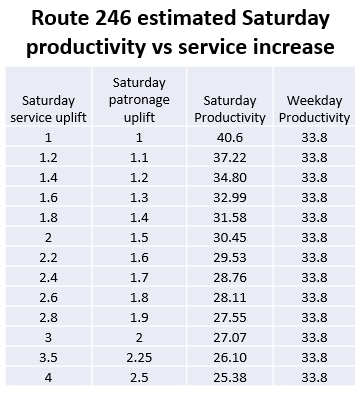
Route 246 is a popular route along Hoddle St/Punt Rd between Clifton Hill and Elsternwick. It's Melbourne's most frequent bus, with service every 10 minutes on weekdays and 15 minutes on weekends. Saturday productivity averages 40.6 boardings per hour versus 33.8 for normal weekdays. 

The table below shows a test where I've kept weekday service constant but am dialling up Saturday service to various points between 1.2 and 4 times the number of trips that run today. Can I appreciably increase Saturday service while retaining better productivity than weekdays? 

I've conservatively assumed 0.5 elasticity. Hence if you increase the Saturday service by 20% (x1.2) the patronage rises by 10% (x1.1). The Saturday productivity falls but is still well above weekday usage at this point. Keep stepping up the service and it slowly declines, though it remains above 27 even with a 5 minute headway (an uplift to 3 times the current 15 minute frequency). 


The graph for this chart is below. This gives a better visual indication of the relation between productivity and service at a given elasticity. It also shows us where the lines cross. 
 

Saturday meets weekday productivity at about 1.5 times the existing Saturday service. Multiplying Saturday's existing 4 buses per hour by 1.5 gives you 6 buses per hour, ie the same 10 minute frequency the 246 already runs on weekdays. 

To summarise, Route 246 is underserved on Saturdays. Instead of every 15 minutes it should run every 10 minutes, like it does on weekdays. You can be fairly confident that such a 50% boost will give a Saturday productivity that matches weekdays even without counting the likely network effects expected from a route that crosses about half of Melbourne's train and tram lines. Even greater network effects would likely accrue if a 246 service boost was accompanied by opening all entrances at Richmond Station at all times and providing multimode information and maps at key interchange points.  
 
Example Two - Route 623

Route 623 runs between three popular weekend destinations - St Kilda, Chadstone and Glen Waverley. It's far less frequent than the 246, being every half-hour on weekdays and only hourly on weekends. But it is 1.43 times more productive on Saturdays as it is on weekdays, versus the 1.2 times for the 246. This makes it proportionately more underserviced, even ignoring its vastly lower frequency (every 60 vs 15 minutes on Saturdays). 

Redoing the above table and graph with 623's numbers means that we can multiply Saturday service by as much as 2.6 times before productivity falls to reach weekday levels. 60 min / 2.6 gives a boost to 23 minutes. In practice though you would run daytime core service every 20 minutes with early mornings and evenings dropping to every 30 minutes along with some longer operating hours. 


Higher than 0.5 elasticities may be possible through modest network reform, eg removing duplication and consolidating with duplicative parts of the 624 between Chadstone and Caulfield and enhancing network effect connections by routing via Caulfield Station. 

Example Three - Route 800

Route 800 runs from Dandenong to Chadstone, mostly via Princes Hwy. It is the only public transport in some areas of Noble Park. It is one of five high-performing routes that lack 7 day service. Saturday service is also limited. The Saturday / MF ratio is 1.16, ie a shade under the 246 discussed before.

About 1.4 times the number of trips would bring its Saturday productivity in to line with weekday productivity. Given that 8 trips run on Saturdays that's an extra 3 trips. You would almost certainly add these to the afternoon to 120 minute gaps to 60 minutes and improve operating hours to approximately 8am to 6pm.

This is still a very limited service for a main road route whose strong weekday usage proves its worth. Many more trips (similar to those suggested for the 623) would be justified, not to mention a Sunday service. And the strength of Saturday trip generators and catchment demographics may mean a higher elasticity than assumed for other routes.  

And Sundays?

Sunday usage is closely correlated with Saturday usage. You can see a graph I plotted showing this here, though note my concerns with the data for Dysons routes. 

Three clusters of routes stand out. These include: 

a. Routes that are very productive yet underserved on Saturdays as discussed above. Sunday usage and timetables tend to be similar so the pattern discussed for Saturdays applies on Sundays too. This includes routes to major shopping centres eg 623, 626, 900 etc.  Generally speaking the Saturday frequencies proposed above for these routes should apply on Sundays too. 

b. Routes that are so productive on Saturdays that they are listed above. But they do not run Sundays so  there are no figures. However the tight link between Saturday and Sunday usage indicates that we can predict with high certainty that these routes will be productive if Sunday service was provided. Examples include the 281, 506, 800, 804 and 885. Three of the five are in the Greater Dandenong area, indicating the extent to which the area's 'safe seats' missed out on 2006 MOTC upgrades and neglect by successive governments since. 

c. Routes that don't feature above but are more productive on Sundays than Saturdays. These are typically in Melbourne's established north-western and western suburbs. These popular routes typically had a 15-20 min Monday to Saturday service that collapses to every 40 - 60 min on Sundays. Examples include the 406, 408, 410, 465 and 472. This cluster of routes typically has Sunday productivity that is 1.3 to 1.4 times that for Saturday. If we do Saturday's exercise but use Saturday productivity for weekdays and Sunday productivity for Saturday then we can get Sunday's productivity to equal Saturdays when we double Sunday frequency. That should be taken as a starting point if considering Sunday service improvements to these routes.  

What hasn't been mentioned?

A limitation of the approach taken of comparing weekend with weekday productivity is that it 'rewards' routes that have relatively lower weekday productivity. 

It's important to mention that there are certain routes that have both very high and very flat productivity across all 7 days. For example 495 in Point Cook has productivity of between 36 and 42 boardings per hour throughout the week. If one set a target productivity of a (still above average) 30 boardings per hour each day then you could increase off-peak service from every 40 to 20 minutes and extend evening operating hours and still likely meet it. Similar comments would apply to other busy Wyndham area routes like 150, 170 and 182 too.  

Conclusion

A significant proportion of Melbourne's most productive bus routes are underserved on weekends with disproportionately high usage versus service when compared to weekdays. 

Scope exists for significant frequency uplifts that would make the service more useful while retaining productivity that is higher or equal to weekdays. 

This is even assuming conservative patronage elasticity figures which could be exceeded due to network effects and favourable destinations and demographics. 

Next week I'll get into the nuts and bolts of specific bus service upgrades around one of Melbourne's major shopping centres and biggest weekend destinations. 

Index to other Useful Network items here

Tuesday, August 01, 2023

[Video] First Day of new Glen Huntly Station

Tram and bus hold-ups and train slowdowns at Glen Huntly are now a thing of the past with the removal of level crossings at Glen Huntly and Neerim roads. This saw the removal of one of the last tram squares in Melbourne and a rebuilt station with more shelter. 

I was there on Monday 31 July 2023, its first day of opening, and made this video. 


Here's an older Glenhuntly station video, showing the station before last.