Thursday, August 24, 2023

[History] Two decades of policy juggling in public transport

Transport departments can juggle only a few balls at a time. At any one time some are in the air while others are dropped, staying on the ground for years if not decades. 

Some matters are urgent and, while they have to be done, distract attention from what's important or gives most benefit. Some matters are active almost continuously while others spend most of the time grounded, getting only brief periods of airtime. 

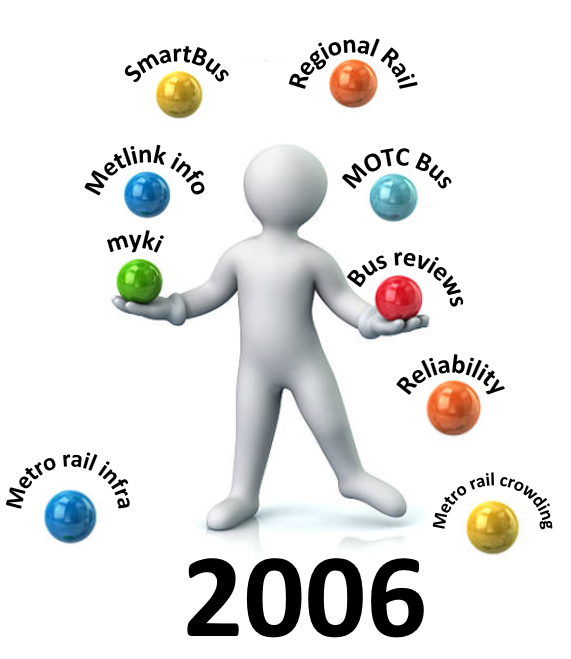
Below is an attempt to show the last 20+ years of juggling in the public transport portfolio. I take juggler snapshots every 2 or 3 years to show the main airborne and dropped balls. Many projects are long-term so I've taken some liberties with exact timings. Still it should still be a useful 'high level' history of the last two decades of priorities. 

1999


This was the last year of the Kennett government before its shock loss to Labor. Internal reforms had cut costs and improved service delivery in the last few years of government operation. Some regional lines were closed but minister Alan Brown managed to 'save the furniture' with metropolitan train and tram lines retained despite proposals for their closure.

In its second term the government became infatuated with UK-style franchising with the view that services could be run even cheaper, with payments dropping over time but tied to patronage growth. So, following some earlier franchising with Met Buses the government split and franchised the train and tram services. The fare system also started to be broken up with single operator only tickets made available.  

Everything was fragmented with a confusing array of brands and no one really in charge of providing integrated information for passengers. Also dogging the government was the troublesome roll-out of the over-budget and over-time Metcard ticketing system. These preoccupations meant that movement on other matters important to passengers, including bus reform in most areas, was slow.  


2002

The focus on franchising continued under the new Labor government which honoured the previous government's agreements. The 'light touch' philosophy from the previous government continued. And reliability was generally good. But however much insiders liked the first franchising model it was not to be sustainable with National Express walking out at the end of the year. The idea that you could boost patronage by changing a branding on a train was moonshine but many fell for it at the time. 

International operators, willing to win business at any cost to shut rivals out, had bid too low and a naive government had misplaced faith that the privateers could stay the distance. They didn't and operations went to government-appointed receivers. So the government had to find more money which they did by making the then under construction East Link a toll road. 

Metcard continued to be troublesome but improvements were made including making daily tickets available on trams, improved reliability and eventually removing single operator tickets. This was also the era of the much-hyped Melbourne 2030 plan that was predicated on a barely existing 'principal public transport network' whose expansion the government rarely funded.

Thus we were promised transport plans, some internal work was done, but we didn't get much. This was possibly because the Bracks government presented itself as financially responsible (like the Baillieu government) and broke some train and tram promises it made in 1999.

However it implemented a large number of 'oily rag' 7 day bus service upgrades in August 2002 which set the scene for bigger initiatives that came later. Ditto for two pilot SmartBus routes that proved a success despite still limited hours and frequencies. Small incremental upgrades don't always grow to become something bigger but they did in this case. Meaning that it's always important to press for what you can when you can. 

2004


Rail patronage was starting a strong trajectory of growth as the state's economy boomed, CBD employment strengthened and fuel prices rose. The government was still cleaning up after the failure of rail franchising including a driver shortage due to some previous skimping on training. The state took back V/Line while awarding the train and tram operations to the sole surviving operators from each mode. This was under a modified 'less pure' franchising model that saw higher payments to the operators and the government take on more risk. 

The 2004 refranchising reversed the network splits that were born out of competition doctrine but had proved so operationally difficult, especially for trains. It also gave birth to Metlink which restored a brand identity to the network and improved passenger information through an ambitious signage project. 

Regional rail was the big infrastructure focus, with Regional Fast Rail and Southern Cross Station construction either way. There was both a genuine need and a political imperative with Labor highly dependent on support from the larger regional centres and (in its first term) regional independents to hold government. 

Metropolitan rail was however badly neglected with reliability falling off a cliff from late 2003, never to fully recover. Crowding was emerging and a few extra trips were shoehorned here and there into the timetable. But there wasn't the sort of wider timetable review, stepped up maintenance or investment in infrastructure that should have been done. And in keeping with the franchised responsibility lore at the time, government either said everything was fine or blamed the rail operator Connex. 

Even while memory of Metcard's problems were still fresh, the government started work on a 'new ticketing solution' that we would to know as myki. This IT-heavy project took a lot of airtime with similar project management issues to Metcard. Meanwhile buses were in a bit of a lull despite a widening gap between modern travel needs (including 7 day trading) and timetables.  
2006

Both a Commonwealth Games and state election year. Regional Fast Rail was now in delivery phase. Reliability didn't recover to pre-2003 levels but the improved and mostly hourly pulse timetable to major regional centres greatly simplified service and led to increased usage. There were also significant improvements to regional city buses around this time.  

Rail in Melbourne wasn't so rosy. with reliability continuing its free-fall as patronage  boomed. The state government was still flaky on rail maintenance and infrastructure. An example was a proposed third track to Dandenong which was promised (making front-page news) and then ditched. 

Buses though were in their brightest time for a generation it not more. Meeting our Transport Challenges (which was effectively a bus plan) proposed 7 day service on all local routes, an ambitious cross-suburban SmartBus network and local bus network reviews. From mid 2006 it was rare for a month to pass without several bus routes getting 7 day upgrades. While these upgrades left a lot of loose ends (including no boosts to high patronage / high priority routes like the 800, a failure to address many network complexities and still low weekend frequencies) they were still transformative relative to anything that had happened before. Which was rewarded with major patronage growth. 

These upgrades went hand in hand with Metlink, which rolled out bus timetables and local maps (since removed) at all bus stops and introduced an online journey planner. The latter introduced the potential for bus travel to people who would not have previously considered it since awareness of where buses went was low. 

2009


Increasingly frequent rail meltdowns, and with the Connex name being mud, the government had little choice but to dump Connex in the rail refranchising later that year. Yarra Trams' franchisee also changed.

Public transport was emerging as a political crisis for the government which seemed asleep when it came to managing Melbourne's growth. The latter was universally realised when the Eddington Report and then the Victorian Transport Plan came out in 2008. Large scale rail infrastructure for Melbourne was at last on the table, though lead times were such that commuters experienced significant pain before the benefits were realised. Rail unreliability was subject to a parliamentary inquiry and contributed to the Brumby government's loss in 2010, especially for marginal Frankston line seats. 

Bus improvements had continued, especially with regards to the roll-out of 'minimum standards' 7 day safety net service. This era also saw SmartBus orbitals and upgrades to Doncaster buses (with the latter a substitute for often requested rail). These initiatives were (largely) straight service upgrades and new routes. 16 comprehensive local area bus network reviews were done but implementation was patchy.

While stuff planned a couple of years prior was still being done with buses, it was this era that saw government interest flip from bus to rail (to address the latter's reliability woes which had emerged as a political problem for it). For example the later SmartBus stages (including the 'Blue Orbital' and the Werribee extension of the Green Orbital) as promised in 2006 were not a part of the 2008 plan. We saw an acceleration of rail timetable improvements with these becoming more and more ambitious in an attempt to untangle the network and simplify stopping patterns.  


2012


By 2012 Victorians were living under a Coalition government - the first that the younger generation could remember. The era of big capital spending on public transport was out as they sought to reverse what they said was Labor's waste. The originally conceived Metro Tunnel was put off and aspects of the under construction Regional Rail Link were removed from the project's scope.

Some of the previous government's rail initiatives were now in place including new stations and the Sunbury electrification extension. The big change was simpler 'greenfields' train timetables on some lines and a big uptick in reliability, reversing most (but not all) of the slump since 2003. This upgrade included weekend trains every 10 minutes to Ringwood, Dandenong and Frankston, a service lift that no subsequent government has matched on the metropolitan network. 

PSOs at stations during the evening was another major initiative. Governance was shaken up with the creation of PTV as a 'one stop shop' to replace previous complexities. Before the election the public transport authority concept had been championed by Greens and the Coalition but opposed by Labor who thought current arrangements were fine. The PTV roll-out included (yet another) rebranding. However this went further than Metlink's especially with regard to common livery. 

Unlike Metro train services, very little new money was put into buses. However there was a greater willingness to do more radical bus network reform, as exemplified in areas like Point Cook, Brimbank,  Wyndham (post RRL) and Transdev routes in 2014. The arrival of Transdev is a consequence of refranchising routes that were previously run by Melbourne Bus Link and National Bus. Repeating some past errors with franchising, the government went with a cut-price offer from an operator unable to clean or maintain its buses with problems emerging a few years later. 

Party disunity and falling polls led to a leadership change with Denis Napthine replacing Ted Baillieu as premier. The new leader flagged increased infrastructure builds including East-West Link and the Melbourne Rail Link - a capacity-increasing Metro tunnel substitute that prioritised service to Fishermans Bend over the denser St Kilda Rd - Melbourne University axis. 

2015


The Coalition government was not to last with Labor returning in 2014. As soon as it could it flicked the switch to 'big build infrastructure'. Most notably level crossing removals and the Metro Tunnel.

Reminiscent of the Bracks period, there was significant interest in regional rail service but not in metropolitan rail or bus service. A 2015 greenfields Metro rail timetable that would have simplified stopping patterns and increased frequencies did not proceed. Transdev's 2015 greenfields bus network was also ditched (though admittedly this had problems including short-changing the west). Bus network reforms planned under Coalition for the Regional Rail Link in Geelong and Wyndham were saved as were those associated with Mernda electrification.

The lesson was that unless it was promised in 2014 or associated with a new station opening there wasn't going to be any bus network reform, even the low cost 'optimisation and simplification' type that happened under the previous government. And, except for 2016's Night Network, large scale metropolitan rail service upgrades all but ceased, leaving popular unreformed lines like Ringwood and Craigieburn with complex peak timetables and low Sunday morning frequencies respectively. Melbourne's inattention to service put us on a diverging course to Sydney which cut maximum waits from 30 to 15 min at many stations, even late at night, in its 2017 train timetable. 

2018
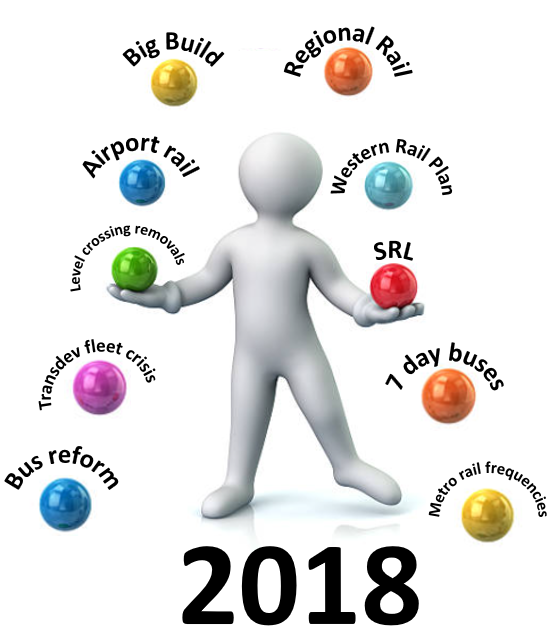
By now the Andrews government reckoned it was on a winning formula, with it feeling vindicated after a large 2018 election win. It was running ahead of schedule on its level crossing removals and Metro Tunnel construction was continuing. Interest rates were super low, with it being easier to find $10b for major capital infrastructure than a couple of hundred million per year to transform train and bus services. It was a feast for infrastructure but a famine for service, with the backlog on buses growing rather than lessening. Political opposition and scrutiny were also weak, including in the public transport portfolio. 

In this environment the government committed itself to its biggest ever round of major projects including the Western Rail Plan, the perpetually on and off again Airport Rail and, biggest of all, the Suburban Rail Loop. The last was of a scale beyond that thought possible or likely by much of the bureaucratic establishment. However with Melbourne's growth seemingly unstoppable it provided a vision that voters rewarded at the ballot box, especially in formerly Liberal heartland seats. You can see this above; all airborne balls are infrastructure related while those relating to service have all been dropped. 

Institutionally the government dismantled PTV, folding its functions into an enlarged Department of Transport. However the shift to infrastructure construction made dedicated authorities for specific projects the best funded and most powerful in the portfolio. DoT was big but not necessarily right at the centre of things, with the secretary resigning shortly after the Suburban Rail Loop, which was conceived outside it, being announced. 

Interest in patronage and operations was less with contract supervision reaching a low point during Transdev's fleet management crisis. Construction also meant frequent bus replacements making much of the rail network unreliable and thus unmarketable for much of the time. This and the pandemic has made previous patronage projections look optimistic, as opposed to gross underestimation of forecasts done about 15 years prior. 


2021


2021 continues the infrastructure program of 2018 except that the government had also picked up a few service balls. Implemented examples include V/Line and Night Network bus reform. A promised example was the Bus Plan. This had some low cost optimisation improvements on the Transdev network introduced in 2021. And, from the 2020 budget's low point for service, there were small increases for buses in 2021 and again in the 2022 budgets. 

This period also saw some frequency improvements on V/Line and, even rarer, off-peak on certain Metro train lines. Cutting maximum waits on the Frankston, Williamstown and Werribee lines, and simplifying City Loop operations they represent the biggest progress towards greenfields Metro train timetables since the government put such service development work in the deep freeze in 2015. 

Overall it seemed that there might have been a more even split between infrastructure and service in the government's transport priorities and the juggling above reflects this. But as you'll see in 2023 this was not to last, with progress on the bus plan slower than expected. 

2023

This year saw a post-election budget. It was a time for honouring certain election commitments (eg the $9.20 regional fare cap) and scaling back or deferring some projects dependent on federal funding. Economic conditions had deteriorated with higher interest rates and rising project costs placing pressure on budgets. No matter what though, the government continues to strongly back its signature Suburban Rail Loop despite the expense (most of which will be incurred in future years once construction gets seriously under way). 

Increased recurrent spending, such as what a swing to service would require, was not a priority in 2023. Thus some of the hopes of 2021 have not yet been met and there has been a changing of the balls. The bus network reform one especially appears dropped while priorities like bus recontracting and zero emissions buses (neither of which have the same direct passenger benefit outcome) have assumed centre stage. 

We'll only know for sure whether this is a temporary setback or more enduring next year. Things to look out for include DTP's finalisation of the 'Bus Reform Implementation Plan' and whether this is considered important enough to win budget funding in 2024. 


Summary

The government can only keep a few balls in the air at any one time. If it picks up a new ball it must drop another. However some balls have had much more airtime than others. Franchising/contracting, ticketing/fares and various regional rail projects have been most enduring. Major infrastructure projects, like level crossing removals, have become another constant in the last decade. 

Organisational reform and restructuring are another almost continual background activity, though thankfully we have shaken off the valueless habit of perpetual rebranding (remember the aborted Transport for Victoria anyone?). Organisational restructuring is mostly unproductive though department heads earnestly speak to their staff as if it matters. And there's no awareness of the need to preserve arrangements when they hit on a model that is mostly effective (eg PTV as a separate authority). 

Even though they are arguably the most important balls (in the sense that they have the highest prospects of benefiting the most passengers and boosting patronage) metropolitan train and bus service reform and frequency has had the most time languishing on the ground. Moss is growing on some like the 800 bus, which has been passed over for over three decades. Similar can be said for tram priority and accessibility. Sometimes it gets talked about with some good things done but rarely do these matters get the sustained attention necessary to get network-wide benefits (unlike say level crossing removals). 

I've attempted to classify a few balls here. These are on a matrix to differentiate those that I think have the greatest network importance and patronage returns to those that seem to have had the greatest emphasis. Everyone will have a different view on their exact placement but it's reasonable to conclude that not everything that is done the most often or has received the greatest attention has had the most impact. 


Have I missed anything major? Please let me know in the comments below. 


Sunday, August 20, 2023

Committee for Melbourne's Course Correction: reforming Melbourne's buses


It's great to see the influential Committee for Melbourne recognise the role improved buses can play in Melbourne's liveability and prosperity. Last Thursday August 17th they launched Course Connection: Reforming Melbourne's Buses

This states the case for improved buses well. You can read the report and media release here

CfM proposes a big investment in more frequent simpler main routes operating every 10 minutes or better. And they ambitiously want it soon, with it being implemented as part of Melbourne bus recontracting in 2025.

They put the cost at $200m pa plus extra for neighbourhood type routes to serve local needs that the main frequent grid wouldn't always. This represents an uplift of approximately 30% compared to what is now paid to metropolitan bus operators (my 2023 budget discussion and links to documents is here). And there's a case for it to go further as its emphasis is on fully using the existing fleet with expansion costs, such as especially desirable for new routes in growth areas, not included (Footnote 69). 

Course Connection is what you might call a high level document without a lot of detail on what a new network might look like. For example it doesn't have a specific network map, though it cites ideas from here and elsewhere. It would likely be something between a metropolitan expansion of the more theoretical UoM Western Bus Plan concept and my more pragmatic Future Frequent Network.

All up it would be a big step forward for buses in Melbourne. Having said that the authors are aware of pitfalls of bus reform, including examples of failures eg Adelaide whose post-mortem I wrote here.  

ABC Radio Melbourne phoned me for an interview on the day of the launch. It starts 6:32 in or hear it here


The CfM funding ask is substantial. But then so are the benefits. A reformed bus network across Melbourne will increase passenger numbers by more than projects we think of as being big like the Metro Tunnel or the full Cheltenham to Werribee Suburban Rail Loop. Sooner and for less cost too.

It's not a matter of bus versus rail. The latter can only justify its investment if mass numbers can reach its stations. Which from most directions means space-efficient access modes including excellent intersecting bus routes. These need efficient through rather than terminating style of operations to adequately support the denser 1.6km radius sized centres envisaged by the Suburban Rail Loop project. Also the short travel times projected for projects like the SRL can inspire people to consider how to speed buses on other important orbital corridors thought less suitable for rail, at least in the shorter term.

Progress in Melbourne's public transport in the last few years has been 99% infrastructure builds versus 1% service. While economic conditions like recent low interest rates favoured the former, our extreme skew is not inevitable. Sydney, which has the same interest rates as us, got a better balance with significant frequency upgrades across all modes (that in some cases like evening trains are now double ours). 

Melbourne's service is now so behind Sydney's (especially evenings and weekends) that we're overdue for a catch-up. And inequalities within Melbourne are now acute with the most diverse and/or lowest income areas left with the least service despite having some of highest needs and most productive routes. 

Bus network upgrade and reform, along with similar investments in off-peak Metro and inner V/Line train frequencies, should be the centrepiece of public transport investments in the next decade or more. This would help clear multi-decade suburban service backlogs that are holding Melburnians back from achieving their dreams and weakening Melbourne's economic competitiveness and liveability more generally.

The Committee for Melbourne's message on the importance of public transport service couldn't be clearer. The state government should heed it and start planning the 2024 and future budgets accordingly.  

Thursday, August 17, 2023

UN 162: Simpler Clyde Rd buses from Berwick


One of the bus service initiatives in the 2023 state budget was permanent funding for Berwick/Clyde North area routes like 888 and 889. This is important as they previously only had temporary funding under the Growth Area Infrastructure Contribution, a hypothecated tax levied on land developers.

It is understood that GAIC funding has tight conditions as to its use, such as benefits being confined to the area from which the money was raised and being of limited term. This makes its criteria more suited to one-off capital works at a particular site (eg a local community centre building) than a service which require ongoing funding. Recent media reports have accused the state government of hoarding GAIC funding.  

Now that Clyde Rd bus routes in the outer south-east are being funded from the same pool of money that others in the area get, it's timely to consider whether reforms are possible to simplify the network.  

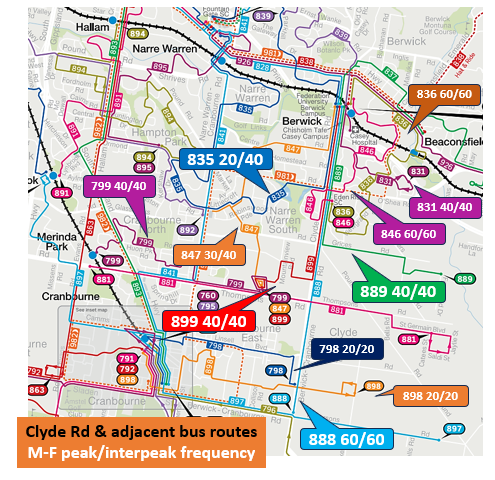
The map below labels what runs south from Berwick. This includes no less than four routes along Clyde Rd (888, 899, 889, 835 in order of longest to shortest). Note that Clyde Rd becomes Berwick-Cranbourne Rd further south, though I will often refer to the former to mean the whole corridor for brevity.  


Weekday peak / interpeak service frequencies are also shown. Every 40 minutes is the most common, though the longest route, the 888, is only hourly, even in peak periods. Combined frequency of the four routes is 6.5 trips per hour off-peak. However if you want good all day train connections these cannot be evenly spaced as trains are only 3 per hour (ie every 20 minutes). 

Local MPs in the area include Brad Battin (Berwick - Lib), Gary Maas (Narre Warren South - ALP), Pauline Richards (Cranbourne - ALP) and Jordan Crugnale (Bass - ALP).  

Existing coscheduling

As mentioned two years ago a good effort was made to optimise combined frequency by staggering the new 889 with the existing 899 (each every 40 minutes) to provide a common 20 minute service on the combined section. However the combined frequency does not extend as south as it could as the 888, which goes further, is only every 60 minutes. That means it cannot evenly harmonise with the 899, the second longest route, operating every 40 minutes.

If you wanted to make a small upgrade here you could boost 888 to 40 minutes and evenly offset its times with the 899. This could make currently difficult Cranbourne to Berwick travel slightly easier if making a change from routes 798, 897 and 898. All the ex-Cranbourne routes run every 20 minutes so an 888 every 40 minutes could mean that one in two of these trips potentially has a connection rather than one in three.

There are potentially also connectivity gains from the east-west 881 (every 40 minutes) that provides a lot of coverage but in itself doesn't go to a lot of places where people want to go (eg Berwick, Cranbourne and Fountain Gate). 

The reason why I say could is that you are still dependent on some serendipity with timings given still low frequencies. This may or may not happen given that routes are primarily scheduled to meet trains at stations like Berwick, Cranbourne and Merinda Park. Still, with the three routes from Cranbourne being every 20 minutes the chances are that you will get at least some reasonable connections. That is if the system is set up for it, including (i) bus stops being located right at intersections to minimise walking distances (something sliplane-loving driving speed-maximising road engineers dislike), (ii) optimised timings for connections and (iii) and good network information at bus-bus interchange points (which DTP and its predecessors have consistently failed at).  

The possibility to avoid unnecessary changing with better network design should also be explored, as I will later. This is particularly desirable given Infrastructure Victoria's passenger surveys finding a  dislike of interchanging. Infrequent routes, isolated locations, stops set well back from intersections and difficult to cross roads would all detract from the interchanging experience. Such experiences would make pure 'Squaresville' networks such as championed by academics from institutions like RMIT and Melbourne University unattractive, with the less theoretical more practically based 'modified grids' far more acceptable.   
    

Extent of overlap

A second weakness of the above network is the extent of overlap between routes, especially if benefit cannot be obtained from high combined frequencies due to the bunching imposed by having to connect to less frequent trains, especially off-peak. And even if you could obtain high frequencies on Clyde Rd, the walking and waiting environment is poor with many back fences facing it. 

While new Clyde Rd routes 888 and 889 added worthwhile new coverage on the south ends, they were layered over an existing unchanged network. Their presence means that the existing 899 now contributes little unique coverage.

To be fair, short of reforming the network, the then DoT tried to make the best of it by offsetting times of the new 889 with 899. Still there may remain potential to take a step back and see if services can be optimised, noting that higher frequency and better connectivity in the suburbs is good but there don't necessarily need to be as many overlapping routes as now. 

There is also some coverage overlap in the residential area around Eden Rise Shopping Centre, east of Clyde Rd. Three routes serve the area - 831, 836 and 846. 831 is every 40 minutes while the last two are every 60 minutes each. Potential may exist for network reform to reduce these three routes to two while simplifying Clyde Rd services and (optionally) connecting Casey Hospital to more places.  

Any network reform to reduce overlaps should also deliver stronger termini and address needs such as direct Berwick - Cranbourne that are currently unavailable. This has been particularly requested as many education and health services people use are in Berwick while more affordable housing tends to nearer Cranbourne.  
 

Berwick - Cranbourne connection: Option 1

The new Route 888 has a weak southern terminus. Routes 798 and 899 have only moderately strong termini, finishing at local shopping centres but not train stations. As mentioned before 888 and 899 have substantial overlaps. Service levels vary from every 20 min for 798, 40 min for 899 and only every 60 min for 888. 

Most notable is that the 888 contributes negligible new coverage. And the 798 and 899 finish only about 3km from one another. Thus, as mapped below, it is possible to fashion a Berwick to Cranbourne route by extending the 798 about 3km to The Avenue shopping centre and then via the 899 route to Berwick.  


Because there are fewer routes and less overlapping, this arrangement delivers higher frequency and a more even spacing of services than what got implemented. A 20 minute off-peak (including weekend) frequency on the extended route would be ideal to match what currently operates on the 798. This would also mesh evenly with train at both Cranbourne and Berwick.

Every 20 minutes is more buses per hour than the 40 and 60 minute combined frequencies of the existing 888 and 899 routes so service resources per year (and potentially also the peak bus requirement) may be higher than now unless scheduling economies can be found. Unless this is so this approach is not cost-free, even though the benefits of a consistent 20 minute all day service would be substantial. 

Other considerations include the fact that existing routes discussed are run by different operators (surmountable with political will, eg the jointly-run Route 900) and that straightening could speed travel and lower costs (at the expense of coverage). Overall this is a minimalist option that doesn't address other bus network issues in the area. 

Berwick - Cranbourne connection: Option 2

Don't like the kinks in the first option? Or see opportunities for further network reforms, including easier access to Casey Hospital? You might prefer Option 2 mapped below:


Its centrepiece is an extension of the 888 to Cranbourne along with a tripling of its frequency from 60 to 20 minutes. This is more direct than the 798 option above. Overlap is minimised by shortening the 897 but with its eastern portion served by an extended 798 to retain coverage. This would remain at every 20 minutes, the same frequency as the extended 888. 

Most notable in this concept is its inclusion of a Same Stop Interchange Point (SSIP). IV said that people didn't like interchanging but if you are going to do it then an SSIP is the gold standard. This is because there is no walking, no crossing roads and no hunting around for another stop. Instead you just alight one bus, stay in place and wait for the next bus at the same spot.

SSIPs can be ordinary bus stops but with improved information and triple length shelters (which could enable both front and rear door boarding substantially under cover). Good frequencies or careful timetabling could provide a train or tram like experience in Melbourne's outer suburbs for relatively little cost. 

In conjunction with a reformed network, an SSIP at Clyde could allow those from residential areas on Pattersons Rd (A) easy access to Berwick (B) via the SSIP or Cranbourne (C) by remaining on the bus. Given the number of schools and medical services in Berwick, an SSIP at Clyde is something that parents and older people would likely find reassuring or more convenient. More on how it might work below:


The above 888 extension to Cranbourne isn't the only one-seat connection to Berwick from the Cranbourne area. A second is provided by extending the 799 from the current weak terminus at The Avenue to Berwick. 

There's several ways to do this but I have the extended 799 and reformed 836 used to simplify routes east of Clyde Rd, with these replacing the 831 and 846. The effect of this is to connect more places to Casey Hospital and reduce overlapping on Clyde Rd. It also reduces the number of routes from 3 to 2, potentially enabling improved frequencies.  Like any network idea there will be pros and cons. The benefits include better access to Berwick and a simpler network overall with three routes (831, 846 and 899) removed. But the changes east of Clyde Rd remove bus access to Beaconsfield Station as well as Berwick's main street shops. Other options may be possible but at the expense of more service kilometres and/or lower frequencies. 

Conclusion

Two networks that simplify buses on the Clyde Rd corridor in Melbourne's outer south-east have been described. Option 1 is less radical while Option 2 is bolder and potentially even transformative for some trips. Which one do you prefer? Or are there other approaches that deliver further benefits? Please  have your say on this in the comments below.  

See other Building Melbourne's Useful Network items  here