Thursday, September 07, 2023

Greater Dandenong area bus route productivity vs 7 day service


As I noted in How Dandenong got short-changed on buses, Greater Dandenong has some of Melbourne's most productive bus routes but the lowest proportion with 7 day service. 

Dandenong got less than its fair share when metropolitan buses were last majorly upgraded 15 years ago. And, despite high usage of the routes that do run, service stagnation remains today. Possibly due to the area having no politically marginal seats and/or the current government favouring infrastructure over service in its transport spending. 

This approach rewarded state Labor in 2018 and 2022 but is not sustainable long term. Even ignoring infrastructure's rising construction costs and interest bills, a neglect of basic services (not just in transport) bodes poorly for Labor long term as its eroding primary vote causes more of its traditional safe seats to be decided on preferences. 

Politics aside, let's talk in more detail about the productivity of Springvale/Dandenong area bus routes. I'm using passenger boardings per live service hour statistics for Spring 2022 as discussed here. One of the big trends was the relative (and also often) absolute rise in the importance of weekend travel despite timetables remaining stagnant, or in Dandenong's case, service sometimes not existing at all.

The numbers are below: 
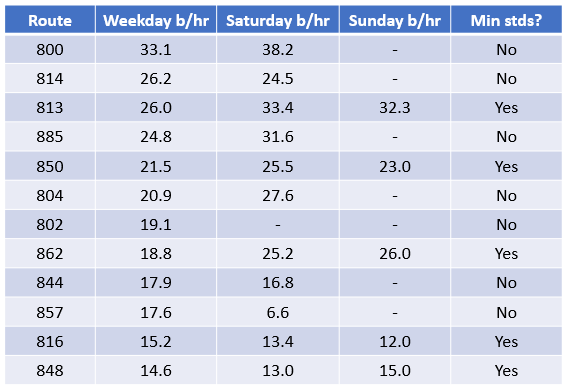
I've excluded very long routes with the majority of their sections outside Springvale/Dandenong (eg 811/812, 828, 901) to keep the focus regional.

This leaves us with 12 routes. All listed happen to be in the top 50% of weekday boardings per hour for buses in Melbourne, with the first four in the top 20%. On weekdays all do as well if not better than the average bus in Melbourne. Most are above average on weekends too. 

Let's discuss them one by one. 

Route 800 tops the list on weekday and Saturday productivity. This is really not surprising - the 800 has all the ingredients of a top performing bus route including directness along a major highway, good residential catchment and lots of jobs including it serving or passing near SE Melbourne's biggest employment hubs at Chadstone, Monash University Clayton and Dandenong. Whether you use weekday or Saturday productivity figures, Route 800 is Melbourne's busiest bus route without Sunday service with only a two hour frequency on Saturday afternoons. Hence boosting its weekend service is top priority for the #Fix800Bus campaign

Route 814 is second ranked on weekdays. If you look at it on a map you wouldn't think it had much hope as it's incredibly indirect. It starts in the back blocks of Springvale South, runs into Springvale, then east across to Waverley Gardens and then south to Dandenong via Noble Park North. No one would ride it end to end. But its the sort of catchment that you could put any sort of bus in (even if only hourly) and large numbers would jump on board. Its weekend service is even sparser than the 800 with only a few trips on Saturday morning operating. 

Route 813 ranks third on weekdays. It's another route that you wouldn't ride end to end. However like 814 it serves key destinations including Dandenong, Springvale and Waverley Gardens. Weekend productivity is higher than weekdays. This is attributable to both its strong catchment demographics and that people will walk longer to it on evenings and weekends because other routes like 814 and 885 are barely operating then. 813 is the area's most productive weekday route to have got 7 day service about 15 years ago. 

Route 885 between Glen Waverley and Springvale is another strongly performing route, especially on Saturdays. Its Saturday patronage performance is so good that it's the third most productive Saturday route lacking Sunday service in all of Melbourne. That's important because Sunday usage is almost 1:1 correlated with Saturday usage meaning that if Sunday service is added there's a high chance of it being a top patronage performer then as well.  Parts overlap the 902 on busy Springvale Rd. Both termini are active on weekends. And it has some unique coverage in parts of Valewood. On paper this might not look enough to matter but the pedestrian hostileness of Springvale Rd would encourage those east of it to walk to the 885 if service is running when they need to travel. 

Route 850 connects the important centres of Glen Waverley and Dandenong via Dandenong North. The catchment includes significant low income housing in the Gladstone Rd area. It is the second most productive (on weekdays) route to have got minimum standards upgrades. The catchment demographics and the absence of 7 day service on the nearby 802 and 804 help to explain why its weekend service is more productive than weekday service (though all are above average). Route 850 has enough ingredients (including strong termini, directness and catchment) to be a more frequent cross-regional route operating (say) every 20 minutes or better 7 days. 

Route 802, 804, 862 are three roughly parallel routes between Chadstone and Dandenong via Oakleigh, Monash and Mulgrave. They are unnecessarily complex with varying timetables across the week. For instance 802 (despite significant unique coverage) is 5 days per week, 804 is 6 days per week (dropping to 2 hourly on Saturday afternoons) while 862 is the trio's only 'minimum standards' 7 day route. The latter contributes to 862's high Sunday productivity. Scope exists for some network reform but the highest priority should be 7 day service (even if only hourly) on all routes. The 804 ranks as No 4 (in all of Melbourne) as a high productivity Saturday route lacking Sunday service. Like the story about it being wrong to estimate demand for a bridge by the number of people swimming across, we can't use this metric to assess 802's likely Sunday usage because it doesn't run on Saturday either. However 802's weekday patronage productivity is only a little below 804's and the 802 arguably has more unique catchment that would benefit from 7 day service. 

Route 844 is the shortest route of the lot, connecting parts of Doveton with Dandenong. It is a coverage style route with a weak eastern terminus. Operating hours are short because, like nearly half of Dandenong's buses it missed out on minimum service upgrades. Usage is somewhat above average as part of its catchment is unique and demographics are favourable for buses. Again it justifies Sunday service given its reasonable Saturday productivity (ranking 14th in all of Melbourne out of residential area routes that lack Sunday service). 

Route 857 a longish route but is included as it provides important Dandenong South industrial area coverage. Very low Saturday usage due to both its catchment and its short (3 hour) span on Saturday mornings. Unless your stay is very brief you are battling to make a return trip due to this. Its usage and even productivity is likely to improve if its operating span was improved on Saturdays. And there's some residential area catchment that justifies a basic Sunday service. 

Route 816 the newest route introduced to extend coverage to Keysborough South. Runs minimum standard service. Part of its catchment is in an area with many parallel routes, reducing its productivity somewhat. 

Route 848 Dandenong to Brandon Park Shopping Centre. Serves parts of Noble Park North but other parts overlap other routes. Just falls in top 50% of routes but the lowest on the list with its weak northern terminus (Brandon Park instead of Glen Waverley) not helping. However it does provide minimum standards 7 day service with a flat hourly frequency. Much of it parallels Route 814, providing a 30 minute weekday frequency on the overlap. This would extend to 7 days if the 814 was was given extra Saturday hours and new Sunday service.

7 day gaps mapped 

The first starting point for a basic legible 'always there' bus network is that every stop should have a 7 day service with service at least hourly until say 9pm. While not a high threshold, this was the 'safety net' criteria behind 2006's MOTC minimum service standards. This got implemented on roughly 70% of bus routes across Melbourne (more if you exclude specialist peak, industrial and university routes) but only 53% of routes feeding Dandenong station

How does the lack of 7 day service in the Greater Dandenong area look like on a map? Below I've plotted only the unique coverage portions of non-seven day routes. That is if another route that runs 7 days serves the same stops then the the non-seven day route's line is interrupted. 


Most graphic is the Princes Hwy corridor due to the limited service on Route 800. The gap between Blackburn and Springvale roads is due to the 631 which runs 7 days (but to destinations different from the 800). 

802 and 804's part-week service create similarly large gaps in large parts of Wheelers Hill, Mulgrave and Dandenong North. The latter's low income Gladstone Rd corridor gets only the hourly 850 on Sundays due to 804 not running then. Also a substantial area east of there lacks any weekend service due to 802's 5 day timetable. 802 and 804's sparse timetables also mean that Dandenong Hospital gets a far inferior weekend service to what it should have. 

814 also ranks due to its second-ranked weekday patronage productivity and significant unique coverage. While the route itself is roughly 400m away from the parallel 7 day 848 in the Noble Park north area, a significant catchment west of Jacksons Rd is significantly further.

Other smaller (but still productive) weekend coverage gaps would be filled if 844, 857 and 885 gained 7 day service. 

I should point out that just because there's a gap in the line does not mean that it should be ignored. Eg 800's gap on Princes Hwy is near the dense high-rise M-City which also has the 631 on a section of Princes Hwy. However this is only every 40 - 60 min on weekends and goes to different destinations. So a boosted 7 day Route 800 on this section is in no way duplicative despite sharing some stops.

Similarly the strong propensity of people in the Dandenong area to use buses (driven by demographics) means that notwithstanding some overlapping coverage catchments all routes are likely to have above average  patronage productivity even if they all got 7 day service. On local routes like 802, 804 and 814 you might start with 40 to 60 min weekend frequencies on the existing alignments with potential future network reform boosting this to 20 to 30 min on reformed routes in areas like Dandenong North and Noble Park/Keysborough for little extra cost. The latter would lead to a simpler overall network but has a more complex implementation process than getting everything to a basic 7 day service first.   

Summary

All the Dandenong area routes listed are above average productivity. They should all have 7 day service but only half of them do. However this data could help inform priorities for campaigns such as #Fix800Bus which directs effort to routes whose improvement would benefit the most people. 800 is right at the top but cases exist for the rest with 814 and 802/804 ranking highly on usage and catchment grounds. 

Friday, September 01, 2023

A quick look at Melbourne's tram plan

While they feature on tourist tea towels, are frequently described as 'iconic' and carry more people than you'd expect from the network's limited catchment area, Melbourne's trams have long been underinvested in.

Major issues include: 

a. slowness and unreliability due to a lack of separation from car traffic
b. often poor stop and vehicle accessibility with glacial progress towards legislated targets
c. routes that stop short of logical termini or miss now dense inner area corridors 
d. crowding due to too small trams, the ill-advised Free Tram Zone and decades of declining or stagnant frequencies with timetables that don't reflect modern travel needs, especially nights and weekends

Yesterday the government released a vision for trams via Melbourne's Tram Plan (media release here). It's the second modal transport plan in as many years, with Victoria's Bus Plan coming out in 2021.

The plan

Melbourne's Tram Plan starts with a snapshot of the network. 475 trams carry over 200 million passengers per year on 250km of double track. 75% of this is shared with car traffic, making, as others have pointed out, Melbourne trams amongst the slowest in the world. Also just over one-quarter of stops are accessible (450 / 1600), making a new rapid-build approach necessary to deliver universal accessibility. 

A second theme is the extent to which trams support city commerce and activity. They connect densifying inner suburbs and activity centres in ways that our trains, with their complex and still half-reversing City Loop, do not. And they provide fill-in last-mile feeder coverage that trains do not. 

Infrastructure renewal is also important. Large accessible trams require new or rebuilt depots. They can also be power-hungry, drawing up to three times the power as older trams. This requires attention to the power system's capacity (although the Next Gen trams will be better with onboard storage and regenerative braking). 

What is the plan's response to these challenges? 

Here they are in summary: 

A network hierarchy comprising the CBD grid, trunk corridors and the suburban network 

The trunk corridors are basically the most heavily loaded inner suburban part of the network extending about 5 or 6km from the CBD (a bit more to the north).

Trunk corridors are intended to have 'high frequency service' while the suburban network is intended to have 'turn up and go' service. The plan doesn't specify the actual frequencies involved but I'm going to guess 5 minutes for trunk corridors and 10 minutes for the suburban portion. Suburban portions today vary from about every 6 to every 15 minutes off-peak with 12 minute frequencies very common on routes that feed into St Kilda Rd. 

How might one do this in practice? The most controversial approach could be to convert the network into trunks and feeders. Trunks might have big trams every 3 to 5 minutes while feeders have smaller trams every 6 to 10 minutes. This may raise objections as forced transfers may replace one seat rides on corridors like St Kilda Rd. A less radical approach, applicable to long routes like 59, 75 and 86, is to have half the trams going to the terminus with the other half going only half way out. This could enable higher frequency and capacity on the busier sections of routes, while those near the end still have a single seat ride. Other possibilities could include splitting indirect routes like the 3, 16 and 72 which few passengers would ride end to end. 

The above is just my speculation as the Tram Plan, like the Bus Plan, is light on network specifics. Given we're not far off the Metro Tunnel opening (which we're told is ahead of schedule) and its interactions with the tram network, a few more hints on what is envisaged here would have been nice. Also, even if resourcing is tight, there might still be scope for some 'quick wins', such as discussed here for Route 12.  

Central Melbourne connectivity and reform  

Certain corridors and precincts are identified including La Trobe St, Spencer St and the western part of the CBD. The latter could be enabled by the Metro Tunnel which could allow some trams to be shifted from the Swanston St corridor. The extent to which this can happen depends on how frequent Metro Tunnel trains end up being (which we don't know yet).   

Stops and corridor upgrades

Due to the scale of work needed, the plan says that stops will be upgraded to accessibility standards by corridor. 1600 stops will be grouped into 100 corridors (averaging 16 stops each) with this shaping how work is tendered out. Two of the first corridors to be upgraded will be along Route 86, with the third along Route 82. 

The future

Those who pick up a plan expect to read about the future. Horizon 1, or the current agenda, is all about more accessible stops and a lot of preparing (for new trams) and planning (for network reforms). Along with reliability and passenger information initiatives. 

What's called Horizon 2 is medium term up to 2032. This includes new trams and stops and exploiting opportunities presented by the Metro Tunnel. 

Finally Horizon 3 is post 2032. This encompasses further network development and some expansion. In political terms this is almost in the 'never never'. And there is a possibility that we will see services on the Suburban Rail Loop start (due 2035) before the tram network gets any longer than it is now.  

A lot of people mention trams to Fishermans Bend. These are not mentioned in this plan. Last year the government greatly upgraded bus services on two routes with an excellent 10 minute weekday frequency. Apart from some extra weekend trips serving nearby apartments, that is probably OK for now. Some will complain but I'm afraid I don't see their angst. Even with a tram Fishermans Bend would lack the fast accessibility from the multiple directions it needs to. It would just be another New Quay - out on a limb, commercially unsuccessful and ages to reach from most places. I'm inclined to prioritise developing the Arden precinct first, and then when Fishermans Bend's time for high density comes do transport properly with a Metro 2 from the west

Conclusion

That's a quick summary of Melbourne's Tram Plan. It's a useful document in that it gives stakeholders and the general public an insight into current departmental thinking. But as always more detail would have been nice. 

How much of it will happen? Parts have already been announced, budgeted and are underway. But other parts are subject to future funding, on which we'll get a clearer picture on in the 2024 and 2025 state budgets. 

While we'd all love to be optimistic, the record so far with 2021's Bus Plan indicates that those who don't expect too much too soon are unlikely to be proved wrong. This is especially given current trends (as exemplified by the 2023 state budget) is in the direction of less rather than more spending due at least partly to rising interest costs on major projects (committed to when interest rates and construction costs were lower). 

Monday, August 28, 2023

Five years since 'Operation Halo' (aka SRL) became public


On this day five years ago at 7:01am something big was announced


The Suburban Rail Loop 


Here's a flashback to stories from the first day it was public


More


More


ABC

Nine News interview

Guardian

Herald Sun


The Suburban Rail Loop was hatched in secrecy, away from the established transport bureaucracy, Treasury hardheads, and, as the minister hastened to add, land speculators. Neither was even the vaguest concept of an orbital railway in Plan Melbourne 2017 - 2050, released just the previous year,

Some within the bureaucracy would have been hostile to the SRL for rational (eg concerns over opportunity cost) and tribal (it wasn't our idea) reasons. This government arguably had reasons to be wary of advice on transport matters from it given that not all that given in the past (eg rail franchising, patronage estimates and myki tendering) had necessarily served their predecessors in the Bracks and Brumby governments well. This may have made the government receptive to transport concepts from those outside traditional circles but trusted by the party. 

SRL was a simple idea that the people loved. It tapped into concerns over the management of growth  in an expanding city. There was a good planning story about jobs nearer homes and an environmental narrative about sustainability. It also decisively appeared to address a genuine issue of slow and inefficient public transport for trips other than towards and away from the CBD. The commentariat class lament about our having only buses to the airport would also finally be addressed. Especially when Airport Rail was rebadged 'SRL Airport' before apparently being deferred.

So SRL ticked a lot of boxes. Thus with only basic work done and not all funding arranged it was presented as an already decided 'fait accompli', bypassing the transport and planning establishment who ordinarily would have expected to have some say. The likes of Infrastructure Victoria would continue to write reports or yearn for an overarching 'transport plan' but the government had its own major project-based agenda, with evidence that it was getting stuff done there for all to see.

It wasn't until later that we got to know how the SRL idea came about. More on the top-secret 'Operation Halo' and how it became the SRL appears in Thrown in a loop: How Daniel Andrews’ biggest project was cooked up behind closed doors published by The Age two years ago. 


Meanwhile the SRL project has marched on. More details on the project came out through its business case. It has been divided into sections with the Cheltenham (Southland) - Box Hill section starting first. More has come out regarding station locations and there are concerns over connectivity with other modes.

State government backing remains unwavering despite budget pressures. The government that proposed it was returned in 2022. The Suburban Rail Loop has its own ministerial portfolio with the minister now the deputy premier. The (now Labor) federal government committed $2.2 billion to the project. That's more symbolic than anything else as much more is needed to build. And while the state government made some tough decisions in the 2023 state budget with PT service again starved and projects like Geelong fast rail and airport rail subject to national review, the SRL has remains protected.


I won't discuss the pros and cons of the SRL here. But there's three things that could apply to other transport initiatives and government support for them.

1. The sky's the limit - if there's the political will then far more than was previously thought possible can be agreed to. Thus public transport advocates shouldn't necessarily fear that they are asking for too much.  

2. A project can often be conceived of as having wider benefits to give legitimacy to its size or win political support that it might not otherwise have. Then once support is achieved it may get rebadged along the way. Two examples include: 

'Project 10 000'. A big plan to create 10 000 jobs in the construction sector. To allay concerns about Labor's cancellation of the E-W Link, address some weakness in employment and keep the CFMEU on-side. Became the Level Crossing Removal Project, Metro Tunnel and other 'big build' projects. 

'Homesafe'. Sought to address concerns over late night workers getting home at night. Became 'Night Network' when it started in 2016 with 24 hour weekend service on trains, some trams and (later) some regular bus routes. 'Night Network' is also more in keeping with similar services elsewhere.

SRL has been changed in scope a bit (eg divided into stages and including other bits eg airport rail) but hasn't yet been renamed. However something that gave legitimacy for its size was its concept as a wider planning project that would address matters like more high-paying jobs near the suburbs most people lived in and connected suburban subcentres (that also had denser housing options). With the (rarely realised) potential for land value capture to shore up its business case.

Those who have raised concerns about SRL opportunity costs have included transport planners. They think they can achieve more with less with some other transport scheme. For instance instead of one super-fast underground rail corridor you could build more kilometres of somewhat slower orbital routes that create a more ubiquitous network with more connection points and thus more spread benefits.

Whereas those approaching the SRL from a planning view aren't so much concerned about the cost but are very keen that matters like land use are taken care of to ensure dense centres around stations with lots of jobs, land value uplift and concentrated accessibility benefits leading to high agglomeration economies. In this case defining SRL as more than a transport project could make its price tag seem better value with so-called 'wider benefits' counted. A worry though is that too much concentration on expensively serving a few centres while ignoring the rest risks perpetuating access inequality, favouring the few over the many.  

3. An initiative must be seen to address a particular problem. It doesn't have to be the most cost-effective approach if the political support is there. Although it's even better if it is as we could have the initiative replicated several more times by 2100. In mass transit, "if it doesn't scale it doesn't count". 

To the chagrin of data wonks who think that "If only we had more data and evidence the funding for effective projects would appear", cost-effectiveness or massively positive benefit cost ratios do not by themselves win political support and funding for initiatives. No matter how good and worthy they may be. 

Examples include a general recent reluctance to invest heavily in highly cost-effective smaller capital projects, active transport or more frequent timetables that work the existing network harder, eg higher off-peak train and bus frequencies on productive routes.

Proponents of such cost-effective transport initiatives simply need to do better, including in political influence. That includes presenting a compelling positive agenda that taps in to peoples' needs (unlike  the 'just say no' SRL critics at the Grattan Institute who seem to think that fiddling with pricing is everything).

Despite not having had this government's ear much, advocates of better value for money in transport projects remain with plenty to think about. Problems aren't going away and Melbourne's still growing. In retrospect 2018 marked 'peak major project announcement year' with the subsequent fare mainly being more level crossing removals. Cost blow-outs, higher interest rates and calls for the government to shift priorities elsewhere (eg to housing) are only likely to increase scrutiny of major transport projects and revive interest in what's possible cost-effectively.  


That's it for the SRL today. Its existence and scale reflects the low interest rate conditions at the time it was announced along with the government's so far unshakable faith in its merits and political appeal (demonstrated over two elections). However it remains quite a while between now and its projected opening in 2035. It will be interesting to see what we end up with as demographic, political and budgetary priorities evolve. Especially since some (like urbanisation) are a long term trend while others (like economic and political fashions) seem to follow see-saw or pendulum cycles.