March is one of Melbourne's major event months. We've just had Moomba. The Grand Prix is this weekend. Footy kicks off soon. And there's festivals and shows for food, garden and comedy to name a few.
Many events are held over weekends, often for several days. But they're not just in March. There's another burst of events from Spring and into summer. With the state government promoting Melbourne as Australia's events capital that's open 24 hours, transport services needs to suit. Other things like fun runs and markets start early on Sunday mornings. Add general shopping and leisure travel and demand becomes substantial to the point of crowding.
Public transport provides major support in transporting workers, volunteers and patrons, especially for events in or near the CBD. So it should, given its ability to move large numbers of people in a short time. You simply couldn't run popular events on the scale that we do without high capacity public transport, especially rail. In fact the only time many suburban families use public transport is when taking the train to special events.
Melburnians also travel widely. Southern Cross Station is where people need to be for state and interstate rail and coach connections. And if you're flying then that's also where Skybus leaves from every ten minutes. If you can't make an early morning connection you're stuck. Particularly for day trips to regional Victoria or the budget flights that backpackers like. Hence access to Southern Cross is important at all times. Not just for locals but visitors as well.
So whether it's early-starting events in the city, markets in the suburbs or connections to coaches, trains and planes, Sunday morning travel is important. If it's missing or infrequent people are up $60 or more for a taxi. That dampens people's willingness to attend, participate in or volunteer for events. The latter is key since many events would die if it wasn't for volunteers and members.
That's today's topic. Train travel on Sunday mornings. We'll look at early Sunday morning services on all Metro train lines. Plus the Geelong line given its large suburban catchment.
The first question to ask is "Does early Sunday service exist?".
That's easy to answer. It didn't used to. Until recently we had the latest Sunday start of any metropolitan rail network. One couldn't reach the city much before 8am. And if you were going outbound, for example to Frankston, you couldn't get there before 9am. Useless for many activities. In 2010 I suggested commencing Sunday service 60 to 90 minutes earlier to make trains more useful.
That problem vanished when Night Network started three years ago. Trains now run continuously from Friday morning to Sunday night. While Night Network's emphasis was party goers and late night shift workers, the improvement it made to Sunday morning mobility was at least as significant.
With the first resolved, the second question to ask is "How frequent?". That deserves teasing out since frequency affects the practicability of use. For example if you're going for a fixed time appointment or onward connection a low frequency can mean lots of waiting. It also renders impractical plans to board an earlier service such as you'd do if catching a critical flight.
Sunday morning frequencies for each line in each direction are below. With minor exceptions, time band boundaries are generally measured at the last stop on each line in each direction. This is fair since, unlike late nights when most people are travelling from somewhere to home, Sunday morning travellers are mostly going from home to somewhere. Often that's time-sensitive, such as an early starting event or transport connection. After all, who voluntarily gets up earlier on a Sunday morning than they need to?
Towards Melbourne
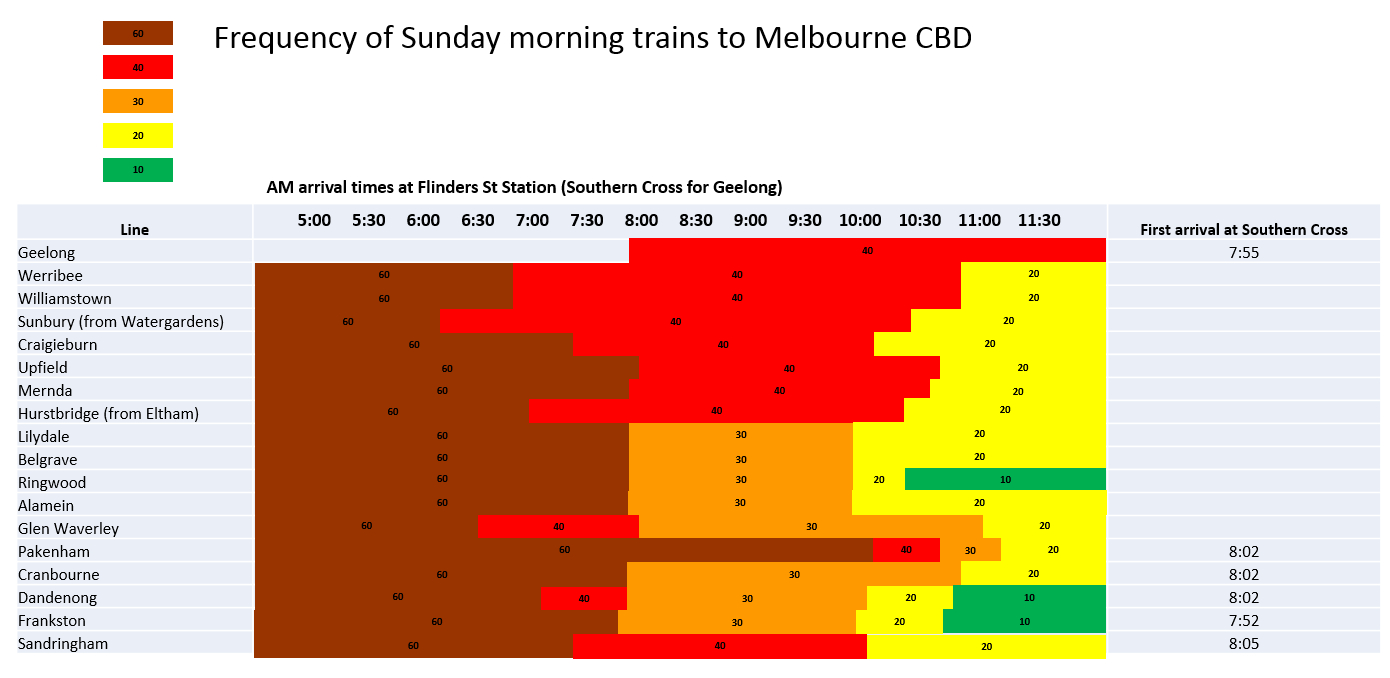
Most striking are the line by line variations in the critical 8 - 11am period. All lines in the north and west have 40 minute maximum waits. Whereas, except for Sandringham and Pakenham, lines in the south and east run every 30 minutes. The 20 minute frequency kicks in later in the west; there's even a short time where trains there are still every 40 minutes while some in the east have gone up to every ten.
Within the west the Mernda and Upfield lines are the least served, with hourly service continuing until about the 8am arrivals. Though bear in mind that before Night Network these trips did not exist at all. On the other hand Werribee and Williamstown has the latest start for the 20 minute service. The Geelong line retains its 40 minute service through the day with no early trains due to not being in Night Network.
Variations exist within the east, too. Pakenham, with its 60 minute frequency, has the least service of all lines until 10am. The outer parts of the Belgrave and Lilydale lines start their 20 minute service earlier than Pakenham and Cranbourne. This is likely a legacy from when lines through Ringwood were the busiest and best served on the network (now it's lines through Dandenong). Sandringham's 40 minute service is an outlier for the east, though it gains at night with its uniquely high 20 minute evening frequency.
From Melbourne
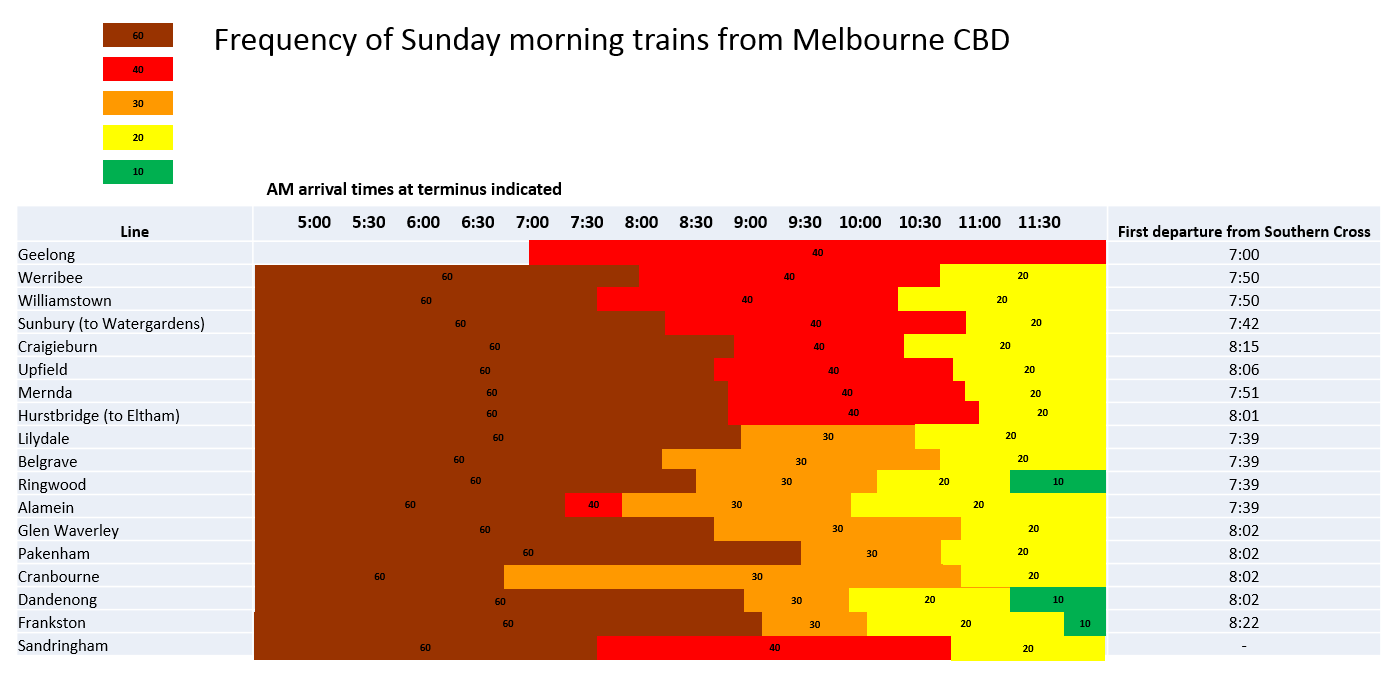
A similar pattern exists for trains from Melbourne. There, except for Pakenham, the frequency changeovers are later, with the hourly service often continuing until about 8:30 to 9am. The 30 or 40 minute service remains about two hours after that. The lines with 10 minute service don't reach that until after 11am.
While arguably in the counter-peak direction and quieter than to-city services, low frequencies in the outbound direction affects connectivity to buses, trains and ferries which are themselves infrequent. An example are waits of close to an hour for connections between trains arriving at Frankston and the cross-regional Route 788. Failure to schedule such connections makes travel to Sunday trip destinations beyond the rail network (eg Rosebud, French & Phillip Islands, Healesville, the Dandenongs and Werribee Zoo) less practical.
Southern Cross
Notice the Southern Cross columns in the tables above? That's because even though trains are running all night they don't start serving Southern Cross Station until around 8 am, despite it being the terminal for long distance trains, coaches and airport buses. The non-availability of early Sunday Metro train service at Southern Cross is a deal-breaker for many. Since walking or a tram connection from Flinders Street is inconvenient, chancy or both, travellers will take Uber or taxis all the way instead.

The Southern Cross problem perhaps remains due to Night Network having its genesis as 'Homesafe', ie helping people get home, rather than its equally significant benefit of improving Sunday morning travel. And, unlike directly-managed stations, Southern Cross operates under a complex PPP contract that may make service extensions harder or dearer.
Other cities
Along with Melbourne, Sydney and Perth have the busiest rail networks relative to the total number of public transport trips made. How do they compare for Sunday morning service? Sydney train timetables are here. Perth train timetable are here.
Both cities lack the all-night service that Melbourne has. However Sydney's rail system starts early every day of the week. And its Sunday morning trains are running every 15 minutes while Melbourne's are every 30 or 40.
Perth trains are the latest starting of the three. But their lowest frequency is 30 minutes on all lines. This has gone to 15 minutes by 8am on the busier lines and 10am on the quieter lines. At certain times Perth has two to three times the Sunday service as any line in Melbourne. This is despite's Perth's weaker CBD, fewer major events, higher car ownership and history of regulated trading hours. Melbourne's sparsity of Sunday morning service relative to Perth can be seen in the timetables below. Had a line such as Geelong, with a length nearer to Mandurah's 70km, been selected the comparison would have been even less favourable.

Conclusion
Suburban trains in Melbourne run every 40 minutes for much of Sunday morning on many lines. The western and northern suburbs lose compared to the better serviced east. Overall Melbourne gets one-third to one half the frequency of Sydney, against which we like to compare ourselves. There are also difficulties accessing Southern Cross Station before about 8am, despite its significance as a long-distance rail, coach and air-feeder transport hub.
Many events are held over weekends, often for several days. But they're not just in March. There's another burst of events from Spring and into summer. With the state government promoting Melbourne as Australia's events capital that's open 24 hours, transport services needs to suit. Other things like fun runs and markets start early on Sunday mornings. Add general shopping and leisure travel and demand becomes substantial to the point of crowding.
Public transport provides major support in transporting workers, volunteers and patrons, especially for events in or near the CBD. So it should, given its ability to move large numbers of people in a short time. You simply couldn't run popular events on the scale that we do without high capacity public transport, especially rail. In fact the only time many suburban families use public transport is when taking the train to special events.
Melburnians also travel widely. Southern Cross Station is where people need to be for state and interstate rail and coach connections. And if you're flying then that's also where Skybus leaves from every ten minutes. If you can't make an early morning connection you're stuck. Particularly for day trips to regional Victoria or the budget flights that backpackers like. Hence access to Southern Cross is important at all times. Not just for locals but visitors as well.
So whether it's early-starting events in the city, markets in the suburbs or connections to coaches, trains and planes, Sunday morning travel is important. If it's missing or infrequent people are up $60 or more for a taxi. That dampens people's willingness to attend, participate in or volunteer for events. The latter is key since many events would die if it wasn't for volunteers and members.
That's today's topic. Train travel on Sunday mornings. We'll look at early Sunday morning services on all Metro train lines. Plus the Geelong line given its large suburban catchment.
That's easy to answer. It didn't used to. Until recently we had the latest Sunday start of any metropolitan rail network. One couldn't reach the city much before 8am. And if you were going outbound, for example to Frankston, you couldn't get there before 9am. Useless for many activities. In 2010 I suggested commencing Sunday service 60 to 90 minutes earlier to make trains more useful.
That problem vanished when Night Network started three years ago. Trains now run continuously from Friday morning to Sunday night. While Night Network's emphasis was party goers and late night shift workers, the improvement it made to Sunday morning mobility was at least as significant.
With the first resolved, the second question to ask is "How frequent?". That deserves teasing out since frequency affects the practicability of use. For example if you're going for a fixed time appointment or onward connection a low frequency can mean lots of waiting. It also renders impractical plans to board an earlier service such as you'd do if catching a critical flight.
Sunday morning frequencies for each line in each direction are below. With minor exceptions, time band boundaries are generally measured at the last stop on each line in each direction. This is fair since, unlike late nights when most people are travelling from somewhere to home, Sunday morning travellers are mostly going from home to somewhere. Often that's time-sensitive, such as an early starting event or transport connection. After all, who voluntarily gets up earlier on a Sunday morning than they need to?
Towards Melbourne
Most striking are the line by line variations in the critical 8 - 11am period. All lines in the north and west have 40 minute maximum waits. Whereas, except for Sandringham and Pakenham, lines in the south and east run every 30 minutes. The 20 minute frequency kicks in later in the west; there's even a short time where trains there are still every 40 minutes while some in the east have gone up to every ten.
Within the west the Mernda and Upfield lines are the least served, with hourly service continuing until about the 8am arrivals. Though bear in mind that before Night Network these trips did not exist at all. On the other hand Werribee and Williamstown has the latest start for the 20 minute service. The Geelong line retains its 40 minute service through the day with no early trains due to not being in Night Network.
Variations exist within the east, too. Pakenham, with its 60 minute frequency, has the least service of all lines until 10am. The outer parts of the Belgrave and Lilydale lines start their 20 minute service earlier than Pakenham and Cranbourne. This is likely a legacy from when lines through Ringwood were the busiest and best served on the network (now it's lines through Dandenong). Sandringham's 40 minute service is an outlier for the east, though it gains at night with its uniquely high 20 minute evening frequency.
From Melbourne
A similar pattern exists for trains from Melbourne. There, except for Pakenham, the frequency changeovers are later, with the hourly service often continuing until about 8:30 to 9am. The 30 or 40 minute service remains about two hours after that. The lines with 10 minute service don't reach that until after 11am.
While arguably in the counter-peak direction and quieter than to-city services, low frequencies in the outbound direction affects connectivity to buses, trains and ferries which are themselves infrequent. An example are waits of close to an hour for connections between trains arriving at Frankston and the cross-regional Route 788. Failure to schedule such connections makes travel to Sunday trip destinations beyond the rail network (eg Rosebud, French & Phillip Islands, Healesville, the Dandenongs and Werribee Zoo) less practical.
Southern Cross
Notice the Southern Cross columns in the tables above? That's because even though trains are running all night they don't start serving Southern Cross Station until around 8 am, despite it being the terminal for long distance trains, coaches and airport buses. The non-availability of early Sunday Metro train service at Southern Cross is a deal-breaker for many. Since walking or a tram connection from Flinders Street is inconvenient, chancy or both, travellers will take Uber or taxis all the way instead.
The Southern Cross problem perhaps remains due to Night Network having its genesis as 'Homesafe', ie helping people get home, rather than its equally significant benefit of improving Sunday morning travel. And, unlike directly-managed stations, Southern Cross operates under a complex PPP contract that may make service extensions harder or dearer.
Other cities
Along with Melbourne, Sydney and Perth have the busiest rail networks relative to the total number of public transport trips made. How do they compare for Sunday morning service? Sydney train timetables are here. Perth train timetable are here.
Both cities lack the all-night service that Melbourne has. However Sydney's rail system starts early every day of the week. And its Sunday morning trains are running every 15 minutes while Melbourne's are every 30 or 40.
Perth trains are the latest starting of the three. But their lowest frequency is 30 minutes on all lines. This has gone to 15 minutes by 8am on the busier lines and 10am on the quieter lines. At certain times Perth has two to three times the Sunday service as any line in Melbourne. This is despite's Perth's weaker CBD, fewer major events, higher car ownership and history of regulated trading hours. Melbourne's sparsity of Sunday morning service relative to Perth can be seen in the timetables below. Had a line such as Geelong, with a length nearer to Mandurah's 70km, been selected the comparison would have been even less favourable.
Suburban trains in Melbourne run every 40 minutes for much of Sunday morning on many lines. The western and northern suburbs lose compared to the better serviced east. Overall Melbourne gets one-third to one half the frequency of Sydney, against which we like to compare ourselves. There are also difficulties accessing Southern Cross Station before about 8am, despite its significance as a long-distance rail, coach and air-feeder transport hub.
The question is: What would you do about early Sunday morning train services? Is 40 minutes too infrequent? Should the 20 minute frequency kick in two hours earlier than it does now? And should suburban Sunday trains start to serve Southern Cross Station earlier than they do now?
2021 UPDATE: Werribee, Williamstown and Frankston lines got Sunday am service upgrades early in 2021. Hence they now run every 20 min instead of every 30-40 min as shown on the diagrams above. Let's see many more lines upgraded to have this level of service!
FEB 2026 UPDATE: The Sunbury, Pakenham and Cranbourne all had their infrequent Sunday morning service upgraded to every 20 min when the Metro Tunnel opened. The core of this line (West Footscray - Dandenong) enjoys a 10 minute frequency. However all Metro Tunnel stations except Town Hall are not open early Sunday mornings.
AUG 2026 UPDATE: Craigieburn, Upfield, Mernda, Hurstbridge (from Eltham in) and Sandringham got Sunday am service boosted from every 40 to every 20 min in the 23 August 2026 timetable. This basically ends the story of 40 minute Sunday morning train gaps, something that we have had for decades (although there are still issues in the outbound direction, Good Friday and Christmas Day late starts).
2021 UPDATE: Werribee, Williamstown and Frankston lines got Sunday am service upgrades early in 2021. Hence they now run every 20 min instead of every 30-40 min as shown on the diagrams above. Let's see many more lines upgraded to have this level of service!
FEB 2026 UPDATE: The Sunbury, Pakenham and Cranbourne all had their infrequent Sunday morning service upgraded to every 20 min when the Metro Tunnel opened. The core of this line (West Footscray - Dandenong) enjoys a 10 minute frequency. However all Metro Tunnel stations except Town Hall are not open early Sunday mornings.
AUG 2026 UPDATE: Craigieburn, Upfield, Mernda, Hurstbridge (from Eltham in) and Sandringham got Sunday am service boosted from every 40 to every 20 min in the 23 August 2026 timetable. This basically ends the story of 40 minute Sunday morning train gaps, something that we have had for decades (although there are still issues in the outbound direction, Good Friday and Christmas Day late starts).


 Steven Higashide
  Gleeson & Beza
 David Levinson
 Jarrett Walker