Tuesday, January 11, 2022

TT #148: Planning & scheduling efficient bus networks


I often talk about networks and timetables as finished products but not enough about the structures, processes and cultures that lead to the creation of good ones. I want to partly remedy that today. 

I first recommend reading this item by Matthew Rosenbloom-Jones, a US-based transport planner and scheduler, as background. 

https://www.linkedin.com/pulse/penny-wise-pound-foolish-decline-transit-scheduling-rosenbloom-jones/

Mr Rosenbloom-Jones wrote about the decline of schedulers and the rise of planners in how timetables happen. In particular, how (more remote) planners may lack the intricate operations knowledge that schedulers (who can smell the bus workshops from their offices and may eat lunch in the same room as drivers) pride themselves in. 

There's likely class and formal education differences too. Degreed planners might never have driven a bus. In Melbourne's case, partly because so many live in tram-rich inner suburbs convenient to their CBD DoT office, even riding one might be a foreign experience. Whereas schedulers possibly started as drivers and got to their position via a driver, maintenance or depot management roles. Thus they are rich in operational experience. But both might be weak in seeing things from a passenger view and be too set in their ways due to bureaucratic or organisational inertia. 

The article is American but many of the same forces apply here. And not just in transport.

For example the decline in prestige of narrow industry and employer-based crafts and the rise of more general and portable degree-based credentialism to soak up the larger number of university graduates now compared to 50 or 60 years ago.

We have also seen the importation of a cadre of transient international manager-overseers and, at the bottom end, an also imported and insecure 'Coolie class' to do outsourced grunt work in areas like cleaning and security. The replication of late 1800s colonial class structures nearly 150 years later in modern franchised rail was discussed here. This is less apparent for our buses, but schedulers fit in to the 'skilled artisan' class category described in that article with planners being dependent functionaries constrained by their DoT management superiors. 

Transport has always had some degree of interest from government and thus regulation. One can go back to concessions being granted for railways and tramways. Not to mention the 'Octopus Acts'. Then when buses started there were rules about them not competing with (now) government railways or even themselves. 

When public transport operations could no longer pay their way (from about the early 1970s) the government went from being regulator to payer. Further involvement came when fares were integrated  across modes in the early 1980s.

The emergence of subsidies should have implied a degree of network planning capability as inefficient routes became a matter of public money cost-effectiveness rather than a private matter for the bus operator. In practice this was only inconsistently applied. The early 1990s service cuts were particularly blunt with popular routes cut but some duplicative services surviving. And in the decades following it has taken an inordinately long time for us to be scrapping or combining duplicative routes with much work still to be done (although the pace is picking up with the very minor 673 to be deleted this month). 

Public concern about the lack of network coordination rose about 12 years ago. The Department of Transport were basically contract managers shovelling money to transport operators regardless of whether bus routes were efficient or connected with trains or not. Besides efficiency could be measured in different ways. 

For example a bus route that's 22 minutes long running every 25 minutes with two buses might be considered to be efficiently scheduled. Its operating hours may also support efficient driver rosters with a minimum of overtime. However it is not an effective service if part of its role is to connect with trains every 20 minutes from early until late. 

The PTUA found little timetable coordination between transport services in Melbourne. 2010's important Lavanas / Stone ATRF paper found no one was responsible for it. The momentum generated led to The Greens and then the Coalition to propose a public transport planning body, though Labor saw nothing wrong with current arrangements. 

Labor lost government to the Coalition which established Public Transport Victoria. This included the contract managers and planners from DoT, the marketers and data people from Metlink plus people from the Transport Ticketing Authority. Hence it simplified institutional arrangements regarding public transport, although it wasn't quite the promised 'one stop shop'.

While not much new funding was provided for bus services, the pace of network reform quickened. 2014, 2015 and 2016 saw major changes in some areas. Some happened after Labor regained office but all were planned during the Coalition's time.

From mid 2015, early in its term, Labor started to wind back potentially controversial service reform in favour of its 'Big Build' agenda. A couple of years later it folded PTV back into a larger Department of Transport that de-emphasised network planning. The term 'bus reform' was hardly heard. But last year it set up a bus reform team to revive it again.

Below is the 'no more excuses' speech from the late Paul Mees delivered before the 2010 election. It proposed significant change to the way we planned public transport in Melbourne. 


The complications of designing and specifying service

Roughly speaking if an existing bus route is upgraded or slightly extended the incumbent bus operator gets to run it. If it's a new route it's subject to an open tender process. Both changes require a service specification document prepared by planners in the Department of Transport. 

The specification gives service-related details like the route required, times of the first and last service, days of operation and frequencies. There may also be requirements such as coordinating with trains at certain stations served in directions that favour peak travel at various times. 

Sometimes the requirements are so complicated that the Department basically has to write a timetable prove the specification can work with reasonable efficiency. Thus their role might be more like the hybrid 'planner-scheduler' that Rosenbloom-Jones talks about. Also to get an idea on costs other factors like run times, the number of buses and the number of stops required need to be known.   

Even that is inadequate if you want to be absolutely sure you are getting value for money. There may be a case where a particular specification causes an inefficiency with bus usage or driver rostering. Or, conversely, it may be possible to combine a new route with an operationally inefficient existing route (eg a bus with a long layover time) to deliver efficient services on both old and new routes at lower cost. In other cases a very small increase in cost might enable a disproportionately better service. 

Some bus depots are at bursting capacity and need adding to before extra buses can be purchased. Another operator may have poorly used school buses that could be run to provide a better service to the public at other times. In another instance a reformed public bus route may be so similar to an existing school route that the special school route is no longer needed and an extra bus is available to boost frequency on a public route.  

All these matters are very bus operator specific. Senior drivers and schedulers in the bus company might be aware of them. But planners in a large transport department several degrees removed might not be, especially if their brief is simply to add a new route over an existing unreformed network. Without knowing it the specification they draft risks being expensive to deliver relative to the service provided or miss opportunities for low-cost improvements. 

Bus operators may regard their scheduling methods and fleet utilisation profiles as their 'intellectual property' to be jealously guarded. This is because it's part of their scheduler's 'craft' and is tied to their cost base which affects how low they can bid for business that is still viable for them. 

Even if bus companies were to share opportunities for low cost service upgrades (sort of like 'unsolicited bids' but for service rather than infrastructure) with the Department of Transport, the chance of the latter being able to find (say) $50 - 500k per year to upgrade one or a small cluster of bus routes outside the convoluted budget bid process is slim. This is while the Department of Transport is embarking on other adventures like new fixed or flexible roues over an existing unchanged network. 

One can see here how there is a risk of antipathy between planners (mainly with the DoT) and schedulers (mainly with the bus operators). And the planners themselves might not have enough influence in the Department to shout down some of the crazier and less efficient proposals their superiors may advocate.   
   
Planning successful bus network reform

What are the ingredients of our most efficient and wide-ranging bus network reforms, such as happened in Brimbank in 2014 and Wyndham in 2015? It was certainly not the administratively clean process of the Department specifying the services and telling the bus operator that's what they need to run. 

Instead it was an iterative back-and-forth process between the Department of Transport and the bus operators who contributed significant local knowledge. Although covering fewer routes the Brimbank reforms were more complicated in that they involved multiple bus companies who each needed to get a fair deal. Wyndham was easier because there was only one operator running all routes in the area. On the other hand Wyndham routes often had difficult coordination constraints due to the need to connect with (sometimes infrequent) trains on multiple lines. Sometimes specification requirements had to be compromised if 'greater good' improvements were possible. 

Hammering out the best solution required a cooperative approach between DoT planners, the bus company involved and a scheduling consultant skilled in the use of advanced scheduling optimising software. The value of this became apparent when some routes were able to be run more frequently than initially planned with the same number of buses.   

In both Brimbank and Wyndham there was some interaction between school and public bus routes. This was critical to deliver efficiencies needed to maximise frequency on as many routes as possible. Leaving school bus reform off a public bus revamp may be simpler but means that less can be done with a given budget, especially with regard to peak service frequencies.    

The smallest reforms, which should be routine business, involve minor timetable tweaks that fix run time issues or recoordinate with trains when their timetables have been adjusted. These have become more common over the last ten years in  Melbourne. 

However larger changes, that other cities (eg Perth) would also regard as routine business, involve the redistribution of service kilometres between routes to suit changing demand patterns are still quite rare. Fortunately this is starting to change, with the best recent example being low cost but very worthwhile timetable changes to routes operated by Transdev last year. Part of the reason for the success of this is that Transdev is big enough to have a mix of routes whose services could be said to be insufficient or excessive. Thus bus hours resources could be shifted from the latter to the former.  If the operator was smaller and/or it didn't have excessive service that could reasonably be pruned then the scope for reform is less without additional funding.  Transport authorities could encourage bus operators to submit ideas for these types of reforms, although this should not replace its own patronage monitoring and network review functions.

Adelaide showed how bus network reform can fail if too much is attempted at once. Transdev Melbourne's 2015 'greenfields network' attempt also failed following a change of government, a more risk averse minister and genuinely bad parts in its plan (that I'd have rejected too). 

Part of the latter was due to the limitation of single operator thinking and planning. Whereas Brimbank and Wyndham's networks were developed within the DoT (with input from bus operators and contracted specialist schedulers), the 2015 network was more Transdev's work more in line with the  outsourced franchising ideology of its contract and its payment method (which included incentives for increased patronage). 

Transdev's single-operator proposal was considered politically unacceptable as its consultation process was poor and it took resources from the west leaving them with a generally inferior service. While it was true that some Transdev routes in the western suburbs were poor patronage performers, the west also has popular routes run by other operators that justified more service. A genuine network approach would have kept bus resources in the west through an integrated multi-operator approach like taken in Brimbank while still scaling back its quieter or duplicative routes. 

This tale shows the limitations of the single operator approach for large network changes or shifts in service levels. Though administratively and contractually less convenient, a multi-operator place-based network reform would have delivered wider benefits and (likely) less of a public backlash. It is significant that unlike the 2012 metropolitan bus franchise contract, the 2020 version does not require the franchise operator to develop its own greenfield network (although it must still cooperate with other reform).    

Maintaining reform's benefits

It's not good enough to introduce a reform and hope it endures. Because it won't necessarily if there isn't the institutional memory to recognise what is good about a network and to retain it through successive timetable changes.

I have been a fan of multi-route timetables where two or three routes served a common corridor before branching out. Provided trips were evenly spaced they could provide a combined frequent service along the overlap section before branching out to provide local type coverage services to less dense or purely residential areas. Provided passenger information highlighted the frequent service you would have a larger yet still legible frequent network that passengers would use. 

The 2014 Brimbank network (or its follow-up echoes) specified such offset scheduling on at least two corridors from Sunshine. These included 400/427 along Forrest St and (later) 426 / 456 along Ballarat Rd. Each route would operate every 40 minutes but their times, staggered by 20 minutes, would evenly feed interpeak and weekend trains (every 20 minutes). Thus those on the combined corridors would get an efficient feeder service mostly operating at the same frequency as trains. 

These benefits are fragile if there isn't institutional knowledge and memory to preserve a network's benefits. In a transport department those who manage relationships with bus operators are not necessarily planners nor appreciate the intricacies of network design. A re-coordination might be approved without it being adequately assessed for suitability against an original specification. Or there might be a little tweak (such as a desire to add a deviation or extension) that adds so much run time that an even and well-coordinated timetable for the other 90% of passengers is harder to implement and falls by the wayside. An example of the atrophy that can occur to a formerly harmonised and coordinated network is this story about the aforementioned 426 and 456 in Brimbank. 

On the other side of town the 802/804/862 group is another example of uneven times. That didn't used to be the case; go back 20 or so years and it was an even 15 minute frequency. While Dandenong line trains have since changed from being every 15 to every 10 minutes, this is likely one instance where they would have been better off keeping the non-harmonised 15 minute frequency than to tolerate gaps of close to 20 minutes as now. Moving back west, the Route 180 to Werribee (nominally every 20 minutes) got a recoordinated timetable that opened up a 28 minute gap during morning peak. 

To summarise, reformed bus networks can atrophy. Original planning aims can be forgotten and neglected. For reason of lack of knowledge or expediency the Victorian Department of Transport has  not always been particularly good at preserving a network's service benefits over the longer term.  

Conclusion

The development of new bus networks in Brimbank and Wyndham were an example of a network planning vision meeting a scheduling craft. And, largely unseen by departmental planners, rosterers able to allocate driver shifts to run the scheduled services. 

The same results may not have been possible if a more hands-off approach, of the DoT simply putting a series of specifications out to tender, or giving them to an incumbent bus operator without detailed feedback and follow-up optimisation, been taken. Even if the routes were the similar frequencies would likely have been less due to less efficient bus usage. 

At the other extreme simply letting individual bus operators develop networks has also not been successful, especially in areas with connecting services and/or where they are not the sole operator. 

Hence a collaborative approach, as has been shown to work in Melbourne for some network reforms, needs to be taken to develop the best possible network from available resources. And once that's been done vigilance is needed to ensure that future timetable changes do not whittle away a network's design features such as good coordination and high frequency.      


Friday, January 07, 2022

How to win votes with public transport: Guide for 2022 Victorian election candidates

So you want to get into (or remain in) Parliament?

You’re standing in November’s state election. You’re contesting a lower house seat, most likely in middle or outer suburban Melbourne. You’ve been endorsed (or are seeking endorsement) from one of the main parties. Or, because of local issues, you think you stand a good chance as an independent. You may even be an incumbent who is struggling because of changing public sentiment towards your party or an unfavourable redistribution which removed your best areas and reduced your margin.  

You will likely have some idea of local issues. If it’s a growth area there may be insufficient schools, libraries, hospitals and other services for your population. Established areas may be facing population decline in the country or densification in inner suburbs. Housing access, development, policing, state taxes or the environment may be other concerns. Service delivery and cost of living are also always discussed, especially during these times where people have lost jobs or have got fewer hours due to the pandemic. 

Public transport is one of those key service delivery issues. More so than other services (eg health and higher education) it is almost entirely a state matter. Thus if you are contesting a state election you must have an idea of community concerns and needs regarding transport. 

Depending on where you are it could be a new rail line, upgraded station or bus route.  If you are in a party you will want their platform to include projects that benefit your area. The best thing a local member can say is “I got you this new station, level crossing removal, bus upgrade or similar” as part of their re-election pitch. Assuming you win in 2022, will you be able to do this in 2026?

Why better public transport?

Public transport might not have been something that you personally have used greatly or thought much about. But it’s still good that other people use it even if it just means fewer cars on the road in front of yours. Other benefits include less competition for parking, more walkable neighbourhoods and lower carbon emissions. 

Then there’s the direct benefits for people you want to vote for you. 

People think trains, trams and buses when the term ‘public transport’ is mentioned.  But it’s actually more than those. Public transport is best thought of as the ‘great enabler’. It enables people to do what they want to do and get the most out of their life. Or, more concisely, to fulfil their dreams. That is it allows people to take up jobs, education or other opportunities they might not have otherwise been able to.  

If transport services are good enough then they can allow families to get by with one less car. That can deliver large cost of living savings or allow them to improve their lives in other ways. At least it gives them security and choice that wouldn't exist if the transport services weren't there.  

A lot of potential improvements are relatively quick and cheap yet can make a substantial difference to peoples mobility. As a candidate it’s a good story to tell – provided that you and your party are advocating the right things. More on that later. 

Why include public transport services in your campaign? There's two main reasons. First of all it's a  basic 'bread and butter' issue affecting how people live and their living costs. And a core state responsibility as befits a state election. Secondly there is more goodwill towards and less division regarding public transport than many other issues, especially on social policy. You might have a position on matters like injecting rooms or 'Safe Schools' like some did in 2018. However these polarised people and you may lose as many votes as you gained by taking a strong stand. Whereas improved public transport has a broader consensus in favour with no serious opposition. At best people will be supportive while at worst they will be indifferent. So if you advocate improvements to it you will only gain, not lose, votes.  

What transport needs improving in your area?

You may or may not have enough first-hand experience to know. If your social circle is narrow (which it can be for hacks-cum-candidates, especially those 'parachuted' into seats they had no previous association with) your friends might not have much of an idea either. There are exceptions, but the 'political class' (that too many candidates are drawn from) can be prone to overestimating household median incomes and misreading community sentiment on some matters.  

Regardless of your own background, you should at least make it your business to know the area's main transport issues. That is so that what voters tell you is not a surprise and you can provide well-based feedback on what your area needs to your party when they’re formulating policies. Also you don’t want to be embarrassed by publicly backing some crazy scheme that is neither feasible nor likely to win funding. Leave that to less disciplined people in your party.  

Where can you start? I suggest looking at PTV local area transport network maps. You should look at several to cover all your seat and popular destinations up to maybe 10 or 15 kilometres away. These maps will show the train, tram and bus lines. 

Use a Melway street directory or similar (which also has bus routes mapped) to see if some pockets have homes or jobs but no routes nearby. A gap may indicate a need for a new route or extension. Also check if routes seem simple and direct and they go to logical destinations like train stations and shopping centres. Some areas have routes that stop slightly short and could be made more useful if extended. People prefer straight to circular routes and there may be scope for improvements here.

Just because there is a line on a map does not mean the service is any good. Did you know there are some bus routes in Melbourne that have just one or two trips a day? These are most unlikely to be useful at the times most people will wish to travel. This is why you also need to look at timetables. The most useful and successful routes have frequent service all week over long operating hours. Again you can use the PTV site to look up timetables (I find the pdfs most convenient). 

Things to look at include starting and finishing times, how frequent services run and whether there are Sunday or public holiday services. If your local bus doesn't run 7 days until at least 9pm then you are being short-changed as this was a minimum service standard introduced in 2006 but not yet fully implemented. 

Weekends are often the busiest times at major shopping centres but buses may not run or be infrequent. Connections with trains are another issue; if the train is every 20 minutes then a bus every 23 minutes will not consistently connect with it. An upgrade could give buses easier to remember timetables that mesh evenly with trains all day. Then there’s peak services – many routes run only every 30 or 40 minutes and may not match school or work start times well. 

You could also compare your area against others. Some areas have better bus or train frequencies than others. This is often due to historical quirks rather than rational planning. If you are in an area where trains or buses are busy but infrequent (or don't run on Sundays) then a strong case may exist for a service upgrade. Don't have time for all that? My 2022 updated interactive frequent network maps gives a snapshot of the have and have not areas when it comes to useful public transport service.  

The PTV journey planner can also help. Try planning random trips to popular destinations within your seat. Industrial areas right near residential areas where there ought to be a bus but isn't can give interesting results. If travel times are too long compared to driving then there may be a need for better frequency or faster, more direct bus routes. 

Want specific network ideas for your area? See my Useful Network series. That has items examining local networks throughout Melbourne. Specific routes are covered on Tuesdays. Other sources include proposals from various organisations including local councils through their transport strategies. Between these you are almost certain to find analysis of and ideas for services in your seat. 

Recent policy 

If you could summarise recent public transport policy it would be this: Spending on ‘big build’ infrastructure while starving service. 

That’s not to say more infrastructure is not needed. For instance some outer suburbs could do with rail extensions. Some stations need access and amenity improvements. Closer in areas could benefit from their trams being extended a kilometre to the nearest station. Bike paths and pedestrian crossings feature highly on cost-effectiveness measures.  

However the incumbent government has built a lot, particularly with regards to level crossing removals, new stations and the Metro Tunnel. And they are proposing airport rail and the Suburban Rail Loop for the future. 

Infrastructure does however need to be used to maximise benefits from its construction. It's no good having grand new stations if few trains stop at them. Or massive fleets of buses that are only used a few hours a day on slow and complex routes. This is the service aspect of public transport. It is every bit as important as infrastructure. Although there has been a minor pick-up in pace lately, service and service reform has been neglected by as much as infrastructure has been boosted in recent years. 

What's the practical result of decades of sidelining service? It means that buses and trains are not as useful for as many trips as they should be. For example many areas haven’t had bus routes and timetables reformed for 20 or 30 years. Problems with unreformed services include routes that no longer meet modern needs, confusing deviations, short operating hours, low frequencies and services that wastefully overlap other routes more recently added.

Only a minority of people commute to the CBD 9-5 yet much of our network is still heavily geared to getting people to just a couple of square kilometres of city when there are larger needs closer by that could be better serviced. There is also a large casually-employed workforce, often on lowish incomes, who could take public transport but can't because operating hours and frequencies are inadequate for good connections at the time they travel. Again fixing this is quite economical, in many cases just working our existing trains, trams and buses harder.   

Bus routes in some areas have not caught up with Sunday or even Saturday afternoon shopping. They may also finish in a dead-end street rather than extend to a new station or shopping centre a kilometre or two down the road. The silver lining for an engaged candidate is that most seats have 10 or 20 'quick wins' with service that could address a multi-year backlog and make buses and trains more useful.  

The stalling of timetable reform several years ago has also left train timetables in some of Melbourne's most politically marginal areas unreformed. Many so far unrealised opportunities to simplify stopping patterns and increase frequencies exist on trains as well as buses. On this we are well behind Sydney which has 7 day trains every 15 minutes on most lines as opposed to maximum waits of 30, 40 and even 60 minutes on ours.   

Both Labor and Coalition candidates can advocate improvements in their seats in a way that suits their party's narrative. For example Labor could sell a 'swing to service' as being a logical step after their infrastructure builds. Meanwhile Coalition candidates could highlight Labor's past neglect of service matters and propose a new emphasis on it. On this the Coalition could point to rail timetable upgrades that happened during the Baillieu/Napthine and even Kennett eras, particularly in the east and south-eastern suburbs.   

Know what is possible and affordable

The costs of infrastructure projects are often reported. Service-related projects can be less easy for an outsider to cost. Although well-organised parties prepared with concrete proposals can get good advice from the Parliamentary Budget Office. An example from a while back was when The Greens got costings on their plan to boost metropolitan train services. 

Something like a rail extension tends to be a longer term project. It may not even be completed in the term that it is promised, especially if the government doesn't quickly start, commissions a study then sits on it again.  

New bus routes should take less time to set up but, perhaps surprisingly, aren't necessarily that much quicker than infrastructure projects like grade separations. A new route requires planning work and almost certainly new buses and a contracting process. 

In very rough terms a new 10km long bus route operating every 30 minutes needs two new buses and costs about $1m per year to operate. An almost similar cost would apply if you were to upgrade an existing 10km long route currently only running hourly to every 20 minutes. Unless you are lucky with slack time in the timetable route extensions also need new buses unless you are willing to cut frequency. I discussed how long it took to start a new bus route here. 

Where several routes overlap it may be possible to review a network to deliver simpler and more direct services without buying more buses. This is more cost-effective than simply layering a new route over an existing network. However it may take longer if there is a public consultation process to be worked through. 

When trains were crowded people were clamouring for peak period service upgrades. Peak train commuters can be politically influential but adding services is expensive where you need to buy new trains and (even more so) where you need to build more tracks (or at least modernise signalling) to fit the extra trains. Also the proportional benefit of adding two extra trains per hour is much higher at off-peak times such as at night (where it may represent a doubling of service and a halving of waiting)  compared to peak times when the extra frequency would hardly be noticed on most lines. Right now there is unlikely to be demand for peak upgrades. However the opportunity could be taken to reduce the number of complex peak stopping patterns on some lines for an overall simpler service. 

The simplest and cheapest upgrades are the sorts of improvements you can make without buying new trains or buses. The costs here involve extra driver hours, fuel and maintenance so are relatively modest. Common examples would be more frequent off-peak trains or boosted weekend buses. In the latter case many bus routes are only half as frequent on weekends than on weekdays despite some of their major destinations like shopping centres being busier on weekends. Compare this for your area with the updated interactive frequent network maps. This is mostly a historic hangover based on past travel patterns. Especially off-peak when you increase frequency you increase patronage since the service becomes more convenient and attractive to use.
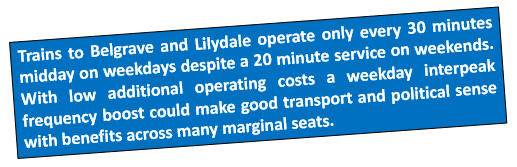

What transport planners call 'shoulder peak' times also present opportunities to make service a lot more useful with only a few extra trips added. Many train timetables become way less frequent when you move away from peak times, even though there are still quite a lot of people travelling. Scope exists to slot in extra trains before and after the morning and afternoon peaks to have more gradual roll offs in service and higher frequency during still-popular times. As an example boosting the 30 minute mid-evening service on some lines for a two hour period (eg 8 - 10 pm) requires just two extra trains each way to deliver a 20 minute frequency and four train trips each way for a Sydney-level 15 minute frequency. More cheap train service improvements discussed here. 

What about upgrading existing bus routes? You might not greatly upgrade poorly used or convoluted bus routes without first reforming them to make them simpler and more appealing. Unless the route was the only one in a neighbourhood and you wanted some cheap 'quick win' upgrades now with a more thorough review planned for later. For instance you could add a modest Saturday afternoon, Sunday or public holiday service. Or maybe an extra weekday early morning or early evening trip for commuters. 

Such small upgrades are good and often cheap. But other upgrades to busier routes would get more riders and thus aid your campaign more. Increased usage potential is greatest on routes that are already reasonably popular and direct to major stations, universities and shopping centres. 

Depending on the area a look through timetables may reveal such routes that are every 15-30 minutes on weekdays but drop off to hourly (or sometimes worse) on weekends, particularly Sundays. There is often no patronage rationale for such a sharp drop-off in service as the weekend trips that do run are amazingly busy. Consequently a weekend frequency upgrade, and possibly some modestly extended operating hours, is likely to be popular. It is also the simplest upgrade to implement as there is no need to change routes, open tenders nor publicly consult (as it's just adding trips). Also the message is clear and there are no complications that can arise with misunderstood network reform proposals. Simple upgrades like these are thus ideal for a candidate to advocate.       
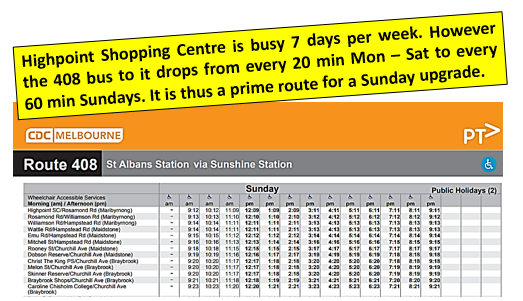

Service increases like these involving the same number of trains or buses makes your network more efficient as its high fixed costs are distributed over more passengers. The more passengers there are the more voters benefit from the extra services you campaigned for. 

Summary

I've given some ideas if you are thinking about what transport things to advocate for your area. 

The first step is to understand the area and the services that are there already. You need to have an idea of how they compare with services elsewhere along with local needs to identify where gaps might be. 

A practical local transport package will likely include measures across all modes. Look out for 'small infrastructure' opportunities like short missing walking and cycling links. It may be possible to work with local government to deliver these. Back rail extensions or new stations where warranted. Advocate new and extended bus routes where there are logical new destinations. And champion frequency and operating hours upgrades, especially on popular lines and routes at times where they can be done by working the existing train and bus fleet harder. 

All these can deliver benefits that get to the core of why you went into politics - ie to make  a difference and make peoples lives better. And, unlike (often necessary) big infrastructure, a focus on the service aspects is long overdue and can deliver relatively quick wins that could assist your re-election in 2026. 

Follow-up (specific measures seat by seat) 


Tuesday, January 04, 2022

Some holiday reading: Train and tram history

Not a full post today but I wanted to refer you to the excellent https://www.victorianrailways.net/ website. 

This has more reading than you'd ever find here. 

If you're into Victorian Railways history the most important link is the timeline at https://www.victorianrailways.net/vr%20history/history.html

Not only is the information there handy but also the scanned copies of annual reports and VR newsletters. Archives of the latter exist for the 55 years from 1924 to 1979. This spans a period from when suburban electrification was new almost up to when suburban patronage and service levels reached rock-bottom a couple of years later. 

Something else I want to refer you to is The Bellcord from the Melbourne Tram Museum. This very professional quarterly magazine has some great historical articles. I wasn't able to find a page with links to all issues. However the latest (December 2021) is at https://www.hawthorntramdepot.org.au/downloads/bellcord/bc-052.pdf . If you want to see earlier issues just paste the abovementioned URL into your browser and change the issue number. All issues are online, going back to 001 from July 2007. 

It should be noted that whether it's scanning old magazines or writing historical articles for current publications, the job of making the past alive to current and future generations falls predominantly on volunteers - both as individuals and via various groups.

The old proud (but arguably a touch arrogant!) outfits like VR and MMTB constantly communicated their history  through staff newsletters and the like. Modern management practices, including the recruitment of non-transport people to executive positions, the scrapping of a visible internal library function and foreign franchising has pretty much hollowed out the 'corporate memory' in organisations such as the Department of Transport. Continuity is now mainly confined to the older middle level specialists in some organisations and the remaining few family bus operators.  

If you want your transport history you can not necessarily expect today's providers to be consistently good custodians of it. Voluntary societies play an essential role in preserving and articulating our transport history and we'd be stuck without them. Although more creative types in say the premier's office or a major construction authority might occasionally draw on it for their social media. 

History isn't only worthwhile for its own sake. It is also essential for planning, evaluation and debate today. For instance, when discussing the merit of infrastructure projects and whether slicker operating practices could unlock capacity at lower cost, the late Paul Mees used 1929 timetables to press his view that our rail system could handle many more trains than ran at the time (15 or 20 years ago). Similarly some themes have been recurring for the better part of a century, for instance congested level crossings and that a past removal program was wound down as road builders favoured freeways and widened arterials from their budgets.

When you are next waiting for a tram, reflect on the fact that your grandparents probably waited only half as long as more frequent service was then the rule and we have yet to fully recover from 1960s sevice cuts. We only know that through history like documented here. And certain crises, such as happened 70 years ago with buses have echoes today if not here then elsewhere. 

So transport history is important. Read it! 

PS: For even more see my web history of public transport in Melbourne. Also information sources here will prove valuable for researchers, historical or otherwise.