Tuesday, May 09, 2023

Past budget funded service upgrades - what's been done?


With the federal budget tonight and the 2023 Victorian budget in two weeks let's do a review of what the previous few state budgets have funded. That's important so we know which budget has funded what service upgrade. 

2019

From what I can tell everything service-wise funded in the 2019 state budget has been delivered. 

Notable examples include the new route 390 Craigieburn - Mernda bus, the new route 816 Keysborough South bus plus bus improvements in Romsey, Lancefield, Alexandra and Eildon. 

Metro trains on the Werribee, Williamstown and Frankston line got a major upgrade with maximum waits reduced from 30-40 min to 20 min in early 2021. Such reduced maximum waits have been unheard of on the metropolitan rail network for decades, particularly since the evening service cuts made in 1978. The City Loop was also simplified with single direction running for trains coming from Dandenong. I'm going to hazard a guess and say this was funded from the $56m allocated to new train services from 2020-21 in the 2019 budget. 

The main rail infrastructure projects on the planning agenda in the 2019 budget included Suburban Rail Loop planning, Melbourne Airport Rail planning and Western Rail plan, including electrification to Wyndham Vale and Melton (p 5).

There was funding for planning and business case development of tram and active transport connections between Fishermans Bend and the CBD. Remember 'Fishermans Bend' as it comes up in future budgets. 

And, returning to buses there was $6.8m for a 'Bus Industry Innovation Fund'. This was to support the bus industry "through delivering initiatives focused on improving network efficiency, patronage, customer experience, safety and driver support. Maybe it was used to develop Victoria's Bus Plan (which came out in mid-2021)? If you have an idea of funded examples then please mention in the comments below. 


2020

The 2020 state budget was generous for infrastructure but  parsimonious for service. 

The only really new item for the public bus network was network reform and service upgrades on the Mornington Peninsula. This featured much needed upgrades to the 788, a new 7 day Rosebud - Frankston express buses, some welcome coverage extensions and simplification to other routes and a new FlexiRide for Rosebud. However service levels remained underbaked with some routes shutting down as early as 3 or 4 pm and not running weekends. 

The Route 390 Mernda - Craigieburn bus from 2019 also got a mention with accelerated delivery. Actual delivery was October 2021.  Some outer suburban secondary colleges will get improved school special services in this budget. 

$3m was committed for a tram corridor strategy. This was to consider network reform to optimise the use of both existing and next generation trams. Again comments on this are appreciated as we haven't yet seen a lot of tram network reform. Maybe, like mooted rail frequency upgrades, these will wait for the Metro Tunnel's opening? 

Airport rail and Geelong fast rail were the major projects in the 2020 budget. However recent media reports indicate that these may get delayed. We'll know for sure in two weeks.

There was also funding for 100 next generation trams, the Dandenong rail corridor, station parking and more. Furthermore, this was the budget that introduced a (modest) charge on electric driving along with $20m for a zero emission bus trial. 


2021

2021's budget was an advance on the 2020 low point with regards to service. The year also marked a revival of official interest in bus network reform after several years of not much. A way forward was charted in Victoria's Bus Plan, out six weeks after the budget. Areas for the first network reviews were announced in late 2022 with an online survey done. 

Growth areas in the south-east got some love with new or extended routes in Clyde, Clyde North and Cranbourne in the last few years. 888 and 889 started in early 2021 (so would have been funded from a previous budget). Then 881 from Lynbrook started in January 2022. Finally 897 and 898 got extended in August 2022. 

Tarneit North gained a FlexiRide though the original plan was for two fixed routes (154 and 155). This started in October 2022. High usage may mean that fixed routes will be needed as discussed here

Also implemented were Moonee Ponds - Melbourne University improvements as extra trips on Route 505. These started in February 2023

Funded in the 2021 budget and starting in October 2022 were large improvement to buses 235 and 237 between the city and Fishermans Bend. These two routes run at 10 min (ie tram-like) frequencies during the day on weekdays but remain with either occasional or no weekend service. These upgrades may buy some time given there's been no government interest in tram extensions to this area (or anywhere else) for a long time.

In a similar vein, the West Gate Punt retained funding as a foot and bike alternative to a Metro 2 rail tunnel or even a direct Fishermans Bend bus from Newport over the West Gate. Planning money for future Fishermans Bend transport was still there but this time it was broadened to 'high capacity transport' (rather than the tram-emphasis in 2019).  

Also mentioned were network changes in Yarra Valley and Broadmeadows. Yarra Valley changes aren't operating yet. However an update last month indicated the new network will be running later this year. As for Broadmeadows, there's less definite to report. However Craigieburn got significant upgrades with four local bus routes improving from every 40 to every 20 minutes later, in April 2022. Route 538 was mentioned in some material but that's had no service uplift. 

2021 also saw some low cost but worthwhile bus network reforms associated with (i) Night Network reform and (ii) redistribution of service within the Transdev / Kinetic network. The former was planned some time ago while the latter was so low cost that I don't recall any mention of it in either 2019-2020 budgets. It seems to indicate that a resourceful department can get smaller service reforms through without recourse to the drawn-out budget process. There should be much more of this, with some examples presented here

To sum up most of the 2021 funded bus upgrades have been implemented except for the more complex ones involving network reform. On the infrastructure side the budget mentioned the development of a battery electric train potentially for Wyndham Vale as part of the Western Rail Plan. It would be interesting to see an update on this project in the light of current concerns about rail in the west being de-emphasised, firstly in relation to airport rail and latterly in relation to projects like SRL in the east.   

2022

Last year's budget continues the gradual upward trajectory of funding for service. As it's more recent it's reasonable to expect that less of it will have been done given that current DTP processes require two or more years to implement new or greatly reformed bus services once funded. 

Here's the status of some of the funded service initiatives from the May 2022 budget: 

Bulleen Park & Ride: OPERATIONAL. Associated route and service changes only minor.  

Improvements to bus routes between Box Hill, Deakin Uni, Monash Uni and Southland: PARTLY OPERATIONAL. Route 733 and 767 gained their service upgrades last month. Other reforms involving 201/768 Deakin shuttle and 903 via Deakin University planned for later in 2023.  

Greensborough FlexiRide and associated network changes: IN PROGRESS. A survey was done in 2022. The website states that the consultation report was released in April 2023 (though there is no link to it). A late 2023 start is stated. Background here

Network changes in Heatherton to complement SRL works: IN PROGRESS. Information at stops and online put out to advise of changes. Involves the deletion of Route 821 and some upgrades and rerouting for 631. Background here

Weekday shuttle between Donnybrook and Craigieburn stations: IN PROGRESS. Route 501 due to start some time in 2023

New Diggers Rest - Sunbury bus route: IN PROGRESS. October 2022 release from Josh Bull MP gives Route 475's service levels but not a start date. 

Improved buses for Torquay and Armstrong Creek: IN PROGRESS. Consultation April 2023. Implementation planned for 2024.

Bus upgrades in Cranbourne West and Narre Warren: UNKNOWN - PRESUMED IN PROGRESS. Release here. Local bus network is very complex and infrequent with inefficient overlaps so waiting a bit longer for proper network simplification may be desirable. 

I'd expect there'd be announcements about at least some of these upgrades later this year. 

Other funding items in last year's budget was work on the tram plan, V/Line improvements, new V/Line trains, a northern transport and land use plan and Caulfield station interchange. 

Related: Has State Labor kept its transport promises? (2014 - 2018)


Conclusion

This has been a run down of funded implemented and forthcoming service upgrades for the Melbourne and Geelong areas. Regional and school bus improvements have been omitted.

Join me in two weeks for a look at what (if anything) new gets funded in the 2023 state budget


Thursday, May 04, 2023

UN 152: Transport for Mambourin

Take the train from Melbourne towards Geelong. Look right towards the YouYangs a couple of minutes after you depart Wyndham Vale Station. You will see lots of houses. That's Mambourin.

Their local station at Black Forest Rd is neither funded nor built. While a cruel tease for now its appearance on some maps may build expectations that cause it to eventually happen. But for now, like many new estates, service provision is lagging with not even a local bus route serving a now populated area. 

The nearest bus stop is 30 minutes walk away. Like at Mt Atkinson, locals are campaigning for a local service with a 'bus marathon' held last month. Mambourin is in the state seat of Werribee, held by Treasurer Tim Pallas.  

Mt Atkinson, discussed last week, was quite difficult to draw a bus route concept for. I presented several potential alignments, each with its pros and cons. Fortunately better planned Mambourin looks easier with a potential through route between two major stations. 

The first, and most easily resolved question, was whether an existing route could be extended. That would be the most economical way of improving coverage if this was possible.

The only route in the area is the 192 between Werribee and Wyndham Vale. That has a lot of unique coverage and is a good patronage performer. So it's best left alone and a new route added for Mambourin. 

Desirable features of such a new route include: 

* Connectivity to trains on both lines in the area (Geelong and Werribee)
* Good access to the nearest shopping centre (and preferably others)
* Good coverage of residential areas with reasonable directness
* Potential to feed trains at a future station at Black Forest Rd
* An efficient route length for a frequency that harmonises with trains

Mapped below is a rough concept for something that might reasonably satisfy these points. I've called it the 193 given that its nearest existing route is the 192. 


It feeds trains at both Wyndham Vale and Werribee, serves local shops and provides reasonable (though not complete) coverage. Its 12-13 km length should take a little under 40 minutes.

A very basic service every 40 minutes (meshing with off-peak trains at both stations) would require two buses while four buses would be required for a more attractive 20 minute frequency (which a lot more routes in Wyndham should have - all day - due to strong patronage). 

If the cheaper 40 minute option is chosen it is desirable that timetables are offset with those for Route 192 (also every 40 min off-peak) to provide a combined 20 minute frequency on common portions.   

That's the concept anyway. The actual alignment might be different, depending on roads that are open and where further housing has been built by the time that service starts. 

Thoughts on all this are appreciated and can be left below. 

Index to other Building Melbourne's Useful Network items 

Note: From now on I will post on Thursdays instead of Fridays. This should widen readership and discussion on a day of the week where influential readers are more likely to be in their offices with colleagues rather than working from home.   

Tuesday, May 02, 2023

TT #183: New Hurstbridge, Mernda, Belgrave & Lilydale train timetables


Being a regular train rider hasn't been easy on much of the network in recent years. 

Prolonged bus replacements of busy line sections have slowed travel, with rail's main selling point - freedom from being stuck in car traffic - gone. 

Furthermore increased travel time variability has made trip planning harder, especially for time-critical trips or if the journey home requires a change to an often infrequent bus.    

Passengers accept these inconveniences for a better future, such as promised by 'Big Build' advertising. That could include removed level crossings, new stations, new paths and capacity for better service.  

As more projects reach fruition it's worth asking whether the benefits were worth the hassle.  Or will some who switched to driving never return to rail if the post-project service is hardly better than before?   

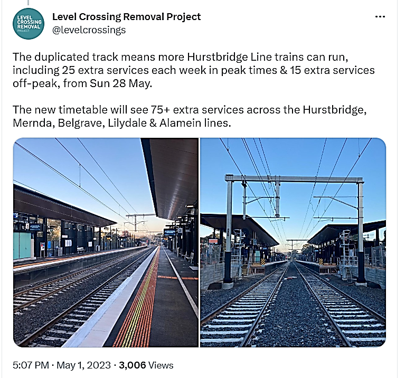
Two significant rail projects will reach operating completeness on Sunday May 28. These include track duplication on parts of the Hurstbridge line and two (more significant than normal) level crossing removals in Surrey Hills/Mont Albert. Both have resulted in revised timetables that are now available.   

A summary of these projects and what the new timetables offer is below: 

Hurstbridge 

Project purpose: Duplications of some single track sections on Hurstbridge line. Single track sections can be a hindrance so project should permit improved peak capacity and better reliability. 

Infrastructure gains: New duplicated track for Greensborough - Montmorency and Diamond Creek - Wattle Glen. Two new stations at Montmorency and Greensborough (latter with much needed bus interchange). New shared path between Greensborough and Montmorency.

Disruptions: Long term bus substitutions between Macleod and Hurstbridge and other portions of the line at times. City Loop not always operating.  

Rail service gains? An extra 40 services per week mostly in peaks. This is made up of 25 in the peaks and 15 off-peak. That's 8 per weekday. This has helped give the Hurstbridge - Diamond Creek section a fairly even am peak service with 20 rather than 30 min intervals as well as better shoulder peaks later on. Also the extra tracks permits greater scheduling flexibility with more and more evenly spaced counter-peak trips. 

Another gain is shorter dwell time at Flinders St, speeding travel for those travelling to City Loop stations. Many more (if not all) trains from both the Hurstbridge and Mernda lines will stop at Victoria Park. This should aid connectivity to Melbourne University via the newish 202 shuttle bus

Talking about expressing, patterns will be swapped south of Clifton Hill with Hurstbridge trains stopping all stations (even in peak) and Mernda trains express through Collingwood and both Richmonds on that line. The travel time in the timetable is similar whether trains are express or not so I'm guessing this is done for load balancing purposes and to maximise reliability.  

There are no weekend timetable reforms as far as I can see with the dreaded 40 minute Sunday morning headways remaining. Neither has the start time for the 30 minute evening service been pushed later. This makes the timetable largely a peak affair, though reliability should improve with the duplication. 

Complementary bus service gains or network reform? Minor timetable changes on some bus routes to maintain coordination with trains. However this does not fix systemic issues such  as the chronic mismatch between train and bus frequencies on routes such as 517, 566 and 580 whose frequency will continue to not harmonise at most times. No bus network reform was included as part of these changes but some will come when Greensborough FlexiRide starts. 

What further cost-effective service upgrades could have been done? A good way to assess priorities is to look at times of the week where a significant number of people wish to travel, frequencies are very low and worthwhile upgrades could be done by inserting a small number of train trips per week. Three particular service opportunities stand out. 

a. Sunday morning frequency. This is most notable with passengers having to grapple with a 40 minute frequency until a (not early) 10:26am arrival in the CBD. This compares to a 20 minute service on lines like Frankston, Werribee and Williamstown that got upgrades in 2021. 

An upgrade to start the 20 minute service at a 7:05am CBD arrival would need 10 extra trips per week (5 each way starting/finishing at Eltham like the Saturday timetable). That's only a small increment on the 40 services per week that got added. However it would simplify train service with a maximum 20 minute wait (from Eltham inwards) between 7 am and 7pm 7 days per week so would have been worth doing. 

b. Mid-evening frequency upgrades. With evening trains 30 minutes apart on most of the system, Melbourne has amongst the least evening service of any similar developed city's train network. Sydney, for example, runs a lot of its lines every 15 minutes following large service upgrades in 2017.  

The Hurstbridge line is a bit of an oddity in that there's an uneven and non-clockface mid-evening frequency on weeknights. That's been retained in the new timetable. Departures from Flinders St are 8:18, 8:42, 9:04, 9:19, 9:42pm. That is varying gaps of 15-24 minutes.

It is strange that this has not been made an even 20 minutes given that this regular service is achieved at other times. It might have been possible to juggle existing services to close the gap. Or failing that, one extra trip each way per weekday could have helped with a roughly 20 minute service until approximately 10pm. That's an extra 10 trips per week. 

If you wanted to do weekends you'd need to add more trains per day as the 20 minute service finishes at 7:19pm (from Flinders St) and it falls off more quickly to 30 minutes. That would need two trains each way, or 8 added per week to cover both weekend days. 

To summarise, a revised Hurstbridge line timetable involving a 20 min maximum wait between 7am and after 9pm 7 days per week would need a total of 28 additional trips per week, mostly between the CBD and Eltham. That's an average of just 4 per day - ie pretty small relative to the number of trips that currently run.

Or, even bolder, you could run the upgraded 20 minute service to midnight all week if about 4 trips per day (on average) were added after about 9:30pm. This would make the timetable like that of the Werribee line, which got an upgrade similar to this in 2021.   

That none of these options were done indicates a reluctance to fully exploit our rail assets to  transform service from their now obsolete narrow commuter orientation to a more broadly useful all-week service suitable for diverse trips. 

Mernda 

With Hurstbridge, the Mernda line is part of the Clifton Hill group, so-called as trains pass the same stations between the City Loop and Clifton Hill. As a result the two lines operate as an interdependent group. Hence timetable changes for Hurstbridge typically require a complementary change for Mernda, if only to ensure reasonably even intervals between the CBD and Clifton Hill. 

There are exceptions but generally speaking the Mernda line serves a more diverse, growing and lower income catchment while the Hurstbridge line is a more established, slower growing and typically wealthier catchment.  

Rail service gains? Mernda will get 35 extra services per week, made up of 25 in the peak and 10 off-peak. In other words 7 per weekday. As noted before, the Mernda line gets more inner area expressing though no time is saved. The pm peak builds up a bit earlier from the 20 minute interpeak pattern. This should be a handy benefit for school students and early finishers. Depending on your destination the City Loop can be either a blessing or a curse so the 2 minutes faster travel around it should be welcomed.    

There are no weekend timetable reforms with the dreaded 40 minute Sunday morning headways remaining. There is also no change to the weeknight frequency, with the half-hourly service continuing to start at 8:30pm from Flinders St. Evenings are the major area where Melbourne is less served than Sydney with them having a lot more lines with trains every 15 minutes until midnight.  

Complementary bus service gains or network reform? There are some minor timetable changes on some South Morang and Mernda area bus routes to maintain coordination with trains. However the changes overlook systemic coordination issues with bus routes further south such as the huge number of routes around Preston, Reservoir and Epping which will remain with odd 22 or 24 minute frequencies (as they have for years). Also Route 389 in Mernda remains without weekend service. The Mernda line operates through an area that is slated for the northern area bus review so there may eventually be some network reform.  

What cost-effective service upgrades could have been done? Many of the comments above made for Hurstbridge apply for Mernda, but even more so due to stronger demographics and higher patronage potential.

This includes the need for Sunday morning and evening frequency upgrades. The number of extra trips required would be about 2 to 4 per day higher than for the Hurstbridge line as Mernda drops down to every 30 minutes earlier on weeknights. As the Mernda line is more urbanised than Hurstbridge all trains added would run the line's full length.  

Belgrave and Lilydale

Project purpose: Remove level crossings at Union Rd and Mont Albert Rd

Disruptions: Long term bus substitutions on one of Melbourne's busiest rail corridors through crawling traffic. High risk of losing people to public transport permanently unless service is improved afterwards.  

Infrastructure gains: Two level crossings gone. One new station (Union) to replace two old stations (Surrey Hills and Mont Albert).   

Rail service gains? Very limited. Union Station will get a more frequent peak service than the old Surrey Hills did with three morning and three afternoon peak trains altered to stop there. Higher peak frequency may compensate some commuters for their longer walks. 

The line's peak timetables will remain complex with numerous stopping patterns. Stations beyond Ringwood remain with infrequent 30 min service weekday interpeak with a missed opportunity to deliver 10 minute frequencies to Ringwood.  

Complementary bus service gains or network reform? None. Routes and timetables for 284, 612 or 766 in area will remain unchanged. All operate limited hours with no Sunday service despite serving the major hub of Box Hill. A low-cost 7 day upgrade would have been a good starting point, though further network reform possibilities are discussed here.  

What cost-effective service upgrades could have been done? This is a bit different to the Hurstbridge and Mernda line in that, except for weekend evenings, most of the reform possibilities are on weekdays. These include:

a. Simpler peak 'Greenfields' timetable with fewer stopping patterns. Needed because current arrangements are extremely confusing with too many variations. More here.  

b. Reformed weekday interpeak timetable.  including a 10 minute frequency for Ringwood and 20 minute service for Belgrave and Lilydale. Essentially it is running the weekend timetable (which got a frequency upgrade several years back) on weekday interpeaks as well. More here.  

c. Evening and Sunday morning frequencies increased from 30 to 20 minutes. Issues basically similar to the Hurstbridge line except that Sunday morning frequencies are 30 rather than 40 minutes. This makes an upgrade to every 20 minutes relatively cheaper as there is less to add. Ringwood also has a relatively good weeknight service until about 10pm from the city, though service drops off east of there. Like with the other lines you don't need to add very many trips per week to make a worthwhile difference, especially if the general reluctance to improve before midnight weekend timetables can be overcome.   

d. 7 day service on 284, 612 and 766 buses. Would have been a nice touch for relatively little cost.  


Summary

The 75 trips added are a step forward for Hurstbridge and Mernda line passengers. However they mainly benefit peak passengers. They also fall short of getting the most from the infrastructure we build (and must now pay for).

The peak skew means that the overall service offer on both lines remains substantially unchanged, with the hours per week that trains are operating at 30 to 40 minute frequencies hardly budging.
 
Just a few extra trips per day (on average) could have ended the despised 40 minute Sunday morning gaps and pushed the start of the 30 minute evening service later by one or two hours. 

Such a reformed timetable would have delivered a simpler, more attractive and more usable service with maximum waits reduced to 20 minutes from 7am to 9pm (or later) to Mernda and Eltham. 

Similar comments apply for Belgrave / Lilydale especially with regards to simpler weekday peak timetables, interpeak service levels and evening service - again only a few extra trips can make a big difference. 

While the opportunity might have been missed this time, it's never too late to start. More frequent service is the missing ingredient that makes trains genuinely useful for diverse trips. Indeed it may become necessary as economic pressures force a 'making the best with what we have' thinking that recent governments, side-tracked by cheap credit, have tended to downplay.  

Index to Timetable Tuesday items