Sunday, October 29, 2023

Highlights from MTF's ZEBs and Beyond Forum

On Tuesday October 25 the Metropolitan Transport Forum held the Zero Emission Buses and Beyond forum as part of Bus Awareness Week. Addressed by Gabrielle Williams, the new minister for Public and Active Transport, it had some great presentations and discussions. Here they are: 


Minister's address


Victoria's Transition to Zero Emission Buses


Fair Share Cities: Gender and planning


Auckland’s New Network – a Bus Reform case study


Dr John Stone presents a frequent grid network for Melbourne's west


Panel discussion on FlexiRide bus performance in growth areas

Above has a particularly exciting mention of possible new GAIC funding for growth area bus services to be announced in December 2023. 


Watch one or watch them all. You'll be glad you did! 

Thursday, October 12, 2023

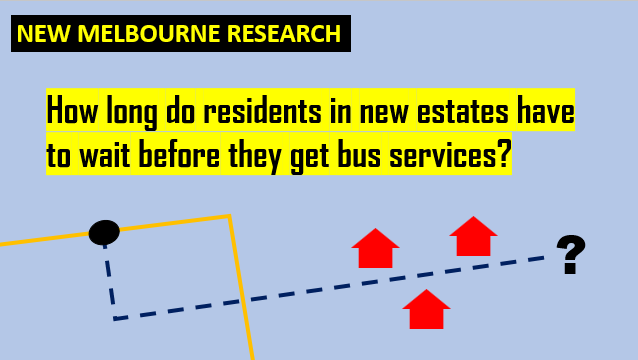
Research spotlight: How long do residents in new estates have to wait for bus routes?


Nothing much by me today but I can bring you something both better and more important. 

It's RMIT research on how long it takes for new estates in Melbourne to get bus routes put in. 

This is absolutely vital. Because people are most likely to change their transport habits when they face a major change in their life circumstances. That can include a new work location, large changes in income or (especially) moving house.

This is because peoples' habits are shaped by the transport they find (or don't find) in their new location. If cycling is easier and parking is harder then that will change how they get around. And in the long term households (especially couples) will sell their second (and sometimes even only) car. Thus further decreasing car usage.

Conversely if people move to an area with no public transport then high car use will be entrenched as part of daily life from Day One. Couples getting by with one car will buy another even if they'd rather use the money for another purpose (including affording the basics for those on low incomes) since having one car per adult is pretty much a pre-requisite to finding or keeping work. Or even a basic level of community participation. 

Public transport connections established well after most people move in will still get used but since people have bought all their cars usage won't be as high compared to if it was established early in a suburb's establishment  when it had a chance shape peoples travel habits from the start.   

Thus having even a basic bus service early in a new suburb's life is essential to give it the best chance of success. And to allow residents the choice of buying only the cars they want to have, not those that poor transport forces them to have. Getting more people on public transport right from their neighbourhood has wider benefits, especially if both road connections and parking at the nearest station are limited.

I've written multiple times about new suburbs waiting for public transport well after people have moved in. How typical is this experience in outer Melbourne? 

You're about to find out thanks to this great new paper by researchers Annette Kroen, Steve Pemberton & Chris De Gruyter. In a nutshell 3 to 4 years it typical, though waits can be up to 14 years. And, while it's beyond the research's scope, I'd argue that 30 to 40 year established areas like Rowville, Lysterfield, Ringwood East, Croydon, Frankston South and many more remain lacking without a full service too, getting, at best unreliable or limited hours FlexiRide services. 

The above doesn't do the research justice. So I think you should read the paper here. 

https://www.sciencedirect.com/science/article/pii/S1077291X23000292

It's also worth nothing that even where there is service the limitations of leap-frog development, the lack of through roads and/or highly conditional GAIC funding can lead to a pattern of multiple overlapping and infrequent routes  such as in Clyde North where not a single bus runs continuously from Berwick to Cranbourne, despite both being destinations where people would wish to go. Long-term government uninterest in bus network reform and slow internal processes (when there is interest) can mean that even though suitable through roads get built and level crossings removed, it can take years (sometimes decades) for buses to get routes that take advantage of these works.  

In contrast things were done differently (and better) a century ago. For example here is a case (from a century ago) where the bus was put in before all the blocks were developed. 

Tuesday, October 10, 2023

Minister Williams' top 5 local public transport priorities


Last week I welcomed the new Public & Active Transport Minister Gabrielle Williams and listed some important agenda items where she could make a real impact. These tended to be quite broad, even state-wide. 

Today I want to cover Dandenong area issues that are important in her capacity as local MP. As I've written extensively about most in the past I'll make this a short list with links for further detail. 

1. 7 day service on all Dandenong bus routes

First priority as it's important, cheap and easy to fix. Dandenong is amongst Melbourne's lowest income and most diverse areas but has the least 7 day bus service of any comparable area. There was a big push to fix that across Melbourne about 15 years ago but implementation was only half-hearted in Dandenong. Thus timetables for many routes remain untouched, retaining their early finish and limited Saturday afternoon and Sunday service. This is despite the buses that do run (especially the 800) being amongst Melbourne's busiest bus routes that lack 7 day service. 

Priorities for upgrade include 800, 814, 802/804, 885, 844 and 857, probably in that order. Funding for all these would be desirable in the 2024 state budget. 


2. Simpler, more direct and more frequent bus routes

Bus routes in Dandenong can be complex, overlapping and not have been reformed for decades. Along with the short operating days/hours mentioned above their frequency can be low, with 60 and even 120 minute service found on the network. Simplification of the network should allow some frequency increases especially if accompanied by some modest extra funding for weekend and evening operating hours. Simplification could mean that each route runs every 20 to 40 minutes at all times rather than every 40-120 minutes as currently. There could also be more even spacing on routes that continue to overlap. 

The simplest candidate for network simplification in Dandenong is a mini-review of the 802/804/862 corridor. Also worth considering is the complex network further west in suburbs like Keysborough and Mulgrave, which although outside Dandenong have implications for services in it. 

Network simplification often requires public consultation and takes more time to plan than a simple timetable upgrade. Thus it can't happen as quickly as a 7 day service roll-out. Nevertheless the 2024 state budget should allocate at least planning funding to enable a start to be made.


3. New bus routes to Dandenong South and the Monash precinct

Could be part of the network simplification reviews above but would require additional funding. Connections to jobs in Dandenong South is a key need with the desirability of direct routes to adjoining suburbs including Keysborough, Hampton Park and Narre Warren. Also important is better connections to the Monash precinct, which my Metro Tunnel Bus Network has from Dandenong via Heatherton Rd and Springvale. 


4. Trains every 10 min until midnight 7 days

Justified as Dandenong is Melbourne's busiest line. One hopes that this happens when Metro Tunnel opens next year, though Melbourne's record at adding service once infrastructure is built is patchy. Current waits for trains at Dandenong are 30 min on weekend evenings and Sunday mornings. This is despite high need for travel at these times with trains every 10 minutes from early morning to midnight, all week justified for the City - Dandenong portion. 

A good approach would be to extend the current daytime operating pattern (Pakenham/Cranbourne each every 20 min) into the night and Sunday morning as well.   

5. Regularly maintaining and cleaning the disgrace that is Dandenong Station

The centre of the area's transport network is dirty, dusty and unloved. And you can't blame vandals for most of it. Paint is badly chipped, platforms are unmaintained and certain areas look as if they have not been reached in for months if not years. Bus network maps are wrong, having not been changed since 2014. Hence there needs to be more regular maintenance and a deep cleaning regime. Stations that are a similar age to Dandenong (eg on Perth's Joondalup line) are better maintained. 

A spruce-up with regular maintenance and cleaning thereafter would do wonders for Dandenong's presentation. Better station maintenance is a no-brainer for the 2024 budget and/or should be a requirement of the new rail franchise currently being negotiated. 

Conclusion

Presented are five top priorities for the new minister. None are particularly expensive yet they together would make a big difference to how useful public transport would be in the Greater Dandenong area.