Friday, March 08, 2019

Flashback Friday: Service success stories since 2005

Melbourne on Transit has been covering public transport service issues for nearly 14 years. The political context, operating environment and expectations of the network were different in 2005. For example the rail network had only just commenced its most recent patronage growth phase. And what was left of the bus network after the deep service cuts of the early 1990s, was starting to show tentative signs of revival.

Today, using 2005 posts as references, I'll list some of the service successes, large and small, we've had since.

 * June 10 2005 How to transfer to a SmartBus discussed the train-bus transfer arrangements at Chelsea station to the then fairly new 888/889 SmartBus. A poor bus stop location made interchange difficult, with three roads needing to be crossed.  The successor route, the 902 orbital, now stops at a very convenient spot just metres from the station exit.

* June 11 2005 Harmonised and clockface timetables commented on the uneven connection times if trains and buses operated at incompatible frequencies as was common back then. Progress has been made when bus networks have been reviewed. And the ten minute trains now on some lines during the day make consulting a timetable much less important.

* July 17 2005 Getting to Watergardens Shopping Centre by train Did you know that back then there were no direct paths and one had to step over a fallen fence in a field to reach the shopping centre from the train? This situation is much better now with a developed town centre now clustered around the station.

* July 24 2005 Bus info by SMS mentioned a trial in the UK. Now people have Smartphones and real time information is more common. But issues with data accuracy and disruption information remain.

* August 3 2005 Passenger information old new and improvised featured a handwritten bus stop timetable at Elsternwick. This was a remnant of an era when no one seemed to be in control of bus information and timetables at stops were rare. But within a couple of years the Metlink signage project would install flags, stop-specific timetables and route maps at thousands of bus stops around the network. In conjunction with service improvements this led to substantial patronage growth.

* October 16 2005 Timetable tidbits had a brief item announcing $44m in funding for new and improved bus routes. This was a precursor to the much larger Meeting Our Transport Challenges program announced the following year. The latter resulted in most suburbs getting 7 day public transport until 9pm. Service upgrades for routes between and within regional cities were announced the following month.

* December 17 2005 Good news on V/Line - Metlink fare integration heralded the integration of fares between city and country. No longer would country people need to buy a separate ticket if they needed to make connections in the city. And the separate Route 788 fares mentioned have long been incorporated into the myki zone system.

* December 22 2005 Merry Christmas and good luck catching the bus highlighted how much of a gamble bus travel was over the December-January period. This is because public holiday service on buses was rare, without a network standard existing.  Reduced service summer timetables, in some cases operating for much of January, were also often in force. Things are much better now. The MOTC program has largely (but not entirely) standardised public holiday arrangements and relatively few routes (operated by Kastoria, Moonee Valley and Ventura) remain with reduced summer timetables.

Are there any improvements since 2005 that I've missed? If so please leave them in the comments below.

You might enjoy these well-regarded books on transport topics

Better Buses, Better Cities: How to Plan, Run, and Win the Fight for Effective Transit Steven Higashide NEW!

The Public City: Essays in honour of Paul Mees Gleeson & Beza

A Political Economy of Access: Infrastructure, Networks, Cities, Institutions (Access Quintet Book 4) David Levinson

Human Transit: How Clearer Thinking about Public Transit Can Enrich Our Communities and Our Lives Jarrett Walker

Transport for Suburbia: Beyond the Automobile Age Paul Mees

(Sales links: I get a small commission if you buy via the above - no extra cost to you)

Tuesday, March 05, 2019

Timetable Tuesday #13: Deja vu with the 566

The most important factor that determines the usefulness of a public transport service is not whether it's a train, tram or bus but its timetable, route and stops.

"Didn't we go past that 20 minutes ago?". That's a common thought of riders on the incomparable Route 566 through Watsonia and Greensborough in Melbourne's north. For this is not the straightest of bus routes. And, yes, it double backs on itself. The route map is below. 


You can't always tell its direction from the map but you can from the stop sequence on the website. If we ignore the dotted line around Lalor the northern half of the 566 is simple enough. It (mostly) starts at the Lalor shops, almost reaches Epping Plaza before turning east along Childs Rd. It forms the main service along there, serving a couple of secondary colleges and Mill Park Stables shops. Then it's straight down Plenty Rd (overlapping the 86 tram) then into Greensborough via Grimshaw St (overlapping the more recently added 902). There's no turn at Macorna St - that's for later. 


After a loop for Greensborough shops and station, the bus again heads west along Grimshaw St.  So do buses in the other direction. Here you need your wits about you in case you end up in Lalor rather than Northland or vice versa. 


Being on the correct side of the road (unlike most places) won't always save you. And if the buses in both directions come at once (like below) then the alertness and reaction time required to hail the right one puts you in the Super Mario champion category. If you lose on a weekend, it's 40 minutes until the next chance. 


If you manage to survive that the bus goes north to Gillingham St. The street layout here makes efficient public transport routing impossible, and large areas west of Macorna St lack anything.  Then the bus crosses Grimshaw St (passed through before), then south to Watsonia before uniquely serving Greenwood Dr. It skirts La Trobe University then runs parallel the 561 in Kingsbury. A few twists and turns later and you're at the Northland terminus. You can see how the 566 fits in with surrounding routes on the area map below. It was never always this complex, with some useful history here.

Extract from PTV Whittlesea area map

Remember that Lalor deviation on the map? It rates a mention in PTV's route description. Although, according to the timetable, it's am peak and evening trips that start at the station, not off-peak.


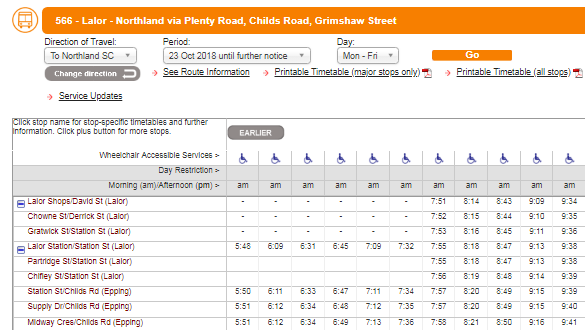
You can see the stops skipped in this expanded view of the timetable.


To conclude, Route 566 is a long route that permits a one-seat ride to numerous destinations including Lalor shops, Mill Park Stables, Bundoora RMIT, Greensborough, La Trobe University and Northland. It takes people to stations at Lalor, Greensborough and Watsonia.  Childs Rd Mill Park and Greenwood Dr Macleod are the main areas where it's the only route. Elsewhere it has significant overlaps with the 86 tram and the 902 orbital.

What about the timetable? 566 was one of many routes upgraded about 10 years ago to minimum service standards. That means 7 day service until at least 9pm.

The weekday timetable (towards Northland) is below. The full route runs during daytime shopping hours while services commence from Lalor Station in the morning and evening.

While weekday services operate at regular 24 minute intervals, it is not what you'd call a clockface timetable as they are not the same number of minutes past the hour. Neither do they connect consistently with trains, which in this area operate every 20 minutes. Evening headways drop to around 40 minutes.


Saturday and Sunday frequencies are a flat 40 minutes for most of the day.  Weekend service commencement times are much earlier than the 2006 minimum standards. These set down start times of 8am on Saturdays and 9am on Sundays. These are still too late for many weekend trips. Consequently it's been common for more recent bus upgrades to start Saturday and Sunday service at 7 and 8am respectively.

Even before minimum service standards started there was a tendency for bus routes (especially in the northern and western suburbs) to start their Saturday service earlier again. This, in conjunction with the then-common 1pm finish, reflected traditional shopping hours (and before that the old 44 hour week with half-day Saturday work). Even today you will find barbers and butchers in some older shopping strips opening early on Saturday.


And Sunday mornings? If they ran at all buses (like shop trading) started later. However there remain variations, despite minimum service standards. For instance Moorabbin area buses start (and finish) late on Sundays. Whereas early Sunday starts are evident on some northern suburbs local routes. Route 566 is an example, with service starting shortly after 6am. The early shortworkings are likely due to the depot being nearby.


To conclude, Route 566's timetable meets minimum service standards. Its frequency is broadly similar to that of other suburban bus routes. However its 24 minute weekday frequency is non-clockface and doesn't reliably meet trains. And, as mentioned before, the route is not legible, particularly in areas where buses in both directions can be caught from the same stop.


The question is: What (if anything) would you do with the 566's route and timetable? Would you split it at Greensborough, calling one half (say) the 565? Or is more thorough network surgery required? Extra points if you consider wider area travel needs and other routes in the area.
Timetable Tuesday simultaneously appears on melbourneontransit.blogspot and as an article on the Urban Happiness Facebook group. Maps and timetables are from the old PTV website . 

See other Timetable Tuesday items here 

Friday, March 01, 2019

The rise of the 20 minuter

The last new SmartBus routes to commence service were the four DART services back in 2010. Since then Melbourne's added over a million people but no more SmartBus routes. In fact one of them (908) got shortened so it only operates its full route during peak times.

Some SmartBuses did receive frequency upgrades. For example Routes 703, 907 and 908 gained weekend trips. And just recently peak services were added to 900, 905, 906 and 907.


Although it grew slower than population, we still added bus service in most years. 

Where has it gone if not much went to SmartBus?

Some went to the university shuttle routes such as Routes 301, 401 and 601. Although frequent they are short, making them relatively cheap to run. And they've been popular, improving last-mile transport between university campuses and the rail network (see previous post).

Then there's outer growth areas. Recent years have seen new networks in areas like Wyndham Vale, Tarneit, Werribee, Point Cook, Epping North, Mernda and Cranbourne.  There have been winners and losers; little has happened in Melton (town), Cardinia, Knox or Mornington Peninsula for instance.

But possibly the least remarked feature, and the topic of this post, is the increase in the number of bus routes operating at 20 minute frequencies, whether it be peak, interpeak or weekend.

Why is this significant?

Go back about 10 years. Local middle to outer suburban bus routes typically ran about every 40 minutes on weekdays. You were doing well if yours ran every 30 minutes. At the other extreme the extent of 15 minute service increased with the SmartBus program. However that's still beyond walking distance of most and non-existent west of Sunshine. Apart from some routes in the inner west, north and east, a 20 minute peak service had been quite rare since the early 1990s cuts.  And on a Sunday a 20 minute bus frequency was unheard of, with even 30 minutes confined to SmartBuses and a handful of others.

Thus there existed a chasm between sparse and expensive to run SmartBus routes and the mass of infrequent local services that had not been invested in for years. Moderately direct routes across the suburbs either did not exist or were no more frequent than neighbourhood routes. And when funding did come about 10 years ago, it mostly went on coverage and span rather than frequency upgrades. While operating days and hours are better, peak and midday frequencies often reflect previous cuts.

There's also the bigger picture. Unlike Perth and Sydney, which have a base network-wide 7-day 15 minute train frequency that everything can pulse off, Melbourne has no such clarity. Instead we had a mix of 15 and 20 minute off-peak weekday rail frequencies.  That's largely still true, except for 10 minute service now on some lines. 

Longer term network planning, as articulated through the Rail Network Development Plan, advocated a core 10 minute base frequency with key feeders (including buses) harmonised with 10 or 20 minute frequencies.  While there has been little recent movement on upgrading 15, 20, 30 and 40 minute suburban rail frequencies to a 10/20 minute pattern, progress has occurred with daytime bus frequencies. 


Below are some examples of upgrades and the circumstances under which they occurred. All happened in the last 5 to 10 years.

* Routes 170 and 180 operating every 20 minutes 7 days/week under new 2015 Wyndham network.  7 day/week 20 minute combined corridor between Hoppers Crossing Station and Pacific Werribee (Plaza) on routes 166 and 167. 190 every 20 min on weekdays. Other routes such as 150, 151,160 and 192 operate a ~ 20 minute service in peaks.

* Routes 200 and 207 simplified to operate a combined 10 minute service along common portion under 2014 network change.

* New Route 234 simplifies services in Port Melbourne and operates on a 20 min Sunday frequency.

* Route 235 simplified and given a 20 minute interpeak frequency under network changes for the Fishermans Bend area.

* Routes 250 and 251 simplified to operate a combined 10 minute service along common portion under 2014 network changes.

* Route 270 modified and given 20 min interpeak frequency as part of local network restructure.

* Routes 356, 357, 358 new Epping North network features 20 minute peak frequency on each route.

* Route 386 and 387 provide combined 20 minute service (10 min peak) under reformed Plenty Valley network.  Other routes in area upgraded to operate every 20 minutes in peak.

* Route 400 upgrade to operate ~20 minute peak frequency under 2014 Brimbank network review. Also provides combined 20 min interpeak service with Route 427 in Sunshine West.

* Route 402 Footscray - East Melbourne route upgraded to operate at an even 10 minute frequency on weekdays. Sunday service later upgraded to every 20 minutes.

* Route 418 upgraded to operate ~20 minute peak frequency under 2014 Brimbank network review.

* Route 420 New direct Sunshine - Watergardens route operating every 20 minutes as part of 2014 Brimbank network review. Later upgraded to every 20 minutes on Sunday.

* Route 423 upgraded to operate ~20 minute peak frequency under 2014 Brimbank network review.

* Routes 426 and 456 formed to provide a 20 minute 7 day/week frequency along Ballarat Rd between Sunshine and Burnside as part of network change. ~10 min frequency in peak.

* Route 471 Weekday frequency upgraded from uneven ~25 minutes to every 20 minutes as part of 2014 Brimbank network review

* Route 477 Weekday service upgraded from every 30 to every 20 minutes

* Routes 494, 495, 497 New Point Cook network features ~ 20 minute peak frequencies timed to meet trains at Williams Landing. Subsequent am frequency upgrade on Route 495.

* Route 529 and 533 peak service upgraded to ~20 minutes in Craigieburn area.

* 541 Weekday service upgraded to every 20 minutes.

* Route 561 extended to provide 20 minute weekday service to Pascoe Vale Station.

* Route 570 upgraded to run every 20 minutes on weekdays.

* Route 693 peak service upgraded from every 30 to every 20 minutes.

* Route 791 Route simplified and upgraded to run every 20 minutes on weekdays between Cranbourne and Frankston as part of new 2016 Cranbourne network. 10 minute frequency operates between Langwarrin and Frankston in conjunction with Routes 789 and 790.

* Route 798 Service every 20 minutes 7 days/week between Cranbourne and Selandra Rise

* Route 828 simplified to provide 20 min weekday service between Hampton and Berwick (previously several less frequent routes).

* Route 893 Route straightened and upgraded to run every 20 minutes 7 days/week as part of new 2016 Cranbourne network.

* Route 897 Route upgraded to run every 20 minutes 7 days/week as part of new 2016 Cranbourne network.

* Route 898 Route operated every 20 minutes on weekdays as part of new 2016 Cranbourne network.

* Route 900 peak service increased from every 15 to every 10 minutes.

* Route 907 Weekend daytime service upgraded from every 30 to every 20 minutes

* Route 908 Weekend daytime service upgraded from every 30 to every 20 minutes

* Sunday morning trams typically ran every 30 minutes. However the time that 20 minute or better service is starting is moving earlier. And some new or upgraded tram routes (eg 30 and 58) have a 20 minute frequency from the first regular Sunday service.

* Frankston, Cranbourne, Pakenham, Werribee and Williamstown trains were upgraded from every 30 minutes to every 20 minutes on weeknights until approximately 10pm. Further upgrades have since been made on the Dandenong line to extend their 10 minute service into the night.  The Sandringham line remains the only one that has a 20 minute service until midnight each night.

* Geelong area. Interpeak train frequency upgraded from every 60 to every 20 min at larger stations.  New 2015 bus network featured many routes upgraded to operate every 20 minutes on weekdays to match train frequencies.

Many of the 20 minute frequency upgrades appeared in clusters related to network reviews. For example the Brimbank, Wyndham, Geelong, Cranbourne, Plenty Valley, Point Cook and Epping North networks feature extensive 20 minute service, if only in the peaks for the last three.

While a good case exists for most if not all routes above to be upgraded, some critical high-performing routes (eg 733 and 737) remain on 30 minute base frequencies.  In some cases only parts of a route may justify an upgrade (eg the 733) and/or there may be significant catchment overlap that requires a review to sort out (see last post). 

Nevertheless, though patchy, there has still been a significant roll-out of 20 minute service. It is likely that the population within walking distance of a service every 20 minutes or better is appreciably higher than it was a decade ago.

And, if offered the choice between a 15 min weekday/30 min weekend service (ie the traditional SmartBus pattern) and a 7 day 20 minute service (as run on northern/western suburbs train lines and some bus routes listed above), many with flexible travel schedules will quite possibly prefer the latter, especially if operating hours were more like SmartBuses.

You might enjoy these well-regarded books on transport topics

Better Buses, Better Cities: How to Plan, Run, and Win the Fight for Effective Transit Steven Higashide NEW!

The Public City: Essays in honour of Paul Mees Gleeson & Beza

A Political Economy of Access: Infrastructure, Networks, Cities, Institutions (Access Quintet Book 4) David Levinson

Human Transit: How Clearer Thinking about Public Transit Can Enrich Our Communities and Our Lives Jarrett Walker

Transport for Suburbia: Beyond the Automobile Age Paul Mees

(Sales links: I get a small commission if you buy via the above - no extra cost to you)