Friday, July 01, 2022

UN 130: Ignore the ideologues!

Recently I saw an interesting tweet from the Association of British Commuters about how application of UK competition law could threaten that country's ability to reform bus services and create integrated local networks such as operate in many European and Australian cities. 

As background, Britain de-regulated buses outside London in 1986. The planning role for local councils was greatly reduced while private operators competed against one another with their own routes, timetables and fares. This led to wasteful duplication or 'cherry picking' along busy routes while other routes were cut or abandoned. There were some local successes but overall it failed, with patronage falling greatly. In contrast usage held up much better in London, which kept its integrated service. 

Hence there's been pressure to re-regulate buses with councils wishing to take back at least planning and network integration functions through 'enhanced partnerships'. As you can read here the Competition and Market Authority (the UK's enforcer of competition law) hates removing single operator tickets as it will have a potentially significant impact on the incentives of operators to compete against each other. This is based on a doctrine that public transport operators compete with each other (and not, say, against the car).

Later on the CMA says it wants bus operator branding to be prominent on vehicles. We tried that in Melbourne 20 years ago with our trains and had an unstable period of continual rebrandings and a weak network identity. Not to mention the monetary waste involved. Common liveries is way for cities to effectively communicate they have an integrated transport network, so recommending anything other than that would be a step backwards. 

There's other things as well, for instance the potential of bus operators to veto progress towards integration.  It is clear that CMA is driven by an ideology that market competition in public transport and while planning and co-operation in areas like fares policy and network design is bad.

And in Australia?

The same armchair economist doctrine that disintegrated Britain's public transport in the '80s and is resisting their moves towards integration today is active in Australia as well. 

It resides in taxpayer-funded organisations such as NSW's IPART and our Infrastructure Victoria. They profess expertise in matters including public transport network planning. And they claim an independence with the public interest at heart. Unlike those rent-seeking vested-interest leeches in the transport unions, private operators or even a hidebound Department of Transport! This distance however puts them remote from the 'coal face' of public transport network planning and operations which is not always a good thing. 

It is possibly no accident that Sydney lacks fully integrated public transport fares while IV, so far wisely ignored by the Victorian State Government, wants to dis-integrate ours with its crazy modal fares scheme

In a self-serving move to put people who think like them in control of our network, IV has also recommended removing fares policy from the Department of Transport (who plans services) to a separate IPART-like body, presumably with less political control. Splitting service planning from fares policy reduces the effectiveness of the former since there is an interactive relationship. For instance you can't have a full integrated network without multimode fares. 

IV's conceptual model of public transport seems to be one of duplicative overlapping modes that compete against one another, thus providing the all important (in their minds) consumer choice informed by modal pricing (no trains for poor people, thanks). In this they have learned nothing from the de-regulation that was so disastrous for buses in the UK and which gave birth to their model of rail franchising (now being wound back).  The passenger, who must navigate an often confusing system, has a different view, seeing no reason why they should pay more for trips involving a transfer or for buses being unevenly spaced or not connecting with trains.  

IV's thinking seems to come from how their types see everything as a competitive market. If it isn't then it probably should be, including for areas previously considered public services or utilities. Even if their thinking originates in industries that lack an equivalent of public transport's network effect, coverage and frequency (which all make the service more useful and thus build patronage). Yet these bodies make pronouncements about transport planning (like assuming public transport modes compete rather than coordinate) that are too infrequently challenged. 

The thing that most strikes me is that, despite claims to the contrary, efficiency and maximising service seem to play second fiddle to ideology about competition between modes. If you have a given service kilometres you can run in a year (basically fixed by government funding) then you need a network that, amongst other things, maximises the number of people near frequent (ie most useful) service while also maximising network coverage. 

Jarrett Walker talks about a frequency versus coverage trade-off. As resources are not unlimited we in Australian cities typically settle somewhere between the two, ie some people get frequent service but nearly everyone gets some coverage. Planners juggle this with their limited resources and concerns about what amount of network reform their political overlords will wear (which regrettably up to very recently has been very little!). 

If you want to deliver the best service to the most number of people, especially for connectivity across a region as opposed to just the CBD, then you definitely do not duplicate radial train and tram routes with radial bus routes. Like what you might have in an unplanned network where each player seeks to maximise their share but in doing so makes the overall network offering worse (*). 

Doing that wastes service kilometres that are better spent improving coverage and frequency in suburban areas that need it. That means accepting that people will need to change for some trips; one cannot run a frequent network by giving everyone a single bus from their door to all places. The best you can do is to make the network as frequent and transfer-friendly as possible to win acceptance. 

A major part of this is integrated fares that charge according to something like distance, zone and/or time rather than mode. Something that Infrastructure Victoria, apparently under the spell of competition ideology more than maximising efficiency or service, wishes to dismantle. 

This is despite modal fares providing a disincentive to network reform that would improve efficiency. It's hard enough to sell changes to the public without also introducing a fare hike. Which could happen with modal fares where a network reform involves some previously all-bus trips including a train or tram component. For example if you wanted to split or reform the orbitals. 

It's very strange then that those who have championed economic reform with words like 'efficiency' and 'public benefit' are seeking to stymie same when it comes to reforming bus networks by making the job harder at best and politically impossible at worst. IV has also not been on efficiency's side when they overestimate the potential role of flexible route buses as opposed to just reforming fixed routes (which, even if quiet usually carry more passengers per hour). 

The lessons in all this? Study history. Do what works. And just ignore the ideologues!

(for more on this see my Twitter thread here in response to the UK developments) 


See other Building Melbourne's Useful Network items here

(*) Note that such an unplanned network needn't involve private operators nor privatisation. Conversely you can have private operators participating in an integrated network. Brisbane is an example of the former where the state government runs trains and its large city council runs buses, with negligible connectivity between them and both networks being almost entirely radial. Basically two rival bureaucratic fiefdoms unable to deliver the best results for passengers. In contrast Perth can contract out its buses to private operators but still have planning that delivers them as part of an integrated network feeding trains. 

Overall access to frequent service and the ability to make cross-suburban trips is higher in Perth than Brisbane due to the former's strong network planning culture. This culture also means that Perth's trains also carry more passengers despite having half the number of lines, stations and track length, aided by having double Brisbane's frequency and better bus connectivity. Productivity measures such as annual passenger trips per rail employee is also likely to be lower in Brisbane due to the Perth system's leaner staffing.  

Tuesday, June 28, 2022

TT #169: V/Line rail-rail connections: How good?

How easily can you travel between Victoria's second, third and fourth largest cities exclusively by rail? 

All have train stations in their CBD. And their lines intersect somewhere in metropolitan Melbourne. So the answer boils down to how good the connections between them are. That's what I'll try to answer today. 

From Melbourne all three lines head west to Sunshine and then fan out. Bendigo branches north while Ballarat and Geelong separate just west of Deer Park. Hence Deer Park serves as an interchange point for Geelong - Ballarat travellers. 

Footscray does the same for those travelling to Bendigo. This involves backtracking from Sunshine as, despite hopes about it being a transport 'superhub', Bendigo trains don't currently stop there. 

I'll look at Saturday times only. Sunday timetables are generally similar except for later starts and earlier finishes. Weekday timetables are more frequent, particularly for Geelong and Ballarat (20 and 40 minute interpeak services respectively). Scheduling to ensure connectivity is more important when services are less frequent so I think looking at Saturday times is fair to gauge its quality. 

What is a good connection? You don't want it to be so tight that even the slightest delay to the arriving train will cause it to be broken. Conversely you don't want to be waiting an hour around on a platform in the middle of nowhere especially late at night. 

Due to V/Line's difficulty in meeting punctuality targets, the prudent passenger may distrust scheduled connections of less than say ten minutes, especially if a timely arrival is critical. I'm going to make a stab in the dark and say 10 to 20 minutes is OK as a planning aim. Some might see these somewhat longer times as legitimising poor punctuality performance while others view this as prudent robustness based on 'what is' today. 

Geelong - Ballarat

The earliest you can reach Ballarat from Geelong is just before 9am. Because both lines operate hourly at this time connections are a reasonable 19 minutes at Deer Park for the first two trips. Total travel time is 2hr 11 min. 

From late morning the pattern changes as Geelong trains improve to every 40 minutes while Ballarat trains stay hourly. These unharmonised frequencies mean varying wait times. Typically either 19, 39 or 59 minutes. In other words a 1 in 3 chance of making a reasonable connection. 

Note: Morning and evening ex-Warrnambool trains do not stop at Deer Park 

What does a 59 minute connection mean if the train you’re changing to comes hourly? It means that if you are arriving you will likely see the previous train departing. It’s a bad experience for passengers and should be avoided. It happens six times on Saturdays at Deer Park under current timetables. This puts the onus on passengers to carefully choose trips that connect rather than on the network to provide it as a matter of course. This reduces effective frequency, travel flexibility and thus network usefulness. 


A special problem happens in the mid-evenings where Ballarat trains drop to every 90 minutes before recovering to hourly. Waits are never less than 39 minutes between 18:55 and 21:35. The longest wait is 91 minutes. The 18:52 train from Geelong arrives Deer Park at 19:35. Passengers on it would see the lights of the Ballarat train that departed a minute earlier at 19:34. Thus they must wait at Deer Park until the next train at 21:06. The two 90 min evening gaps in the Melton/Ballarat timetable is an issue in itself, independent of connectivity concerns discussed here. 

Ballarat - Geelong

There’s fewer trips here as I’ve only shown Geelong trains that have a connection from the less frequent Ballarat service. Interchange times at Deer Park are mostly :04, :24 and :44. None are ideal with 4 minutes too tight for good reliability and :24 and :44 adding to journey time. 


The main after 7pm issues are low frequency (with a 128 minute gap between second last and last train) and an early finish with the last train leaving Ballarat before 9:30pm. There isn’t the very long mid-evening wait we saw from Geelong but there is one tight (4 minute) connection.   

Ballarat - Bendigo

Unlike what we saw between Ballarat and Geelong, Ballarat and Bendigo trains operate at close to an hourly headway during the day. This means that connections are likely to be either consistently good or consistently bad. 

The earliest a train – train trip will get you to Bendigo is 9:55am if starting at Ballarat. This is the second Bendigo train from Melbourne as there was a first, departing Southern Cross at 7:01am, arriving at 8:58am. The V/Line timetable shows an early coach leaving Ballarat at 5:35am. However this arrives Southern Cross at 7:05am, missing the Bendigo train by 4 minutes. This illustrates the effect of a few minutes in determining how early and late you can and cannot reach a place. 

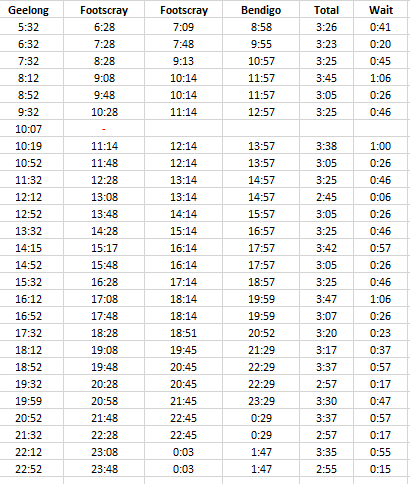
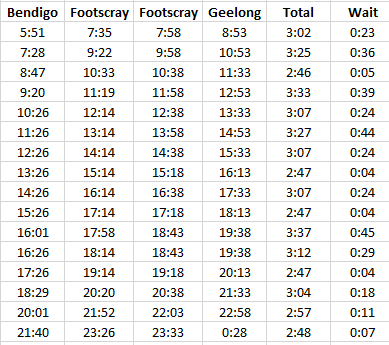
As for the rest of the day, waiting times at Footscray are typically 36 minutes out of a 3hr 37 minute trip. Why Footscray and not Sunshine, when both lines go through there? The answer is that Bendigo trains don’t stop at Sunshine. 

If they did and timetables were optimised then Ballarat to Bendigo travel time could be cut by 20% to about 3 hours. Removing such backtracking and speeding overall travel times are the sort of ‘quick wins’ that should be the 'bread and butter' of Department of Transport and V/Line planning work. Where constraints exist to not currently permit this then this should drive investment and reform in areas like infrastructure and operating practices.  

What happens at night? There are some quick trips (3hr 9 min) but these are based on tightish (7 min) connections. Maybe they’re not tight by Japanese and Swiss standards but we don’t have their reliability. It can sometimes be hard to make the business case for better reliability and even basic maintenance stack up on assessment criteria used. Flashy new station roofs are sometimes seen as having greater electoral appeal even while tracks under them rot. However I should point out that the 2022 Victorian state budget has a $248m allocation for 'V/Line efficiency and reliability'. 

There is again a >2 hour gap between the second last and last inbound train from Ballarat like we discussed before. Those in Ballarat would be wise to catch the second last train if at all possible and forego any food or entertainment they might have had. Why? It’s because the last train reaches Footscray at 22:46. When did the desired train to Bendigo leave there? 22:45 – 1 minute earlier. The result is an unsatisfactory 77 minute wait at Footscray for the next and last train at three past midnight.

To summarise, unless you are lucky taking a train from Bendigo to Ballarat on a Saturday (or likely Sunday) is a mugs’ game and you wouldn’t want to do it unless a stopover in Footscray was part of the plan.     


Bendigo - Ballarat 

Travel is happier for those going to Ballarat, provided there are no disruptions. Waiting time is 8 minutes for much of the day.  Good if everything is running to time, but if not ...

The earliest you can reach Ballarat by train is 9:43am – a little earlier than going the other way. Again there’s an earlier train but the first train from Bendigo reaches Footscray 13 minutes too late to meet it. The subsequent and one other connection involves 47 – 49 minutes at Footscray until the pattern (mostly) settles down. Nothing operates at a suitable time to meet the train that arrives at 11:43am.

Evenings present 32 to 58 minute connections. The latter is because the last train (Footscray at 23:26) is two minutes after the Ballarat train at 23:24. However night owls have a coach option where they can go in to Southern Cross with a 15 minute change there. Total time is however still slower than earlier train trips.    

Note: Last trip is coach via Southern Cross.


Geelong - Bendigo

Here we're back to unharmonised frequencies and thus varying connection times at Footscray. Mostly they're about 26, 46 and around 60 minutes. The last happens if you choose an unsuitable train at Geelong; if you delay your departure to get the next train in 40 min time then you cut your waiting by that amount and end up on the same train to Bendigo. There are some reasonable 17 minute connections in the evening and a tight 6 minute connection in the afternoon. 

Bendigo - Geelong

Like with Geelong - Bendigo you can get there by 9am on the first trip. Waits can be up to 39 minutes in the morning but settle down to an alternating 4 minute and 24 minute connection time in the afternoon. A problem arises at 17:58 where a train from Bendigo arrives at Footscray at exactly the same time as a Geelong train departs. This results in an impossible connection unless the Geelong train is serendipitously delayed. 

Some evening connections are more consistent, though the 7 minutes for the last trip would be tight for the conservative traveller. Again Bendigo's 90 minute evening headways limit journey time  flexibility. Like Ballarat and unlike Geelong (which has later trips) the last inbound service leaves at about 21:30. 


Coach options

Coach services operate from Geelong to Ballarat and Bendigo. The Geelong - Ballarat coach trip takes about 1 hr 35 min while Ballarat - Bendigo is about 2hr 15 min. Both these are faster than all-train trips. However trains, though less direct and involving a transfer, win out on frequency, particularly on weekends. With a coach travel speed 4hr 30 min (including a 40 min break at Ballarat), trains are always faster for Geelong - Bendigo travel. 

Findings and solutions

Trying to travel between our largest regional cities in Victoria by train requires significant planning on the part of the passenger to avoid long waits or exposure to fragile connections with a high chance of failure. While trains on these lines are typically every 40 or 60 minutes at most times, the period between instances of good connections can be longer due to incompatible frequencies. For Ballarat to Bendigo frequencies may be harmonised but poor connections can repeat over most of the day. 

Amongst the most cost-effective way to speed regional train travel and make the rail network less 'Melbourne-centric'  would be to review timetables to optimise connections for inter-regional trips. This is likely to assume increasing importance given the regional-based nature of the 2026 Commonwealth Games

As Melbourne outer areas grow, shorter trips like Tarneit to Melton are likely to grow in importance. These lack direct buses between them. For them V/Line is their local train service. Thus what's been written here about connectivity between regional cities applies in equal force to them, with travel time comparisons even less favourable compared to driving.

Need for higher frequency

Even ignoring connectivity concerns, higher frequency is needed to accommodate crowding. Adding carriages (where available) may be cheaper but, while it improves comfort, does not reduce waiting time or end-to-end travel speed like boosting frequency would. The most urgent need for improved frequency is at night where services frequencies drop to 90 - 120 minutes on the Ballarat and Bendigo lines. Inserting one or two extra trips to improve this to 40 - 60 minutes would make a substantial difference, especially if the day timetable pattern can be extended consistently into the night. 

Also desirable are weekend daytime frequency increases, notably on the Geelong and Ballarat lines that have a significant suburban transit function. A 20 minute frequency would bring these lines up to weekend frequencies that operate on most electrified Metro lines. Added frequency on a line doesn't guarantee perfect coordination with other lines but it does put a ceiling on maximum waits and provides capacity to avoid scenes like above. 

A VictoriaTakt?

A network planning approach that explicitly considers and promotes to the public connectivity between lines is essential. The idea is to harmonise frequencies and optimise connections at key interchange points, which in this context means Deer Park and Footscray (or Sunshine). 

Because rail planners have done the painstaking planning and scheduling the passenger often does not need to. Thus they can hop on any train and expect good, reliable and repeating connections to important destinations.  

The Swiss and German approach to achieving this is "First the timetable, then the infrastructure". 

This is based on a vision of state (or country) wide mobility based on good connectivity across the network. This requires significant work in scheduling. Where this isn't efficient (eg a train's run time is too long for it to reach an interchange point in time) then consideration of infrastructure that would allow improved timing is given.


We could potentially make a start by reviewing the extreme cases of services missing one another by a few minutes and considering the scope for rescheduling. This is particularly the case early and late in the day where a change of a few minutes can extend the period that travel is possible by an hour or so. More detailed work could look at the practicality of a more regular and consistent harmonised pulse pattern over the day and night. 

The nearest we get to this is the Regional Network Development Plan and the Western Rail Plan. The recent Ballarat Line Upgrade increased frequency from 60 to 40 minutes on weekdays interpeak but not weekends.  Neither were the long weekend evening gaps plugged. A 40 minute off-peak service remains as an aspiration for the Bendigo, Seymour and Gippsland lines on any day of the week. 


Direct transport options

Faster rail to Geelong, Ballarat and Bendigo would mainly improve connectivity to Melbourne. There may be some indirect effects for inter-regional travel provided the speed increases are in the outer portions of the lines and interchange points are preserved (and if possible pushed out to improve geometry and reduce backtracking). The latter is not assured and results can vary. For example if Geelong trains are routed via Laverton to go the 'old way' (as proposed in the Geelong Fast Rail Project) then there's more back-tracking for Geelong - Ballarat travel while that for Bendigo is may be lessened (assuming interchange at Footscray). 

Electrifying Geelong and running via a Melbourne Metro 2 tunnel from Newport would further improve geometry and speed for the CBD but make the interchange an even less direct Southern Cross Station for regional trips to adjacent regions eg Melton and Ballarat.

Options could include continuing to run some Geelong trains via Wyndham Vale, Sunshine and Footscray. That gives extra choice but there's the risk of splitting frequency (and lengthening some waits) unless service is vastly improved over now. Ideas for restoring direct rail service between Geelong, Ballarat and even Bendigo also bob up with local advocates including the Rail Revival Alliance. Hopes were raised by the Coalition parties before the 2010 state election (which they won) but their feasibility study found it would cost $935 million and not be viable

Improved coach services to be more than a few trips a day are eminently possible and could offer good travel times, especially between Geelong and Ballarat. However in terms of public and political profile this seems to be even lower than metropolitan buses. Little has been done despite their cost-effectiveness. There's certainly some opportunities here. Notwithstanding this pursuing rail connectivity remains essential since there are growing populations in places like Tarneit and Melton that could and should benefit from better rail access to regional cities.

Conclusion

We’ve identified three main problems with regional train timetables. Low frequencies at important travel times, unharmonised timetables and planning that doesn’t necessarily consistently optimise regional to regional trips. 

Money invested in service, work done planning timetables and infrastructure priorities driven by network connectivity have big payoffs in saved time for passengers and likely higher patronage as more trips are made consistently easier.  

See other Timetable Tuesday items here