Sunday, December 31, 2023

Will 2024 be the year of bus reform?


I reflected on 2022's achievements and events in the public transport service space here. On the broader scene, 2023 was most notable for the retirement of premier Daniel Andrews, his replacement with Jacinta Allan and the elevation of Ben Carroll to Deputy Premier. The resultant reshuffle led to Gabrielle Williams gaining the renamed Public and Active Transport portfolio.

In terms of what got done, transport's main service successes in 2023 were initiatives funded in 2022's budget. Almost all of these got implemented and are proving beneficial. However there have been few announcements of anything new. This can be attributed to the state government's underwhelming 2023 budget (for buses & PT service generally) and its now apparently in-recess Bus Plan that emerged with so much promise over 900 days ago. 


Days since Victoria's Bus Plan was launched

link to count-up Bus Plan clock

That not even the promised 'Bus Reform Implementation Plan' has come out after the better part of three years is a poor reflection on the Bus Plan and its lowly status within government. In fact it's hard to find many government activities that the previous premier's famous quote that "we're not wasting a single minute" was any less true.  

Still 2023 was not all bad for bus reform. Substantial research has come from the Committee for Melbourne and Infrastructure Victoria. Both bodies recommended similar - ie that buses must be made more direct, frequent and useful similar to my Future Frequent Network.  This work has sparked significant media coverage, raising the profile of community campaigns across Melbourne which really kicked up a notch in 2023. Buses also got a good run in parliamentary questions and speeches during the year. 

The government might claim it's broke but they have nowhere to hide given that Melbourne's transport needs continue to grow and buses remain the most cost-effective means of delivering the frequent 7 day service the community needs. Questions have also been asked about GAIC and the possibility of more or better use of funds from this tax to fund improved growth area bus services. 

Maybe this will be the future of bus reform? DTP's recipe of releasing a shallow 'plan for a plan', doing a few good things at the start, then wasting nearly 3 years on an increasingly improbable implementation plan as the state's finances deteriorated has turned out a dud. 

This course of action was taken despite there never being mystery about what needs to be done. After all adequate data existed to assess priorities back in 2021 when the Bus Plan came out. Not to mention significant prior planning work, most of which the public doesn't know about. 

DTP should have pondered less and done more, starting with simple and cheap to grow their currently stunted yet byzantine delivery capabilities. Then new bus routes would no longer take longer to implement than major capital works like level crossing removals and growth areas would get the service they need sooner. 

Minister Gabrielle Williams and DTP secretary Paul Younis could draw inspiration from none other than both the previous and current premiers. While some in 2014 looked at Labor's level crossing removal promise with incredulity, thinking it couldn't be done, it was. Ahead of schedule with the program subsequently expanded.

Yes money's tighter today but a lot of bus (and indeed off-peak train) service boosts are incredibly cost-effective. Especially when you add the broader cost of living and housing access benefits of a more extensive frequent 7 day public transport network. And that the operational costs involved are easier to predict than the current runaway build bills for certain major projects.

Although they've spent nearly a decade spurning service (and reform of it) in favour of big build infrastructure, if this government wants to do something beneficial and affordable in public transport, it's going to have to revive interest in service basics like useful routes, operating hours and frequency. And 2024 will be a critical year to bed down the changes needed before the 2026 state election.

The clock is ticking. The time to start is now.  

Thursday, December 28, 2023

UN 168: Why Melbourne's outgrown the City Loop


While urban rail networks are often described in terms of the number of lines, number of stations and even their trains per hour capacity, there is one thing that we should hear a lot more about.

Network configuration. 

This is particularly critical around the network's core where multiple lines converge and public transport's role is greatest.  

The maps below show the varying rail configurations used in four Australian state capitals. Brisbane isn't shown but currently operates what is effectively a single through trunk for multiple lines.    


Stub terminus

The most basic configuration is where all lines approach the CBD from one direction, terminating at a 'stub station', often inconveniently on the edge of a CBD. This has little to recommend for anything more than a small city. This is because unless the CBD is very compact a single station isn't sufficient for adequate coverage without an inconvenient transfer (which adds time). Also, assuming the CBD is roughly central to the metropolitan area, having the lines come from one direction lessens inner area coverage and directness, thus further increasing travel times. 

Through travel requires backtracking, adding a transfer penalty or at least a delay for inner north to inner south trips. Backtracking is also terrible for perceived time and thus system attractiveness. Thus rail network with stub stations are one-trick ponies, only really good for CBD trips. Stub platforms also requires arriving trains to change ends to depart. Compared to through running this reduces platform capacity and thus the ability to run a reliable and frequent service that moves large crowds. 

The practical experience of all this in Adelaide is a city far more dependent on buses than trains for its public transport because despite being slower the former are more direct and often more frequent. All other main Australian capitals evolved their rail systems away from stubs decades ago. There is however local advocacy for underground rail that if ever built would provide through running and transform the network.

 A CBD loop

A rail loop is one way to add coverage if your CBD is too big to be served by a single stub station or even a few stations in a line. It could also speed trips if passengers previously had to walk, bused or trammed to their destination. And if built in an expensive manner (like Melbourne opted for with 4 underground platforms) it could provide a convenient one-seat ride to all CBD stations from all suburban lines. Speed could be further increased from the newer stations if the loop changed direction in the middle of the day (as Melbourne's did and still partially does).  

Unfortunately the loop's design and operations were driven by the then fashionable single purpose view of the rail network as being only for one-seat ride CBD commuters. This was viewed as rail's last and only role as rising car ownership, inner suburb hollowing and new shopping centres remote from rail led to fewer local and off-peak trips being made on rail. 

Un-named c2008 video explain the evolution of services that lead to the City Loop's operating pattern with only some reforms made since.

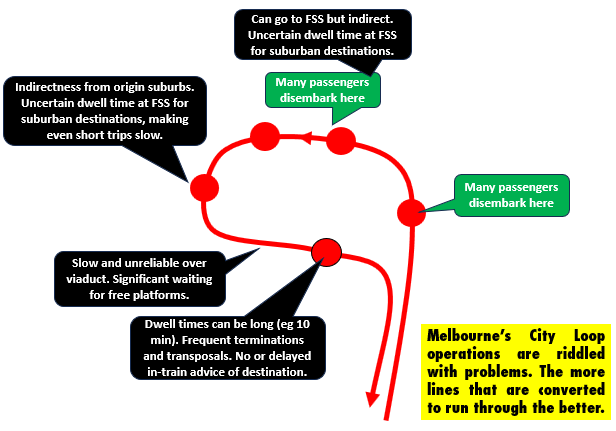
Unfortunately optimising the loop for a subset of suburban commuters made central area rail travel and transferring confusing at best and counterproductive at worst for everyone else. Some passengers had slower trips, with them being taken the 'long way around' compared to the previous through-route operations. The huge drop off in public transport's modal share even in Docklands and Southbank when compared to the Hoddle Grid can partly be attributed to the Loop making connectivity worse for areas just outside it. 

The Loop's reversal also made some trips only possible at some times of the day on some days of the week. But even on lines where the reversal has been removed dwell times remain unpredictable and sometimes excessive with huge variations in travel times for short trips in dense areas. Even on the latest HCMT trains passenger information can be ineffective since anything can happen once a train arrives at Flinders Street. The funnelling of multiple lines via each Loop portal also meant that disruptions to one line could affect other lines, making the network less resilient than it should be. 


The City Loop undoubtedly encouraged development and brought coverage gains for rail in the north and east of the CBD. But the version we got was too expensive and had too many shortcomings to be really worth its dollars. Like a squiggly bus route it provides coverage and one seat rides. But unlike a bad bus its effects are felt metropolitan wide, hindering thousands daily. 

A bruise at the rail network's heart, the City Loop's negative effect would only increase as the CBD expanded outside the Hoddle Grid to precincts like Docklands and Southbank, which relied on 'old' stations like Flinders and Spencer Streets. Not to mention densifying South Yarra whose travel to stations like Jolimont and Collingwood is complicated by Loop operations.

The City Loop is as bad as it is because it was planned at a time when commuter access to the CBD was king and we had forgotten the need for a versatile rail network good for diverse trips across a wide area. That's been rediscovered in the last 15 or so years, during which better plans that seek to untangle the loop have been produced. The reason why I say rediscovered is that because concepts like direct and efficient through-routing were well understood and proposed in 1929 but forgotten for 80 years.     

Other cities (eg Sydney) also built city circles but it's unlikely this retarded the usefulness of the rail network for diverse trips anywhere like Melbourne's did.  Besides Sydney has other tricks up its sleeve including an increasingly polycentric network with suburban connection points. Generally speaking though cities should avoid building Melbourne-style CBD rail loops and instead use other configurations to provide the coverage extensions and core capacity enhancements they need. 


Through lines

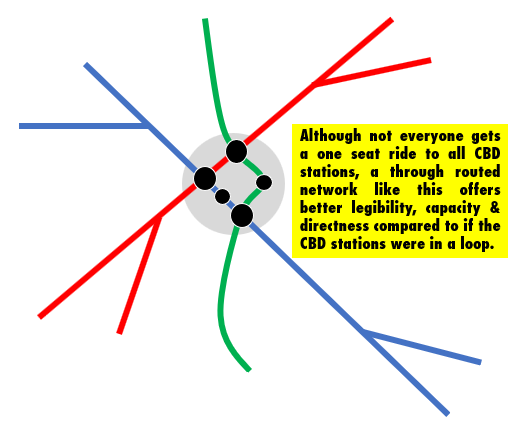
This is where it starts to get good. Through lines are direct, fast, legible and efficient. They support efficient transport not just from the suburbs to the CBD but between densifying inner suburbs too. This gives trains a speed edge over driving as there's no slowness caused by passing through the CBD or driving the extra distance to a bypass. There is no train reversing or backtracking in the central area so frequency and capacity can be high. Ideally demand  is reasonably balanced in both directions to limit the need to terminate trains in the CBD. It is also desirable that branching is kept to a minimum but if it has to happen then both branches should have similar demand and be free of single track sections to preserve reliability. Avoiding sharing with faster regional and/or freight trains is also desirable to provide both high and even frequencies during peak times.  

The main problem, as anyone in Brisbane or Perth knows, with a through line is that it does not cover the CBD as well as a loop might. However the solution is not to build a geometrically and operationally inefficient loop but to add through line pairs on new corridors that (a) provide needed coverage, (b) boost core capacity and (c) intersect with other lines to provide a network, while otherwise being reasonably operationally isolated to minimise knock-on delays. Equally important is that all corridors, whether existing or new, operate at high frequency to facilitate said interchange.

A single pair of through lines cannot serve more than two (or at most three) suburban lines if you want each to run at high frequency. To overcome this you either add another pair through the same location or (preferably) add another pair somewhere else. The latter is the better approach where you can increase coverage by adding one or more new stations unique to the new pair. However good interchange at one or more points on the existing network is required for connectivity.

Melbourne's Metro Tunnel will soon provide extra capacity and connectivity of this type. It's a big project so we can't expect something like it to be built every few years. However we can gets many of the benefits by starting to reform the rest of the network with more lines operating as efficient cross-city through services. A start could be made by reforming operations on the cross-city group to provide Metro Tunnel style frequency, legibility and reliability on the Newport - South Yarra axis. After that the worst sins of the City Loop need to be undone by splitting it as proposed as an add-on option in the Metro Tunnel Business Case. 

In a sense this is 'back to the future'; all these would transition rail from being a suburbs - CBD peak commuter service to a higher capacity, more connected and more versatile 7 day network nearer to what existed in 1939 than runs now.   

As for other cities, Perth has had two through line pairs ever since the new Joondalup and Armadale lines were connected in the 1990s, with this remaining when Joondalup connected to the new Mandurah line instead. Brisbane only really still has one through trunk (accommodating too many lines) though this will change with Cross River Rail which will also add eastern CBD coverage.   

Multi-centric

You get this with metro systems internationally but the ability to make circumferential trips on suburban rail does not exist outside Sydney. Perth will be the next city to gain a minor circumferential capability when the Thornlie line gets extended to Cockburn Central. Then it will be Melbourne's turn when the Suburban Rail Loop opens. 

For the foreseeable future the vast majority of circumferential public transport will be by bus, with Sydney, Melbourne and Perth the only capitals with at least semi-premium bus routes for this. Still, in a big growing city some form of fast and frequent orbital transport fully separated from cars will be as much of a game changer for its metropolitan transport as going from stub to Loop is for the CBD area or either of the first two to through lines will be for the inner suburbs. This is something that not all Suburban Rail Loop opponents have necessarily grasped with some critics being reluctant to put out their own proposals (which also won't be cheap if they're any good).      


Conclusion

Melbourne's City Loop had some benefits but the configuration chosen proved an expensive time-wasting diversion. For decades it distracted us from building more connective networks such as could be achieved from a series of bidirectional through line pairs that connect (for passengers) at well-designed interchange stations. Its basic assumption - that of rail being for white collar Hoddle grid commuters and providing a second class service for everyone else - was already fading in the 2000s, with the pandemic and more working from home finishing it off more recently. 

Although its operations are still not satisfactorily consistent nor reliable, the Frankston - Newport cross-city group was the first real challenge to this mentality when it was created about 10 years ago. The next challenge will be the Metro Tunnel, that being free of the mid-line split at Flinders St, should familiarise Melburnians with a new operating culture. If done properly I think people will like it, leading to pressure to cost-effectively modernise the rest of the network in a similar manner. 


More Building Melbourne's Useful Network items here

Tuesday, December 19, 2023

TT 186: Melbourne bus routes without Sunday service - unique portions

A quick plot of Melbourne bus routes without Sunday service. Map shows unique portions only, ie most routes are longer than shown but may overlap sections of other routes. 


A more detailed interactive map appears here. 

Concentrations of non-Sunday routes form an arc from Melbourne's middle western, northern and eastern suburbs. There are also clusters in the south-east around Dandenong, the outer east around Croydon/Lilydale and some others around Frankston. 

A lot of this is historical accident - there have only been sporadic attempts to correct high patronage or connectivity potential routes that the otherwise large scale MOTC 'minimum hours' upgrade program of 2006 - 2010 left off. Particular concentrations of high usage but underserved routes are found around Dandenong while high connectivity potential routes are the circumferential routes across Melbourne's inner/middle north and east.  

The longest lines aren't necessarily the routes that need 7 day service most due to these being in semi-rural or industrial areas. But the map can still be helpful if you consider routes that serve major destinations, areas of high social needs and/or which have high productivity on the days they do run. And which could provide key cross-suburban links that would otherwise require long train or tram trips into the CBD. 

Conspicuous examples include 503, 506, 536, 542, 546, 548, 609, 612, 800, 802/804, 844, 885 and a few more. Then there are routes with very short unique portions but which nevertheless link key weekend destinations like shopping centres. These are the likes of 468 and 549 that hardly show on the map if at all. 

Another cluster of routes are in the outer east and south-east. Their catchment is mixed, with some low density. Still a basic minimum-standards type 7 day service would be appropriate. Most notable examples include 772, 675, 680 and 689. 

I listed the 13 routes that most deserved Sunday service back in 2019. I discussed cost effective upgrades, based on more recent data here and here. Weekend and particularly Sunday buses are a proven patronage winner, with more and more bus routes recording higher passenger productivity on weekends than weekdays. And the costs are relatively low as weekend upgrades typically involve working the existing fleet harder. 


Index to Timetable Tuesday items here