Station Park & Rides - is there a higher and better use?
A term popular in property valuation and development circles is 'highest and best' use. In commercial real estate the value of land depends on the use to which it can be put. If it has high rental, development or subdivision potential it is worth more than land that does not possess these attributes.
Failure to develop land for its 'highest and best use' represents an 'opportunity cost' for the owner. The owner may still profit from its existing use, but the return will be lower. But if the return the owner is getting is at a lower risk, or if it is taken in a non-financial form such as a better standard of living derived from living on a large block, then they may be quite content not to develop further.
But where publicly owned land is used for marginal, low-return uses, it is only prudent that one asks if it has a higher and better use. In this case the utility may be measured in financial terms, social terms or a mixture.
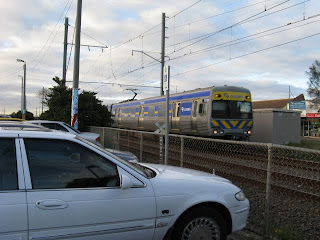
Parking space at stations is a case in point. Its provision may attract passengers who find driving to the station preferable to walking, cycling or taking a bus. The land may be useful to keep in reserve for future infrastructure, such as extra tracks, stabling, passing loops or bus interchanges.
On the other hand, because parking is uncharged, it returns no direct income to the railways and so may incur opportunity costs such as foregone rental income (if the land was developed), lower bus patronage or reduced walkability.
To try to quantify opportunity costs, one needs to assess both capital and income gains possible from a 'higher and better use' for park and ride land. This needs to be compared to the maintenance costs of park and ride, and if a park and ride is being built or expanded, capital costs as well.
These factors vary by area; a park and ride in a high-land value inner or bayside suburb imposes a much higher opportunity costs than using a scrap of otherwise unusable land near an outer or ex-urban station. It's also worth mentioning that even with different types of parking there are differences; substituting high-turnover short-term shopper parking for low-turnover long-term commuter parking benefits local retailers so probably represents a higher and better use, at least for the local area.
While coarse, the following back of the envelope calculations may assist in estimating opportunity costs.
The first thing is to look at the cost of park & ride. The Victorian Transport Plan has a $60 million program. 1700 new spots are mentioned, but these are only part of the program, so to claim $35 000 per spot sounds excessive. However a figure less than half that is mentioned here. The cost in Perth appears to be a bit over $10 000 per bay. Passengers contribute up to a maximum of around $2000 in fares annually, which buys unlimited travel in Zones 1 and 2.
The other input is the land itself. Wikipedia reckons you should allow 30 square metres per average parking spot, including circulation areas and landscaping. In other words, 100 parking spots equates to about 3000 square metres, or 0.3 hectare.
How much is the land worth? This varies greatly depending on the locality, use and zoning. But going on residential values, $400-500k will buy a house on a 600 square metre block in a median suburb. If we take the land component as being $300k per block, then that's a value of $500 per square metre. Land near a station may be regarded as undesirable due to noise and traffic despite its convenience. So it could be worth less - maybe $300 - 400 per square metre. That is unless its development potential makes it more rather than less attractive. Anyway, let's say the 0.3 ha is worth $1 million, which is very conservative.
How does this relate to the 100 parkers and riders? They're getting exclusive use of a million dollar asset for 10 hours per day. Based on a land value of $10k per spot and an imputed commercial rental return of 10% pa, they are getting a 'free lunch'. 10% of $10k is $1000 per year, or over 50% of their fare (which ought to be going onto running the service). And this does not include the capital costs required to build the car park.

Having done the costs, let's get to the opportunities. What can you do with 0.3 hectare, or 3/4 acre in the old money? It's good for five houses on standard 600m2 blocks, fifteen townhouses or villas each with generous courtyards. Stack said units to make a 3-storey block and we're up to 40+ flats.
Assuming $400k per house, $300k per unit, or $250k per flat, that's a developed site value of $2 million with houses, $4.5 million with units or $10 million with flats.
With a 5% rental yield on the above prices, annual rental revenue would be about $100k for the houses, $225k for the units or $500k for the flats. While we have over 200 suburban stations, if just 20 could be developed, the potential rental income would be in the low millions, or the financial equivalent of hundreds if not thousands more commuters buying Zone 1+2 full fare yearly tickets.
Good design could incorporate improved amenity, for instance passive surveillance of the station precinct. Less NIMBY-minded councils may even provide a waiver on car space requirements in return for a portion of the development being for social housing or (say) a womens refuge.
While there would be a loss of parking spots, this would have to be balanced against the increased population with the station on their doorstep who'd likely on average use the train more, and not just for work trips and the gains possible with improved feeder buses and bicycle facilities.
All things considered, it appears that park and ride may represent close to the 'lowest and worst' land use at many station locations and incur opportunity costs that are not always recognised.


