Showing posts with label economics. Show all posts

Sunday, October 17, 2010

Urban plans, density and the middle class

Noel Pearson's 2010 John Button Oration (highly recommended - listen here) got me thinking about the relationship between urban plans (such as Melbourne 2030) and the relationship between it and various economic classes (especially the middle class).

To summarise, the intellectual middle class says what ought to be built and the capitalist landowning class goes off and builds, taking a risk in return for a possible profit. While planning regulations (largely drafted and interpreted by the middle-class) have some influence, the capitalist can apply the ultimate sanction, ie choosing not to build if they see no profit. This puts a limit on the strictness (or 'unworkability') of planning regulations, otherwise undersupply will be the result.

Urban planning can be seen as a tussle between a portion of the middle class (either as bureaucrats, academics or activist residents) and the capitalist upper class. The working class has a role as consumers through housing and shopping preferences. There is thus a consumer-producer relationship between the working class and the capitalist (if buying a project home for example), but the relationship between the working class and middle class is very limited.

I previously described Melbourne 2030 as a plan that favours the grouping of certain land uses (cafes, galleries, educational establishments and higher density housing) around transport hubs.

Favoured land uses represent the interests of the humanities-educated portion of the middle class plus some perceived working-class wants (or should haves). The latter being desirable to foster 'diversity' and 'inclusion'. Certain other land uses, such as bulky goods retail, fast-food and (especially) light industrial, are not part of the academic's world so tend not to feature prominently in their plans. Ignoring them does not make these uses go away, instead they go to the periphery without public transport or pedestrian access (Tullamarine and Laverton North spring to mind).

Lacking capital, the interested middle classes (especially academics, bureaucrats and council planners) use plans to advance what they see as the public (or is it their?) interest against the capitalist landowning class. To the extent that they are implemented they advance the former group's quality of life and aesthetic sensibilities. A Marxist analysis would also see city planning as part of a broader contest between intellectual and capital, with each group wanting their strength to prevail.

The middle class, even its humanity educated portion, is not homogeneous. As often played out in The Age, it is deeply split on the question of housing density.

There is what I would call the 'technocratic' or 'urbanist' middle class which favours higher densities for a more compact, less sprawling city better able to be served by public transport and other services. A substantial proportion of this group would have lived in or visited overseas cities with higher densities than ours. Some may work in planning. Their arguments are both environmental and economic, with the economic one being an echo of Le Corbusier's vision of cities as being 'machines for living in'. While it is another debate, this group may be quite relaxed about the city's capacity to house a higher population (though being quite well paid they will always be able to afford to live in the city's 'better' areas).

There is common ground between this group and developers (whose profit increases with density, since fixed costs can be spread across more units). The developers need this group to argue their case, while the urbanists need the developers to allow their preferred city form to be built.

Opposed to densification (at least in their backyard) is another faction of the middle class. 'Suburban protectionists' are less enamoured with high-rise and go by names such as 'Save our Suburbs'. This group professes a wish to preserve their neighbourhood's quiet streets, leafy verges and an always-free parking spot in front of the house. High-density is also thought by residents to be associated with crime, especially if 'outsiders not like us' (eg public housing tenants) move in. Hence NIMBYs ('Not in My Back Yard') are vulnurable to accusations of xenophobia or selfishness. While another (though related) debate, protectionists often question the benefits of continued population growth in our big cities, and may propose decentralisation (for others of course) to lessen pressures on our bigger cities.

As homeowners,suburban protectionists' key economic interest is their house value.

This is especially so for the middle-class.

The biggest determinant of wealth in Australia is whether you live in your own home or rent (those who both rent and invest are a small, savvy minority). Poor people are by and large not homeowners, so values are irrelevant to them. Then there's the rich. While they may live in nice homes the genuinely financially independent hold most of their wealth (80 - 99%) in other assets, such as their own businesses, rental properties, shares and the like. In contrast the middle-class person's home is their biggest asset, with most of their other wealth (superannuation) being untouchable until retirement. Hence concern that a development may lower house values is quintessentially a middle-class concern.

The relationship that high density leads to better public transport is also disputed. 2004 - 2008 for instance saw a train patronage boom but no commensurate service increase. And if higher traffic slows buses and trams, their efficiency will fall without priority. Academic support (in the sense that successful public transport is more a function of service planning than density) is offered by Paul Mees of RMIT.

To conclude, planning and the argy-bargy that goes with it, is a game between a protectionist middle class and a capitalist class (legitimised by a technocratic middle class). The middle class has brains but no capital. The capitalists have money and can co-opt as many middle-class minds as necessary. The middle-class itself is divided. Hence we generally get a largely market-oriented plan with some urbanist features such as denser activity centres and protectionist features such a (movable) urban growth boundary.

Wednesday, October 14, 2009

Why housing's 'Zone 1' price premium is no longer justified

Estate agents and property investment spruikers will tell you that one of the benefits of buying an inner suburban home is its cheaper fares (for city commuters) than a place beyond about 15km from the city. Anecdotally many buyers and renters seem to value this criteria as well. 'Located in Zone 1' is perhaps not quite as coveted as being in the catchment of a so-called 'good school' but it's not far off, especially for childless couples.

Three years ago I demonstrated out that the higher mortgage payments of a dearer inner suburban home generally outstripped the savings in fares. Unless the Zone 1 suburb 14km from the CBD had amenity benefits that the Zone 2 suburb 16km out didn't have, the fare difference is not worth paying much of a premium for if buying a home.

To put it in dollar terms, the difference in monthly fares for a full fare passenger is about $60 per month or $15 per week. Double that for a two income household (both taking public transport to a city job) and half that for a concession passenger. $15 per week is just under $700 per year, or the same as 7% interest on $10 000 owing. And $10 000 is trivial where average house prices are over $100 000 different between adjoining suburbs on opposite sides of the zone divide.

Has anything changed in 2009? Average house prices are generally higher than in 2006 but interest rates are lower, so the difference in mortgage payments between then and now even out.

While we have a metropolitan fare system that generally works well, don't let anyone tell you it is immune from change. For example, in the last 30 years we have seen section-based fares with fine increments, one type of zone system, its abolition in favour of a neighbourhood system, another type of zone system and lately its significant modification with new flat fare tickets.

The two major fare changes in the last five years or so are:

The first is a gradual flattening of the fare system. Longer trips are now a lower fare multiple of the shortest trips. Each recent trend has been in this direction. Examples include the abolition of both the cheapest fares (Rail+2, Short-Trip, National Bus section tickets) and the dearest fares (Zone 3, V/Line fare reductions). In 2006 only Seniors could get flat fare tickets (the Seniors Daily).

Since then new ticket types, starting with the Sunday Saver, school student periodicals and then the Weekend Saver, extended flat fares to new groups of passengers. Free travel at certain times has been extended, with the Early Bird and Sunday Pass being examples. While trips that involve zonal tickets still remain in the majority, zones are becoming irrelevant for an increasing amount of travel.

The second change is what is likely to happen with Myki ticketing. Nominally this involves no change to fares or zones. However people who select the 'Myki Money' option won't need to think about zones if they don't want to; instead they will just top up when their balance gets low. Fare zones become less of a 'barrier', which can happen with otherwise flexible tickets such as the 10 x 2 hour. Finkestein argues that users of roads with electronic toll collection are less mindful of the amount they pay than where toll collection was manual. There is no reason to suggest that passenger behaviour will be different with public transport smartcards.

To summarise, both flatter fares and less awareness of exact payment amounts will make fare zones less important in real life. Unless flat fares completely take over, distance (or its modern proxy of zones) will remain one of the main bases of calculating fares along with travel time, time of travel, and method of ticket purchase or payment.

While there is a great deal of appeal in buying in a Zone 1 suburb, it is desirable to know the real factors that attract people to the area. These are things like general amenity, facilities, walkability and quality of transport which do affect quality of life. While Zone 1 status doesn't hurt, the lower fare won't save much money compared to the likely higher price paid to buy into the area. Contrary to what the property agents and promoters claim, Zone 1 isn't worth paying much of a premium for if the area otherwise satisfies 'high amenity' or 'value for money' tests.

Thursday, October 08, 2009

Station Park & Rides - is there a higher and better use?

A term popular in property valuation and development circles is 'highest and best' use. In commercial real estate the value of land depends on the use to which it can be put. If it has high rental, development or subdivision potential it is worth more than land that does not possess these attributes.

Failure to develop land for its 'highest and best use' represents an 'opportunity cost' for the owner. The owner may still profit from its existing use, but the return will be lower. But if the return the owner is getting is at a lower risk, or if it is taken in a non-financial form such as a better standard of living derived from living on a large block, then they may be quite content not to develop further.

But where publicly owned land is used for marginal, low-return uses, it is only prudent that one asks if it has a higher and better use. In this case the utility may be measured in financial terms, social terms or a mixture.

Parking space at stations is a case in point. Its provision may attract passengers who find driving to the station preferable to walking, cycling or taking a bus. The land may be useful to keep in reserve for future infrastructure, such as extra tracks, stabling, passing loops or bus interchanges.

On the other hand, because parking is uncharged, it returns no direct income to the railways and so may incur opportunity costs such as foregone rental income (if the land was developed), lower bus patronage or reduced walkability.

To try to quantify opportunity costs, one needs to assess both capital and income gains possible from a 'higher and better use' for park and ride land. This needs to be compared to the maintenance costs of park and ride, and if a park and ride is being built or expanded, capital costs as well.

These factors vary by area; a park and ride in a high-land value inner or bayside suburb imposes a much higher opportunity costs than using a scrap of otherwise unusable land near an outer or ex-urban station. It's also worth mentioning that even with different types of parking there are differences; substituting high-turnover short-term shopper parking for low-turnover long-term commuter parking benefits local retailers so probably represents a higher and better use, at least for the local area.

While coarse, the following back of the envelope calculations may assist in estimating opportunity costs.

The first thing is to look at the cost of park & ride. The Victorian Transport Plan has a $60 million program. 1700 new spots are mentioned, but these are only part of the program, so to claim $35 000 per spot sounds excessive. However a figure less than half that is mentioned here. The cost in Perth appears to be a bit over $10 000 per bay. Passengers contribute up to a maximum of around $2000 in fares annually, which buys unlimited travel in Zones 1 and 2.

The other input is the land itself. Wikipedia reckons you should allow 30 square metres per average parking spot, including circulation areas and landscaping. In other words, 100 parking spots equates to about 3000 square metres, or 0.3 hectare.

How much is the land worth? This varies greatly depending on the locality, use and zoning. But going on residential values, $400-500k will buy a house on a 600 square metre block in a median suburb. If we take the land component as being $300k per block, then that's a value of $500 per square metre. Land near a station may be regarded as undesirable due to noise and traffic despite its convenience. So it could be worth less - maybe $300 - 400 per square metre. That is unless its development potential makes it more rather than less attractive. Anyway, let's say the 0.3 ha is worth $1 million, which is very conservative.

How does this relate to the 100 parkers and riders? They're getting exclusive use of a million dollar asset for 10 hours per day. Based on a land value of $10k per spot and an imputed commercial rental return of 10% pa, they are getting a 'free lunch'. 10% of $10k is $1000 per year, or over 50% of their fare (which ought to be going onto running the service). And this does not include the capital costs required to build the car park.

Having done the costs, let's get to the opportunities. What can you do with 0.3 hectare, or 3/4 acre in the old money? It's good for five houses on standard 600m2 blocks, fifteen townhouses or villas each with generous courtyards. Stack said units to make a 3-storey block and we're up to 40+ flats.

Assuming $400k per house, $300k per unit, or $250k per flat, that's a developed site value of $2 million with houses, $4.5 million with units or $10 million with flats.

With a 5% rental yield on the above prices, annual rental revenue would be about $100k for the houses, $225k for the units or $500k for the flats. While we have over 200 suburban stations, if just 20 could be developed, the potential rental income would be in the low millions, or the financial equivalent of hundreds if not thousands more commuters buying Zone 1+2 full fare yearly tickets.

Good design could incorporate improved amenity, for instance passive surveillance of the station precinct. Less NIMBY-minded councils may even provide a waiver on car space requirements in return for a portion of the development being for social housing or (say) a womens refuge.

While there would be a loss of parking spots, this would have to be balanced against the increased population with the station on their doorstep who'd likely on average use the train more, and not just for work trips and the gains possible with improved feeder buses and bicycle facilities.

All things considered, it appears that park and ride may represent close to the 'lowest and worst' land use at many station locations and incur opportunity costs that are not always recognised.

Sunday, March 01, 2009

Melbourne 2030 - is it working?

Any plan to put more people onto public transport has two complementary prongs to bring the two closer together. These are as follows:

* Bring good transport to more people. This may require line or route extensions, longer-running and more frequent services, and bus route reform with key corridors served by Adelaide-style Go-zones. The general aim here is a convenient network of frequent services extensive enough to be within walking distance of most homes and jobs. These matters are within the province of the various transport plans, such as 'Meeting our Transport Challenges' and the 'Victorian Transport Plan'.

* Bring more people to good transport. Amongst other things this requires clustering denser housing, jobs and shops around railway stations, discouraging large-scale developments remote from transit and requiring that all neighbourhoods have walkable, crossable and bus-friendly local streets. These topics, but particularly the activity centres and an urban growth boundary are part of the 'Melbourne 2030' plan.

The two are not independent; achieving the former is easier and cheaper if the latter is done as less route mileage is required to achieve equivalent coverage and resources can be put to better span and frequency instead.

It is important for the long-term relevance of public transport for a plan something like 'Melbourne 2030' to exist and be implemented. Those who think otherwise take Melbourne's rail-based mid-sized suburban centres too much for granted and haven't lived in Perth where the newer stations, mostly located mid-freeway, scarcely have even a milk bar nearby. Hence public transport there is effective for CBD trips to work, but more complex trips (eg shopping after work) will probably requires extra bus trips instead of a simple dash across the road, so are less attractive.

So this brings us to the question - is Melbourne 2030 working?

Bob Birrell's mob at Monash Uni doesn't think so.

His team found that new housing simply wasn't being built around activity centres. Instead it was all happening away from railway lines and transport hubs, contrary to the Melbourne 2030 aims.

To be fair, I should mention that Birrell has always been a critic of denser living, urban growth boundaries and transit-oriented development. Hence the report is a polite 'I told you so'. In this they are like Wendell Cox/Demographia. But unlike developer-funded Wendell, Monash do have academic standing, independence and rigour so they are worth taking notice of.

Even better though is to make one's own observations, and these are documented below.

Exhibit A is Carnegie. This is a Melbourne 2030 major activity centre between two major university campuses, not far from Chadstone Shopping Centre and only a few stations along from affluent suburbs like Toorak and Malvern.

This 5-part video shot last year, shows the suburb's retail and residential building boom. The shopping centre pictured as being under construction is now open. A major new library opened in 2007. Transit improvements that year included extended hours for local bus routes 623 and 627 and the new Route 900 SmartBus along Dandenong Road. There's both development and transit, so count this as a success for Melbourne 2030.

Exhibit B is Frankston, a principal activity centre. Under major redevelopment, this centre is still in transition with many empty shops. Unlike Carnegie it has lost major stores and its retail diversity has declined. For example, Dimmeys, vacated its large premises and is now a small shop in an arcade. And Spotlight has abandoned Frankston CBD altogether, joining a major new auto-based shopping area near Bunnings on Moorooduc Highway. Buses though have gained, with the new 901 SmartBus and longer hours on most local routes.

If 2030 works, Frankston might be a better place to watch a movie or grab a coffee, but as a diverse retail centre it has lost ground. We are not seeking much new residential above CBD shops, and the station's pedshed is poor as there is no exit onto Beach Road from the northern end of the platform.

If we apply Monash's test of whether there is more development further from the station than nearer to it, the shift of activity to the bulky-goods, auto and hardware precinct on the highway do not demonstrate success.

Exhibit C is the Hoppers Crossing area, particularly the shopping area around Hoppers Crossing Station and the Point Cook Town Centre.

The Hoppers Crossing station and retail precinct is pedestrian-hostile and has not thrived. Though designated as a Melbourne 2030 centre, there have been no attempts at denser development, despite its potential, given the station, shops, hospital and nearby university campus. Buses though have benefited; two Hoppers Crossing routes were upgraded to 'minimum standards' (ie 9pm finish time 7 days a week) in 2007.

Point Cook and its shops have grown rapidly in the last couple of years as a heavily car-based development. Its gridlike street patterns are relatively pedestrian and bus friendly. Bus services though limited; after upgrades elsewhere Point Cook is probably the largest remaining area in Melbourne without Sunday buses.

Just like Central Plaza (Altona Meadows) took over from the shops around Laverton Station (now largely abandoned), there is a risk that Point Cook and an ever-expanding Werribee Plaza could take over from the shops around Hoppers Crossing Station. The risk is particularly high due to Hopper's poor walkability and lack of surrounding housing within a 10 minute walk. Much more than Frankston, the Hoppers Crossing station area can be considered to be a missed opportunity at best and a failure at worst.

These examples demonstrate a great deal of truth in the Monash study; despite its intentions, Melbourne 2030 has not materially changed the basic direction of suburban development of new centres. Transit centres that have successfully developed appear to be in high-value inner areas in which housing demand is (by definition) already highest.

Otherwise the economics of higher housing densities (as advocated in 2030) are poor, both from a homebuyer and developer point of view. The further out you go the worse it gets, which explains why the Mitcham Towers development did not proceeed.

From a buyer point of view, one can buy a basic 3 bedroom house on a full sized block in Werribee for as little as $200 000; even less if you look around. This is below replacement cost so represents good buying, especially if you find somewhere so cheap it's only slightly dearer than the land alone. The cheapest established unit in the area (which may or may not be near the station) would sell for (say) $180 000. Hence houses are much better value than units.

To build a new new version of same, the land would cost around $100 000 and construction cost of around $150 000 per unit. A development comprising two units on the block would cost $200 000 per unit. The economics get better when you're building three or more units per block, but even so it will still not be possible to sell a new unit for less than the cost of an established house on a full block, so purchaser value will still be poor. And for the private investor, buying two established $200k houses is likely to return more with less hassle than buying only one house, demolishing then building two units.

To profit from developing you need either high sale prices or low costs/cheap land. Cheap can mean nasty so often new units will be in inconvenient and inaccessible areas such as Tarneit (instead of central Werribee or Hoppers Crossing). While some buyers are willing to sacrifice backyard space for closeness to facilities, in somewhere like Tarneit they get the worst of both worlds. Nevertheless enough people like the sniff of new carpet and paint so these denser places on cheap land still get built, making a net negative contribution to Melbourne 2030 aims.

The classic retiree downsizer will find that selling their $300 000 house and moving into a $250 000 unit will not boost their nest egg after sale costs and stamp duty are deducted. Besides the house would be better for grandchildren to stay and likely appreciate faster in value. So provided they can still look after the house they're better off staying put.

For first homebuyers, outer area houses are hardly dearer than units, so there is no financial imperative to buy the latter. Also from the developers point of view, the low prices on established houses puts a ceiling on what can be charged for new units (it can be a bit more but not $100 000 more). This imposes a tight lid on costs so development is only profitable if land costs are low and big sites are available.

Hence for both buyers and developers the economics of denser housing in outer areas is quite poor, and it's only likely to work in unserved, cheap land areas away from transport. The problem then is that people pay in other ways, through increased car dependence and the atrophy of shopping centres near railway stations. Plus of course the high cost of providing extra kilometres of infrequent, indirect and poorly patronised bus routes.

That is not to say that the principles of Melbourne 2030 activity centres are not worthy, even in outer areas. Hoppers Crossing Station is surrounded by poorly used land that could become improved housing and retail, though probably at the cost of significant land resumption. Bus stop and station pedsheds could be extended through better pedestrian facilities and resuming land to open up culs-de-sacs for better bus routes. And Melbourne 2030 needs to say something about designing bulky goods and industrial areas to be suitable for efficient public transport.

Unfortunately 2030 overlooks these major retail and employment landuses, so betrays its bias towards the cafe-sitting inner-suburban unmanual white collar type (who may guiltily drive to the Nordic IKEA more often than the out-of-mind Bunnings or Spotlight).

The situation is much brighter in the high amenity inner suburbs. A basic 1-bedroom unit might sell for $200 000 to 250 000, while houses might be $500 000 to $800 000 or more. People on average incomes can't generally afford the latter but the area is super-handy so they'll put up with a unit. And it doesn't hurt that many residents are students or professionals who don't care for gardening much either.

Building costs for units are pretty much the same everywhere, innner or outer suburbs. Anything with more than one level (eg 2-storey townhouses with garaging underneath) will cost more. But a new unit or townhouse for $500 000 doesn't look so bad in value to buyers if the house next to it is worth $700 000 (as it could be) rather than $300 000, as in an outer suburb.

And, though the land value is higher, the resale value for the developer is higher still, permitting a better profit to be made. Plus new townhouses will often have garaging, open-plan and two bathrooms that the Edwardian next door won't. Whereas in the outer suburbs most new houses are the now-standard 4 x 2, despite shrinking household sizes. This again means that new units and townhouses in outer suburbs are less advantageous in term of features or better value relative to full-sized houses.

But the situation is more favourable in inner suburbs, and this is why these are redeveloping as someone has identified sufficient buyer appeal to make a profit and hence worth doing.

To summarise, the relative prices of homes and the economics of developing are not helpful to Melbourne 2030 succeeding around outer suburban nodes, which in many cases are only a few kilometres from cheap greenfields land accessible by freeway. In such areas individuals are no better off buying a unit as they're hardly cheaper than houses and are probably not even near the train.

Turning this around may require an unfashionable level of housing-commission style government intervention to resume and develop sites near stations. A problem here is that developers can sometimes be wary of bureaucracy or getting involved in such projects. Plus governments can change or projects can be shelved, so relying too much on them presents a risk bad for business.

Melbourne 2030 also failed because it was not associated with a major capital works program of walking and cycling projects in established suburbs. The only thing it is associated in the public mind is increased density at little direct benefit to existing residents.

Some apparently simple and cheap transport projects like opening culs-de-sacs can cause huge controversy, yet may be essential for efficient buses. Nevertheless this should not be a reason for inaction; bottom-up community consultation clearly supports better urban design and better transit access, and there are many allies in seniors, disability, school and local government that could implement pedestrian amenity projects and assure community support.

Disability access is particularly useful for pedestrians since two birds can be killed with one stone. It will be increasingly realised that although the bus buying program is ensuring that all new buses will be low floor, stops will remain inaccessible. This is because increasing road traffic and a fetish for roundabouts is causing more roads to be uncrossable on foot, let alone wheelchair.

Then there are market-based pricing or tax mechanisms based in incentives rather than direct interventions. I regard vacant land and buildings, particularly near stations, as an opportunity use, crying out for a higher and better use. Sitting on it is not in the public interest; there could even be an argument for vacant land near stations to be taxed more highly than developed land. This could encourage owners to 'develop or sell' rather than hold for speculative purposes.

Density and distribution of jobs is another factor, with a worry being offices in light industrial or bulky goods areas. Offices don't even need the sort of heavy truck access that industrial areas need, and low-density 'business parks' are unnecessary. The high costs of 'free parking', and the opportunity cost this presents (from public transport access to being able to walk somewhere for lunch) needs to be realised.

Clustering around transport nodes is desirable; from a public transport perspective it's easier to move people from many suburbs to one centre than to move from many to many. And with the daily commute the largest distance travel most people often make, it makes sense to aim to increase efficiencies here by worrying as much if not more about 'job densities' than 'housing densities'.

Wednesday, February 04, 2009

Stimulating public transport

This week the Prime Minister announced billions of dollars in cash handouts and funding for various projects to 'stimulate the economy'. The object appears to be, in Keynes style, to get people spending and thus retain jobs. There are some things like home insulation subsidies, road blackspot fixes and community facilities that might benefit. However the spirit of the personal handouts appears to be that it matters less where the money goes than if it ends up being spent. Besides most of those working aren't too badly off at the moment; lower interest rates and lower petrol prices are bringing relief to the key outer suburban 'mortgage belt' electorates.

But what if you had a stimulus package to spend on public transport? What sort of things would be in it, and what would be missed? Given the emphasis is on short-term spending on quick projects, very large rail and road projects would not be included. And though highly desirable, and necessary to maximise use of public transport infrastructure, off-peak and shoulder-peak service frequency increases involves some recurring funding so might not be sustainable if funded by a one-off 'stimulus measure'. Hence while important, they won't qualify for money from this particular bucket.

So having excluded them, here's my list of top five transport projects that would deliver lasting benefits from stimulus money.

1. Small scale pedestrian access improvements. Each metropolitan municipality might have an average of 50-100 such projects, which might include zebra crossings, underpasses, traffic islands, roadworks, roundabout conversion to traffic lights, cycle modification, etc. These would be focused around shopping centres, bus stops and railway stations, and also larger roads where there are long intervals between safe crossing points.

2. 1000 kilometres of new cycleway to form a new city-wide network, including grade-seperation with roads on major routes. This rate of construction is several times that which currently occurs.

3. Modification of suburban streets in transit-hostile neighbourhoods. This might include widenings (to permit bus movements), modified roundabouts (to permit buses), opening of culs-de-sac (to permit more direct bus, cycle and pedestrian movement) and new pedestrian and bicycle bridges over rivers and creeks between suburbs. The latter would expand the pedsheds of bus stops and railway stations and reduce backtracking. On larger roads, minor works to assist bus and tram movement could also be done, perhaps complementing the worthwhile 'blackspot' program.

4. An expansion of passenger information, with bus information at railway stations and general information in 'main streets' off the system. Travelsmart-style maps at interchanges and in public places would also identify key walking and cycling routes.

5. A program of works to improve train reliability and make the currently fragile network more robust. This might include projects such as accelerated concrete sleepering, better security for often vandalised trains, lightning protection of vulnurable signal boxes, track duplications, communication improvements and more.

A veritable shopping list for sure, but doing them would kill two birds with one stone; 'stimulate the economy' and deliver improvements of enduring value. At least the higher taxes we'll have to pay in the future to support increased public debt will have had something to show for it in this period of building.

Saturday, January 24, 2009

Our recession threat and its impact on public transport

With opinions varying on what's in store for Australia's economy, it's worth reflecting on the effect the economy has on public transport.

Here's a few possible consequences of a slowing economy on public transport.

Recruitment and retention of key staff, eg train drivers Operators and maintenance companies should find staff retention easier. No longer will the big money in mining lure eastern states workers. Wages pressure may also moderate and the effect of the 'skills shortage', impacting industries from bus drivers to maintenance will lessen.

Unemployment and a reduced labour participation rate Should boost off-peak patronage on all modes, especially if households sell their second or third car. This increases the importance and use of local public transport, especially suburban buses.

Reduced tourism, overseas student recruitment and retail activity May affect the CBD and some student-dependent suburban centres. These groups have high public transport usage so patronage may also suffer, especially if retail and catering staff numbers fall.

Reduced immigration Would reduce the rate of household formation and thus housing development. Especially in outer areas a slower pace of growth would reduce pressures to extend bus routes to new areas.

Reduced business activity The Australian car industry, propped up by fleet and government purchases, is in for more hard times. Consumers might stick with small cheaper to run imports, despite lower petrol prices. Lower business activity (eg fewer taxis, tradesmen, couriers) may lower traffic volumes during the day and even provide relief for crawling trams and buses.

CBD employment and office vacancy rates Fewer full-time jobs, especially in the CBD, will reduce our very high rates of patronage growth. In a perverse way, decision-makers who did not predict the 2005 - 2008 patronage boom may heave a sigh of relief as 'train crush' stories no longer feature in the papers. Demands on infrastructure may be less and fewer improvements may be proposed. Job suburbanisation or casualisation is also bad for our existing transport network since driving is so much more competitive outside the CBD and 'business hours'.

Reduced environmental consciousness Historically green consciousness and activism peaks towards the end of long booms. During good times few people worry about the economy and environmentalism surges. But during a recession 'it's the economy stupid' and 'the environment' becomes less urgent amongst decision makers. Given that the environment is an often quoted justification for public transport investment, this reduced emphasis makes it harder to successfully advocate improved public transport.

The evaporation of private capital for big infrastructure projects Ambitious projects (eg the Very Fast Train and various road tunnels) often get proposed by entrepeneurs and financiers after generous tax write-offs. However during leaner times such projects are considered risky, credit is tighter and growth projections are less rosy so financiers lose interest. Big ideas die and emphasis instead turns to holding on what we have. However this applies to freeways as much as public transport, so the net effect in modal shift may be negligible.

Less favourable government budgetary position Every person who loses their job makes the government at least $30k pa worse off (from less tax revenue and more benefits paid). Company tax and stamp duty revenues also fall. Governments also lose heavily if they 'play business' and bail out failed companies or finance dodgy public/private partnerships. The effect of all this are 'across the board' cuts, which affect public transport since it is majority government-funded. Infrastructure spending, maintenance, staffing and service levels are the main casualties, if the 1990s experience is anything to go by.

Big 'recession-busting' infrastructure projects In contrast to the above two points, governments facing recession may be willing to follow Keynesian-style economics and go into deficit to 'stimulate the economy'. Major capital infrastructure benefits (which provide jobs and build for the future) may be funded. Sometimes these involve public transport, such as the Cranbourne electrification. However these have long lead times, and recent government policy has instead been to provide one-off cash bonuses to certain groups such as pensioners and first homebuyers since these can be spent quickly. While the federal government has invited submissions for infrastructure spending, few asked for projects will proceed since the money's already been spent.

Wednesday, November 19, 2008

Transport: Visions for a Sustainable Future

Held in the ironically-named 'BMW Edge' at Federation Square earlier tonight this gathering attended by about 400 provided a stage for various academics and lobbyists to say their bit on transport. Thanks to Transport Textbook for the notice.

Here's a quick summary from each of the speakers:

William Mitchell (MIT Design Lab) advocated electric micro-cars aimed to satisfy last-mile 'mobility on demand' that existing bus services generally do not.

Like Flexicar they turn car ownership on its head, with 'swipe and drive' one-way rental replacing full-time ownership. They provide an intermediate position between no and full car ownership. Stackable like shopping trolleys with kerbside recharging depots dotted around the inner suburbs and near railway stations. Unlike Flexicar (which uses standard vehicles) their small size means that they're less useful for some errands that can't be done with public transport such as large-scale grocery shopping and bulky retail.

Rob Adams (City of Melbourne): Argued that nearly all non-housing infrastructure we'll have in 2020 is already built and we can't build our way out of congestion.

Blames the early 20th century Garden City Movement and later motorisation for our low densities which he says are unaffordable. Strongly advocates high housing densities (4-8 storeys) along every major road within about 20 kilometres of Melbourne CBD; this could accommodate an extra 2 million people within the existing urbanised area. These corridors would be served by trams or frequent buses. Housing in between these corridors (about 90% of the urban area) would be at existing densities but 'greener'. Cities such as Barcelona and Curitiba provided examples.

Like other speakers, high density was considered essential due to a claimed relationship between it and good public transport (similar to Newman/Kenworthy). Having single-family houses on tramlines (a common sight 5 - 10km from Melbourne) was considered a waste that this reurbanisation would address and bring more people closer to public transport.

Dr Jago Dodson (Griffith Uni) introduced us to his mapping work comparing fuel dependency with suburban location, transport infrastructure and incomes (called VIPER). When interest rates and fuel prices rose in 2007 the study got an M (for mortgage) and became VAMPIRE.

As would be expected, the lower income outer suburbs had the biggest susceptibility to fuel price increases due to more widely spaced services, poorer walkability and less public transport. Conversely the posh inner suburbs had high incomes, better public transport, lower car usage and thus high resilience to oil price hikes. Hence we had an urban structure that conspired to increase inequalities as cities grew larger and fuel prices rose. While he did not advocate a government housing program he did mention that private developers tended to seek highest returns by developing in (dear) inner city areas instead of outer areas (I assume this referred to unit development; there are plenty of private housing estates on the fringes).

Not mentioned tonight were two points; that mortgage holders are generally not the lowest income earners (most of these rent) and that the outer suburbs can be quite diverse and include high-service nodes such as central Werribee, Frankston and Dandenong where people can live without a car. Comparison between residents very close to those centres and those further afield (but in the same suburb) would have been interesting.

Dr Jago was a Melbourne 2030 skeptic for a couple reasons. Most activity centres are in the inner suburbs therefore they perpetuate existing inequalities, and much high-density development is of low quality and poor energy efficiency (which might even offset saving from reduced car use). A critic of large infrastructure projects, he saw planning, co-ordination and service as important and supported high-frequency buses. He also preferred local road/rail seperations to mega-projects such as road tunnels.

Nicholas Low (GAMUT) started off with a shopping list of transport projects that he claimed were to be in the Premier's transport statement next month. His particular list included: Tarneit railway line to Southern Cross, extension to South Morang, electrification to Melton, what was called Mees-style trains through central Melbourne, 100 new buses, Doncaster and SmartBus improvements, bike paths. Plus road projects like the Frankston bypass (already announced), Greensborough - Eastlink freeway and half the Eddington road tunnel (Sunshine to Citylink via Tottenham, Kingsville and Seddon).

Prof Low saw this list as being biased too heavily towards roads. Instead he (like Prof Currie but unlike Prof Mees) advocated Eddington's rail tunnel plus rail lines to Doncaster and Rowville. This could help stem car use in Melbourne, which had recently outstripped Perth (in average kilometres driven per year). He stated his opposition to the plan (before it has come out), instead favouring a 'no new roads' policy and bigger cuts to carbon emissions (350ppm suggested).

Cath Smith (VCOSS), like the previous speakers mentioned how lucky she was to live in a bikable inner city neighbourhood with trams, trains and buses. However with high rents and property prices such living was less available and affordable.

VCOSS' constituents comprise many who don't drive, the disabled, pensioners and the unemployed. While train crowding was important, it was clear that VCOSS' priorities were elsewhere, especially with regard to co-ordinating community transport, integrating country school buses and, in Melbourne, local bus route coverage. Industrial estates have no or little public transport and apprentices in particular can find jobs difficult to reach due to 'historical' bus routes that skip job growth areas. As with prevous speakers, the interplay between housing, jobs, transport, education and services was mentioned.

Faster DDA roll-out and higher multi-purpose taxi funding was advocated (the ministerial announcement today was praised) as well as minimum frequencies for buses. Every 30 minutes seven days a week was proposed; while this is a doubling of the existing MOTC safety net, it still may not necessarily guarantee connectivity with trains.

On the environment the point was made that transport modal shift was the key to carbon reductions, not more efficient cars. This was contradicted by Robin Batterham who said that our car fleet (amongst the least efficient in the world) could double its efficiency to European standards if only regulation was applied.

After the main speakers were two respondents; Robin Batterham (former Chief Scientist) and David Ettershank (Kensington resident and, like other speakers a self-confessed 'inner-city elite member of the chattering class').

Robin Batternham drew several threads together and saw a general consensus (at least amongst those there, an important qualification given the non-representative speakers and audience). These included support for higher density and a belief that (pace Mees) it is necessary for good public transport. This can be made to happen politically if those in power are convinced of sufficient support.

David Ettershank carried the political theme further. He claimed that the Labor Party was abandoning the inner-city (Andre Haermeyer was mentioned), and that ALP focus groups have such a construct called 'Cranbourne Man' (who always wants more roads), as well as a 'Shepperton Man' (who was not explained) to draft policy.

Questions from the audience were about housing, train over-crowding and one from left-field apparently advocating a high-speed ferry to Hobart. Jago Dodson said good houses cost no more than bad houses and all should have 6-7 stars (in energy rating). Nick Low said that more trains were needed, but we also needed more train paths as well so they could run. Rob Adams said that train infrastructure had long lead times and 100 'green' buses could be put on special bus lanes on major roads overnight. A Vicroads employee suggested an intermediate road network for human-powered and low-powered vehicles. Such a metro-wide network would cost about the same as a single freeway and overcome the main impediment to cycling - safety and cars. However one of the panel suggested kerbside lanes on all roads would be cheaper and provide a more extensive network.

Overall it was an interesting session, albeit predictable given the narrow inner-city pro-density panel. The attendance of 400 (estimated) indicates extreme interest in transport and city policy.

Monday, October 13, 2008

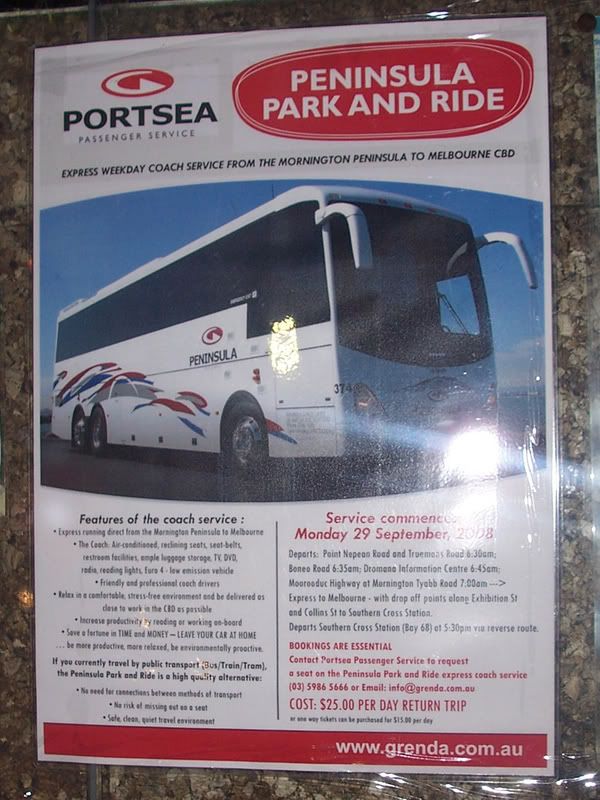
The Rosebud - City Express: Will it survive?

Grenda's is currently trialling a premium commuter coach service from the Mornington Peninsula to the CBD. The prebooked service completes a round trip, departing Rosebud West at 6:30am weekdays and Southern Cross Station at 5:30pm. A premium fare of $15 (one-way) or $25 (return) is payable. As a non-subsidised private service, the coach operates outside the integrated state-wide fare system.

Poster advertising the service (photo by Craig Halsall)

The posters above have been seen in route buses and at Frankston Station. This plus the wording indicate that the intent of the service is siphoning existing passengers from existing services as much as attracting new commuters from their cars. If successful this could be advantageous to the operator since their special fare means they keep all revenue. On the flip side the service is non-subsidised, so the number of passengers needed to pay is much higher than for a regular (subsidised) route.

About to leave Southern Cross

Last Friday afternoon Craig and I got on board to see how it was going. One other passenger boarded on Collins Street, but that was it. Before jumping to conclusions on its likely survival, let's look at the service in a little more detail:

The speed A major hold-up was the CBD portion, accounting for nearly half the 2-hour total travel time. While taking an indirect freeway route via Mitcham, travel time from then on was fast. Nevertheless had the bus called at Frankston Station it would have been about 30 minutes slower than an equivalent train trip from Southern Cross. However given that there is no waiting time and the express running compared to train+788, the coach wins for those near one of the stops.

The frequency No contest here. The coach has one round trip, so has no flexibility of arrivals and departures. In contrast express trains to Frankston run every 10-15 minutes with Bus 788 every 45 minutes, permitting better flexibilty of travel times.

The fare It's higher than the standard fare. Plus transferring passengers will need to buy a Metcard to board other buses, trains and trams in the CBD as it is not tied into the statewide fare system. However $15 for an 80-odd kilometre trip still represents fair value, so if the service fails the fare probably won't be the reason.

The profitability. Zero. The $45 collected would certainly not cover the fuel of the large coach, let alone Eastlink tolls, the driver's wage, any dead-running, vehicle maintenance or opportunity cost. I don't know the break even point, but even 20 passengers wouldn't be enough to make it pay. Even if it was subsidised as much as a regular local bus (say 25% farebox recovery) much higher patronage would still be required.

The patronage One (genuine) passenger per almost 100 kilometres is not good. Expressed in another way it's 0.01 boardings per kilometre or just 1% of that of even a moderately quiet local route (1 boarding per kilometre). Even if it was subject to public subsidy the service would almost certainly be withdrawn, alternative more frequent services already existing.

The future It is difficult to see one, whether it remains independent or becomes subject to public subsidy. Public subsidy would likely require incorporation into the statewide fare system and a social rationale for the service, which doesn't exist given alternatives. Ride it when you can!

Saturday, September 20, 2008

How to get concession public transport and not be poor

Concession public transport is only for low-income people, such as age pensioners, disability pensioners, students and the unemployed. Right? Wrong!

This post will examine two cases where one can be quite well off (a millionaire household, even) yet get concession or cheaper public transport. It raises some welfare policy issues of who gets what, whether the greatest benefits go to the most needy, or if it's more about votes.

Chapter Six of the Victorian Fares and Ticketing Manual explains who gets concession and free travel.

While many groups get free or concession travel, in this post we will talk about only two; low income earners and seniors.

Low income earners

This group of passengers do not need to be on any welfare benefit, but they do need a Low Income Health Care Card, issued by Centrelink.

Maximum qulifying weekly incomes for various household types are shown here, but for our purposes an amount of $23192 for singles and $38636 will suffice. Income can go up a bit and you will not lose the card, but you won't be able to renew it unless it is below the qualifying amount mentioned above.

The income limits above are not particularly high. There would be many people working part-time (and even some full-timers) who could qualify. Since commuting is a major added expense when one goes to work, the effect of this benefit as it applies to public transport is to assist the 'working poor' and provide an incentive to get off welfare.

If income rises further (eg extra hours at work) a poverty trap effect is created as the concession entitlement cuts out and the passenger must pay full fare. This difference is about $23 per week, assuming Zone 1+2 travel. This is not unique to public transport, and also applies to any heavily targeted welfare benefit with a steep taper rate. The alternative in this case is lessening the benefit withdrawal taper rate, but the problem with this is that welfare becomes both dearer for the taxpayer and less targeted at the needy.

I see nothing wrong with low income working people getting concession travel on public transport, and indeed there are social benefits, especially if it improves work incentives.

However it gets interesting if the cardholder is not working, for instance living off investment income.

Since the Centrelink low income health care card has no assets test, only an income test, you can have quite a lot of assets and still qualify for one (and thus concession travel). How much? Well it depends on the deeming rates.

Working back from the income limits above the result is up to $386533 of assets for singles and up to $643933 for couples. This is a rough (conservative) calculation based on a 6% deeming rate; where 4% applies for part of the capital the figures will be higher.

On their own these are quite respectable asset levels to be deriving government benefits (or concessions). But that's not all. Since the family home is exempt we can add that as well. Assuming ownership of an average home (worth $400000), you can be worth nearly $800 000 as a single or over $1.2 million as a couple and still get transport concession benefits!. Or to put it in another way, you can be a millionare couple who owns their own home and gets $38000 pa and still get concession tickets since Centrelink deems you 'low income'!

Seniors Card

Sick of slumming it on just $38k pa so you can get concession fares? Well you've got a treat coming as soon as you turn 60! Provided you watch your working hours (because I doubt others will), getting a Seniors card is your key to a wonderland of benefits unavailable to working people.

Younger Centrelink clients report various letters, compliance checks and audits to verify you're still entitled to benefits (which is as it should be to maintain the welfare system's integrity). But if you've got a seniors card, about the only mail you'll get are free country travel vouchers. Plus you can rely on the local rag to convey news of seniors festivals (more free travel!) and other goodies.

Admittedly the above has been a bit flippant but the reason will become apparent later. But beforehand, let's distinguish between seniors and (age) pensioners. All age pensioners are seniors, but not all seniors are age pensioners. The single age pension at around $280 per week (single) isn't exactly a life of caviar. However at least they do get various Centrelink benefits, and the assets and income tests ensure there is a sound needs basis for them.

Seniors Card is a quite different animal in no way related to various needs-based Centrelink pension and health care cards.

Over 60? Victorian resident? Well that's two out of three criteria met. The other one is a rather curious work hours test. If you're delivering junk mail around the streets part-time you're in. If you've got your own surgery so can control your work hours to 34 per week you're in. Ditto if you're a BHP board member. But if you're a PAYE earner working 38 hours per week you fail. Eligibility boils down to the control you have over your time, and self-funded investors or business proprieters have more of that than full-time (and taxpaying) employees. Plus, unlike Centrelink cards, no assets or means tests apply.

Since its criteria is so rubbery, you'd think that Seniors Card would attract less generous conditions than than the concession fares enjoyed by holders of Centrelink cards (which have needs-based eligibilty requirements). Again you'd be wrong, at least for Melbourne.

Compare the daily ticket fares between a Zone 1+2 concession daily ($5.30) and the Seniors Daily ($3.30). The non-means tested Seniors Daily is nearly 40% cheaper than the means-tested regular concession tickets. This indicates that if the Seniors Daily ticket has a sound reason for existence it cannot be on fairness, equity or welfare grounds.

However my journey to find a rationale for the sub-concession Seniors Daily did not return empty-handed. This came about because a lot of senior travel is 'discretionary' or 'impulse'. And elasticity for impulse, recreational and other concession fare trips is higher than (say) another person's journey to work.

On all modes interpeak weekday service frequencies are higher than during the weekend or at night. Working people are working and youth are at school during this time. So that leaves the unemployed and seniors as the main potential interpeak passenger base. While services may not be crowded, interpeak patronage is still important to a successful public transport system.

And as the buses are already running, it seems to be in everyone's interests to stack them with sub-concession passengers rather than have them empty. The same seniors who so powefully resist a ticketing change can also resist a bus service cut, so it may be that it is in the interests of operators and public transport generally that seniors form a political constituency for a route's survival.

Since public transport relies on public funding it is inherently political and susceptible to government decisions with regard to services and service levels. A bus route full of seniors is less likely to be withdrawn than one that runs empty, so from the point of view of self-preservation it seems better to carry seniors cheaply, even if the equity is terrible vis a vis concession passengers.

This leads us to a conflict; the policy rationale for the Seniors Daily ticket is poor, but it has great value in getting 'bums on seats', especially during the interpeak period. Outright abolition of the Seniors Daily (while the best on equity grounds) could cost patronage and, given recent events, is politically impossible. Another option could be to maintain the Seniors Daily but confine its use to off-peak travel. This might shift a small amount of discretionary peak senior travel to the off-peaks, so slightly relieving congestion and increasing overall patronage and revenue. Plus equity is slighly improved vis a vis concession passengers as the latter's relative penalty is less ($3.30 vs $4.75 instead of $3.30 vs $5.30). Politically, event this may not be worth the trouble, despite its policy soundness.

Conclusion

I have illustrated two ways in which wealthy households can get concession (or cheaper) public transport.

The first is through the Centrelink low income health care card. Though some millionaire households (living on interest or rents) also qualify overall it is generally in the public interest that such cards continue to be good for concession travel because the main benficiaries would be the 'working poor'.

The second is through the Seniors Card, which can sometimes offer cheaper travel than available to concession holders. The Seniors Card (and thus the allied Seniors Daily ticket) has slack eligibility criteria, fails all equity tests and appears to be more about buying votes. The Seniors Daily however successfully promotes off-peak use and the retention of this ticket for off-peak travel would slighly improve equity while still promoting patronage.

Wednesday, May 21, 2008

Service costs and spreading the peak - 1

What gives best 'bang for the buck' when it's decided to use service levels as a lever to boost patronage or change patronage patterns (eg spreading the peak)?

Whether you look at it from the customer side (better services) or the supply side (costs and resources), the answer is rather 'lumpy' and not linear.

As an example, adding an extra three trains per hour to a subway service that's already running every three minutes isn't going to make the service that much better, assuming the existing system is already reliable and is not overcrowded. On the other hand, using them to increase an hourly service to every fifteen minutes is a major boost and makes the service much more attractive.

On the supply side, the costs in boosting services escalate as follows:

Stage 1: Existing infrastructure sufficient, existing rolling stock sufficient, need to train/roster more drivers.

Stage 2: Existing infrastructure sufficient, need more rolling stock, need to train/roster more drivers.

Stage 3: Need more, infrastructure, need more rolling stock, need to train/roster more drivers.

Stage 1 is the fastest and cheapest, while Stages 2 and 3 are the dearest and take longest.

Additional peak capacity is likely to require Stage 2 or 3. In contrast, major improvements to off-peak services only require Stage 1. This explains why the marginal costs of increasing off-peak patronage is lower than increasing peak riders. If some of the latter can be induced to shift their travel times to shoulder peak periods, total patronage grows and the large fixed costs of rail are spread across more passengers, increasing efficiency.

Against this is a question as to transport's role in society. Should transport adapt itself to people's lifestyles, or should we expect people to change their living according to what suits the transport system? The former will obviously cost more than the latter, since more Stage 2 and 3 improvements will be needed to cater for a sharp peak. However public transport economics can't afford to impose itself too heavily on passengers, since more will find driving more attractive, train patronage will stagnate and modal share will fall.

To date the main measures that have been taken to spread the peak include:

1. Local bus improvements. Many routes now finish at 9pm instead of 7pm. This may lengthen the evening peak, although there is still a frequency penalty for those leaving work after about 6pm.

2. An 'early bird' ticket. A special ticket providing free travel for train travellers (only) who reach their destination by 7am. Intended to spread the morning peak.

3. Some increases in shoulder period train services.

The following graphs compare current service provision across the AM and PM peaks on several popular lines. For those not from Melbourne, the lines can roughly be described as follows: Belgrave/Lilydale: 3 tracks for better peak expresses, high service levels and low catchment population growth; Cranbourne/Pakenham: 2 tracks, moderate to high service levels and high catchment population growth; Frankston; 3 tracks for better peak expresses, moderate service levels and moderate catchment population growth. All are at least 40km long and have stations every 1 to 3 kilometres. Suburban services on the latter two lines also have to share with goods and/or country trains.

All trains that pass through the nominated points are counted; even when they do not stop. Using a moving time period (rather than fixed 30 minute blocks) would be better, but is not needed for broad comparisons.

Apart from the intensive services on the Belgrave/Lilydale line, the major distinguishing feature is its extended morning peak. This compares to the Dandenong line (especially) where service falls to off-peak levels by 9am. In this regard the Frankston line does better, though its frequency is less during the 'early bird' period.

During the evening, the broad peak on the Belgrave/Lilydale line is again apparent. Frankston again has the shortest peak, with the period of significantly enhanced service lasting for about two hours. Possibly due to its third track and relaxed capacity constraints the general pattern is that the Frankston line runs faster expresses (but fewer of them) than the Cranbourne/Pakenham lines, which has more stopping trains, but better frequency.

Of the lines surveyed, the Cranbourne/Pakenham lines have the least infrastructure, the most non-suburban trains to share with, the highest overall patronage and the greatest patronage growth. This causes its peak services to be under a degree of pressure unseen on the Belgrave/Lilydale line, as reflected in the reliability statistics. This makes it the most attractive candidate for peak spreading, particularly around 9am, 4pm and 7-9pm.

Monday, December 03, 2007

Improving access to suburban stations

With our current suburban rail network (and any conceivable extensions to it) the majority of our city's population will always be beyond reasonable walking distance from a station.

The question then is how do we bring fast public transport within reach of more people.

Possible solutions to consider include:

(i) More walkable streets for faster, more direct and safer pedestrian access
(ii) More cycleways and bicycle shelters at stations
(iii) Better feeder bus services with improved connections
(iv) Park and Ride

The first two will appeal to some passengers only. However as they are low cost and have other benefits noone can really argue with them.

Feeder buses and park and ride are more controversial. People see that station car parks fill early in the morning peak so consider that more parking spots equals more patronage, so is a Good Thing. They might also look at the loadings on nearby buses and conclude that in a car-owning society few people will catch a bus.

Users of park & ride seldom pay for this privilege. Opposition politicians go crying to the press if even the possibility of charging is raised in some departmental briefing. However free Park & Ride is effectively giving one groups of people use of some very expensive land for 50 hours a week. This might not sound so bad until it is realised that by locking away this land we are denying other people more profitable and socially useful uses for it.

Such alternative uses could include additional retail, which provides services and creates local jobs. Or residential, which puts more people near a station and retail centre, so increasing usage of both. The more land for parking, the is less available for these 'higher and better' uses for the land.

Hence Park and Ride, particularly in established high-value suburbs, has a high opportunity cost that is not always realised by its proponents. Before it gets the nod, it should be compared to alternatives (notably better buses and better uses for the land) since these are likely to bring about better outcomes.

Now even if some scrap of land is deemed unsuitable for an non-parking purpose, commuter Park & Ride is not necessarily a no-brainer for that either. Local retailers generally want more parking, but hate long-term commuter parking.

The reason? A park & ride passenger is going to be 9 - 10 hours away working. In contrast a short-term 2-3 hour parking spot is going to be used by shop customers throughout the day. Hence there's more people and more business spread over the day, which must benefit local business more than an absentee parker. Though there are issues with local traffic management, short-term parking is clearly financially better for local centres than long-term commuter parking.

Then there is the scale that park & ride requires before it can substantially boost suburban rail patronage. Park & Ride requires heaps of land to benefit comparatively few people. Most people who catch the train in Melbourne continue to walk to their station. Enlarging P&R might encourage more beyond walking distance to catch the train, but the increase isn't going to be that great. That is unless there is a huge (and expensive) increase in P&R space, which in established high land-value suburbs will usually be at the cost of more productive uses and urban amenity.

Improved buses have none of these disadvantages. A bus carrying 30-50 people arriving every 10 minutes makes far better use of its bus bay than the handful of people who'd otherwise be parking there.

An improved bus service isn't cost-free either, but when compared to the increased value and trade from the more productive use of land, it looks a lot more attractive. And there's some elements of improved buses that are extremely cheap that we haven't done that well in Melbourne to date.

An example is bus service information at stations. A bus timetable installed at a station might cost between $1 and $1000 (depending on if a timetable case is needed) yet may benefit 100 alighting passengers. In contrast, one extra parking spot might cost $8000 (similar to a secondhand car) and benefit just one passenger per day. These benefit ratios of ten to one thousand to one are too large to ignore and tend to favour improved buses.

Timetable co-ordination to slash waiting and overall journey times is another low-cost measure. Wider spans and frequency cost a bit more, but again if opportunity costs of P&R are considered then it might even work out cheaper, as well as bringing other benefits such as better access to the local centre, urban amenity and a better-used bus service with reduced per-passenger costs and carbon emissions.

An objection to better buses is that most people have a car and most will use park & ride. This may be true with current bus services and levels of co-ordination. However it it not inherently true with every transport system, even in affluent high-car ownership cities.

Perth is an example. It has higher car ownership than Melbourne and purpose-built park & ride facilities at railway stations. Despite this, the proportion of train passengers who arrived at their stations by bus is far higher there than here. While Perth's relatively smaller rail network may play a part, the main reason is that Perth has made some effort with passenger information and service co-ordination. There is nothing to stop us from introducing similar measures, and I believe good along these lines will come from the current bus reviews.

To summarise: Park & ride does have benefits for some passengers. Some passengers will always use P&R even if the buses are good. However big expansions of it in built-up high land value areas are not without considerable penalty, opportunity cost and foregone revenue that its proponents tend to ignore.

Bigger bus improvements will naturally cost more relative to smaller bus improvements. However they also offer other benefits since they do not contribute to the traffic and land use issues that reduce the attractiveness of P&R.

While a balanced site assessment of the pros and cons of each needs to be made, I believe that in most cases, at least for built-up areas, a 'better buses' option is likely to produce greater overall economic, social and environmental benefits than a purely park and ride approach.

Tuesday, August 08, 2006

How much is Zone One worth?

Real estate ads sometimes boast that properties are 'walking distance to Zone One station'. Even though houses as far out as Laverton (22km from CBD) qualify, the implication is that this is desirable due to short travel times, low commuting costs and (perhaps) better service levels.

Balanced against this is the higher property prices in Zone One. If anything the price disparity between inner and outer suburban properties has increased over the last 30 years, with the former generally exhibiting the highest capital growth.

The costs of yearly full fare tickets are as follows:

Zone 1 $1058 ($88 per month)
Zone 1+2 $1633 ($136 per month)
Zone 1+2+3 $1999 ($167 per month)
Zone 2 or 3 $709 ($59 per month)
Zone 2+3 $1434 ($120 per month)
Source: Metlink Fares & Travel Guide 2006

The difference between Zones 1 and 1+2 is just under $600 per person per annum. For most concession fare passengers it's a little over $300. The difference when moving from Zone 2 to Zone 3 is less, especially for concession passengers.

There are a couple of instances where fares are lower in the outer zones. The most important is for local travel, since Zone 2 or Zone 3 only tickets are cheaper than Zone 1 only travel. Fares are similarly reduced for school children living in Zone 2 or 3 rather than Zone 1.

However because public transport's modal share is highest for CBD and near CBD jobs, I will assume that people are commuting to work in Zone 1 and, as a result, will need to pay more if they live in Zones 2 or 3.

The next part of this exercise will try to convert fare differences into capital.

For a working couple the annual difference between Zone 1 and 2 will be $1200. $1200 extra will pay 8% interest on $15 000 of borrowed capital. If the couple have sufficient deposit this means that they can afford a home that's $18 750 dearer, assuming a conservative 80% loan to valuation ratio.

There are cases where houses in Zone 1 sell for less than what most people pay for a house in Zone 3. However this is generally confined to a handful of western suburbs. It is more common for homes in Zone 1 to be $100 000 to $200 000 dearer than homes in zones 2 or 3 and the published statistics reflect this.

This means that differences in transport fares across the zones are too small to offer little benefit to the inner-suburban home buyer because of high home prices. However this small difference also means that the public transport component of the extra transport costs involved in outer suburban living is small compared to the vastly lower house prices.

The only way that reducing transport costs can have a bigger impact are if households can reduce the number of cars owned and (especially) financed. This is more practical in Zone 1 suburbs which generally enjoy better public transport services and more closely spaced amenities within walking distance. Conversely if people moving to outer suburbs are forced to buy more cars and drive more then the increase in the 'private motoring' component of transport costs far outstrips the increase in the 'public transport fares' component.

Another way to make Zone 1 suburbs more financially attractive is to substitute unrealised future capital gains on real estate for higher mortgage payments being made today. Any number of property 'gurus' will tell you that suburbs within 10-15 kilometres of the CBD have superior capital growth histories than areas further out. A bit of guessing and fiddling can make the projected equity growth look impressive, but many would prefer extra money in the hand today!

For renters the fare difference works out to be $12 per week. This doesn't sound much, but I still maintain it is relatively more important for renters rather than buyers. This is for the following reasons:

One is that rental yields tend to be low in prime Zone 1 suburbs and highest in low socio-economic outer suburbs. Thus compared to home prices, there is less variation between rents across the metropolitan area.

Related to the above is that when property yields are lower than interest rates (as is the case currently) renting is far cheaper than buying. Also renters tend to have a lower income profile and a smaller average household size than owners. Hence a $1200 annual saving is more significant relative to both incomes and housing costs.

Another factor is housing diversity; the inner suburbs have low-rent studio and one bedroom apartments rare in outer areas. Many renters are willing to sacrifice space for convenience and low transport costs.

Considering all these factors, the situation is less clear for renters than home buyers. Especially for renters in smaller households, zones make a difference and influence location decisions. For buyers differences in fares are small compared to mortgage payments so they cannot be that significant except for those near zone edges.

Private transport costs, such as needing to buy, finance and run additional vehicles are likely to have a far greater impact on households. Car financing is a particular wealth hazard, especially given high interest rates, running costs and a depreciating asset. If this can be avoided by buying a more expensive but better located home then paying the difference could be worthwhile even for buyers (especially if buying a unit).

However once the high financial opportunity costs of additional cars are accepted (and there may be little choice in areas with limited public transport), then the marginal costs of driving aren't so bad, especially for families. Where useful services exist, the pricing of fares versus the marginal cost of driving is an important marketing point and a discussion for another day.

Friday, June 16, 2006

Social mobility and public transport

Noted economist Fred Argy is advocating the need for social investment to foster social mobility. His excellent paper, called Equality of Opportunity in Australia has listed public transport as one of the areas that needs investment for a more mobile society free of entrenched poverty.

Wednesday, April 12, 2006

Quick whip around the blogs

Plenty of reading this week, especially if transport economics is your thing:

Ari on the Web proposes various ways of taxing car use. Civil Pandemonium lampoons 'TV current affairs' shows, with petrol prices the topic.

Both Urban Creature questions whether privatised public transport has given value for money. On the Broad Gauge agrees and provides links to the main news articles. Though less current, a contra view is put by Michael Angelico who gives some possible advantages of privatised running.

Wednesday, April 05, 2006

Tax and public transport

It's common knowledge that the national tax and super system doles out hundreds of millions each year to support profligate private motoring, while discouraging public transport use. FBT benefits, car leases, salary sacrifice, mileage allowances and other nonsense are just some of the hidden subsidies that provide perverse incentives to drive more.

So what to do about it?

Labor's Tanya Plibersek wants to keep the car subsidies intact (does she have union mates in the car industry with vested interests?), but allow people to buy public transport yearly tickets.

Crikey's Christian Kerr takes a different view, preferring not to subsidise either and return the savings to people in the form of tax cuts.

Though I have misgivings about the quality and benefit of tax cuts that might be offered, in principle I'm with Kerr. Plibersek wants to keep a major rort and offer a small countervailing benefit. Whereas Kerr wants to remove a major rort and not offer a small benefit. That's a much better approach, especially if some of the savings can be invested in public transport services.

Monday, March 13, 2006

'Free' transport: a threat to the 'virtuous circle'?

Recent 'Age' articles have suggested that public transport should be free (or nearly so) with more funding coming from taxes.

'Free transport' is a populist mantra that sometimes gets headlines but doesn't solve very much at all. Though there are cases where fares are dear (eg Glenhuntly to Patterson costs $5.20, only slightly cheaper than a taxi), the overwhelming problem is a lack of service rather than the fare.

This is particularly so for the 60-70 % of the metropolitan population whose only service is a bus route, nine-tenths of which operate limited hours unsuited to modern lifestyles.

How is this fixed?

The solution is to establish the conditions for a virtuous circle that build more attractive and usable services. Because fares bring in revenue, these can usefully be employed to make it a sustainable cycle of improvement, rather than a one-off boost. The revenue benefit is amplified if a disproportionate number of new passengers are those who previous drove, ie 'choice passengers', many of whom will be paying full fare.

The ingredients of the 'virtuous circle' in public transport are:

1. More/better service (cheapest improvements first)
V
2. Increased service attractiveness (especially to full fare-payers)
V
3. More patronage
V
4. more revenue (especially more passengers paying full fares)
V
5. even better services

And so the cycle repeats in an upward spiral.

Allowing some costs to be recovered by charging fares assists security of service. Indeed service security probably increases with higher cost-recovery. For example, when a system recovers 60% of its costs, it's much harder for a politician to save money by cutting services (as happened under Kirner when buses were severely pruned) than if it recovers only 30% of costs. A 'free' service that returned 0% of costs would be an even 'softer' target, and the biggest losers would be those with no alternative (the rest can just drive).

With service-driven patronage increases, PT would become a sort of 'sacred cow' that politicians daren't meddle with because its constituency is so large. This is much like neither Liberal nor ALP governments will touch veteran's entitlements as they fear the RSL (remember Bruce Ruxton?). It's the same story for negative gearing, private school subsidies and other things, but there is no reason why public transport shouldn't be on this list as well.

With a stronger public transport system meaning that more passengers and dollars are at stake, it will be easier to dismantle the road lobby's control of our roads. Finally the old paradigm of 'maximising throughput of car traffic' will have to play second fiddle to accessibility, bus/tram priority, pedestrian amenity, cycleways, etc. This further improves public transport's attractiveness and thus patronage.

My biggest objection is that making PT free or very cheap (eg a $365 yearly ticket) kills this virtuous circle and returns us to a stalemate of bad service with no improvements. The only difference is that crowding might be a bit worse.

As mentioned earlier, being able to take fares represents a leverage opportunity that can be used to magnify the benefits of service improvements.

How so? If transport was free (or very cheap), service improvements would not cause revenue to increase. Yet if fares were charged, $10 worth of service improvements might return $3 of increased revenue. If it's particularly high-value improvements (eg co-ordinating timetables, fixing bad connections and removing route duplications) benefits might be nearer $10, ie an elasticity of 1. And so you've got an extra $3 (or $10) which could go towards even more improvements.

In contrast, with free or very cheap PT, the financial returns drop to zero. Hence the business case for service improvements diminishes. Even fewer will be attempted. And if some are done, it will only be possible to get half the improvements for a given sum since returns are zero.

Eventually (i) service will deteriorate due to lack of improvement (and mounting road congestion in the case of trams), and (ii) those who persist taking PT will complain about all the begging vagrants. Then people will start calling for fares to be reintroduced, politicians will think 'that's a good idea' and the deed will be done (possibly manufacturing a financial crisis to justify it).

After a few years have been wasted then maybe it's time to return to the substantive issues, like creating the virtuous service - patronage - revenue circle mentioned above, which is what should have been done in the first place!

Friday, January 20, 2006

Melbourne most vulnurable to oil price shocks

A Griffith University study indicates that outer and poorer suburbs are most vulnurable to rising oil prices.

The report Oil Vulnurability in the Australian City recommends a shift from road funding to public transport service quality to make communities more resilient to oil price fluctuations.

Dodson & Sipe also found that Melbourne contained a greater proportion of vulnurable suburbs than either Sydney or Brisbane. Areas of highest vulnurability include the outer western, northern, south-eastern suburbs and the Mornington Peninsula. All these areas combine low incomes with sparse public transport service provision.

Download the full report (pdf 922k) here: http://www.gu.edu.au/centre/urp/URP_RP6_OilVulnerability_Final.pdf (right click to save)

Sunday, December 04, 2005

Supply vs Demand-led service provision

The public transport version of the chicken and the egg dilemma seems to be the debate about which comes first; supply or demand.

Transport operators and governments may take the view that as existing services are not overcrowded at the moment, providing more services would produce few returns for the cost. Cost-effective patronage growth would have to come from better marketing, such as 'Travelsmart' programs or increasing charges for motorists.

Consumer and passenger groups counter by saying that people cannot use services that do not exist. Hence service increases must precede patronage growth; marketing alone isn't enough and could be counter-productive.

In anticipating future demand, others such as shopping centre builders and road engineers are also big fans of supply-side planning. Just the act of initial supply helps shape consumption. Provided the product isn't completely to the customer's disliking, the total market for it will probably be bigger than if a more timid demand-side scarcity-based approach was taken. The slogan 'build it and they will come' explains the supply-side planning assumption well.

That these debates apply in areas other than passenger transport was brought home when listening to today's Hindsight program on Radio National (downloads available). The program profiled Gordon Barton, who got his start by challenging (then) government-controlled railway monopolies on freight by forming a trucking company in the 1950s. IPEC grew and became a dominant company in its field.

In 1979 he moved to Europe and successfully established IPEC there. The Hindsight report mentioned that established transport companies waited they could fill a truck before despatching it. Hence it took many weeks to send items a few hundred kilometres. Though not pointed out, this is a good example of a demand-driven approach, ie not running a truck unless the load was sufficient.

Barton's genius was that he sent off trucks on a regular schedule, regardless of whether they were full or empty. Regular departure times allowed connections with other trucks, forming a co-ordinated network. In the early years running nearly-empty trucks around the countryside was expensive. However IPEC Europe provided a superior service, and as the loads increased, it thrived. In this example, Barton showed that his agressive supply-driven approach not only worked but took business from his more complacent rivals.