Thursday, June 15, 2023

Melbourne's little-known suburban V/Line coach stops


A direct coach from Bundoora to the high country. Or Campbellfield to almost the NSW border? These are some of the lesser known V/Line trips possible from Melbourne suburbs. Keep reading as we uncover some of the 'hidden' suburban stops to country destinations that may be near you.

Introduction to V/Line coaches

While rarely talked about, did you know that V/Line's coach network is vastly more extensive than its train network? Coaches took up the slack as the rail network shrunk and quiet stations were closed in the 1950s through to the 1990s. The result is an extensive co-ordinated coach network typically operated under contract by local bus companies. Travel is a bargain if the times suit as the $9.20 fare cap applies.

Most V/Line coach routes leave from large regional hubs like Ballarat and Bendigo but some start from Melbourne's Southern Cross Coach terminal (the same bleak concreted place that you get Skybus from). Not only that but some stop in Melbourne suburbs. That's today's topic as I don't think these stops are widely known. 

Network maps

Our starting point were the V/Line network maps. The state-wide map shows that coaches exist but is just a tangle if you want to know where routes start and finish.

V/Line's area by area maps are only slightly better. That's because because individual routes are shown with the same colour, even when many converge. Several years ago the Metlink/PTV metropolitan train and tram maps had that problem but thankfully that got fixed. V/Line has yet to catch up here. 

Suburban locations where you can catch V/Line coaches

With maps unhelpful it was time to hit the online timetable books. These were more useful, with listings and descriptions of stopping locations. Most were on highways, so as not to delay through passengers like an off-street bus interchange would. This meant that their locations were easily missed, typically not being at or near the suburb's railway station.

Going roughly clockwise from west to south-east, I found the following:  

* Deer Park V/Line station. Served by: 
- Short distance coach route operating to Caroline Springs. This is because weekday peak direction trains tend to stop at either of those two stations but not both. The coach operates in peak direction only, ie inbound in the morning, outbound in the evening. 
- At time of writing served by a temporary shuttle to Tarneit during construction works 

* Caroline Springs V/Line station. 
Served by:
- Abovementioned coach to Deer Park.
- Wendouree Night Network coach in the small hours of Saturday and Sunday mornings from Southern Cross.  

* Coburg/Bell St near primary school. Street viewServed by: 
Barmah to Melbourne via Heathcote coach stops Monday - Saturday mornings. The return trip to Barmah via Heathcote stops there on weekday afternoons only.  Connection from ex Barham coach available at Heathcote. 

* Campbellfield opposite Kmart. Street view. Served by: 
Barmah via Heathcote coaches that also stop at Coburg (see above). Connection to Barham coach available at Heathcote.
-Some Moama/Deniliquin via Heathcote coaches 

* Melbourne Airport/near T4. Served by: 
Barham via Heathcote coach
- Some Deniliquin via Heathcote and Moama coaches (sometimes requiring changing at Heathcote or Rochester)

* Box Hill/Maroondah Hwy & Watts St. Street view. Served by:
- Some Mansfield via Yea coaches. Coach connections to Mt Buller operate in snow season.  

* Nunawading/Front of tennis courts, Walker Park, Whitehorse Road. Street view. Served by:
- Some Mansfield via Yea coaches. Coach connections to Mt Buller operate in snow season.  

* Ringwood/Ringwood – Warrandyte Road near Eastland Entrance. Street viewServed by:
- Some Mansfield via Yea coaches. Coach connections to Mt Buller operate in snow season. 

* Croydon/ Croydon – Corner Exeter Road and Maroondah Highway. Street viewServed by:
- Some Mansfield via Yea coaches. Coach connections to Mt Buller operate in snow season. 

* Lilydale. Served by:
- Some Mansfield via Yea coaches. Coach connections to Mt Buller operate in snow season. 

* Yarra Glen/Toy Library. Street viewServed by:
- Some Mansfield via Yea coaches. Coach connections to Mt Buller operate in snow season. 

(Note: Box Hill - Yarra Glen served by same service)

* Bundoora RMIT/Plenty Rd. Street viewServed by:
- Some Mansfield via Yea coaches. Coach connections to Mt Buller operate in snow season. 

* Whittlesea/Amcal chemist, Walnut St. Street viewServed by: 
- Some Mansfield via Yea coaches. Coach connections to Mt Buller operate in snow season. 

(Note: Bundoora RMIT and Whittlesea served by same service)

* Dandenong Station. Served by:
- Coaches to Cowes and Inverloch via Anderson
- Some coaches to Yarram via Leongatha

* Cranbourne/near level crossing. Street view. Served by: 
- Coaches to Cowes and Inverloch via Anderson
- Some coaches to Yarram via Leongatha

* Cranbourne/Lyall St. Street view. Served by: 
- Coaches to Cowes and Inverloch via Anderson
- Some coaches to Yarram via Leongatha

Street view links are provided above for stop locations not at stations or in formal interchanges. 


Conclusion

The above are, to my knowledge, all the Melbourne suburban stops served by V/Line coaches.  Especially for those in outer suburbs using them could save time compared to going into the CBD and out again. Service frequencies are typically limited but there are some cases where day return trips are possible, notably South Gippsland from Dandenong and Cranbourne. 

Unlike a suburban bus you can't just rock up at a coach stop with your myki; instead you will need to book ahead and get a paper ticket. Booking can be a foreign process, especially if you're used to unbooked myki train travel and you want to avoid paying a double fare on the day. You are probably best off booking the trip and getting a paper ticket from a premium Metro station a few days prior. (Info at PTV & V/Line).

Comments on your travel experiences with V/Line coaches from suburban stops are appreciated and can be left below. 

Tuesday, June 13, 2023

Bus Plan turns two: Still alive?


Two years ago today Victoria's Bus Plan was launched.

It promised a fresh start for Melbourne's closest public transport to most homes and jobs. This was sorely needed since buses were in a stupor with little happening.  

Background


The last serious investment in bus services was about 15 years ago under the Bracks-Brumby government. Key Meeting Our Transport Challenges achievements included 7 day service on many (but not all) local bus routes and new SmartBus routes in the middle (mostly eastern) suburbs including three orbitals. There were also local bus network reviews but implementation was limited. You can read what MOTC achieved in its first 2.5 years here (spoiler: it was a lot). 

The 2010 Coalition government did some very good bus network reform and simplified the organisational structure with PTV. However they tipped in little new money. Their biggest mistake was signing the cut-price metropolitan bus franchise that inflicted the maintenance-skimping Transdev Melbourne on a third of the network. 

Labor returned in 2014 but, as far as public transport was concerned, in a different guise as an infrastructure-only government. Once their 2014 promises were honoured, there was little new money for buses and even less network reform than under the Liberals. Also the prevailing economic conditions including low interest rates made it easier to borrow billions for ambitious mega-projects than find a few million recurring for services, especially buses.

Melbourne's grown by over a million people since the last SmartBus route was added. And as the minister stated at last week's PAEC estimates hearing, there still remained bus routes with timetables that did not reflect travel needs since Sunday trading started in the 1990s. Hence buses have became less relevant with each passing year with popular routes (like Route 800 between Dandenong and Chadstone) remaining with timetables stuck in time.

Infrequent (yet busy) cross-suburban buses have made getting around harder than it should be during Melbourne's numerous long-term rail shutdowns while authoritative voices including people from Infrastructure Victoria have called out Melbourne's sparse Sunday service.

Has the government responded? Only rarely, resulting in service per capita slipping further behind.  

Victoria's Bus Plan and the start it got

2021's Victoria's Bus Plan promised to break the inertia. It diagnosed issues with the existing network well. Key objectives included a simpler network, cleaner zero-emissions buses, improved bus performance, better customer experiences, governance improvements and overall improved value for money. Of these the first, including 7 day service, decent operating hours and reasonable frequencies, is by far the most important when it comes to delivering a useful bus network. If you don't have those then nothing else really matters. 

A simplified Night Network, which upgraded some regular bus routes to run 24 hours on weekends, commenced in August 2021. That was followed, less than a month later, with other low cost timetable upgrades on the Transdev/Kinetic network. These involved minimal extra funding but had an overall good in transferring resources from quiet to busy routes.  

These weren't earth-shattering but it was a fair start. My end of year summary said that 2021 was better than expected for public transport services, with bus changes making a fair contribution to this. Compared to the 2020 budget the state budget in 2021 put more money into improved bus services. 2022's budget was a further improvement, though measures were still modest relative to the large backlog of network reform and service upgrades. 

Progress to 2023

In March 2023 I checked up on the bus plan's progress, listing these and other achievements. Since then there has been further announcements on the transition to zero emissions vehicles and bus re-contracting. Network reviews for Melbourne north, Melbourne north-east and Mildura were announced with an initial survey in September/October 2022. Results of that came out 10 months later, in May 2023. 

The 2023 state budget offered little for new bus services. It ended the upward trajectory we saw in the 2021 and especially 2022 budgets. Emphasis instead went to honouring election commitments (including the $9.20 regional fare cap), increased interest payments on borrowings and continuing the construction agenda that had been electorally successful for Labor in 2014, 2018 and 2022. 

Without budget funding, the most important (ie service) aspects of the Bus Plan are clinically dead. That is unless DTP can internally fund small timetable reforms similar to those of 2021 (but spread across more operators) or like super cheap boosts discussed here, The government may also be pinning its hope on savings arising from bus recontracting. Though with the new contracts to start in 2025 there won't be anything coming from that soon, even if they are successful in reducing costs (which isn't a certainty). 

How is Victoria's Bus Plan going on its deliverables? I've already mentioned the 10 month lag in the results of surveys. These basically give legitimacy to the Bus Plan's favoured approach of simplifying routes to be more direct, more frequent but more widely spaced with more reliance on connections for some trips. 

2021 - 23 was going to be the period of some small network changes to Mornington Peninsula, Fishermens Bend and Yarra Valley. The first two introduced some welcome changes but were nothing to write home about, especially with regards to operating hours and weekend services. Yarra Valley, meanwhile, should happen later this year. 

We don't yet know anything about "The route changes as part of the Doncaster Busway are planned to become the first large-scale network reform", though some very small changes commenced when Bulleen Park & Ride opened.  

How have they gone with delivering more attractive networks in high needs areas (another priority)? The Craigieburn, Endeavour Hills and Keysborough upgrades fit into this category. As do the Hampton Park changes starting later this month. However possibly the highest need area are parts of Greater Dandenong without 7 day service (including Princes Hwy and the 800 bus). That got nothing. Indeed the state budget funded more in removing vehicle registration for apprentices and tradies than it did on the Bus Plan in 2023-24.   

The last two years were to have seen the development of the Bus Reform Implementation Plans BRIPS). We are approaching the last half of 2023 and we aren't sure of the form these will take. 

Finally the bigger network reforms were to take place from 2023. This is now optimistic for several reasons. These include a. the BRIPs not being completed, b. substantial reform often requires larger planning and public engagement, c. there being no substantial funding in the 2023 budget and d. long lead times (eg 2 years or more) from budget funding to implementation, as illustrated here

Even if the 2024 budget funds what 2023's missed, substantial bus network reform seems unlikely much before 2026. This means that hopes of tying significant bus network reform with major infrastructure (eg the Metro Tunnel due to open in 2025) are fast fading. Even 2026, with the Commonwealth Games and the State election (where they might want to avoid controversial stuff), looks a stretch. 

Conclusion


Parts of Victoria's Bus Plan less consequential for passengers, notably bus electrification, remain alive and in progress. But its key element, that to do with service, is sickly due to a loss of budgetary commitment from government.

The risk of it being (yet another) unrealised transport plan is thus high with the Department of Transport and Planning protected from accountability only by the masterful vagueness of its proposals. I'd describe its condition as that of a comatose toddler with an uncertain future.

To stop the Bus Plan dying life support is essential. This requires that DTP to internally fund small timetable and route reforms to tide the plan over a difficult time where neither the premier nor transport's senior minister apparently considers bus (or for that matter train) service a priority.

WA's McGowan government had a similar political mix of generously funding infrastructure but (mostly) doing less about service. However Perth has been able to keep network and timetable reform going through the approaches described here.

We could do worse than copy them to keep bus service reform alive in the hope that it's still there for a reinvigorated and more pro-service state government.   

Sunday, June 11, 2023

A history of organised singing on (or about) Melbourne public transport


As they say online, "PTV just got ratioed". Not due to the usual complaints public transport gets like ticketing, inspectors, poor frequencies, crowded trains or disruptions, but over singing. Singing?

Notwithstanding major winter disruptions due to construction on some of the network's busiest lines, PTV has been running the Autumn of Adventures and Winter of Wonders promotions to drum up ridership. 

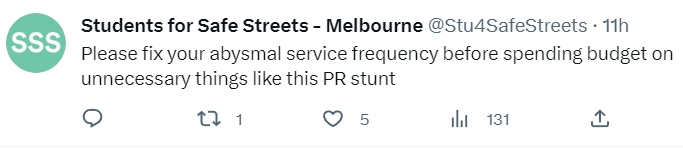
Part of that includes introducing a 'surprise element' with a choir popping up on trains, stations and stops to entertain passengers. However this was not welcomed by everyone. Especially those on Twitter.


People who tweet aren't necessarily representative of the general population. But the somewhat more representative Facebook crowd didn't like it much either. So PTV might have scored an 'own goal' on this one. It seems that people value taking PT more for solitude than sociability. Especially if the latter is forced. 


Even though hiring a troupe or two of singers is mere spare change in PTV's budget, people still think it's a misplaced priority when there's bigger things that need fixing, like the service itself. Or doing better at their core job of clearly telling people what's happening during the continual construction shutdowns currently crippling the network.


Others object on health grounds. Sensory overload is a real thing. Some supermarkets have 'quiet hours' to general acclaim. Transit authorities point to the quietness of new electric buses as a benefit. Yet PTV's singing promotion is deliberately introducing noise. Which not everyone likes, especially if it's in a confined space like a train carriage.   


If you subscribe to the view that 'any publicity is good publicity', the fact that people are engaging on social media and it got picked up in the news is a tick for some PTV social media marketer's performance indicator. 

But if you're after a good passenger experience then maybe PTV should stop the singing. They've already tried to stop the talking, with comments switched off on their Facebook and Twitter posts after overwhelming push-back.   


That's the present. What about the past? 

Passenger discontent with public transport in Melbourne peaked around 2010. Though new bus services had been added, rail delays, cancellations and crowding were acute. That year's state election saw a change of government with public transport reliability a major issue.

That drove people to sing about how public transport could be better. 

The Melbourne Complaints Choir was formed in May 2010. Meeting in an inner city pub, they seemed to be a mix of socialists, anarchists, artists and activists under the umbrella We Love PT (which had a website at https://welovept.com.au ). Those involved included musicians Stephen Taberner and Katrina Wilson. 

They soon became the Melbourne Public Transport Complaints Choir, with a trailer to a Ch31 TV documentary here. This was understood to be the only complaints choir that sung about public transport.  


They appeared at Southern Cross Station with speeches and singing. Below is a 20 min recording (link here if you can't view it below). 

Despite 'complaints' being in their name, the choir saw singing as a way to raise awareness and action for a public transport network that people would use and love.

Much of the style comes from complaint choirs overseas (eg Birmingham) and then popular urban flash mobs where people would appear out of nowhere to bring performance to the streets. The term flash mob entered the dictionaries earlier that decade with the concept originating in Manhattan in 2003

What happened later? The choir sung at other venues including Flinders Street Station and Melbourne Town Hall. There was a change of government. Then it seemed to dissipate. Trains got more reliable from about 2013. And presumably choir members went their own ways. 

The unexpected appearance of the PTV singers in 2023 appear to draw a bit from this tradition. 

Where else has singing made its appearance? Metlink, especially, featured singing in its marketing about 15 years ago. Here's an example for ticketing, though there was also the "highly recommend you get on the bus" campaign. 


What are you thoughts on all this? Singers on the network - do they add a welcome spontaneity? Or are you more the 'quiet traveller' type? Comments appreciated below.